
Hello dear Wayfinders
I’m continuing to write to make sense of things, to gather thoughts, ask questions, hold longings, and to try and find my place in a world that I struggle to understand.
The Antlered Way is the current iteration of my Substack as I continue to navigate my way through midlife and finding out what living meaningfully means to me in a collapsing world.
I am studying feminist philosophy and whilst choosing a question for my assignment found myself researching the history of women at university; I am preparing for the start of The Commons and having deep and wonderful conversations with the women who have applied to join and spending a lot of time thinking about what they’re sharing; I am parenting in Devon and caring for parents in London; and of course there’s the daily onslaught of the news cycle!
I return again and again to Margaret Wheatley’s concept of ‘finding your path of contribution’ which I have previously written about:
and here:
Dissatisfaction and Finding Meaning
·
April 2, 2024
I’m beginning to make peace with my dissatisfied state. It has a wholly different quality to despair. In dissatisfaction I am agitated to take action, rather than sinking helplessly into the clutches of “there’s nothing I can do”.
My path of contribution has long been Circles - although the focus of that contribution has taken different shapes over the years, and sometimes I forget!
With regards to my writing, there so many threads to follow, and just as I think it’s taking me somewhere, it breaks and I find myself following another, and then tying myself in knots!
I’m not sure I have anything helpful to offer, but today I’m sharing one of those threads; it started with a quote from a brilliant writer!

Several months ago, I saw a meme with this quote attributed to Ursula Le Guin: We will need writers who can remember freedom. It wouldn’t let me go, so I needed to find out where and when she wrote, or said it!
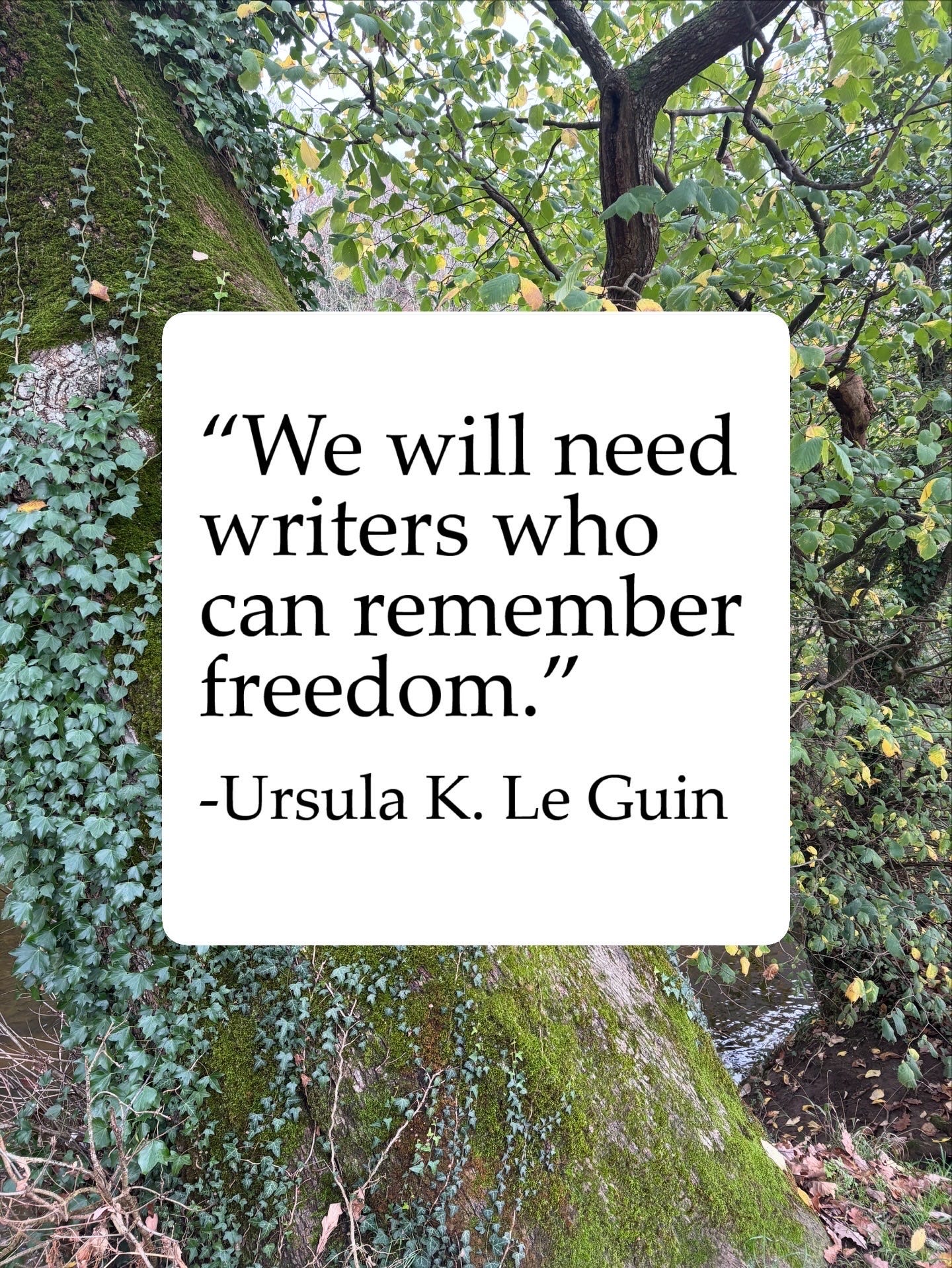
It was from her acceptance speech at National Book Foundation Awards in 2014. A speech in which she called out the publishing industry: from their lack of recognition for Science Fiction and Fantasy authors, to giving sales departments editorial control of storytelling by deciding what gets written, what gets published and what gets called worth reading. And she called writers in, asking them to resist.
I invite you to watch her speech here - it is only 6-mins long and well worth it.
But for my purposes, I am sharing this slightly longer quote, to put that single line into the broader context of her message:
I think hard times are coming when we will be wanting the voices of writers who can see alternatives to how we live now, and can see through our fear-stricken society and its obsessive technologies, to other ways of being and even imagine some real grounds for hope.
We will need writers who can remember freedom. Poets, visionaries, the realists of a larger reality.
Ursula Le Guin was speaking about writers and the freedom of imagination. But I keep hearing her words with a word change:
We will need women who can remember freedom.
Many of us raised in Western cultures who are in midlife now, grew up believing that certain political freedoms were settled. We were the daughters of second wave feminism, we benefited from the Equal Pay Act, from the right to open a bank account without our father or husband’s signature, from access to contraception and abortion, from legislation that (in theory at least) said we could not be discriminated against for being women. We inherited rights that were hard-won.
And now we are watching those rights being rolled back, alongside political discussion on why more should be repealed.
Since the overturning of Roe v. Wade in the United States, abortion has been banned or severely restricted in over a dozen states. Women have been denied care in medical emergencies. Doctors have faced criminal prosecution for treating patients. These harms are documented, and ongoing.
The release of the Epstein files has shown the world the extent and depravity of organised trafficking, abuse and rape of girls and young women by most the powerful of men, and then nothing, and still nothing!
This lack of accountability or remedy for survivors, is not a shocking for the girls and women who have experienced abuse. There are many more examples, from the survivors of Al Fayed and the case against Harrods, to the abuse and violence happening inside homes worldwide. I wonder how emboldened these men now are as they see there really are no consequences.
In Afghanistan, women have been removed from public life almost entirely. Banned from education beyond primary school, from most forms of employment, from appearing in public without a male guardian. An entire generation of girls is growing up without access to the futures they must have imagined.
And here, Reform UK, currently (apparently) the most popular party in UK opinion polls, wants to leave the ECHR and has proposed repealing the Equality Act 2010 (the Act).
The Act brought together over 116 separate pieces of legislation into a single framework, consolidating decades of protections, including the Equal Pay Act 1970, the Sex Discrimination Act 1975, the Race Relations Act 1976, the Disability Discrimination Act 1995, and protections against discrimination on grounds of sexual orientation, religion, and age. It was drafted under the guidance of Harriet Harman, then Minister for Women and Equalities, and described by journalist Polly Toynbee as “Labour’s biggest idea for 11 years.”
And of course, it didn’t emerge from Parliament without the decades of feminist organising, legal campaigning, trade union activism, and the work of women in local government, community organisations, and law firms and chambers, making the case that discrimination is not inevitable, and that the law could and should say so.
There is much more that can said about the history of the legislation, but what matters is that to repeal the Act would have sweeping consequences for so many people!
Reform UK have also floated a policy of increasing taxes for women who don’t have children; they want to penalise women financially for not having children (presumably regardless of the reason) AND they will remove your protection from being sacked for being pregnant!
Perhaps amongst this, there is both a burden and a gift for those of us in midlife; that we carry the before and the after in our own bodies and in our own stories. We know what was fought for and we understand what is being taken from us.
I am not suggesting that things were ever equal, or just, or safe for all women. Violence against women has always existed under patriarchy. Inequalities have always been structured into our institutions and the rights that were won, often still excluded some, and were at best, temporary. The hard times are not new; although maybe those previously shielded by privilege of colour and class, have a new awareness of what is at stake.
We are now advocating not only for enhanced rights and protections from new forms of violence in online spaces and from AI, but for the rights we took for granted. What this moment is showing us (and we can look to examples in Iran and Afghanistan) is that the distance between a right that exists and one that no longer exists is frighteningly short.
We are navigating all of this inside a world in collapse, where we continue to witness the destruction of habitats and species, huge rises in people being displaced by climate change and war, alongside the erosion of women’s legal and political rights.
We will need to remember what has been lost as we fight for what is being eroded. As Audre Lorde teaches, the master’s tools will never dismantle the master’s house. We will need to develop our capacity to imagine new ways of being and envision alternatives for how we live now.
If we manage to pull it all down, what comes next?
We will need women who can remember freedom.

If you are navigating these times as a midlife or older woman, I would love your thoughts on our collective role, and you can read more about The Commons here (it’s a google doc - there’s no sales page or buy now button - it’s an idea that I’m exploring with those it resonates with).

Next Monday, I am gathering with women in Circle. Not to fix what is broken or to solve what is vast and painful, but to practise something smaller and more sustaining - the act of listening together for what we carry, and what we wish to carry forward.
This Circle is an invitation into remembrance, not as nostalgia, but as a living practice.
Clarissa Pinkola Estés, in Simple Prayer for Remembering The Motherlode, writes:
We do not become storytellers. We came as carriers of the stories that we and our ancestors actually lived.
And Robin Wall Kimmerer, writing from within the Potawatomi tradition says in Braiding Sweetgrass:
Images of Skywoman speak not just of where we came from, but also of how we can go forward.
The stories of those who came before us offer guidance and information for this time in the world’s story.
This is the contemplation I am holding for our time together. Not a mapping of personal matrilineal memory, but something wider; our stories and cosmology as orientation. An opportunity to listen for what has sustained us, what has been passed to us, and what still matters enough to be tended in these times.
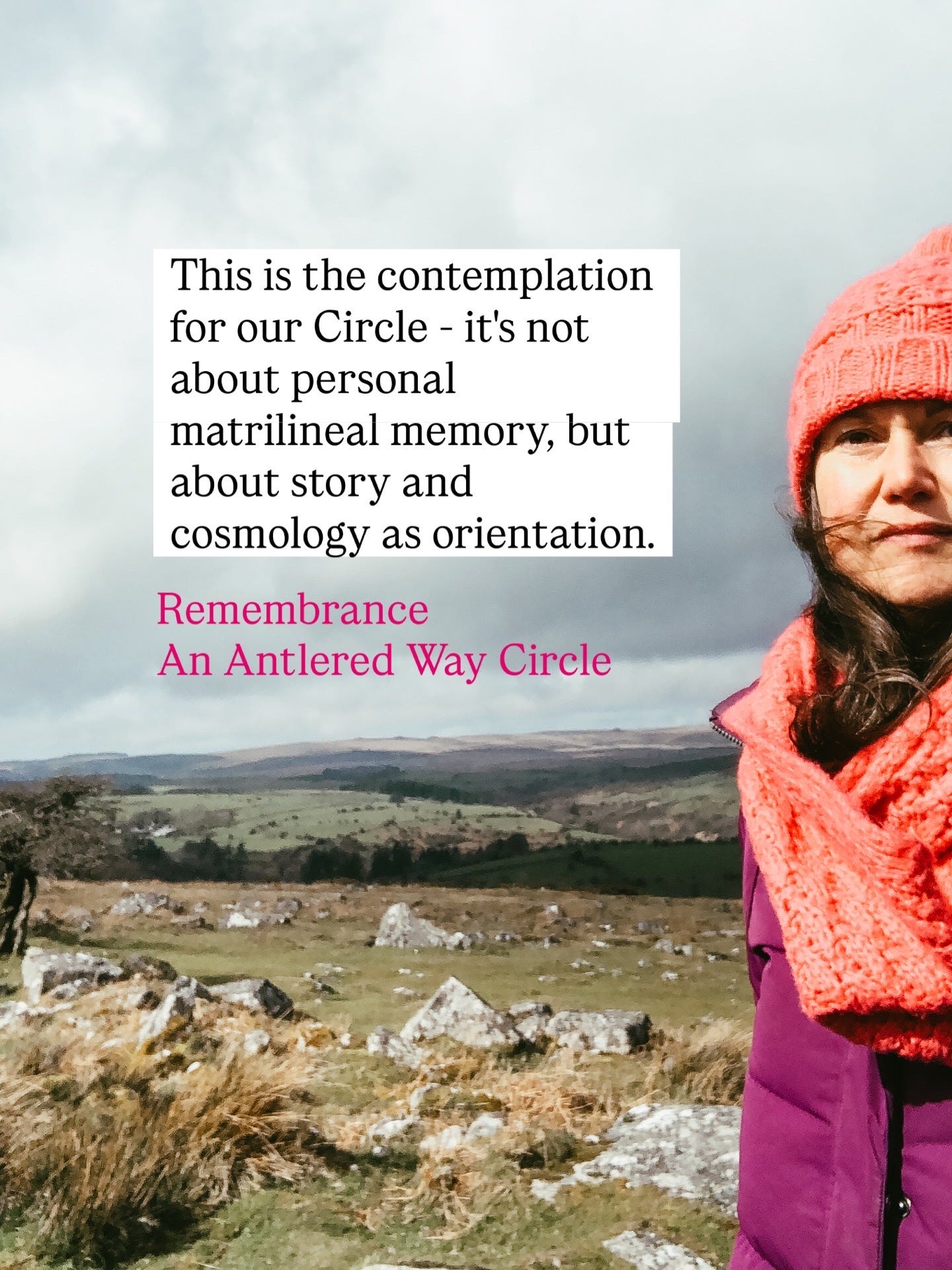
Through guided practices, shared reflection, and simple ceremony we’ll explore questions such as:
What do I wish to remember, even as the world urges forgetting?
What has been passed to me, through story, practice, tradition or observation that I want to take forward?
What forms of freedom, care, or courage live in my own history and lineage?
adrienne maree brown, in Emergent Strategy, argues that transformation happens the way change happens in nature, not through grand gestures from the centre, but through small, connected, intentional acts at the edges.
Gathering is one of those acts.
Remembering together is one of those acts.
If it speaks to you, do join us in Circle.
With you in Circle

Comments
Nothing yet. Say the first thing.
Sign in to join the conversation.