
When it comes to serious issues like climate change, we are presented with a rigid binary. You are either a smart, thoughtful, educated citizen who knows without a doubt that the climate is collapsing, carbon dioxide (CO2) is the culprit, and we must act immediately; or you are an uneducated, unsophisticated, pig-headed climate denier who can’t tell the difference between climate and weather.
As someone who wants to be a good, educated person, I knew full well the accepted narrative that the science of climate change is completely settled. Extreme weather, hurricanes, multi-year droughts, and record-breaking heatwaves mean we only have a few years left to radically reduce our CO2 emissions or face extreme climate collapse. It’s daunting to even question the narrative.
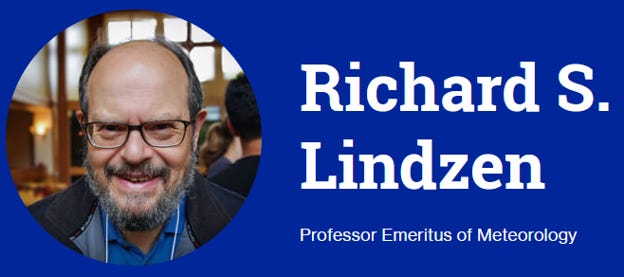
So it was with some trepidation that I sat down with Dr. Richard Lindzen, Professor Emeritus of Meteorology at MIT, a lead author on the Third Assessment Report of the UN’s Intergovernmental Panel on Climate Change, and (in)famous climate contrarian. He’s a threat to the climate narrative, and thus has been labeled a climate denier, fossil fuel shill, and fringe conspiracy theorist.
Yet if we genuinely value nuance, we must acknowledge that Dr. Lindzen is a foundational figure in atmospheric physics. He proposed the “Iris hypothesis“ in 2001, the idea that increased sea surface temperatures would lead to a reduction in cirrus clouds, allowing more infrared heat to escape and act as a natural cooling thermostat for the earth. As far as his theory was concerned, the scientific method played out successfully. It was treated as a serious scientific proposition, debated by other scientists, and ultimately unsupported by subsequent data. In normal times, that’s the cycle of science.
Where Dr. Lindzen really transgressed was when he started pointing out the uncertainty in climate models, which the political establishment were treating as absolute, unquestionable truth. Because he refused to agree that the “science is settled” the establishment began treating his Iris hypothesis not as a normal result of the scientific method, but as “proof” he was a crank.
Arithmetic is Very Helpful
When asked how young researchers can find the courage to defend the process of inquiry, he was blunt: “You are posing serious questions. But, the CO2-Climate story is not serious science.”
Yet what I found was not a fiery contrarian or bitter exile. I found a profoundly calm theoretician who simply likes to do the math. I asked him how a normal person is supposed to navigate the terrifying narrative of the climate apocalypse without getting overwhelmed. His answer was surprisingly simple: “Arithmetic is very helpful.”
He recalled the media frenzy in the late 1980s. “Newsweek still existed then, had a cover, and it showed the earth on fire. It had the statement, ‘all scientists agree.’ Did people do their homework? When somebody made these claims... did they ever ask themselves, when we went to college, did we ever meet anyone studying climate? And the answer was no. But somehow, the world was suddenly full of thousands of the world’s leading climate scientists. It’s amazing to me that they could get away with the assumption no one would check.”
In the 1970s and 80s, Dr. Lindzen noted, “maybe there were a half-dozen universities that had something going on in this area. You didn’t major in climate. You studied rigorous, foundational disciplines like applied mathematics, physics, or meteorology.”
The explosion of dedicated, interdisciplinary climate studies programs is a relatively recent invention. He noted how political funding shifts abruptly alter scientific landscapes, recalling how earlier events, like Sputnik, led to the space race. Later, massive federal grant money flooded into the environmental space and the modern climate consensus was born.
He pointed out that if you actually run the numbers regarding global policies like the Paris Agreement, the panic evaporates into mathematical absurdity.
“It would tell you immediately that if western Europe and the U.S. decided to commit suicide, bury all their cities and people, it would have no impact,” while China, India, and Russia would continue their energy trajectories. “At which point, why should the limited things you are doing have an impact? It’s a symbolic gesture saying you somehow agree with the statement, even though you know what you’re doing has no consequences.
“Whenever you have the state, promoting fear and hate...that state probably does not have good intentions. And yet, people are very receptive to having hate and fear promoted.”
Science as Religion
If the math is that clear, why does MIT, which is full of some of the smartest people on the planet, not do the math and simply follow the base scientific process?
Dr. Lindzen attributes it to tribalism. “I’m impressed with the resilience of this issue. Despite the fact that virtually every prediction has failed... we do know there’s an exception to that, which is religion.”
For an MIT researcher, heaven is the laboratory. It’s the ability to secure funding, publish in prestigious journals, and remain in the respected priesthood of the academy. Hell is institutional exile. As Lindzen recalled about the pressure to conform in the late 1980s: “Someone I knew at NSF said, ‘Look, if you don’t get on board, you’re going to lose your funding.’
“The environmental movement changed dramatically. It was concerned before with ‘save the whales’ and species diversity, but the emphasis changed to the energy sector. The first attempt was a scare scenario for global cooling.”
When the scientific method is tethered to billions of dollars, the institution demands compliance. Brilliant scientists look at the professional punishment for speaking up, and the immediate professional reward for bowing their heads to the consensus.
Staying True to the Math
By the time Dr. Lindzen drafted a letter to President Trump in 2017 urging him to pull out of the Paris Agreement, he was already viewed as a massive thorn in the side of the climate consensus. The letter was the ultimate flashpoint. In response, MIT’s administration urged the department to sign a counter-letter supporting the consensus.
Dr. Lindzen’s colleagues—brilliant, highly capable scientists—came to his office in private. “At least two of the people signing on, the only two who actually worked on the problem, apologized to me,” Lindzen recounted. “They knew this was bad. One admitted he did something wrong, he doesn’t believe it. The other one said, well, isn’t it at least possible?”
Dr. Lindzen ultimately refused to let funding drive the math. “As a theoretician near retirement with limited need for funding, I felt little need to respond to pressure that I regarded as illegitimate. For a younger scientist—especially one involved in expensive observations—the situation is different.” He also noted, separately, that, “When you start out presupposing the solution, and insisting that everything go toward that, you’re taking the fun out of it.”
In his essay for the Claremont Institute, Dr. Lindzen quotes Voltaire: “Those who can make you believe absurdities, can make you commit atrocities.” As the policy debate shifts on climate change and scientists continue to conduct climate research, Dr. Lindzen has added to the conversation in a way MIT and his peers don’t always appreciate.
But true environmental stewardship requires knowing the actual, unvarnished truth about a wildly complex system. We cannot find that truth if the scientists tasked with observing it are terrified of professional exile. As for Dr. Lindzen, he can say that whatever happens, he followed the math.
No posts
Comments
Nothing yet. Say the first thing.
Sign in to join the conversation.