
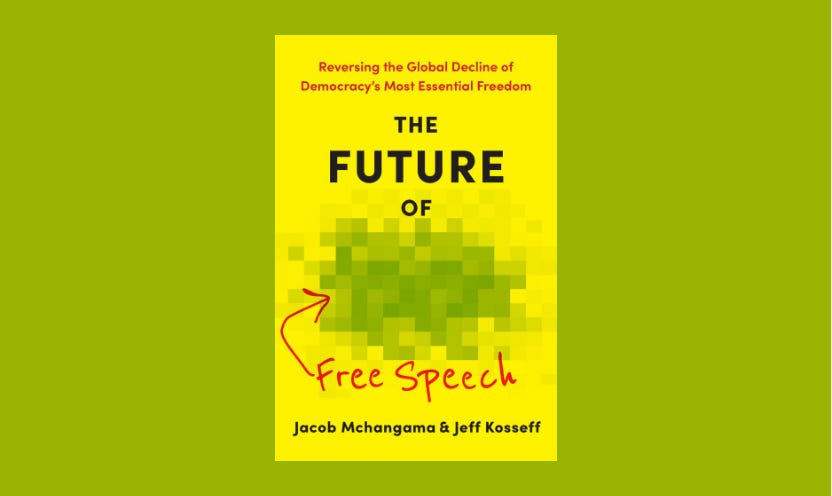
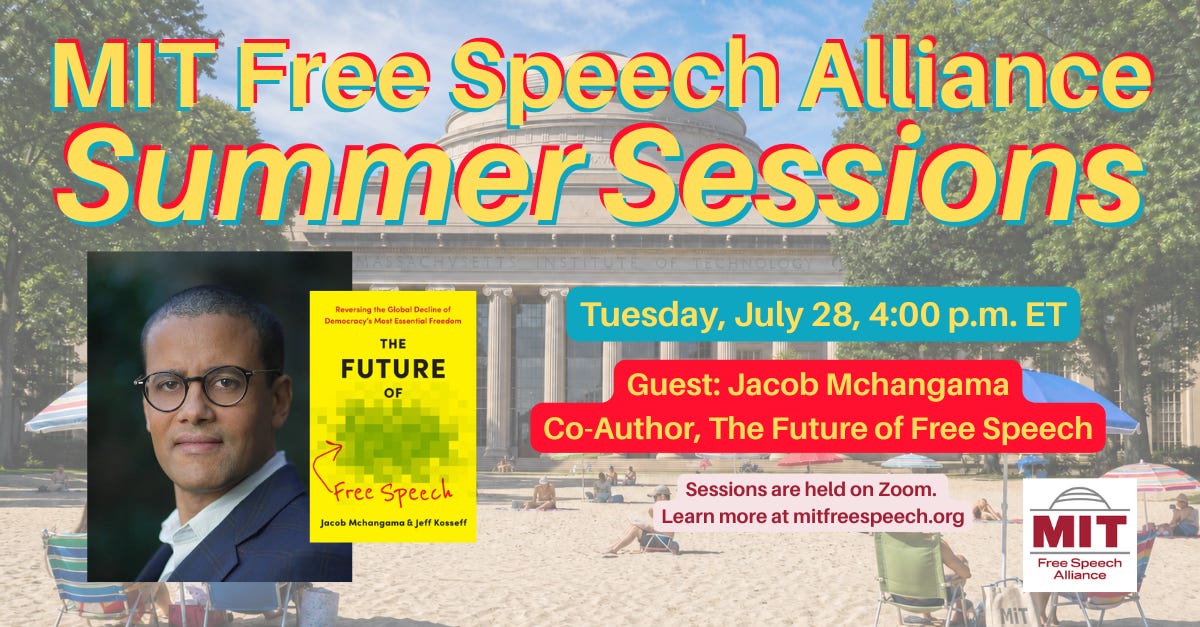
Tomorrow (July 28), I’ll be hosting a webinar for the MIT Free Speech Alliance with Jacob Mchangama, discussing the book The Future of Free Speech: Reversing the Global Decline of Democracy’s Most Essential Freedom and his broader work in the free speech movement. You can register here.
Having spent most of the past 20 years in the free speech movement, I highly recommend The Future of Free Speech. It gives a good birds-eye view of modern speech trends in the free and unfree world alike, where authoritarian countries have become more authoritarian and liberal democracies less liberal and democratic. The U.S. remains the gold standard, but the book leaves me wondering if we have the political will to keep it that way.
Below are some of my key impressions and takeaways from the book, which I look forward to discussing with Jacob. I hope you’ll join.
This wasn’t news to me, but the authors have collected a formidable number of examples showing the lengths some countries have gone to fight extremism.
In Germany after the October 7 attacks, Berlin’s police effectively banned all protests in languages other than German and English, breaking up even a Ukrainian protest outside the Russian embassy. Police also forced their way into a woman’s apartment to arrest her for posting the pro-Palestinian slogan “From the River to the Sea.”
French president Emmanuel Macron used France’s “Law on Strengthening Republican Values” to ban nearly four dozen NGO’s by decree, and in the six months after October 7 prosecuted nearly 400 “apology for terrorism” cases. Among those that were investigated: A survivor of the Charlie Hebdo attacks, who called Hamas a “resistance movement.”
In England, police tracked down and arrested a woman who derided the UK’s Minister and Home Secretary as “coconuts,” as in brown on the outside, white on the inside. (The woman was of South Asian descent, as were the two government officials she criticized.) Not only did they charge the woman with a racially aggravated offense, they charged several of her supporters with the same offense for using the same term to satirically protest her arrest.
None of this would pass muster under our First Amendment. More to the point: these efforts don’t work. Antisemitism, anti-migrant sentiment, and right-wing populism are all surging across Western Europe not in spite of governments’ efforts to curb extreme speech, but partly because of them.
I hadn’t fully appreciated that censorship by liberal governments gives cover to censorship by authoritarians before reading the book, which lays out the practices of free and unfree countries side by side, but you don’t have to infer the point since authoritarians are happy to make it explicit. Consider:
Within days of the EU banning Russian state networks RT and Sputnik, Russia blocked online access to Western media, calling it retaliation in an “information war.”
Rwandan president Paul Kagame used the country’s genocide denial laws to target political opponents, with officials citing Germany and France’s own Holocaust denial laws as precedent.
Venezuela’s Maduro government unleashed its “Anti-Hate Law for Tolerance and Peaceful Coexistence” on critics, with a proponent citing Germany’s Network Enforcement Act as inspiration.
A lesson for Europe: if dictatorships are citing your repressive speech laws to justify their own, perhaps those laws weren’t a good idea.
The United States has great cards to play in the global free speech game. Our First Amendment is the envy of the world, and our Supreme Court has generally given it strong protections. Communications Decency Act Section 230 shields platforms from liability for users’ posts, further strengthening our internet’s protections. And yet this wasn’t much comfort, because as I read The Future of Free Speech I kept wondering if we have the political will to keep our position.
The book’s chapter on jawboning—governments unduly pressuring private actors to censor speech—calls into question American’s free-speech leadership. In the EU, jawboning is codified through the Digital Services Act, which requires platforms to remove “illegal” speech and pressures them into removing “disinformation” under threat of steep fines. Commissioner Thierry Breton’s attempts to use the DSA to bully Elon Musk and X make for one of the book’s most engaging accounts.
But the United States has its own recent history with jawboning. A unanimous Supreme Court ruled for the National Rifle Association, finding New York State had inappropriately pressured insurers to cancel its policies. Anger over the Biden administration’s pressure on social media companies to censor views on COVID-19 and elections helped propel Trump’s return to the White House.
And yet, jawboning has emerged as a favored tactic in the second Trump administration, used against higher education, TV networks, and app developers, among others. The authors rightly peg federal anti-SLAPP (Strategic Lawsuit Against Public Participation) legislation as key to shoring up First Amendment protections, but Trump’s own track record of frivolous litigation dims hopes of it passing while he’s in office.1
The issue, though, is bigger than Trump. Both the left and right both have major blind spots and liabilities on free speech. Where they do find consensus, free speech often loses. Just last month a bipartisan House majority passed the Kids Internet and Digital Safety (KIDS) Act, with age-gating requirements that would harm online privacy and anonymity—and therefore free speech.
Not surprisingly for a book released in 2026, AI looms large in the conversation, with two dominant concerns: who controls AI platforms, and how their models are trained.
Chinese models such as Deepseek represent one extreme: powerful, cheap (and therefore attractive to foreign buyers) and thoroughly trained on Chinese Communist Party talking points. Just try asking them anything about the internment of Uyghurs in Xinjiang or the Tiananmen Square Massacre.
In America, meanwhile, just as this book was hitting bookstores, the Trump administration threatened to seize Anthropic’s technology after it refused to give its unrestricted use to the Pentagon. They also temporarily banned export of its Mythos 5 and Fable 5 models, forcing Anthropic to shut them off worldwide.
AI might be the next stage on which the U.S. and China battle for global influence, but a less visible battle has barely begun over whether the models we use daily will trust their users, or be laden with guardrails around nebulous concepts of hate speech and disinformation, which the authors call “preventive safetyism.”
If there’s one sentence from the book the future of free speech hinges on, it might well be this:
The greatest risk to freedom of expression arises if preventive safetyism becomes embedded in legally binding standards that specifically mandate heavy filtering of prohibited content, based on categories such as hate speech, disinformation, defamation, abuse, offense, and the like (as opposed to speech-neutral regulation aimed at avoiding catastrophic risk, such as the development of nuclear, chemical, or biological weapons).
In the current climate, it’s encouraging to see Senators Ted Cruz (R) and Ron Wyden (D) introduce the JAWBONE Act, which would try to force the federal government out of this game.
No posts
Comments
Nothing yet. Say the first thing.
Sign in to join the conversation.