
Peter Bonilla, Executive Director of the MIT Free Speech Alliance, will be hosting a webinar with Adam Szetela on June 23, 4:00 pm ET, part of a series of summer book discussions the MFSA is hosting. Register for tomorrow’s webinar here.
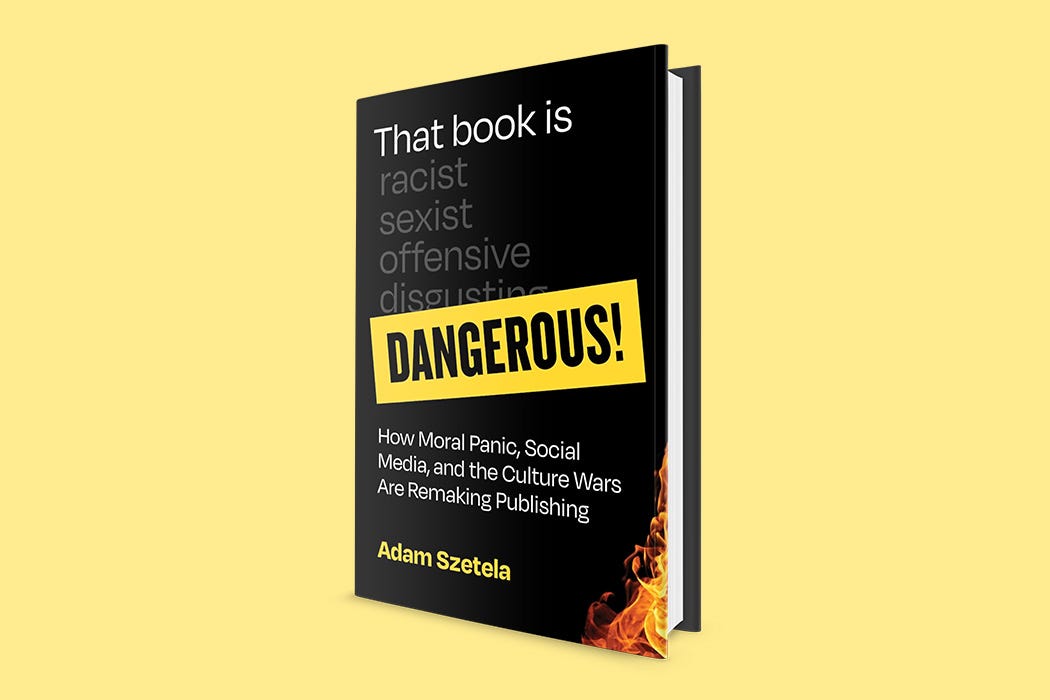
Adam Szetela describes the culture war battles in the publishing industry in That Book is Dangerous!, published by the MIT Press. He describes how the Young Adult (YA) space especially has been the site of several spectacular blowups over language, tone, and representation, causing multiple authors to cancel their own publications and issue groveling apologies to escape the merciless glare of Goodreads and Twitter cancellation campaigns.
Szetela gives us several of these accounts, but is more interested in unwinding the whys of this phenomenon. What are the structural problems this movement is trying to solve? What are the incentives for participation? How do these incentives affect the outward behavior of the participants? His patience walking us through the answers to these questions elevates That Book is Dangerous! from a standard culture war blow-by-blow to a title that helps unlock some of the confounding realities of our cultural moment.
Szetela focuses significantly but not exclusively on YA publishing. A few decades ago, it faced a real structural problem: the characters in its books were far less diverse than the rest of the country. From the desire for more diverse representation flowed the desire for more diverse authors, and from there the desire to make sure that nonwhite and LGBTQ characters were presented thoughtfully.
Representation dramatically improved, but in the process some unproductive practices became entrenched. Frequent are the accounts of non-white authors who bristle at the race essentialism of the industry, told that their voices aren’t “authentic” because they don’t fit into neatly defined notions of how certain characters should talk and behave.
Also unproductive is the hardening of the mindset that writers should not write characters of different ethnicities or gender identities, and the ruthless policing of those who do.1 One notable example is the case of black and queer YA author Kosoko Jackson, who canceled the publication of his novel A Place for Wolves following a backlash over, among other things, the fact that his novel, a same-sex romance set during the Kosovo war, featured an ethnic Albanian Muslim as its villain.
Ironically, only months earlier, Jackson had happily participated in a pile-on campaign targeting another YA author, Amelie Wen Zhao, who pulled publication of her book Blood Heir after online critics (nearly all of whom, it needn’t be said, hadn’t seen the advance text) savaged the book and the author as anti-black on the basis of the book’s treatment of one racially ambiguous character. That Zhao, a Chinese immigrant, intended the book as a critique of human trafficking in Asia carried no weight.2
These episodes happen because they take place in a system whose participants know they won’t be punished, and may in fact be rewarded, for even deplorable behavior. Sensitivity readers employed by the major publishing houses, of course, are incentivized to find insensitive speech or characterizations simply by virtue of the fact that they’re paid to do so. What’s more, publishers are open about how they’ve outsourced this work to their most extreme flank. Just look at this interview between the author and a major publishing house president:
The sensitivity readers that we're employing are at the very, very, very farthest edges of the cultural police. They are over-vigilant to a large degree. I've seen some editors push back hard against what they recommend. Nevertheless, it's great to have that. It's great to have the most extreme possible reaction to a book, which catches even the most apparently neutral points and casts a severe light on them.
Szetela rightly notes that this would be considered insane in any other industry: “One would not expect the World Health Organization to consult QAnon activists before they publish a report about vaccines.” Further, publishers should stop listening to angry people on the internet, as they mistake the rantings of a tiny minority for popular opinion and misalign their priorities as a result.
But that’s easier said than done, given the economics of the field. Space allotted for book reviews in traditional publications has dwindled, and publishers need the scale Amazon can provide after its decimation of the traditional retail model. Amazon, incidentally, owns Goodreads, the launchpad of so many unhinged cancellation campaigns against wrongthinking books. The influencers and BookTok-ers, alas, aren’t going anywhere.
Readers of Szetela’s book, who are likely not in the target audience of the YA publishers, might wonder why they should care. For starters, there’s plenty of evidence that this toxic discourse has filtered up into the world of publishing at large, as the meltdown over Jeanine Cummins’ American Dirt shows.
Further, this dynamic replicated across a number of industries and its cumulative effect on our political culture is significant. When publishing was entering its “sensitivity era,” universities were becoming more censorious and conformist places, with newsrooms and major nonprofits coming apart as insubordinate, social justice-minded younger staff turned the power dynamics upside-down, leaving upper management terrified of their underlings. Public trust in these institutions cratered.
A related book is Musa al-Gharbi’s excellent We Have Never Been Woke, with publishing professionals as a prime example of “symbolic capitalists.” The social and cultural capital that accrues to their positions gives them a disproportionate influence over our cultural language and production.3
In his Washington Post review, Szetela zeroed in on one of the key aspects of the “Great Awokenings” al-Gharbi chronicles: “[T]hey do little or nothing for the marginalized people they are supposed to benefit. As the historical record shows, they mostly serve to create jobs, scholarships and other opportunities for symbolic capitalists.”
This appears to be Szetela’s greatest frustration with the publishing industry. More diverse representation in literature is an objective good, but when writers of color are aiding cancellation campaigns against other writers of color, who exactly is this system serving?
I’m curious to discuss with Szetela how the political economy of the sensitivity era changed in the year since That Book is Dangerous! was published. The political backlash against the excesses of the post-George Floyd protests was already well underway at the time of its writing, with book bans proliferating at state houses around the country. Yet the industry is presented as one in strange denial about the unpopularity of its worst excesses. Publishing houses, Szetela reports, responded to cancellations and social media meltdowns not by disempowering the loudest and most intolerant voices, but by doubling down. More publishers have required authors to hire sensitivity readers before publication, and others have added morals clauses to their writer contracts.
In 2024, Donald Trump ran explicitly against higher education, which made an easy target of itself with out-of-control protests and encampments that proliferated after the October 7th attacks on Israel. The subsequent years have been far from great for higher education, but many universities have at least used it as an opportunity to shed some of their more divisive practices. The publishing industry, however, does not loom nearly as large in the public consciousness, it’s not clear what would induce it to rid itself of some of these practices that effectively narrow the range of acceptable thought. Even the Murdoch-owned HarperCollins plays along, because, at least for the moment, it remains good business to do so.
What would it take for this to stop being good business? I look forward to hearing Adam’s thoughts, and hope you’ll join the discussion.

An unsettling example Szetela notes is that in her time, Flannery O’Connor was criticized for refusing to write more substantial black characters, saying she couldn’t “enter the mind of a Negro.” In the sensitivity era, this is praised.
Something else that needn’t be said: These people actively frown upon you reading these books to form your own opinions. One Goodreads review Szetela quotes is likely indicative, consisting of screencap of a summary written by someone else with this encouragement to people to review it poorly for its alleged racism: “Share and/or rate this book on Goodreads, don’t buy it to ‘see for yourself.’”
No posts
Comments
Nothing yet. Say the first thing.
Sign in to join the conversation.