
What gets us into trouble is not what we don’t know. It’s what we know for sure that just ain’t so.
- Mark Twain
We like to think that innovation stalls because of a lack of ideas or resources. More often, it’s because of something far simpler: we hold too tightly to what we believe is already true. The habits, assumptions, and success stories that once served us well can quietly become blinders that keep us from seeing what’s changing around us.
In behavioral science, this is called the ostrich effect—the tendency to avoid or ignore information that feels uncomfortable or threatening. Investors do it when markets dip. Organizations do it when new technologies emerge. And in health care, we often do it when innovation challenges our routines, roles, or metrics.
Every health system has its version of the ostrich. Sometimes it’s a team that explains away a troubling data trend. Sometimes it’s leadership waiting for “more evidence” before acting on what’s already clear. The result is the same: we keep our heads down just when we should be looking up.
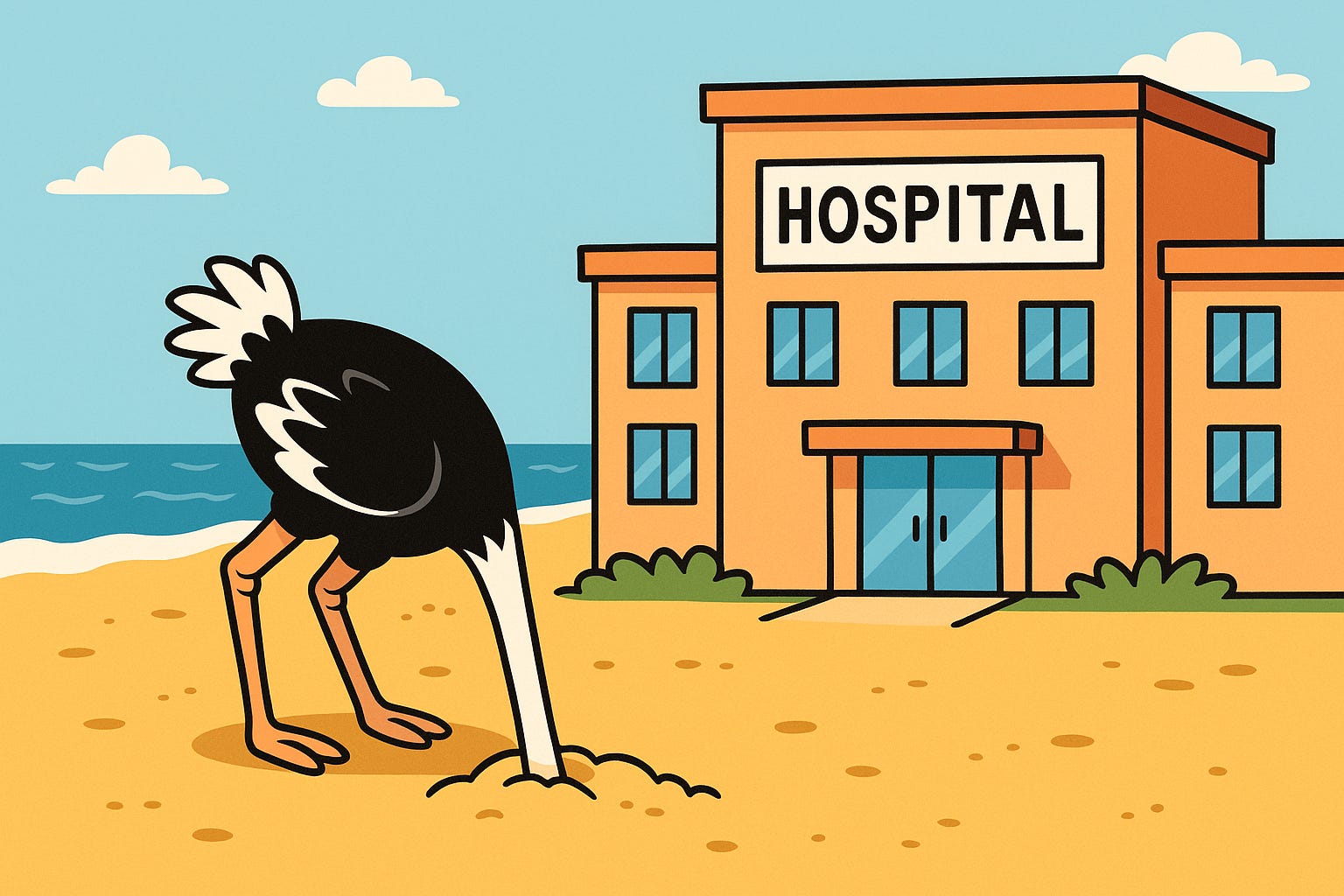
In health systems, the ostrich effect can show up in several familiar ways.
Leaders delay confronting emerging technologies.
When a new digital tool or AI model enters the market, it is often dismissed as “not ready” or “not for us.” The irony is that the longer organizations wait to engage, the harder it becomes to catch up when the technology matures.
Teams avoid uncomfortable data.
Metrics around patient engagement, clinician satisfaction, or portal response times can be hard to face when they reveal cracks in the system. Sometimes those numbers are buried in dashboards, unmentioned in meetings, or explained away as “noise.”
Innovators get trapped in pilot purgatory.
New ideas are tested in small pockets but never scaled because the results are ambiguous or the implications are uncomfortable. Avoidance masquerades as caution.
Each of these examples reflects the same underlying behavior: we shield ourselves from information that might force change.
Avoidance is not laziness. It is human nature. Behavioral scientists have shown that people are loss averse - we feel the pain of losses roughly twice as strongly as we feel the pleasure of equivalent gains. In uncertain environments like health care, this aversion grows stronger.
Information that challenges the status quo can feel threatening because it implies potential loss: loss of control, loss of credibility, or loss of what worked before. So we rationalize, delay, or focus elsewhere.
Organizationally, this plays out as status quo bias and information avoidance. The more complex the system, the more tempting it becomes to keep doing what is familiar. Ironically, this same instinct that once protected us from risk now prevents us from seeing opportunity.
When organizations bury their heads, progress slows in ways that are hard to measure. Opportunities to innovate are missed not because the technology was wrong, but because the timing was.
Think about virtual care. Before the pandemic, many systems had the infrastructure but hesitated to invest deeply. The hesitation was understandable - reimbursement was unclear and adoption uncertain. Yet when circumstances forced rapid change, the ability to adapt quickly separated those who thrived from those who scrambled.
The same pattern repeats with AI, remote monitoring, and digital front doors. The problem is rarely technical capability. It is the collective willingness to confront uncomfortable truths early, while there is still time to act with intention.
So how can we counter the ostrich effect within an organization?
1. Name the avoidance.
Make it a cultural norm to ask, “What are we not talking about?” in leadership meetings. This simple question surfaces blind spots before they become crises.
2. Reward curiosity, not just outcomes.
If success is defined only by metrics that confirm what we already know, innovation will always feel risky. Recognize and celebrate teams that explore new questions, even when the answers are uncertain.
3. Create safe experiments.
Pilots should not be excuses to delay scaling. They should be structured learning opportunities with clear hypotheses and feedback loops. The goal is not to prove an idea right but to learn quickly and adjust.
4. Connect innovation to existing goals.
New initiatives gain traction when they link to current priorities rather than compete with them. Instead of positioning innovation as something separate, tie it to quality, safety, or patient experience objectives.
5. Build a bridge between optimism and realism.
Healthy innovation cultures balance both. Optimists see potential; realists ensure it fits. The bridge between them is learning - fast, open, and iterative.
It’s tempting to think the biggest threat to innovation is lack of ideas or resources. But more often, it is the quiet act of avoidance.
When we keep our heads in the sand, we trade discomfort today for disruption tomorrow. When we choose to look up, we see patterns, possibilities, and problems early enough to act.
Health care is full of talented people who want to make things better. The challenge is not vision but visibility.
Innovation doesn’t only fail because we can’t see the future. It’s often because we refuse to look at the present.
This post is not an endorsement or investing advice. It is personal opinions and does not reflect the views of my past, present or future employers, clients, or colleagues.
No posts
Comments
Nothing yet. Say the first thing.
Sign in to join the conversation.