
Occultism is modernity’s reencounter with the hidden world—its ventured schemas, signs, and symbols—by which our ancient ancestors once lived. As previously explored, the occult idea is the modern West’s readaptation of its own foundational beliefs. The manner in which such concepts were reclaimed, albeit in frayed and fragmentary form, during the Renaissance shapes our image of occultism today. There exist no neat divisions in history. Movements and the populations associated with them do not begin and end in the fashion of a timeline or flowchart. And yet—hindsight clarifies certain markers and tracings of how ideas enter awareness. Our own era will one day be subject to such reasoning. This piece, adapted from the second chapter of my 2023 historical study Modern Occultism considers the eclipse and fitful reemergence of spiritual traditions toward which the West had grown amnesiac in the centuries following the fall of the Hellenic, Egyptian, and Persian empires. Within this encounter, you may recognize principles by which you presently live. -M-
Although esoteric ideas of late antiquity were overshadowed and suppressed, threads of these beliefs and practices experienced revival, rebirth, and renewed relevance during the Renaissance, the flowering of arts and culture in Europe that flourished from about 1400 to the early 1600s.
It is deceptively easy to reference vast ideas and shifts, empires and the rise and passing of historical epochs. One can forget, of course, that there existed countless and diffuse populations. The Roman Empire itself encompassed nations from Central and North Africa, the Mediterranean, Near East, Persia, Western and Eastern Europe, British Isles—people spanning from African to Celtic lands, all seeking stability, survival, meaning, commerce, culture, worship, methods of agriculture, building, and hunting.
So little about their lives reaches us, as little about ours will reach people a thousand years hence. I try to take a moment whenever leaping over swaths of history, which I must as a necessity of space, to acknowledge the vast personas, different languages, dispersed regions united by day-to-day survival and some sense of connectedness that lent meaning—and perhaps provided help—in navigating existence.
Cleopatra committed suicide rather than become a prize of the Roman Emperor Augustus (63 B.C.–14 A.D.), who eventually succeeded the assassinated Julius Caesar (100–44 B.C.). The ruler took her own life in August of 30 B.C., following the suicide of her lover and collaborator Mark Antony by several days. That symbolically and effectively marked the end of Egypt as a freestanding empire. It was dominated thereafter by Roman troops. Although Rome could rule with a brutal hand militarily and economically, the Empire generally permitted a reasonable degree of religious freedom.
Competitive and sometimes syncretic religious cultures within the Empire produced frictions of their own, occasionally exploited by governing authorities. Eventually, Christian forces conflicted with long-established pagan and nature traditions. As noted previously, the scales tilted militarily, economically, and culturally in favor of Christendom when Emperor Constantine converted to a version of Christianity in 312 or 313 A.D.
For generations, many people in the Roman Empire, like Constantine, combined facets of the newly ascended religion with ceremonies and local worship of pantheistic deities. Following Constantine, Rome endured for generations but eventually was so pressed by corruption, fraying outer frontiers, and invasion that by 476 A.D., the city of Rome fell and the Empire was largely extinguished in Western Europe.
Rome, however, persisted for several hundred years as a military and economic power ruling from Constantinople, today Istanbul. The Emperor Justinian (482–565 A.D.) reclaimed parts of Western Europe. By 529 A.D., however, the ruler also closed the Platonic academy in Athens, which for centuries sustained study of Pythagoreanism, Hermeticism, and Neoplatonism. His edict dealt a death blow to formalized study and promulgation of classical and esoteric philosophy.
In centuries ahead, Western life was marked by a fraying of power structures that once reflected the military, economic, and cultural dominance of Rome. Many people struggled to maintain agricultural existence and eventually assembled into clusters we know as feudal states or duchies ruled by local potentates or strong men. Tribes and clans formed into different groups, further fraying power structures.
Indeed, local clashes fractured many parts of Western and Eastern Europe. There was plague, smallpox, banditry, and hunger, along with breakdown of highways, waterways, trade and shipping routes, and centrality. One way that historians detect economic and cultural decline from 600 to 800 A.D. is lack of shipwrecks. Maritime skills hadn’t improved; maritime activity had declined.
In the early Middle Ages, the Christian monastic system, already in practice from late antiquity, developed more fully. The preservation of many ancient and esoteric works, sometimes in the form of books but often in scrolls, papyri, parchments, or canvases, is due to monastic enclaves. Monks organizing themselves into monasteries, sometimes Coptic, Byzantine, Roman Catholic, or Eastern Orthodox, structured libraries where records not destroyed in chaos, persecution, piracy, or warfare were maintained.
The Dark Ages saw new efforts at civilization, religiously, culturally, agriculturally, and militarily. But it was nonetheless an epoch marked for centuries by quest for survival rather than development of civic culture. This began to change by the late 1200s with the writings of Dante and flowering of arts, poetry, painting, religious statements, and Christian architecture—most notably the growth of cathedrals, which often incorporated esoteric and sacred geometric principles.
“In quantitative terms,” wrote Joscelyn Godwin in his 2007 The Golden Thread (Quest Books), “the Gothic cathedrals are as astonishing as the Pyramids. In France alone, the ninety years from 1180 to 1270 saw the building of eighty cathedrals and nearly five hundred abbeys. The whole country’s economy was dominated by it.” Godwin continued:
How would you go about building a cathedral in a paperless and largely illiterate society? . . . The ‘mason’s secret’ of the ancient architect was that he was trained to construct an entire building in his imagination . . . Also, given that the ancient architects, from Stonehenge to Chartres, were primarily engaged with sacred buildings, it is certain that their imaginations were suffused with religious myths and symbols. The mental construction of temples and churches was inseparable from meditation on the meaning of those myths, while the intense effort of imagination could pass over into visionary experience.
The historian’s observation comports with the meaning of the Greek term adytum for “inner temple”—and provides a valuable hint of the merits of modern Freemasonic practice of memorization, the topic of my next article.
The artistic and intellectual dawning grew dynamically in Florence, Italy, inaugurating a period considered the early Renaissance.
With the leadup to the 1300s, life grew stabler, trade routes reopened, and commerce expanded. The longstanding series of wars called the Crusades, from 1095 to 1291, in which Western armies campaigned to retake Jerusalem and other holy sites from the forces of Islam, wound to a close. Economic, military, and familial burdens that the Crusades placed on individuals, communities, and nations eased. Returning Crusaders brought home tales of myth, wonder, and ruins of ancient lands.
The end of the Crusades also brought backlashes. The Catholic military order of the Knights Templar played a major role in the conflicts, both financially and martially. But when the Crusades ended in the late thirteenth century, the Knights’ purpose as a combat and financial institution was unclear. The French monarchy and Vatican, both in debt to the order, considered the Templars a potential rival.
In a push to solidify control over banking and military mechanisms, the papacy decimated the Knights with accusations of heresy, leading to forced confessions, jailing, and, in many cases, torture and death.
Coerced witnesses sometimes recalled the Knights worshipping a disembodied head called “Baphomet,” possibly an Old French corruption of Mahomet (Mohammed), prophet of the opposing forces. The figure may have also been associated with Banebdjedet, an Ancient Egyptian ram god with its cult center at Mendes. As explored below, French occult thinker Eliphas Lévi (Alphonse Louis Constant) in 1855 associated Baphomet with the Sabbatic Goat or “goat of the Sabbath,” a popular pagan retention.
The church developed its own fissures between Western and Eastern branches. From 1438 to 1445, the Council of Ferrara-Florence convened to seek reconciliation between Latin and Greek divisions. The years-long conference drew together a wide range of clerical thinkers, scholars, and philosophers. Much of their business centered on liturgical minutiae. But Florentine leader Cosimo de’ Medici (1389–1464) grew inspired by florid and vivid lectures on ancient wisdom delivered by Byzantine Neoplatonic philosopher Georgios Gemistos (c. 1355/1360–1452/1454), known by his self-chosen appellation Plethon, a name resonant of Plato’s.
Cosimo and others remarked on how the eighty-year-old expounded on Hellenic philosophies as though he had been present for their making. Plethon, or “second Plato” to some students, considered himself the last of the classical Hellenists, a claim not without merit.
Indeed, the philosopher purposefully muted his true beliefs, which would have amounted to a crime of heresy: replacement of Abrahamic monotheism with revived Hellenic polytheism merged with wisdom from Persian prophet Zoroaster (c. seventh or sixth century B.C.) at least as interpreted through the lens of Greek antiquity. A rival at the conference wrote in scandalized tones:
I myself heard him at Florence . . . asserting that in a few more years the whole world would accept one and the same religion with one mind, one intelligence, one teaching. And when I asked his “Christ’s or Muhammad’s?,” he said, “Neither; but it will not differ much from paganism.” [1]
Listening to this dramatic and self-styled figure, Cosimo yearned to inaugurate a new Platonic academy in Florence. One of the animating passions of the early Renaissance, spurred in part by Plethon, was a revival of interest in the ancient past, something also glimpsed by Crusaders. Indeed, some Renaissance thinkers, theologians, and translators began to speak of a prisca theologia, an ancient or primeval theology.
The term appears in the work of scholar-translator Marsilio Ficino (1433–1499) but began conceptually—and possibly in specific usage—in Plethon’s lectures at the Council of Ferrara-Florence. Thinkers began to speculate over the existence of an antique, foundational, pre-Christian theology. Where to find it?
Vestiges of ancient esoteric philosophy and religion survived in Greek, Coptic (which employed a Greek-style alphabet), and Arabic, sometimes translated into Latin, provided a tantalizing scent trail.
But, often, these were fragments. The great libraries, academies, and temple orders were irreversibly gone. Monasteries preserved some precious shards, but the splendor of Ancient Egypt was a faintly retained memory, spoken of by an occasional traveler, tradesman, or Crusader who might have glimpsed some of Black Land’s monuments.
Consider how distant this must have seemed to Renaissance thinkers. When Greek historian Herodotus (c. 484–c.425 B.C.) encountered the pyramids, they were as ancient to him as he is to us.
Renaissance intellects, or at least idealists among them, clung to the belief that some undiscovered source contained this prisca theologia, vessel of cosmic secrets.
Permitting a modern tangent, this is not wholly different from the animating spirit that drove Madame H.P. Blavatsky (1831-1891), cofounder of the Theosophical Society, to produce her two-volume cosmology The Secret Doctrine in 1888. Blavatsky, too, believed that there existed a forgotten primeval philosophy from which all modern religions emerged. H.P.B.’s timeline was considerably vaster and involved deeply antique civilizations and stages of spiritual development.
All of this reached a head of sorts around 1462, or it may have been 1460 because historical dates conflict. On or around 1462, there occurred a small but tectonically influential event that considerably shaped the Renaissance—and gave us many of our modern concepts of the occult.
As the story is often recounted, a Byzantine monk from Macedonia, one Leonardo da Pistoia, entered the royal court of Florentine ruler Cosimo de’ Medici, who had previously thrilled to the talks of Plethon. [2]
The monk Leonardo, who may have been in Cosimo’s employ as an antiquity seeker, presented the ruler with a cache of papyrus manuscripts. Expressing an esoteric philosophy narrated by Egyptian-named figures, the scrolls were signed by Hermes or Hermes Trismegistus. Hermes Trismegistus was a Greek honorific title for Thoth, Egypt’s god of writing and intellect, meaning “thrice-greatest Hermes.” As the signatories meant it, Thoth, a figure often depicted as a man with the head of an ibis pressing a stylus onto a clay writing tablet, was three-times greater than Hermes, god of intellect, writing, culture, and commerce.
The Greek manuscripts thrilled Cosimo, who thought this might be a core sample of the lost primeval theology. The treatises, originally fourteen as translated, had been unseen for at least a thousand years. [3]
He instructed his court translator, scholar and philosopher Marsilio Ficino, to suspend work on translations of Plato and turn attention to these manuscripts. Cosimo was desperate to read this material before his death, which occurred in 1464, about two years after the monk entered his court and one year from when Ficino completed his effort.
Ficino translated the manuscripts into Latin, which remained the lingua franca among educated classes. The philosophical Hermetica presented a vision of humanity emergent from a great mind of creation, in Greek called Nous. This infinite intelligence created or projected humanity and all things through a series of concentric circles.
It stood to reason, in the Hermetic outlook, that as a figment of the great over-mind of creation, the created being also possesses causative mental abilities. More so, through a process of eternal recurrence, the soul, psyche, or essential self, transmigrates through these concentric circles and over a period of lifetimes grows closer to the central mind of creation, until the individual becomes as the gods.
Each of these translated tracts was relatively brief, what we would now consider a pamphlet. Eventually, this cache of manuscripts grew to seventeen and became known as the Corpus Hermeticum, literally “Hermetic Body.” [4]
In most translations of the Corpus Hermeticum, the tracts are numbered one to eighteen—but one tract, number fifteen, is missing. The “lost tract” is a passage from a tenth-century Byzantine encyclopedia of antiquity called the Suda, coupled with three passages from Macedonian Hermeticist Stobaeus (c. early fifth century A.D.). The Suda ventured a Christian interpretation of Hermes as a pagan who foresaw Christianity: “He was called Trismegistus on account of his praise of the trinity.” [5]
Several early Christian writers sounded this theme. Some Christian thinkers were sympathetic toward Hermes as a precursor to Christ while others, including Saint Augustine (354–430 A.D.), were more dismissive. Added in 1574, the Suda passage was later dubbed pseudo-Hermetica and removed. But the Corpus Hermeticum remained traditionally numbered one to eighteen, with the fifteenth entry absent to keep the number system consistent. I note this because students and seekers are often—and needlessly—confounded by scholarly (or academic) shorthand in such matters.
In many regards, Ficino’s Latin translation represents the literary reintroduction of ancient esoteric philosophy into the modern world. Many Renaissance thinkers regarded Hermes Trismegistus as a kind of prophet or even man-god, a figure who might have been an instructor to Abraham and Moses, hence an ur-teacher, soul guide, psychopomp, and, to some, an actual being who belonged to deepest antiquity.
As enthusiasts saw it, this possibly deific being had written, transmitted, or inspired these manuscripts, which reflected humanity’s primeval theology. (The sleeping warrior in the figure above may reflect humanity receiving Hermes—keeper of celestial knowledge—in a kind of clairvoyant dream.) This ideal later hit the rocks of disappointment and, in a sense, produced a second stage of obscurity for Hermeticism.
For now, though, we remain within the period of highest hopes.
As often happens at a defining epoch, many related writings began to appear or reappear. Other works, later dubbed technical Hermetica, dealt with spells, alchemy, astrology, divination, prophecy, talismans, and spirit conjuring. This material arose from Greece, Egypt, Mesopotamia, the Middle East, and Western and Eastern Europe.
What to call these ideas and methods? There existed a term in Latin, occultus or occulta, meaning hidden or secret. These ancient practices and theologies, in many cases pre-Christian and sometimes even pre-Judaic, came to be known in English as occult. The term entered the Oxford English Dictionary in 1545.
German polymath and theologian Heinrich Cornelius Agrippa (1486–1535) proved pivotal in establishing the concept of an occult body of knowledge. In 1510, Agrippa, writing by hand in Latin, produced a three-volume set of books, De Occulta Philosophia (“On the Occult Philosophy”), in which he labored to unite vast strands of this rediscovered philosophy or at least portions that he felt amounted to a philosophy.
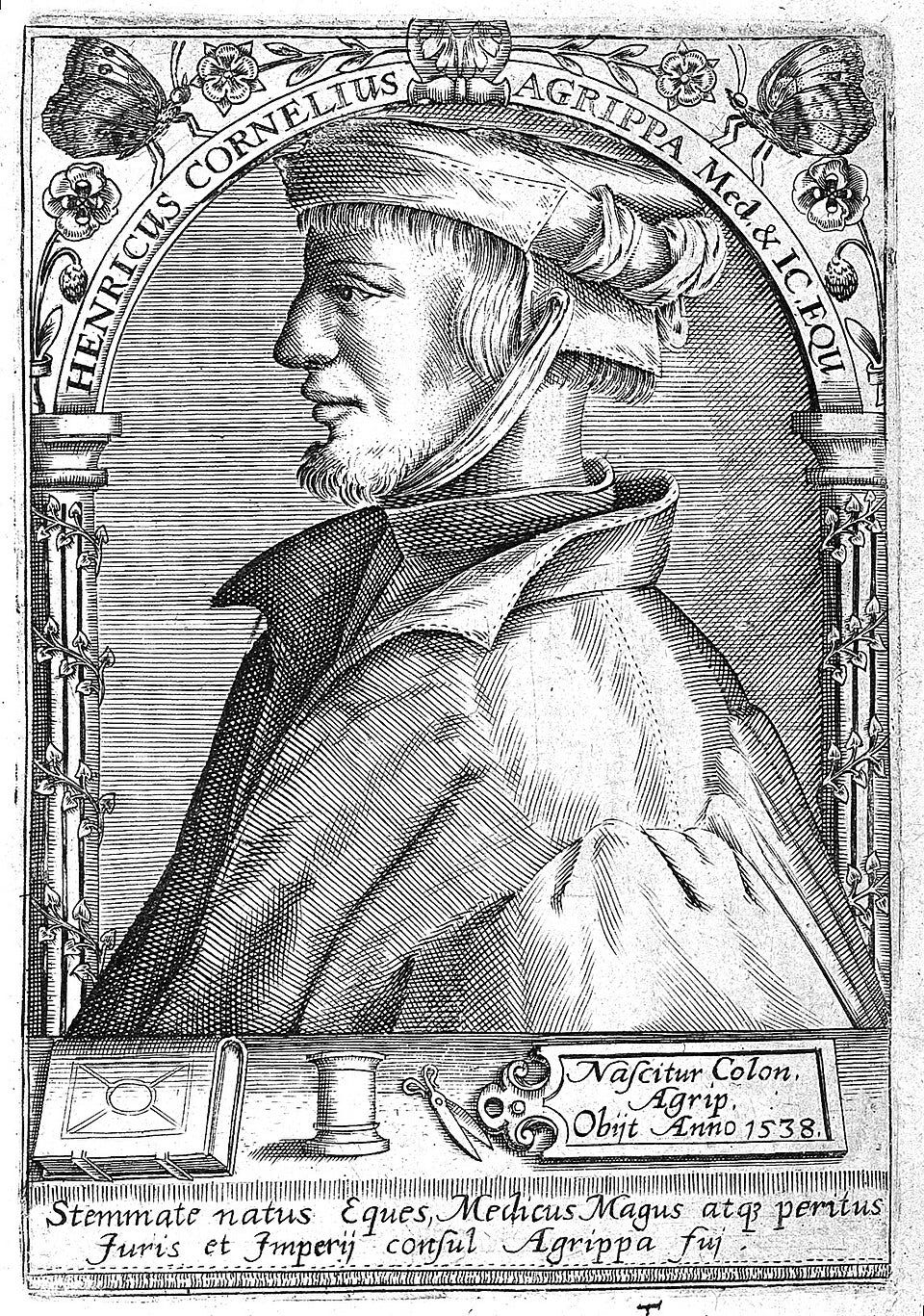
In an act of great fortitude, Agrippa, biding time with the religiously controversial material, waited until 1531 for his first volume to appear. All three volumes did not see print until 1533, two years before his death.
The author and curator also demonstrated exquisite care in navigating church strictures, sometimes winning the imprimatur of ecclesiastical authorities to publish this pre-Christian religious philosophy, which Agrippa diplomatically framed with prayers and prefatory material of an explicitly Christian nature. The scholar shrewdly opened his volumes with an admiring letter from Johannes Trithemius (1462–1516), a German Benedictine abbot with his own deep interests in the occult.
In the 1598 biographical portrait cited above, translated as Portraits of Illustrious Men, chronicler Jean-Jacques Boissard pays the occultist this tribute: “Agrippa spares no one: he condemns, knows, does not know, weeps, laughs, grows angry, rails, and censures everything. He himself is philosopher, demon, hero, god—and everything.”
The first English translation of Agrippa’s Three Books of Occult Philosophy appeared in 1651. The Latin books were translated by an unknown (and probably self-protective) writer who used the initials J.F. Sources dispute whether the initials belonged to antiquarian James Freake or chemist John French. In any case, 1651 marked the appearance of an English translation that would, in various forms, endure and serve as a reference for more than 350 years.
In 2021, a scholar of esoterica, Eric Purdue, published with Inner Traditions the first translation since J.F. from Agrippa’s original Latin into English. As such, it is a significant resource. (I should note that there exists a popular and creditable annotation of Agrippa issued in 1992 by Donald Tyson with publisher Llewellyn, which is based on the 1651 original.)
As translated into English, Agrippa occasionally used the term demon. Here I must add Purdue’s clarifying note from volume one of his 2021 translation:
Agrippa is following the Renaissance understanding of the term daemon. The modern usage of “demon” typically implies an evil spirit. The Greek root, daimon [pronounced DYE-mohn], is more complex. Sometimes it could mean a deity or sometimes a spirit. By the Renaissance, the Latin daemon [DYE-mon] often referred to a lower-level spirit, one that was more terrestrial. Some daemons were good, some evil. Later in book three, Agrippa quotes Iamblichus at length, showing that daemons could be attending spirits for people, places, and various activities of life. Some support life and happiness, others do not.
This is a case in point of how occultic terms are sometimes reprocessed in a uniformly negative light due to centuries of cultural conditioning. At its root, the term demon was a neutral reference to spirit.
To give a flavor of how ideas travel, among Agrippa’s formulas appear instructions for creating a silver amulet with symbols of Jupiter to draw power from the god and planet. That same amulet was found around the neck of Mormon prophet Joseph Smith (1805–1844) following his death by mob violence in Carthage, Illinois in 1844. Raised in Central New York’s “Burned-Over District,” Smith probably did not derive the design directly from Agrippa but rather an 1801 popularization by Englishman Francis Barrett, The Magus. I wrote in my 2009 Occult America:
Magic and myth were part of the firmament of the Smith household. According to historian D. Michael Quinn in his monumental [1997] study Early Mormonism and the Magic World View, Joseph Smith’s family owned magical charms, divining rods, amulets, a ceremonial dagger inscribed with astrological symbols of Scorpio and seals of Mars, and parchments marked with occult signs and cryptograms popular in eighteenth- and nineteenth-century English and American folklore. In her 1845 oral memoir, the family matriarch, Lucy Mack Smith, recalled the Smiths’ interest in “the faculty of Abrac”—a term that might have been lost on some. In fact, Abrac, or Abraxas, is a Gnostic term for God that also served as a magical incantation. It forms the root of a magic word known to every child: abracadabra. [6]
For his part, Joseph Smith venerated the powers of the planet Jupiter, which was prominent in his astrological birth chart. According to Quinn, Smith’s first wife, Emma, reported that Smith carried a protective Jupiter amulet up to his death. The surviving silver amulet displays markings that derive from the work of Renaissance mage Cornelius Agrippa and that were spread among British and American readers by the English occultist Francis Barrett in his 1801 book The Magus, a popularization (and partial copycat) of Agrippa. Smith’s occult interests closely reflected those that traveled through Central New York.
Since we are exploring how texts morph and migrate, it is important to note that Agrippa himself drew upon certain ideas from a medieval grimoire (an Old French-derived term that attained popularity following Barrett) or spell book known in Latin as the Picatrix.
The volume seems to have been written in the mid-eleventh century in Arabic, although some scholars argue for earlier vintage. The Picatrix, whose original Arabic title was roughly The Goal of the Sage, is a book primarily, though not wholly, of astrology. The author of the Picatrix is unknown but the work is sometimes attributed to Arab scholar Maslama ibn Ahmad al-Majriti (d. 1005–1008). It was translated into Latin and Spanish in the mid-thirteenth century, with its name perhaps a mangling of the earlier Arabic title. Hermetic volumes tended to get translated into Arabic, Latin, and Coptic.
In broad terms, the Picatrix might be considered a work of technical Hermetica. Among its concepts are decans, a method of dividing astrological signs by ten degrees. This seems to have influenced Agrippa, making the Picatrix an important work in the development of modern astrology.
One of the key mystical systems that gained prominence during the Renaissance is Kabbalah, specifically in the form called Christian Kabbalah. The cosmological Jewish thought system aroused a wide range of thinkers, including those who populated the start and close of the Renaissance: Catholic theologian and artist Ramon Llull (c. 1232–c.1315); philosopher Giovanni Pico della Mirandola (1463–1494); Catholic scholar of Greek and Hebrew Johann Reuchlin (1455–1522); mathematician, astrologer, and magician John Dee (1527–1609); and physician and philosopher Sir Thomas Browne (1605–1682).
It should be noted that Llull, for his part, created a highly complex visual language of letters, symbols, and geometric shapes imposed within concentric circles, the turning of which is intended to reveal truths about the universe. Llull’s “language” is among the earliest forms of computation.
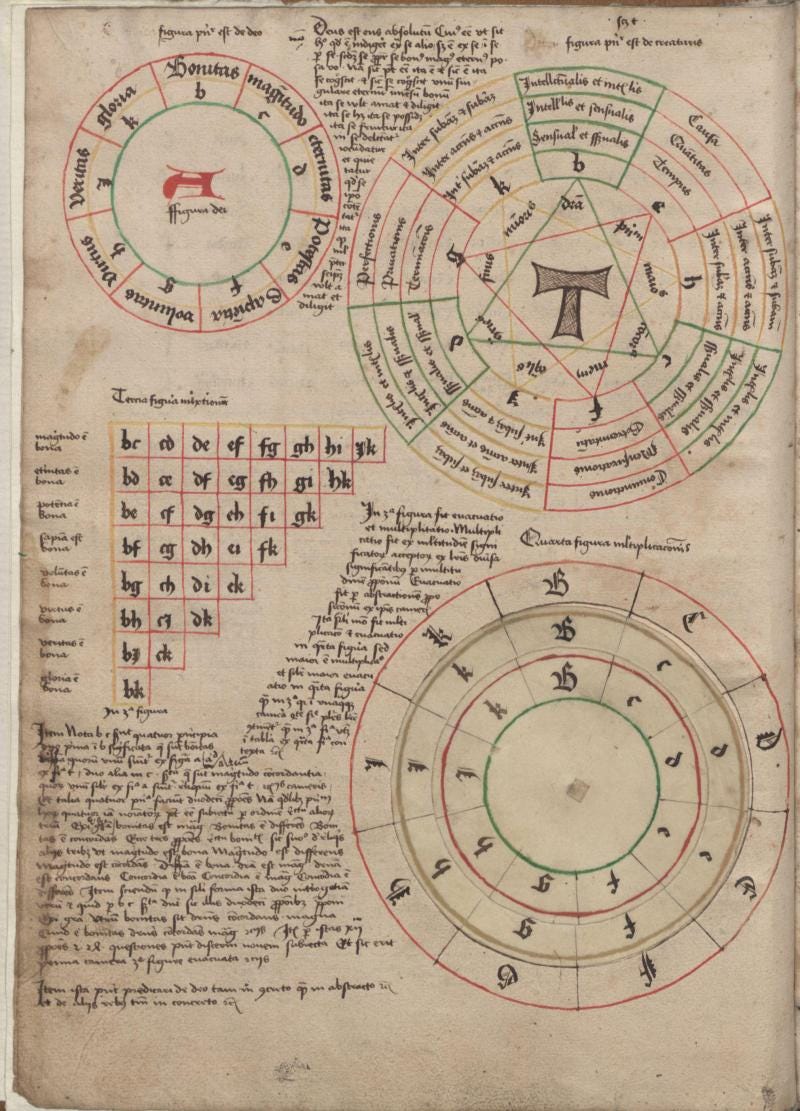
Among their pursuits, these figures and others comported insights of late ancient or medieval Jewish mysticism with belief in the divinity of Christ, seeing Kabbalah as a precursor to Christian practice. Rendering Kabbalah into a Christian framework was also a means of eluding church persecution. Again, Agrippa waited more than twenty years before he finally saw publication of his Occulta Philosophia. A great deal of diplomacy and cat walking were required for Renaissance thinkers interested in Kabbalah, Hermeticism, and occult philosophy. Christianizing a thought system, winning the imprimatur of a local bishop, and declaring fealty to Christ in a preface were standard practice.
Two primary works of Kabbalah were translated into Latin and gained currency among Christian thinkers. The first was the Sefer Yetzirah or Book of Formation. The Sefer Yetzirah was probably written in Mesopotamia in Hebrew between the third and sixth centuries A.D., considered the Talmudic era. The work was likely assembled from a variety of insights among disparate rabbinic sources. The other key repository of Kabbalistic thought was the Zohar or Book of Splendor. This was written in Aramaic in Spain, arguably by Spanish rabbi Moses de Leon (c. 1240–1305) around 1275.
Both the Zohar and Sefer Yetzirah are elliptical works written in Hebrew and Aramaic and thus very difficult for Latin thinkers to translate and grasp. These works and commentaries on them, which exist in various forms today, are challenging, offering facets of the Jewish mystical schema, which in certain respects comports with Hermeticism’s ideal that all of creation is an expression of one great source of intellect fragmented into different aspects.
Within Kabbalah, and specifically the Zohar, one of these models of creation is called the sefirot, or ten units of creation that compose reality. The searching individual is charged with working his way up through these ten expressions of creation—comparable to rising through the planetary spheres in Hermeticism—to understand the mechanics of life, including power, intellect, justice, love, harmony, and empathy.
As the individual rises through the ten sefirot, which in traditional Kabbalah are sometimes arranged in a pattern called the Tree of Life (first drawn by Johann Reuchlin), he grows closer to the Godhead or what might be called the great intellect, Nous. Like Hermeticism, Kabbalah contains teachings about transmigration of souls, as one lifetime is scarcely considered sufficient, even for the dedicated mystic, to rise up through the sefirot.
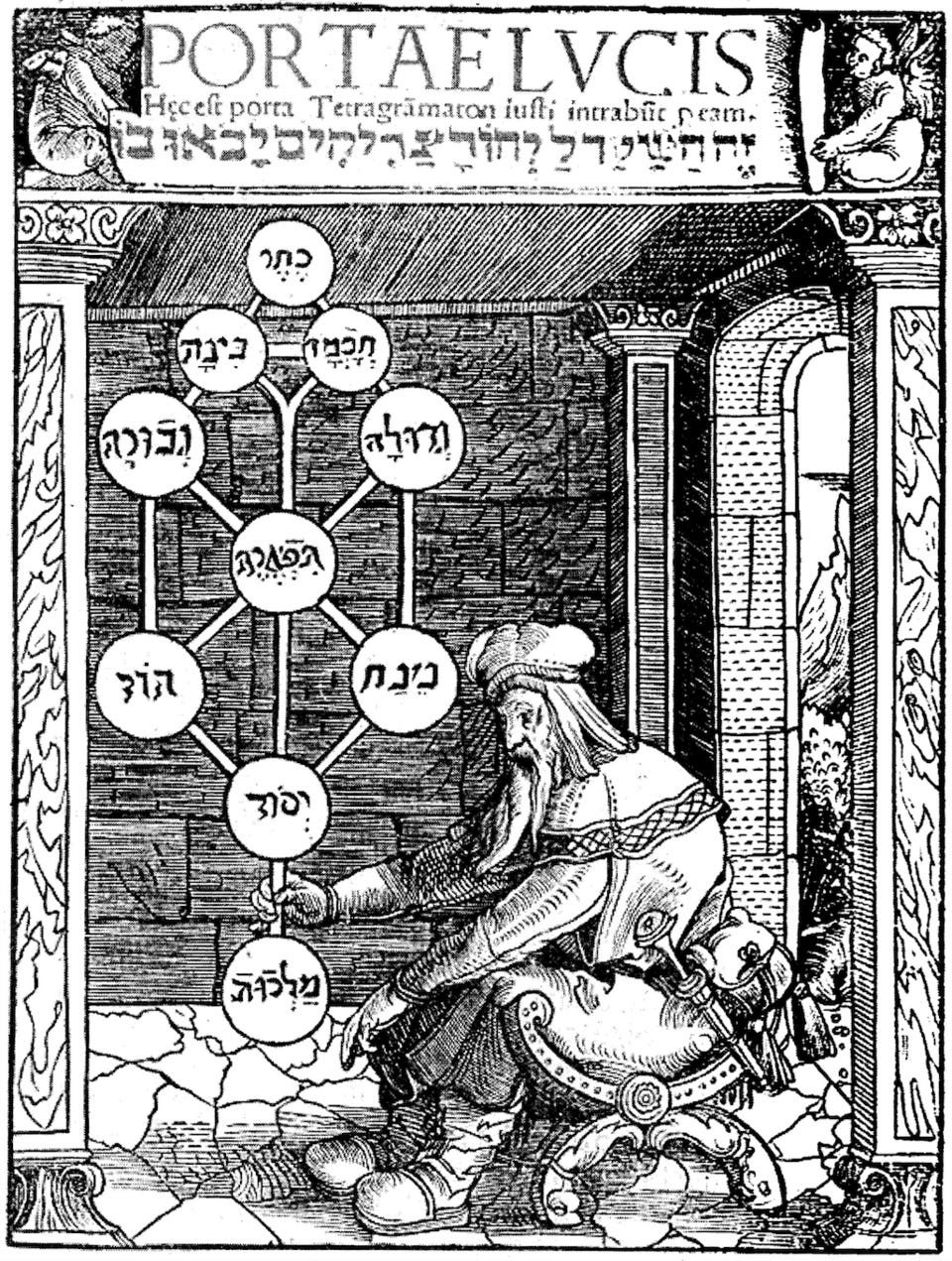
Within Kabbalah are also magical uses of names and numbers. There exist seven names for God within traditional Judaism—the holiest of these, signified by consonants Y H V H, is considered lost to time in pronunciation. Alchemists believed that all matter went back to one primal substance. It is sometimes said that this substance was codified in the ancient Hebrew name for God, Yod Hey Vav Hey, or Y H V H. We sometimes pronounce it Yahweh or Jehovah. Religiously observant Jews use the term Adonai, acknowledging that pronunciation of Yod Hey Vav Hey is lost to history. According to Jewish lore, whoever learns the pronunciation grows all-powerful. For some alchemists, Yod Hey Vav Hey signifies the basic stuff of creation, which in Hermeticism is thought.
In a teaching from the Zohar, the name of God consists of a sequence of 72 three-letter Hebrew combinations. The Hebrew alphabet contains 22 letters but this formation of 72 three-letter terms devises the magical name and encodes the fragments into which divinity dispersed itself in creation. This knowledge forms the “spiritual technology” Moses is said to have used to part the Red Sea. Hence, Christian Kabbalists and magicians believed they were encountering a system through which the seeker could identify and wield constituent parts of creation. The ideal was to transcend the bonds of existence and advance toward the one true power and grace—or, as the Hermetic dictum goes, as above, so below.
Christian Kabbalah flowered throughout the sixteenth century. This opening was, of course, limited to those who had access to education, books, patrons, and financial resources, much of which were stationed in and around church structures. Certain wealthy families like the House of Medici funded translations and printings of books, often by hand. Hence, for all the influence of occult ideas, they were available in real time to a small cluster of clerics, translators, mathematicians, tutors, courtiers, and nobility. But the flowering was authentic so that such ideas were written about, discussed, and vouchsafed to later generations, including ours.
For all that, a backlash began to grow. Some church authorities and local parishes revolted against occult, Hermetic, Kabbalistic, alchemical, and astrological experimentation. There was, most severely, an uptick of violence against accused witches. Although this brutality extended to the early Middle Ages it erupted anew in the late 1500s.
The Witch Craze was not limited to rural areas but traversed Western and Eastern Europe where various victims, usually isolated, unmarried, or older women, were sometimes caught up in paranoid finger-pointing and accused of spell casting or curses. Not infrequently, women unprotected by family structures (and sometimes even then) were considered practitioners of the old nature ways, now heretical, and blamed when animals died, crops failed, or plagues or other sicknesses erupted. The search for a hidden foe nearly always results in one being found. And the enemy is almost invariably defenseless.
The numbers are difficult to track but historical consensus holds that from 1450 to 1750, roughly 40,000 people, and possibly more, were killed, with tens of thousands more subjected to brutal and terrifying trials. [7] What was notable about the Salem witch trials of 1692–93 in the American colonies, which claimed twenty-five lives in hanging, pressing, or death in jail, is that they did not persist, although episodes of mob violence against religious outliers, such as the Shaker founder Mother Ann Lee (1736-1784) certainly did. [8]
One of the last witch trials recorded in the Western world occurred in Switzerland in 1782, which resulted in the torture and beheading of a rural housemaid, Anna Goldi. Consider that Switzerland was a relatively prosperous nation deep into the Age of Enlightenment. Acts of mob violence against accused witches continued sporadically throughout the world, flaring up in economically pressed regions even in the twentieth and twenty-first centuries. [9]
The late-Renaissance backlash was also felt within aristocratic and church-based environs. Shortly before his death, English playwright Christopher Marlowe (1564–1593) expressed anti-occult themes in his Doctor Faustus, written in 1592 or 1593. The dramatist died under mysterious circumstances, stabbed to death in London in 1593 soon after he completed his most famous work.
Based on folkloric sources, Doctor Faustus is the classic tale of a man who attempts to sell his soul to the devil and is thus conscripted to damnation. Marlowe’s statement was considered a satire of figures like Cornelius Agrippa and John Dee who had been the court magician and astrologer to Queen Elizabeth, and to whose remarkable career we soon return. As such, Doctor Faustus proved an ominous bellwether to late- Renaissance occultists.
There was likely a real Faust. He was probably alchemist, Hermeticist, and magician, Johann Georg Faust, who lived in German-speaking Central Europe, dying around 1540. Central European legend held that the mysterious figure made a pact with Satan for knowledge and power. This Faust is likely Marlowe’s model but the matter is unsettled; several magicians, philosophers, and physicians in the mid-to-late Renaissance also bore the name.
A more modern and highly regarded iteration of Faust came from philosopher, novelist, and dramatist Johann Wolfgang von Goethe (1749–1832), begun from 1772 to 1775 and completed near the end of his life. Goethe’s Faust is subtler than Marlowe’s. The philosopher’s version also tells the story of a sorcerer, alchemist, and Hermeticist who makes a pact with the devil or Mephistopheles, as named in Goethe’s play, to serve him for eternity in exchange for infinite knowledge. But Goethe’s Faust does not fully trust Mephistopheles. And the feeling is mutual. The two do a kind of intellectual dance around one another with Faust skeptical that Mephistopheles will deliver the happiness, knowledge, and fulfillment he promises. So, Mephistopheles proposes an odd bargain. He tells Faust that he’ll do everything he says in exchange for the mage’s eternal service, but with a wrinkle: in order to prove that he’s being on the level with Faust, Mephistopheles vows that only when a moment arrives in the sorcerer’s life that’s so sublime that he would be willing to live eternally within it will he die and be claimed by the Dark Emperor. It’s a strange wager—a Faustian bargain—and the magician agrees.
At the end of Goethe’s Faust—this being a spoiler alert—Faust never quite reaches that moment of sublimity. Rather he keeps foreseeing it in the future. He dies thinking of the ultimate moment—but not from it. Mephistopheles finds himself unable to claim Faust because while he ponders euphoric ultimacy he does not experience it. Hence, if anybody tells you that you’re never satisfied, you can respond neither was Faust—and it saved him. It could also be argued that worldly pursuits leave one perpetually unsatisfied. But perhaps it’s worth never being satisfied.
Marlowe’s drama was a morality tale and broadside against Renaissance occultism. But Goethe’s, which I think is the far greater of the two, more subtly and sympathetically probed human striving. Regardless, in its timing Marlowe’s Doctor Faustus mirrored and abetted the reversing tides against occultism. Even prominent figures were unsafe. This is typified by the fate of Italian philosopher and scientist Giordano Bruno (1548–1600), burned at the stake in Rome. After seven years of Bruno’s trial and imprisonment, the Vatican’s court of inquisition convicted the philosopher-scientist of multiple heresies, including practice of magic, teaching reincarnation or transmigration of souls, and endorsing “cosmic pluralism,” or existence of other worlds and beings.
What seems to have most disturbed church authorities was Bruno’s doctrine of a decentered cosmos. In 1584, the heretic wrote in his treatise On the Infinite Universe and Worlds, “There are therefore innumerable suns; there are infinite earths that equally revolve around these suns, in the same way as we see these seven (planets) revolve around this sun that is close to us.” [10] The prevailing view was geocentric or earth-centered, with our planet at the heart of the cosmos and the sun and planets revolving around it.
This perspective was upended by 1514 in the preliminary work of astronomer Nicolaus Copernicus (1473–1543) but later suppressed by church authorities. The well-traveled Bruno cast a powerful shadow across Western Europe and argued for heliocentricity with renewed vigor. Amid mounting tensions between Bruno and his inquisitors, the scientist paid the price of burning at the stake in 1600. Bruno was, in many regards, the consummate Renaissance mage. He was so deeply steeped in Hermeticism that even today you can find online sources that actually misattribute to Bruno variations of a passage from book XI of the Corpus Hermeticum (one of the collection’s most mystical tracts): See what power you have, what quickness! . . .
This misunderstanding derives from—but is in no way attributable to—pioneering British historian Frances A. Yates (1899–1981), who wrote monumental works on the occult revival of the Renaissance. Yates, particularly in her Giordano Bruno and the Hermetic Tradition (University of Chicago Press, 1964)—an invaluable text and personal source of literary inspiration—argued elegantly that Bruno emerged from a Hermetic-Egypto milieu in which the sun is the central force of cosmic creation and Hermeticism bears markings of an Egyptian esotericism that views the sun not only as a life-giving entity but positions it at the center of the known cosmos.
Bruno was also influenced, of course, by the astronomical work of Copernicus. But his interiorized worldview was intellectually, philosophically, and aesthetically Hermetic. As Yates saw it, there existed a marriage within Bruno of revived Hermeticism, Renaissance occultism, and Copernican astronomy. Hence, there is no easy sorting out of magical and enlightenment insight; the two are not only bound but the earlier functions, at times, as antecedent to the latter.
English magician John Dee suffered a far less brutal fate than Bruno but his career nonetheless tells an elegiac story. Dee was titular court magician and astrologer to Queen Elizabeth (1533-1603). Although Dee astrologically selected her coronation date, Elizabeth at times kept the controversial scholar-mage at arm’s length.
Dee, who is said to have signed his letters to Elizabeth with the numerical sigil 007, is sometimes fancifully depicted as an occult secret agent and coded namesake to Ian Fleming’s James Bond. That’s a considerable stretch. There exists no evidence of Dee functioning in an espionage capacity (which to some observers confirms its secrecy) and his signature was possibly an alchemical symbol of eyes and the sacred numeral seven.
The “occult agent” and James Bond connection got launched in a 1968 biography, John Dee, Scientist, Geographer, Astrologer and Secret Agent to Elizabeth I by journalist and popular historian Donald McCormick writing under the pseudonym Richard Deacon. McCormick had made other controversial claims about various figures working as spies. A more reliable and esoterically informed record appears in Jason Louv’s John Dee and the Empire of Angels (Inner Traditions, 2018).
None of this is to say that Dee’s career lacked controversy: in 1555, the police of Queen Mary (1516–1558) arrested and imprisoned Dee in the Tower of London for conjuring or “calculating.” His specific crime was casting horoscopes of the royals. Dee may have placed himself in legal jeopardy by sharing Mary’s horoscope with the younger Elizabeth. He was eventually cleared of treason and released that year. When Elizabeth took the throne in 1558, Dee was more or less protected and elevated as occasional court philosopher and magician.
Artists, occultists, and aesthetes sometimes called the queen diva Elizabetta or “divine Elizabeth” for her cultural liberalism. It would be going too far to say that Elizabeth embraced Dee but she granted him a stipend and held audiences with him. In that vein, Dee typified the late-Renaissance magician in a fitful age: sometimes feted, sometimes condemned.
During his period of relative safety, Dee proved uniquely important to the development of Renaissance occultism. Among his accomplishments was creation in 1564 of a symbol called the Monas Hieroglyphica. It consisted of a simple cross surmounted by an astrological sun and crescent moon, with the rams-horn glyph of Aries at its base. Dee’s Monas Hieroglyphica was designed to unite the zodiac and alchemy. He felt the symbol unlocked all of occult philosophy.
“Dee belonged to a generation that searched passionately for the right key to reading nature’s language,” notes historian Egil Asprem. “Variously, he found cues in optics, kabbalistic hermeneutics, emblematics, mathematics, astrology, and magic.” [11]
For nearly thirty years of his highly productive life, Dee, in a journey that probably began in 1581, attempted to consort with angels or spirits. In his intimate collaboration with occultist Edward Kelley (1555–1597/8), Dee in about two years worked out a twenty-two-glyph “angelic language,” corresponding to letters of English. Future writers dubbed it Enochian based on Dee’s observation that the pre- flood patriarch Enoch was the last figure to know elements of the cryptic tongue, which Dee and Kelley believed was used in Eden. For this reason, Dee also called the language “Adamical.” He believed it man’s primordial, universal idiom. Dee and Kelley employed the “Celestial Speech” in “angelic conversations” with spirits.
Kelley was among several scryers with whom Dee worked—probably four had preceded him—but their partnership, which commenced in 1582, was by far Dee’s most fruitful and fractious. Under the dictate of angels, the two swapped wives for a time, a practice instigated by Kelley whom most biographers felt played on Dee’s ingenuousness and bouts of credulity. Kelley was a scryer or seer who prophesies by peering into a reflective surface like a mirror, crystal, or bowl of water. Dee himself owned a black obsidian “spirit mirror,” pictured here in the author’s photo from the British Museum.

It is often difficult to reconstruct exactly how classical magicians performed their rites since explanations and diary installments frequently prove obscure; the seeker can be left as though mentally trying to reconstruct Plato’s description of the cave. In this case, however, magician-scholar Stephen Skinner, in his 2012 republication of Dr. John Dee’s Spiritual Diaries (Llewellyn), performed yeoman’s work of reassembling the Dee-Kelley operations. I quote from (though substantially abridge) Skinner’s reconstruction not only for its descriptive value but also to capture the arduous effort and patience of the classical practitioners:
Essentially Dee and his skryer Edward Kelley sat in front of a ‘Table of Practice’ in a chamber of practice reserved specifically for these sessions which they referred to as ‘Actions’ (with spirits / angels). The table was referred to as the Holy Table, and the top of the table was engraved with a design . . . The purpose of this design was the same as the floor inscribed magical circle of the grimoires, which was to ensure that the spirit / angel was restrained spatially to the table top, and constrained to tell the truth. The 22 letters on the border (and in the centre of the Table) are from the Enochian alphabet also transmitted earlier to Dee and Kelley by the angels (similar to the 22 letters of the Hebrew alphabet reflected in the Four Worlds of the Kabbalists . . . ) . . . The table stood upon four wax insulating discs, which also had engraved upon them the Sigillum Dei Aemeth (‘Sigil of Truth’) . . . These had a similar function to restrain and constrain the spirit / angel. The same design made in wax was placed upon the Holy Table, insulated by a silk cloth . . . Upon the wax disc is the crystal skrying stone, described by Dee as ‘natural Diaphanite’ . . . Each session began with long and earnest prayers, plus often the recitation of some of the Penitential Psalms by Dee, designed to ensure the purity of the following operation. Kelley would then seat himself in front of, and gaze into the crystal. After a varying length of time (between a few minutes and more than an hour) Kelley would see a veil within the crystal, which then parted to reveal a spirit or angel, often seated upon a throne. I say ‘spirit or angel’ because one of their long running problems was to decide if the entity which appeared was a spirit (who might convey bogus information) or an angel. Dee (and indeed many grimoires) developed tests and questions for determining this. Kelley then reported what he heard and saw in the crystal, and Dee painstakingly recorded it in amazing detail, as accurately as any scientific record. Dee would hastily write the record on rough (sometimes light blue) paper and then make a fair copy afterwards. During the communication, Dee interjected with questions, and Kelley conveyed the (often evasive) answers of the spirits / angels . . . These angels / spirits often delivered prophecies or answered Dee’s questions relating to Central European politics, as well as providing alchemical advice, and a number of tedious sermons and rants about the wickedness of Dee, Kelley or their several potential patrons. Dee was particularly interested in the possibility of an immanent Second Coming and the setting up of a new Kingdom of God. Although Dee had introductions to some of the most powerful men of his time (including the King of Poland and Rudolph, Emperor of Bohemia) he wasted these opportunities by allowing himself to convey these sermons and fire and brimstone rants unmodified to these potential patrons, rather than using his considerable knowledge to secure a regular source of patronage and pension, or at least to promote the religious reformation that he so vehemently desired. It is rather perplexing that a man of Dee’s intellect did not tire much earlier of these unfulfilled prophecies and evasive answers. It may be that his overwhelming piety and belief in the intrinsic goodness of the angels kept his disbelief at a distance.
Scrying, it should be noted, was the method also used by world-famous seer Michel de Nostradamus (1503–1566) who employed the practice—although, again, details are sketchy—to produce his prophetic books of quatrains, or four lines of verse, organized into sets of one hundred or centuries. Nostradamus produced ten centuries across four works (with some quatrains missing and others of questionable provenance).
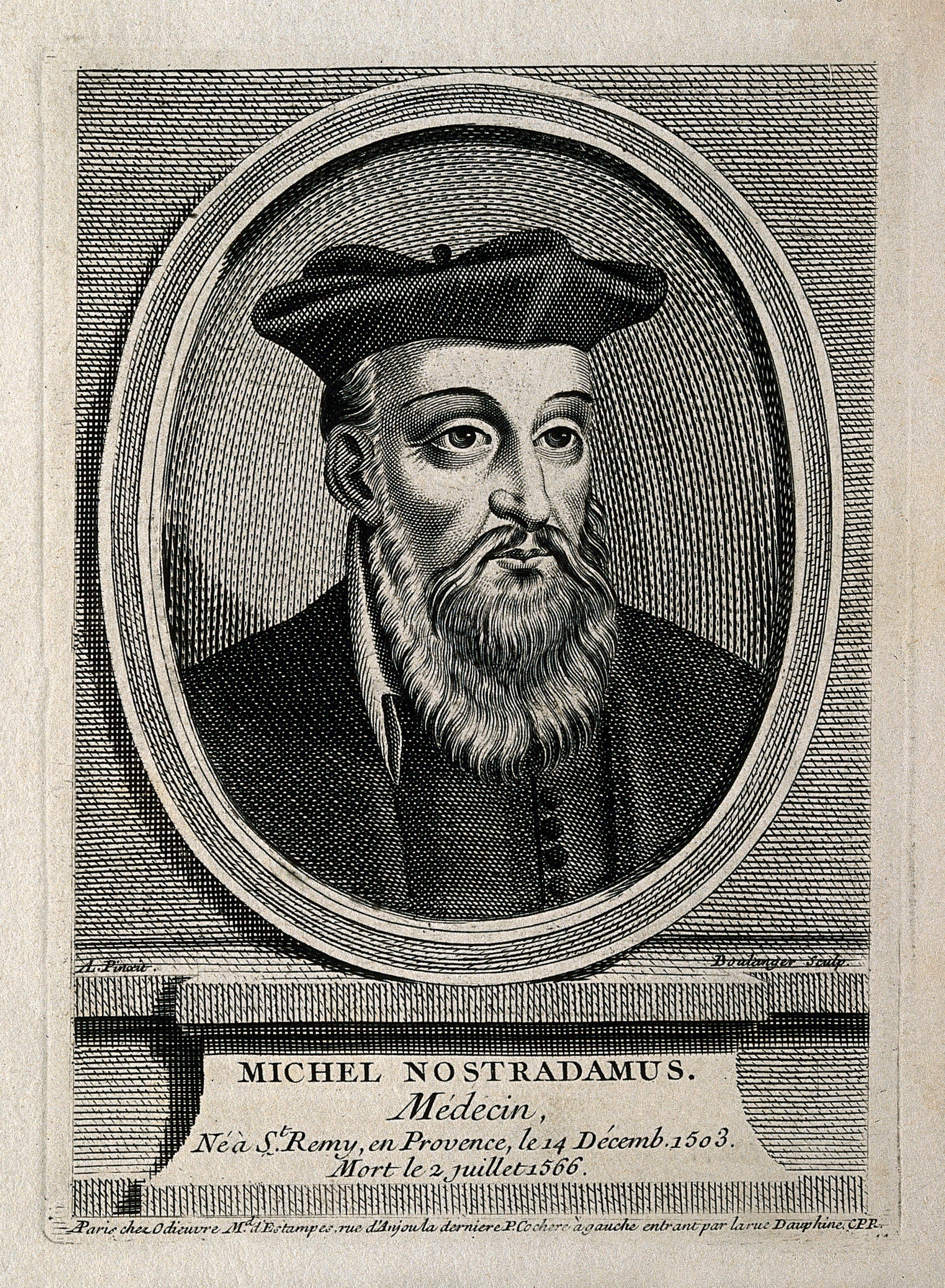
Writing in Middle French, Nostradamus, too, was occasionally feted by royals including Catherine de’ Medici, wife of King Henry II of France. An astrologer and self-styled physician, Nostradamus is famous today primarily because his prophecies experienced renewed scrutiny during World War II due to quatrains concerning “Hister,” later interpreted as Hitler though it is also an ancient name for the Danube River in Austria. Scholar of esotericism Richard Smoley writes in his 2006 The Essential Nostradamus, “A more likely interpretation would equate ‘Hister’ with the Austria of Nostradamus’s time, thus predicting a bloody engagement in which much of Europe is pitted against the Hapsburg monarchy. In fact, this happened during the Thirty Years’ War (1618–1648).”
During World War II, both the Axis and Allies sought to use the prophecies of Nostradamus for propaganda purposes. According to declassified intelligence papers, occult scholar Manly P. Hall was asked to participate in an MGM propaganda documentary in which Nostradamus prophesied Allied victory. Although the studio produced four Nostradamus shorts, this one to my knowledge was never made.
I quote Smoley above from a volume I published at Penguin Random House and recommend it for the author’s typically precise translation and historical notes. I commissioned the work because I wanted readers to have a textually faithful and historically accurate rendering of Nostradamus following the instructive experience of encountering an author, now deceased, who falsified a Nostradamus quatrain. The passage, from Century X, quatrain 72, is sometimes related to the terrorist attacks of 9/11 (“The year 1999, seven months . . .”). The quatrain uses the Middle French word ressusciter, which means to revive or resuscitate. But the author rendered it as devastate, its near opposite. When I called him out, he refused to acknowledge mishap or fakery. He finally conceded: “You must understand that there is an entertainment quality to this.” I replied, “I do understand. But not here.” My dedication is to see that readers receive accurate material. As it happens, most interpretations of Nostradamus’s reported foresight of 9/11, as with other historical landmarks, are made by pointing to his elliptical passages after the fact. Popular renderings of Nostradamus in tabloid and adjacent media are often invented from whole cloth.
In any case, absent perceived confluence between Nostradamus’s quatrains and World War II, the prognosticator, a household name and staple of tabloid and video exploitation (not to mention a bevy of ongoing popular books), might well be a footnote of the magical Renaissance. Unlike Nostradamus, Dee is recalled as a virtuosic astronomer, polymath, mathematician, and proto-scientist. In addition to fluency in Latin, Skinner notes, “Dee was an acknowledged expert, in his own time, on a number of ‘hard’ sciences including mathematics, geometry, astronomy, optics, geography, navigation, on all of which he wrote substantial works.”
But the mage died in ruin. Following Elizabeth’s death in 1603, Dee suffered vandalism and destruction of his home and library in southwest London at the hands of a pious mob presumably reflecting the judgments of Marlowe. Elizabeth’s successor, James I—for whom the King James Bible is named—had little of the queen’s tolerance. Stripped of court dignities and stipends, Dee lived quietly with his daughter and caretaker Katherine, selling possessions to survive. He died in poverty in late March 1609. Even his grave marker went missing, eventually replaced by a commemorative plaque in 2013. In a final indignity, depending on one’s point of view, Dee was posthumously denounced in 1659 for consorting with the devil—a Middle English term—by popular translator and literary critic Meric Casaubon (1599–1671).
“In 1659,” wrote Egil Asprem, “the magical workings of Dee and Kelley were canonized by the publication of Meric Casaubon’s A True and Faithful Relation [of what passed for many yeers between Dr. John Dee . . . and some spirits]—an account brought to the public with the intention of showing how a good but gullible man was lured into damnation by a cunning nigromancer [the black magician Kelley]. The book at first caused a stir, tempting others to try what Dee had done rather than keeping them away from magic.” In fairness, it must be noted that Meric Casaubon’s account provided scholarly curation and preservation of Dee’s work and diaries from this significant phase of the mage’s career. The work is the basis for the 2012 republication by Skinner. Casaubon, as it happens, was the son of philologist Isaac Casaubon to whom we now turn.
I noted earlier that the Renaissance intellect was animated by the ideal of a prisca theologia, or primeval theology, a thought system considered older than any other. When the Hermetic literature was rediscovered in the court of Cosimo de’ Medici, there burned a hope that this was the primeval theology eagerly sought.
But there occurred a decisive and peculiar revelation in 1614, which shook and eventually dashed the ideal of Renaissance Hermeticists that this ancient literature harbored the grail-like primal theology. This episode, although critically important, indirectly contributed to an intellectual lapse in Western thought from which I personally believe we are only beginning to recover.
The incident was a groundbreaking textual analysis of the Corpus Hermeticum by linguist Isaac Casaubon (1559-1614). In a work published in 1614, Casaubon determined through vernacular, textual, and historical references that the Hermetic literature was produced in late antiquity, specifically in the generations following Christ. It should be noted that—as with much of intellectual history—Casaubon’s analysis was preceded by decades of fragmentary effort by other linguists who made related notes. The voice of Hermes, at least in these hallowed works, did not share vintage with Abraham and Moses or belong to the mists of deepest antiquity. This revelation gradually proved deflating to many educated people of the era and in decades ahead. Yet herein lies a strange historical wrinkle, which ripples into the present day.
As noted, dreams of a recovered prisca theologia faded after Casaubon’s textual analysis. Along with these withered hopes, however, another kind of viewpoint settled over the Western cultural scene in the dawning Age of Enlightenment. The viewpoint held that because the wished-for vintage of these philosophical tracts had been dispelled, there was something compromised, fraudulent, and corrupt about the Hermetic literature itself. Other theological statements, both Abrahamic and Eastern, were spared this verdict. This intellectual leap represented an error in the development of Western thought.
In my estimation, the summary judgment of the Hermetica’s “illegitimacy” grew from an ingrained malady of the Western intellect, which is habituated to “either / or” or “take it or leave it” thinking based, in part, on the absolutist formulas of Aristotle. This might also be called black-and-white or binary thinking. Author, researcher, and clinician Raymond A. Moody, M.D., who coined the term Near-Death Experience (NDE) in his 1975 study Life After Life, makes the valuable observation that most Westerners are educated to think in opposites but a third option exists: there is true, there is false—and there is unintelligible.
This is a critical insight, especially in our era when we are, for example, witnessing the mainstreaming of the UFO thesis, throwing modern culture into an indeterminate and uncertain place. Yet we experience hobbled intellectual capacities, often with “believers” off to one side and rejectionist “skeptics” off to another. Reaction to the Hermetic literature was a primary case. Because the Hermetica, so the reasoning went, proved not as old as acolytes and historians believed, it follows that the project of its revival, and even the literature itself, is compromised, sullied, and counterfeit.
Left out of this debate was a historical principle that proves as critical to our understanding of the value of the Hermetica as to contextualizing nearly any ancient text. Simply because we determine the date when a text was produced—sometimes through contemporaneous comparisons, analysis of lexicon, and other historical markers—does not mean that the text’s ideas started then.
Not only were texts copied and recopied, sometimes among different languages, but, as alluded earlier, the story of humanity is itself that of oral tradition. The human story mirrors itself on both a macro and micro scale. When a baby is born that child possesses only the expressive ability of sound. The infant can cry to indicate he or she is hungry or that something is wrong. Eventually, the child develops motor skills and later speech. Later still, speech becomes writing. What else is writing but approximation of speech? The development of human history echoes that of the individual. It is a fact of historicism that much of our religious and parabolic literature began as oral tradition. This is so whether referencing Scripture, Homer, or teachings of Pythagoras.
As noted, most of the ideas attributed to Pythagoras were not written down, in this case by students, until centuries after the Greek sage died. Why would the cultural scene differ for Greek-Egyptian antiquity? Hence, I view the Hermetic literature as a deeply valuable time capsule of a very ancient past to which we possess a frayed thread of connection; that thread has gotten broken, it has intermingled with other related or unrelated ideas, it has been interrupted. But it persists. To assume that classical Hermetic literature is not reflective of older oral tradition is to assume that it is an exception to the history of ideas itself.
In any case, as the Age of Enlightenment proceeded, the Hermetica was written off and, at times, even mocked. Natural philosopher Sir Thomas Browne was left to write in his 1643 Religio Medici, “The severe Schools shall never laugh me out of the Philosophy of Hermes, that this visible World is but a Picture of the invisible wherein . . .” In Mary Shelley’s Frankenstein, published about two centuries after Casaubon, some of her characters—this was not Shelley’s attitude—debase Hermetic tradition and ridicule the tragic figure of Victor Frankenstein for reading its tracts.
As I was writing this piece, I encountered a blog that studies the anthropology of texts whose writer, while offering many erudite insights on early Christian works, reflected on “Casaubon and the exposure of the Hermetic corpus,” noting that, “I knew that the ‘Hermetic corpus’ was bogus, but not why”—conflating the redating (and contending the texts themselves intentionally clouded the matter) with a revelation of philosophical or textual illegitimacy. [12]
This argument is not entirely unfair so much as unsettled. The books of the Corpus Hermeticum emerged from multiple hands and cannot be referenced monochromatically. To the critic’s point, Book XVI does, indeed, proffer the conceit that it was written in Egyptian:
When the Greeks will later wish to translate [my books] from our language into their own, the result will be very great confusion in the texts and unclarity. For when it is expressed in its native language, the discourse retains the clear meaning of its words. And in fact the nature of the sound and the power of the Egyptian words contains in itself the force of what is said. [13]
I do not wish to make a fig-leaf intellectual justification on behalf of texts for which I feel obvious affinity. In this matter, I consider myself in sympathy with the semi-famous lament of mathematician Warren Weaver speaking on psychical research in 1960: “I find this whole field [parapsychology] intellectually a very painful one. And I find it painful essentially for the following reasons: I cannot reject the evidence and I cannot accept the conclusions.”
In essence, dating does not always determine vintage of ideas. Nor can all Corpus tracts be classed together. What of the Egyptian conceit of Book XVI? Scholar Garth Fowden, who did much to restore Hermeticism’s legitimacy as a neo-Egyptian expression, wrote of its unknown author: “Clearly we have to do here with an Egyptian who, desiring to convey the impression that his work is but a translation from his native tongue, acts on the principle that attack is the best form of defence. He may himself have had no choice but to write in Greek, but he shared with many Hellenized oriental intellectuals a suspicion of the debilitating effect of translation—understood in the broadest sense—on the distinctive essence of his own tradition.” [14] This might be called a virtuous conceit.
Arguments and counterarguments aside, the redating brought with it general judgment of fraud. Due to this leap in thinking, the Hermetic literature was mostly excluded from the ancient philosophical and spiritual corpus. Eventually, the Hermetica, this oeuvre so seminal to Renaissance thought, fell into near obscurity. Indeed, after the 1650 English translation and some errant literary references, the trail goes largely cold. No direct Hermetic literature is included, for example, in Harvard’s canonical Loeb Classical Library. There appeared, thanks to the late-nineteenth-century occult revival instigated by Madame Blavatsky, some less-than-satisfactory Victorian translations, along with a monumental effort by her secretary G.R.S. Mead, described earlier. It was only in 1992 when Brian P. Copenhaver’s translation emerged that we came to possess what I think is the first truly serviceable English translation. [15]
I believe that dismissal of the Hermetica cost us centuries of progress in our ability to study the existential philosophy of a critical phase of antiquity. This was due, in large measure, to a misunderstanding of how ideas get passed on and to the thought-habit of absolutism. Yet here we encounter an example of just how strange life is, of its discursive and tantalizing compensatory measures.
In 1614, the same year that Hermes Trismegistus was dethroned, a year that could symbolically be considered the close of Renaissance occultism, there began circulating in Central Europe an enigmatic text written in German called the Fama Fraternitatis, roughly “The Story of Our Brotherhood.”
The work, in existence as early as 1610 but aboveground for the first time, purported itself the manifesto of a secret brotherhood, or “invisible college” as it was sometimes later termed. The fraternity was Brothers of the Rosy Cross or Rosicrucians. As Hermes was exiled, the Fama Fraternitatis heralded an unseen order of adepts intent on instigating a new era of learning, mysticism, esoteric study, radical ecumenism, and decentering of the church from political power and regulation of the spiritual search.
Had the occult moment passed—or was it just dawning?
[1] Esotericism and the Academy by Wouter J. Hanegraaff (Cambridge University Press, 2012)
[2] Leonardo’s and his manuscripts’ vintage are recorded in Marsilio Ficino’s Latin introduction to his Corpus Hermeticum translation as “having been brought from Macedonia to Italy by the diligence of Leonardo da Pistoia, a learned and honest monk.” From “Marsilio Ficino and His Translation of Corpus Hermeticum VI” by Maurits Van Woercom, final thesis, CSW Van de Perre in Middelburg (Netherlands), December 29, 2021.
[3] The Bookseller of Florence: The Story of the Manuscripts That Illuminated the Renaissance by Ross King (Atlantic Monthly Press, 2021)
[4] Ficino in 1463 originally translated fourteen of seventeen tracts, which he printed in 1471. In 1482, Italian scholar and Hermeticist Lodovico Lazzarelli (1447–1500) translated “three extra treatises which he had apparently discovered in a separate manuscript (apparently not preserved),” writes Antoine Faivre in “Hermetic Literature IV: Renaissance- Present” in Dictionary of Gnosis & Western Esotericism (Brill, 2006). “Lazzarelli,” notes Wouter J. Hanegraaff in his article on the scholar in the same source, “is important as the first Latin translator of the three final treatises of the Corpus Hermeticum.” One of the questions of Hermetic history is the nature and vintage of the manuscript discovered by Lazzarelli. As Hanegraaff notes, Lazzarelli discovered the additional three tracts “in a manuscript different from the one used by Ficino, and which had not been translated into Latin.”
[5] Hermetica translated by Brian P. Copenhaver (Cambridge University Press, 1992)
[6] Genesis 41:43: “Pharaoh had Joseph ride in the second chariot and the crowds yelled before him ‘Abrak!’” This Egyptian word of unknown meaning may be the origin of abracadabra. I explore this further in my 2025 Practical Magick.
[7] E.g., see “Case Study: The European Witch-Hunts, c. 1450–1750 and Witch-Hunts Today” at gendercide.org.
[8] It should be noted that witch trials also occurred in the American colonies before Salem: “The first hanging of a witch in New England occurred in Connecticut in 1647; a number of other cases came to court in the 1640s to 1680s, and there were hangings at Providence in 1662.” From A New History of Witchcraft by Jeffrey B. Russell & Brooks Alexander (Thames & Hudson, 1980 and 2007).
[9] See my “Persecution of Witches, 21st-Century Style,” The New York Times, July 4, 2014.
[10] Translated from the original Italian by David Barrado Navascués at “Giordano Bruno: the Philosopher of Astronomy,” July 23, 2015, bbvaopenmind.com.
[11] Arguing with Angels: Enochian Magic & Modern Occulture (State University of New York Press, 2012)
[12] “Casaubon and the exposure of the Hermetic corpus” by Roger Pearse, posted May 12, 2011
[13] From “Protestant versus Prophet: Isaac Casaubon on Hermes Trismegistus” by Anthony Grafton, Journal of the Warburg and Courtauld Institutes, 1983, Vol. 46.
[14] The Egyptian Hermes (1986)
[15] An important adjunct to Copenhaver is Hermetica II: The Excerpts of Stobaeus, Papyrus Fragments, and Ancient Testimonies in an English Translation with Notes and Introductions by M. David Litwa (Cambridge University Press, 2018).
Comments
Nothing yet. Say the first thing.
Sign in to join the conversation.