
I have recently written on how occultism emerged in modern life: its thought inception in late antiquity; rediscovery and codification during the Renaissance; and safekeeping in initiatory orders and fraternities. I now consider, in an article adapted and expanded from my 2023 study Modern Occultism, how occult currents converged in the American colonies. Even amid immense contradiction and suffering, the dawning nation proved a springboard for spiritual heterodoxy. This journey explores how occultism—modernity’s reencounter with its polytheistic roots—after being routed from above-ground life in the Old World, laid foundations in the new. This study does not run from the bitter ironies implicit in that. Within it, many contemporary seekers will discover threads of their own lineage. -M-
When Madame H.P. Blavatsky, controversial occult traveler and co-founder of the Theosophical Society, reached New York City in 1873 she said that she approached America as “the cradle of Modern Spiritualism” with “feelings not unlike those of a Mohammedan approaching the birthplace of his Prophet.” [1] Blavatsky later called America the ideal place to organize her explorations without harassment by legal authorities, as she had previously experienced in Tsarist Russia.
I write the following without sentimentality—or with as little as I can permit: the United States occupies a unique space within the study of occult history. From its colonial era onward, the nation served as a safe harbor for religious experimenters from the Old World. This expanded the permissible margins of the search, including in our era.
Before continuing, I wish to note that this topic is personally meaningful to me: studying America’s schismatic and supernatural religious movements launched my career as a historian, resulting in my first book, Occult America, in 2009. The book had a backstory—one with practical implications for your own designs.
Several years earlier, I consumed a work by British historian Frances A. Yates (1899-1981). Yates wrote several wonderful and significant histories of the influence of occultism and Hermeticism—the late-ancient Greek-Egyptian philosophy—on early modern life. One of her efforts that particularly impacted me was The Occult Philosophy in the Elizabethan Age (1979), her last full-length work before she died in 1981.
The Occult Philosophy in the Elizabethan Age was so revealing, meticulous, and capturing of the human spirit: the wish to know, to search, and to ask the basic but neglected question, what has our gaze, historically and otherwise, failed to capture?
I was deeply affected by Yates’s combined idealism and seriousness: her gravitas yet absence of embarrassment at having ideals—not apologizing or affecting aloofness. Our culture is rotted with cynicism, hastened by social media. Yates represented earnestness with intellectual substance. You can believe in something yet possess the tools, critical outlook, scholarly bona fides, and discrimination of a historian. Reading her, I knew that I wanted: to do for modern alternative spirituality what she had for Renaissance occultism.
In summer 2005, a man who was then president of the Philosophical Research Society in Los Angeles, Obadiah Harris (1930-2019), told me, as a New Yorker, “if you are ever in the neighborhood our podium is open to you.” I got off our call and then and there determined to be in the neighborhood. I emailed: “I’ll be there in September.” When offered the opportunity to hone your craft, details be damned: say yes. Dreams are routed by seeking convenience.
On a September afternoon in 2005, I spoke at the Philosophical Research Society’s Egyptian-Mayan-art deco campus in Griffith Park, one of the under-recognized jewels of American architecture, designed by Robert Stacy-Judd. I titled my talk in homage to Yates, “The Occult Philosophy in America.” It formed the basis for my first book, Occult America, which I worked on as a proposal (126 pages) for a year following.
Needless to say, this subject resounds personally—and historically. Because the United States, for all the flaws and catastrophes of its history—I speak chiefly of slavery, Jim Crow, and the destruction of Native American culture—has served as springboard for much of what is novel, experimental, and alternative on the global spiritual scene, including the rebirth of occultism. And here we find our thread.
Historically, the manner in which ancient religious forms were rediscovered in the West during the Renaissance and later suppressed would seem a story complete. But the colonization of the New World ironically opened a fresh chapter in protection of the individual search for meaning.
My previous article on secret societies considered the backlash against the occult revival of the Renaissance. This was felt with particular fury in Central Europe, an area bordered by the Rhine Valley in the West and Bohemia and Prague in the East, which during the later stages of the Renaissance was, due to the influence of liberal ruler Rudolph II, suffused with seekers interested in alchemy, astrology, divination, number symbolism, Hermeticism, and the theories of Pythagoras and Paracelsus. This was birthplace to the Rosicrucian thought movement and the Bavarian Illuminati.
This German-speaking region of Central Europe suffered devastation between 1618 and 1648 in the Thirty Years’ War, which had many factors but essentially pitted Habsburg Catholic forces against more republican Protestant ones. The conflict began in a church-based backlash against the occult and esoteric religious experimentation of the Renaissance and general religious toleration. The war’s aftereffects, including famine, fires, agricultural and economic devastation, destruction of villages and cultural centers, and marauding bandits (often former soldiers), were suffered for decades. At its end, with the 1648 Peace of Westphalia, resurgent church powers clamped down on religious life.
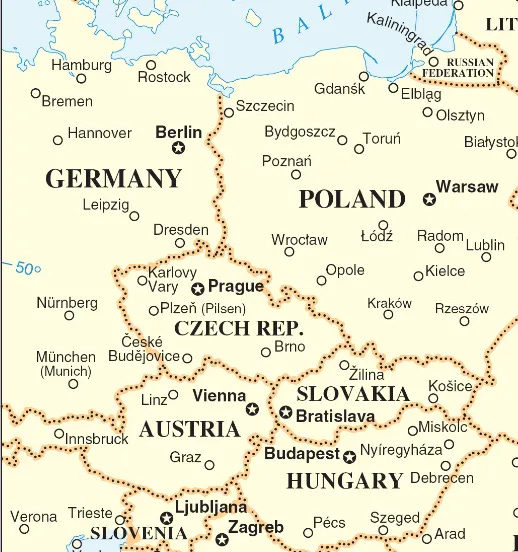
The Rhine Valley and surrounding regions were carved into different aristocratic duchies or municipalities. The atmosphere was oppressive and barren. Whenever possible, pilgrims, monks, experimenters, heretics, and intellectuals, who decades earlier had known relative freedom in Rudolph’s Bohemia, fled the area and, in some cases, made the dangerous and arduous journey across the Atlantic. Word spread that in the nascent American colonies a liberal degree of religious freedom prevailed.
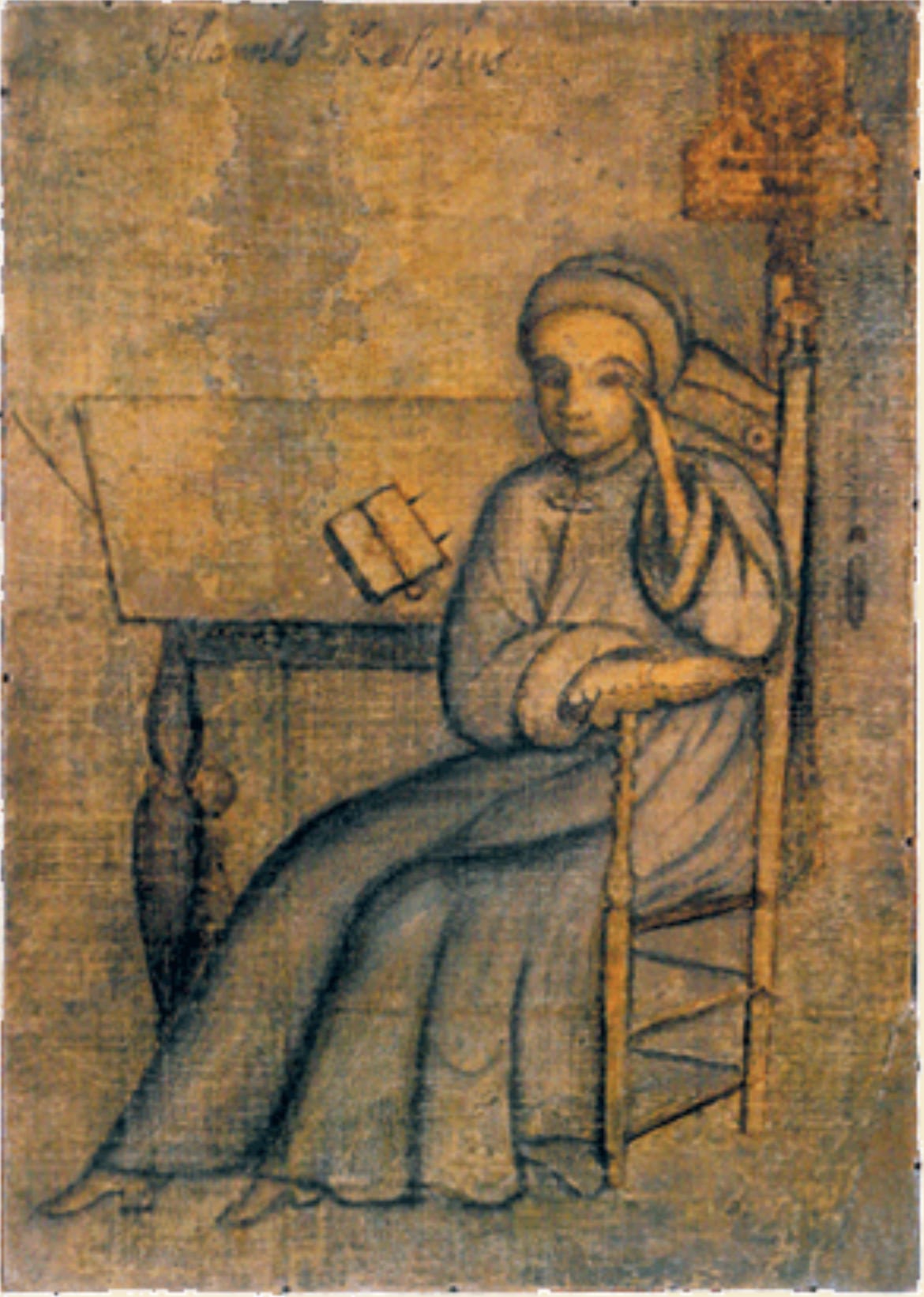
In summer 1693, a young monk named Johannes Kelpius (1667–1708) led a band of about forty pilgrims—or so the legend of his travel party goes—out of the Rhine Valley, sojourned west across Europe, got steerage to England, and from London departed on an extremely perilous journey of about six months across the Atlantic.
In June 1694, they reached the City of Philadelphia, which then consisted of about five-hundred houses. The Hermetic pilgrims made Philadelphia—“City of Brotherly Love”—their destination due to its reputation for religious tolerance. The town was founded in 1682 by William Penn (1644–1718), a British convert to Quakerism who was discriminated against at Oxford and finally imprisoned in the Tower of London in 1668 for his heterodox religious writings.
Unlike many religious radicals, Penn came from a wealthy family to whom the British crown owed money. To get out of debt, the monarchy gave Penn a land grant in 1681 of what is now the State of Pennsylvania. Penn not only became the founder of Pennsylvania, but his ideal was to establish the City of Brotherly Love, a place where people could worship freely.
I do not wish to leave the impression that Penn’s 1682 Frame of Government created a religiously egalitarian society. Jews and other non-Christians could live and practice in the territory but could neither vote nor hold office. Penn made it clear that atheists were unwelcome. Rhode Island alone extended full religious freedom at the time.
It was only in 1777, when Thomas Jefferson wrote, but had not yet presented, his Virginia Statute for Religious Freedom, later ratified on a state level in 1786 and as the First Amendment in 1791, that religious favoritism was on its way to legal prohibition, a principle requiring persistent re-adjudication. The radicalness of Jefferson’s religious vision should not be underestimated.
“Even John Locke,” wrote historian Henry Wilder Foot in Thomas Jefferson (Beacon, 1947), “advocating separation of church and state, had not gone so far as to advocate religious freedom for Catholics or atheists. The Virginia Statute for Religious Freedom, therefore, went far beyond anything hitherto dreamed of in Europe.”
Kelpius and his followers formed a monastic colony along the banks of the Wissahickon Creek, just outside town. Sorting record from lore is not always easy regarding the Kelpius circle. On-site visits net little and period records are scant. But it seems fair to say that the woods-dwellers studied astrology, scanned the heavens for apocalyptic portents and signs—according to some accounts they brought with them a telescope which they mounted to the roof of a forty-foot-square log tabernacle—practiced the magical uses of hymn and music, and produced botanical remedies and talismans.
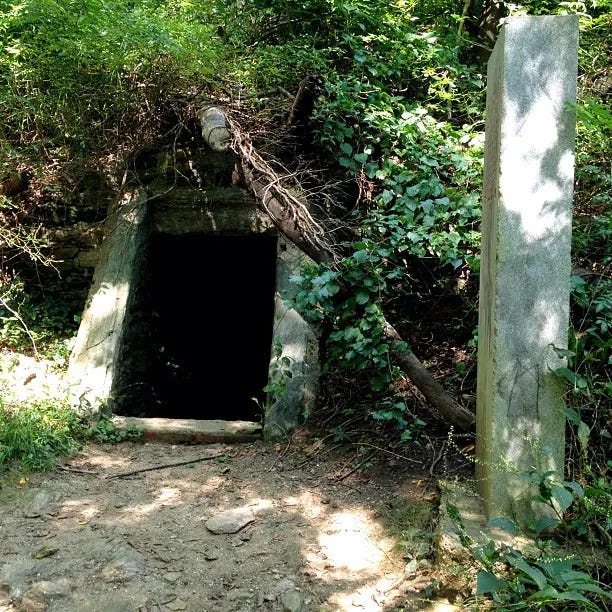
The Kelpius circle settled a harsh, rocky landscape, but they found what they had risked life for: ability to live in a Hermetic, communal setting without molestation; and freedom to study symbolical philosophy and practice monastic, pietistic worship. They traded the world that they knew for a tough, knotty, and weather-beaten terrain. For nearly fifteen years, it worked. In 1708, Kelpius died, probably of tuberculosis. But a seed was planted.
Word spread of the Kelpius colony, sometimes called the Woman in the Wilderness, drawn from Revelation 12:14: “And to the woman were given two wings of a great eagle, that she might fly into the wilderness, into her place, where she is nourished . . .” It is important to note that Kelpius and followers—in a general sounding of Abrahamic religion—were apocalyptic-minded and millenarian, traits fed by the destruction of their Rhine Valley home. Others termed their settlement the Tabernacle in the Forest. News traveled of this little colony of Hermetic pilgrims—even across the Atlantic—prompting others to make the arduous journey.
In 1720, another Rhine Valley mystic, Johann Conrad Beissel (1691–1768), migrated to Philadelphia to join Kelpius’s colony. On arrival, he discovered that his inspiration had died twelve years earlier. Undaunted, Beissel started his own, larger mystical colony in Ephrata, Pennsylvania, in 1732.
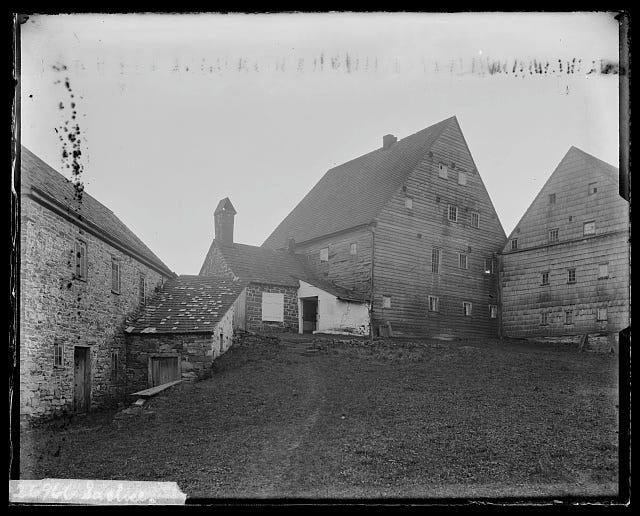
The Ephrata colony, some of whose buildings remain, proved more thriving, stable, and economically self-sufficient. The Ephratans likewise studied the magical uses of hymn, music, and sound. They lived under what could be considered primitive Christianity or biblical communism (to which Penn, as it happens, was personally sympathetic). Ephrata became a more permanent fixture on the American landscape.
Again, word trickled to the Old World that heretical religious movements could find a relatively safe home in the American colonies. This caught the attention of a devout Quaker woman living in Manchester, England, where she was persecuted for witchcraft in the early 1770s. Her name was Ann Lee (1736–1784).
Ann belonged to a sect known as the Shaking Quakers, so called because devotees were observed to writhe and gesticulate in ecstasy of the spirit. Local authorities accused Ann of witchcraft and sorcery. She was jailed, harassed, and beaten. But Ann was not to be another casualty of religious violence. She escaped with eight followers, including an unfaithful husband.
In 1774, Ann and her band of Shaking Quakers journeyed across the Atlantic to New York City. They worked menial jobs throughout most of 1775, sweeping chimneys, scrubbing floors, and cleaning chamber pots. Ann’s husband abandoned her. Undeterred, she and a group grown to twelve left the city in 1776. With money they had scraped together, Ann and her followers traveled up the Hudson Valley where they formed their own religious colony outside Albany in a town then known by its Mohawk name Niskayuna (“extensive corn flats”), and later called Watervliet.
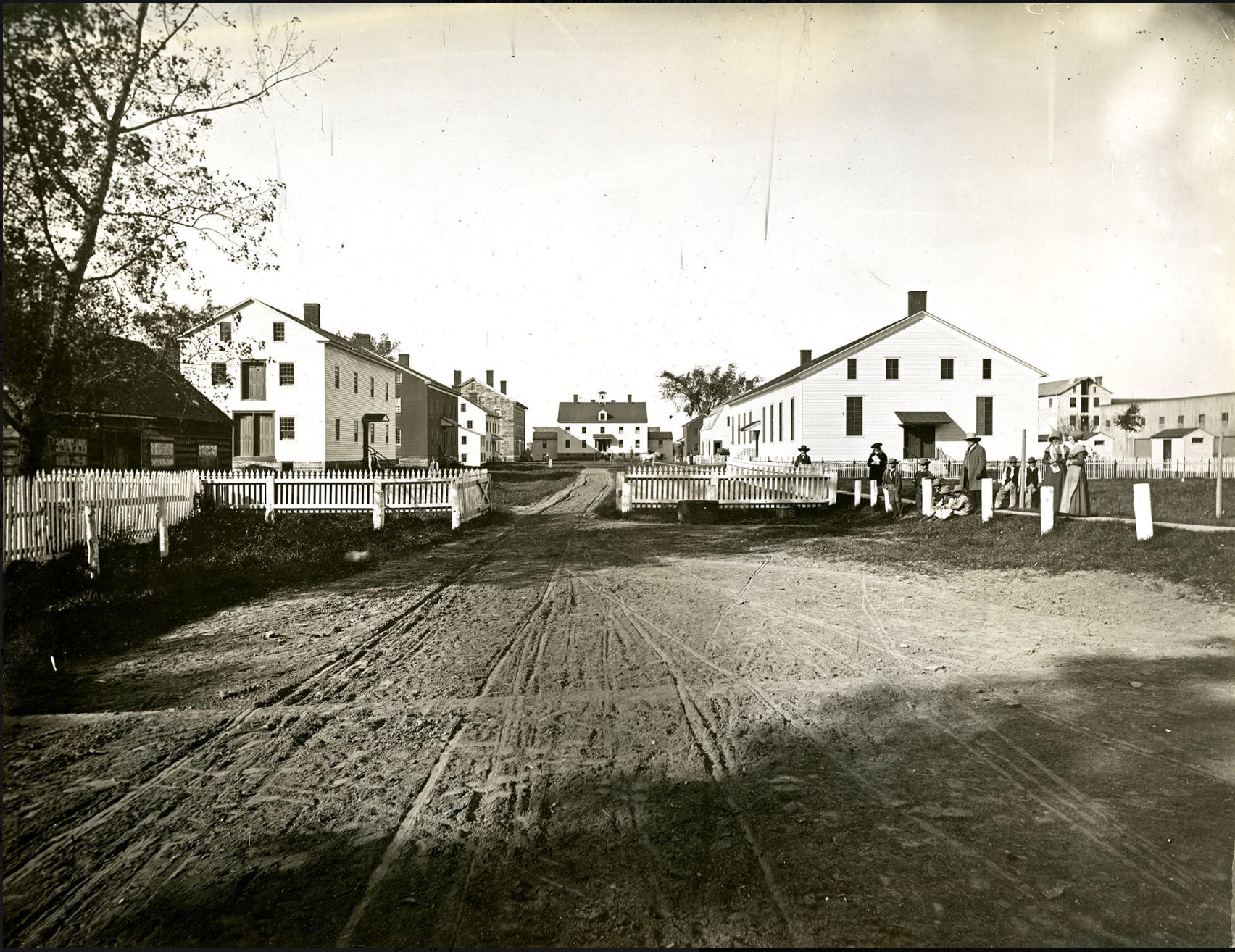
In the fall of 1776, the woman called Mother Ann Lee and her twelve pilgrims inaugurated the nation’s first Shaker Village. The group now known as Shakers broke ground in a root-ridden, marshy, and mosquito-infested landscape. Celibate and pacifist, they refused to fight in the War of Independence, arousing local suspicions that they were British spies. Revolutionary authorities briefly jailed the religious leader in Albany on charges of sedition. During a 1781 Shaker missionary trip to Petersham, Massachusetts, a band of thirty townsmen seized Mother Ann and subjected the celibate woman to the humiliation of disrobing, ostensibly to determine whether she was an English agent in drag.
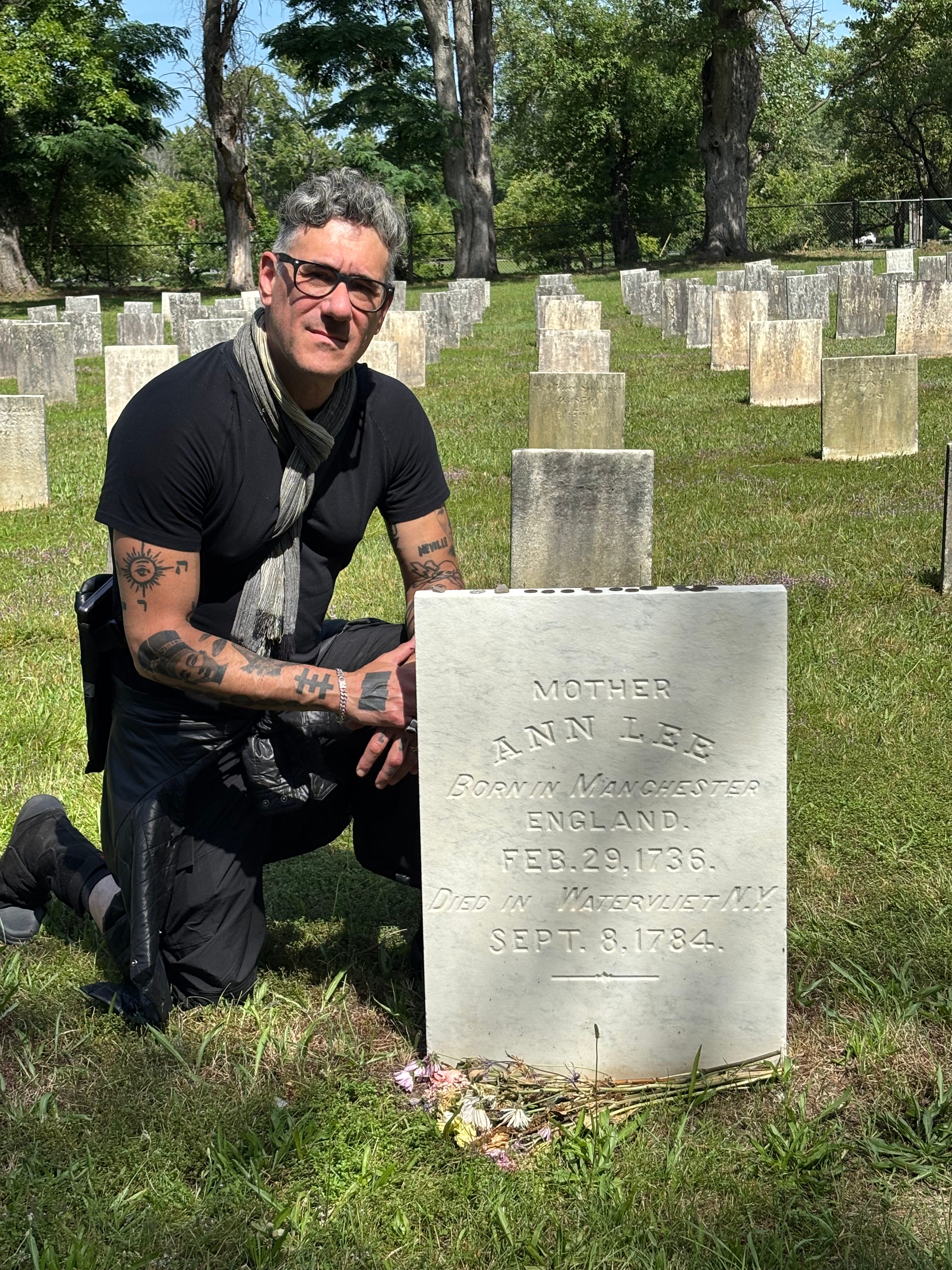
Despite it all, through swampy summers and mud-frozen winters, the band endured and grew, sprouting other villages in New Lebanon, New York, and Hancock, Massachusetts. To admirers and followers, Mother Ann was a spiritual avatar. The buildings of her village stand today—as does Mother Ann’s austere headstone nearby.
Mother Ann did more than found a sect. She set the migratory pattern of a profoundly important geographical area and artery in the spiritual development of America and the modern world. It became known as the Burned-Over District. The Burned-Over District is a snaking stretch of land about twenty-five miles wide and three-hundred miles long, extending from Albany in the east to Buffalo in the west. It developed into one of the main passages through which Americans flowed West, bringing commerce, settlement—and beliefs. Historian Carl Carmer called it “a broad psychic highway, a thoroughfare of the occult.” [2]
In many regards, the Burned-Over District replaced the devastated Rhine Valley as the springboard of religious experiment in modern life. Ann Lee and the Shakers anchored the beginning of the Burned-Over District, a place considered “burned over” by the fires of spirit (although the origin of its name has never been definitively settled).
Fatefully, the Burned-Over District was traversed by a carriage path, which today is Route 20. It is the longest continuous road in the United States, extending from Boston, where it is called Boston Post Road, to Eugene, Oregon. Along its trail, Mother Ann’s movement later migrated as far north as Maine and as far south as Kentucky.
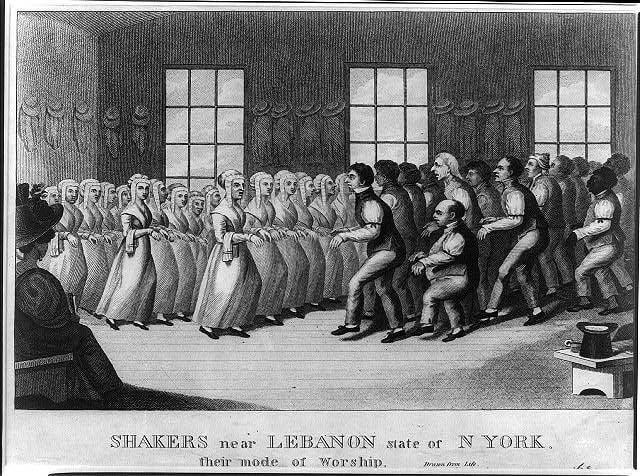
Other seekers, both in the new nation and across the Atlantic, heard about this growing group of Shakers, who described contacting voices and figures of the spirit world, including vanquished Native American tribes. The Burned-Over District itself had been home to the Iroquois, an amalgam of six nations: Mohawk, Oneida, Onondaga, Cayuga, Seneca, and Tuscarora. Self-described as “People of the Long House,” the Iroquois were ruled over by fifty chiefs, a civic system studied by Benjamin Franklin. The Iroquois are sometimes characterized as one of the world’s oldest democracies.
Some nations, including the Mohawk, sided with the British during the War of Independence, giving the colonial government pretext it had long sought to push the Iroquois off the lush farmland and forest, opening Central New York to land speculation and settlement from New England. Throughout the eighteenth century, “the native tribes were dragged into the rivalries of French and English colonists, themselves the reflection of wars in Europe,” notes Joscelyn Godwin in Upstate Cauldron: Eccentric Spiritual Movements in Early New York State (State University of New York Press, 2015).
The neutral Shakers carried on, abstaining from sex, wine, and tobacco. They were ascetic and self-sufficient. Some observers casually hold that celibacy spelled the inevitable end of the Shakers. But ostensibly celibate—and childless—monastic orders persist globally. The answer lies elsewhere. The Shakers built their movement by taking in seekers, widows, orphans, ex-convicts, and others who had difficulty finding structure or resources. By the late-nineteenth century, as American society grew more varied and flexible in living and working arrangements, such retreats from outer life grew less necessary. Broad social changes versus celibacy alone ordained their demise.
Though Mother Ann died in 1784, her influence extended further in death than life. The late 1830s saw the dawn of a feverish and profoundly influential period of Shaker activity called “Mother Ann’s Work.” The departed leader appeared as a spirit guide directing a vast range of supernatural activity and instruction.
The devout received ghostly visions and songs, which they transmuted into strangely beautiful paintings and haunting hymns, many of which survive. Villagers spoke in foreign tongues, writhing and rolling on the floor in meetings that lasted all night—some even growing intoxicated on “spirit gifts” of wine or Indian tobacco.
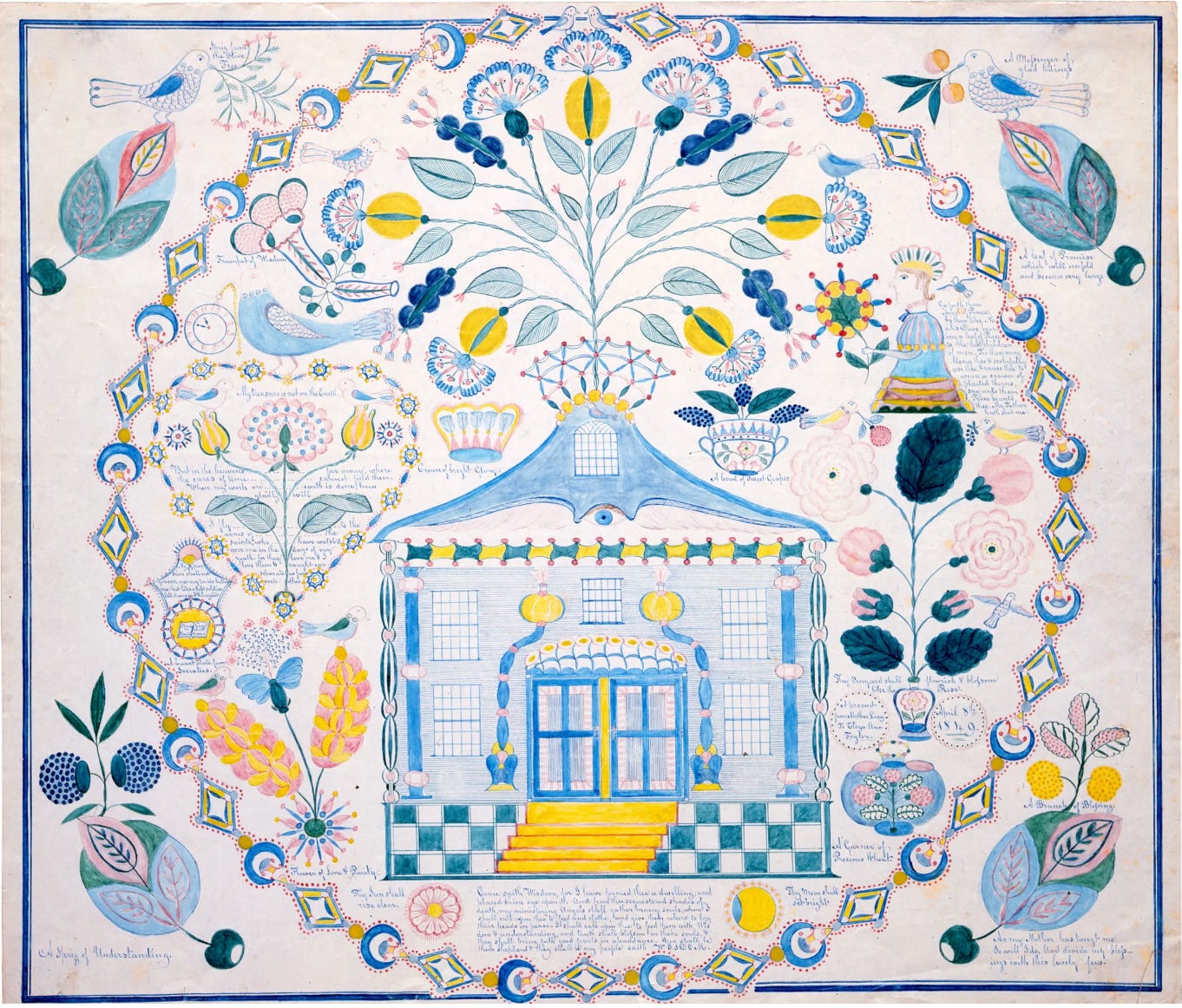
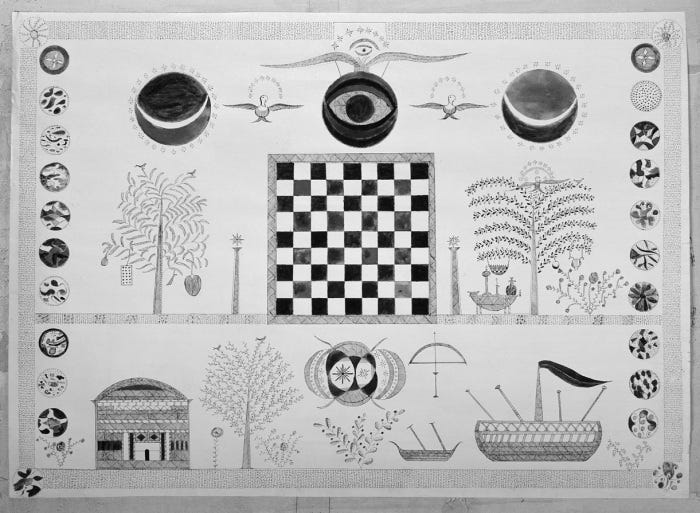
In an America that had not yet experienced the Spiritualist wave of séances, table tilting, or conversing with the dead, the Shakers prophesied that soon spirits would appear in every house and hamlet in the land—that America was poised for a renaissance of contact with the invisible world.
I often say that migratory waves foretell new religious movements. Migrants generally leave behind churches, congregations, and family attachments from back home. They often prove open to new religious voices and commitments. Again, this is among the reasons the place was called the Burned-Over District. Not only was it burned over by the fires of spirit but it was said that everybody belonged to something, not infrequently a breakaway church, metaphysical club, sect, or commune. As far as converts went, one itinerant minister supposedly told another that the place was burned over. This pattern repeated in California in the early twentieth century.
One of the most fateful migratory figures of the Burned-Over District emerged just as Mother Ann and the Shakers were establishing their communities. A strange drama played out in the life of this devout young woman, New Englander Jemima Wilkinson (1752-1819).
Jemima was born on a prosperous Quaker farm in Cumberland, Rhode Island. In 1770, when she was seventeen, Jemima encountered the last wave of the Baptist religious revival movement called the Great Awakening. That year, charismatic British minister George Whitefield (1714-1770) was making his last traverse through New England as part of the final leg of the Great Awakening. He died in late September.
Jemima, this young woman raised in a liberal Quaker household, experienced a religious conversion of deep intensity. Her habits changed. She sat alone in her room poring over Scripture. When someone is ignited with the spirit of the search, there’s no telling where things are headed.
In fall 1776, Jemima was struck with typhus fever. On October 4, she took to her bed and slipped in and out of a coma, experiencing fever dreams of heavenly realms and other worlds. The slender, emaciated woman was not expected to survive. Her family sat bedside in a death vigil.
But about thirty-six hours later, Jemima shockingly sprang up from bed. This figure who had been on the brink of death appeared ruddy and filled with life. She announced to speechless onlookers that the woman they knew as Jemima was, in fact, dead. The being standing before them, she said, was an avatar of the divine spirit and would answer only to the name Publick Universal Friend.
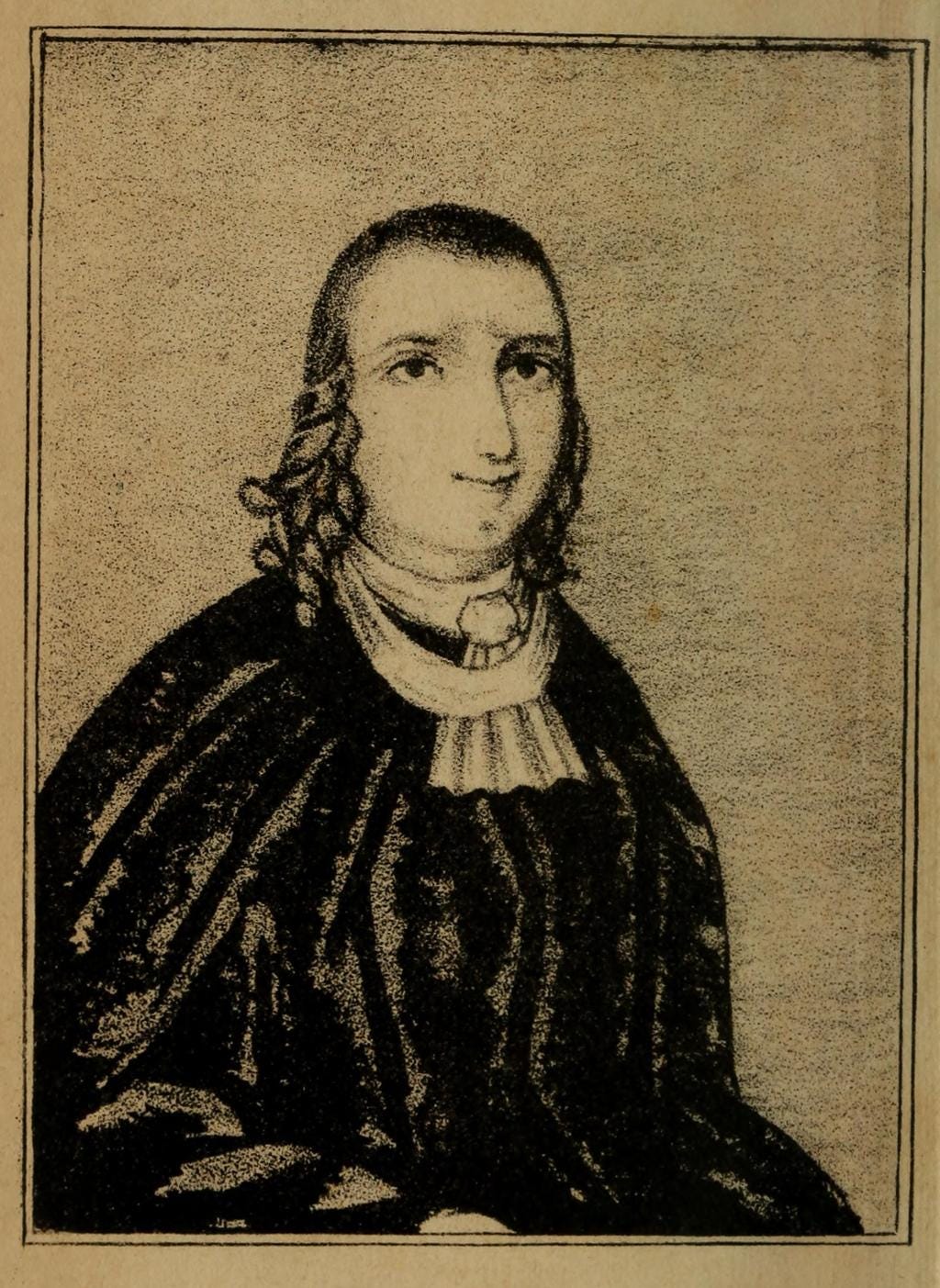
The Sunday following her revival, the Publick Universal Friend marched to a local churchyard and began delivering a homily under a tree. Locals were aghast—not only was Jemima “back from the dead” but this was the first time that neighbors had witnessed a woman deliver a talk in public.
The Friend began speaking in Rhode Island, New York, and Philadelphia. She soon crisscrossed between British and American military lines, one of the only figures capable of doing so.
Followers of the Publick Universal Friend came in contact with members of Johann Conrad Beissel’s commune at Ephrata, Pennsylvania. They were influenced by some of the Ephratan practices, including holding sabbath on Saturday. The Friend’s supporters decided to establish a commune for their own avatar. In 1788, these New Englanders followed the flow into the Burned-Over District; they moved deeper west onto the shores of Crooked Lake, today called Keuka (Iroquois for “canoe landing”).
They settled two towns, both of which still stand, one called Penn Yan and the other Jerusalem. In the latter, they built a mansion for their spirit guide, where she resided until her death in 1819. The dwelling today is a private family home. When I visited 2022, kids on bikes crisscrossed in the driveway with only a historical marker denoting the house’s history.
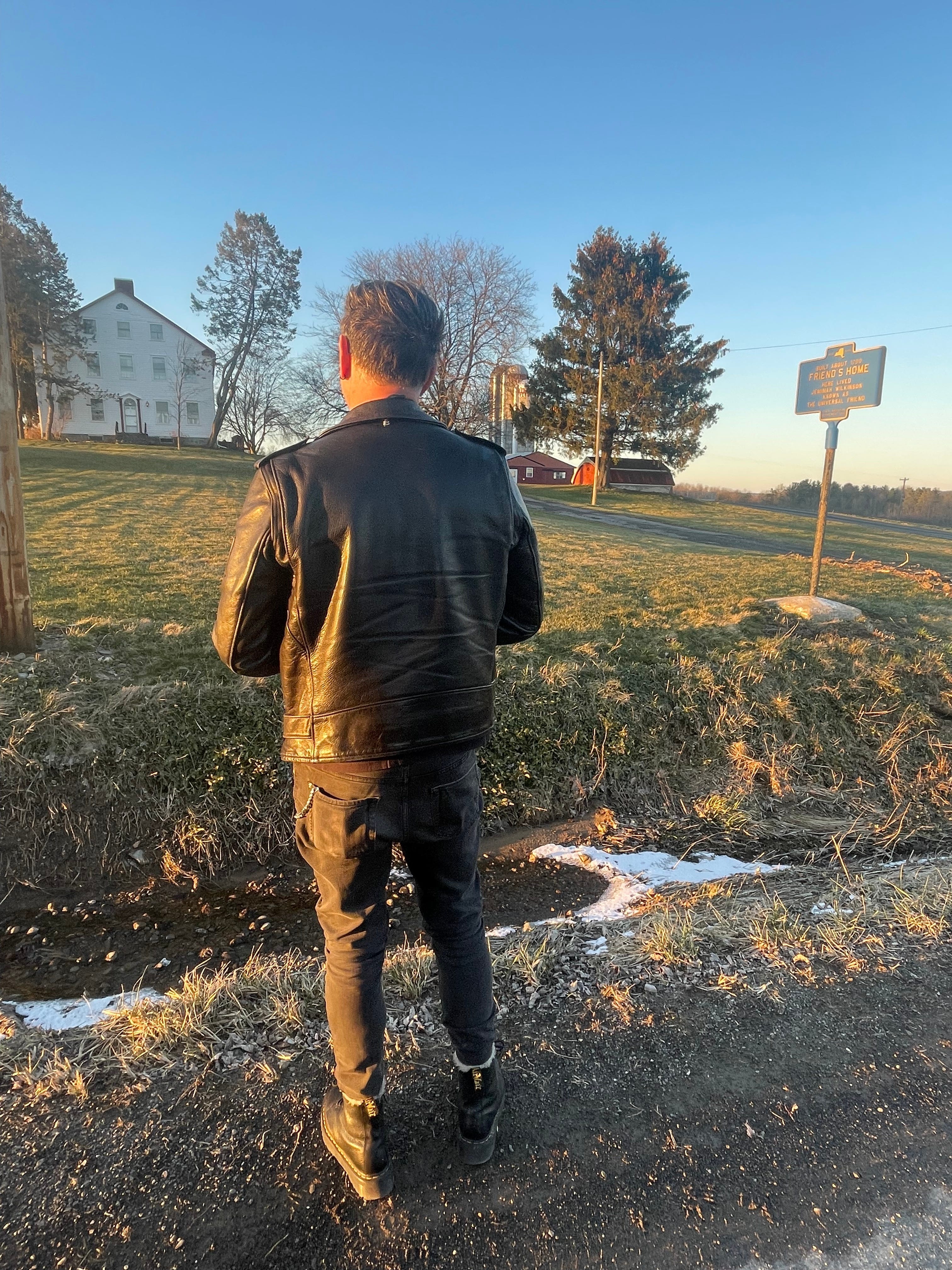
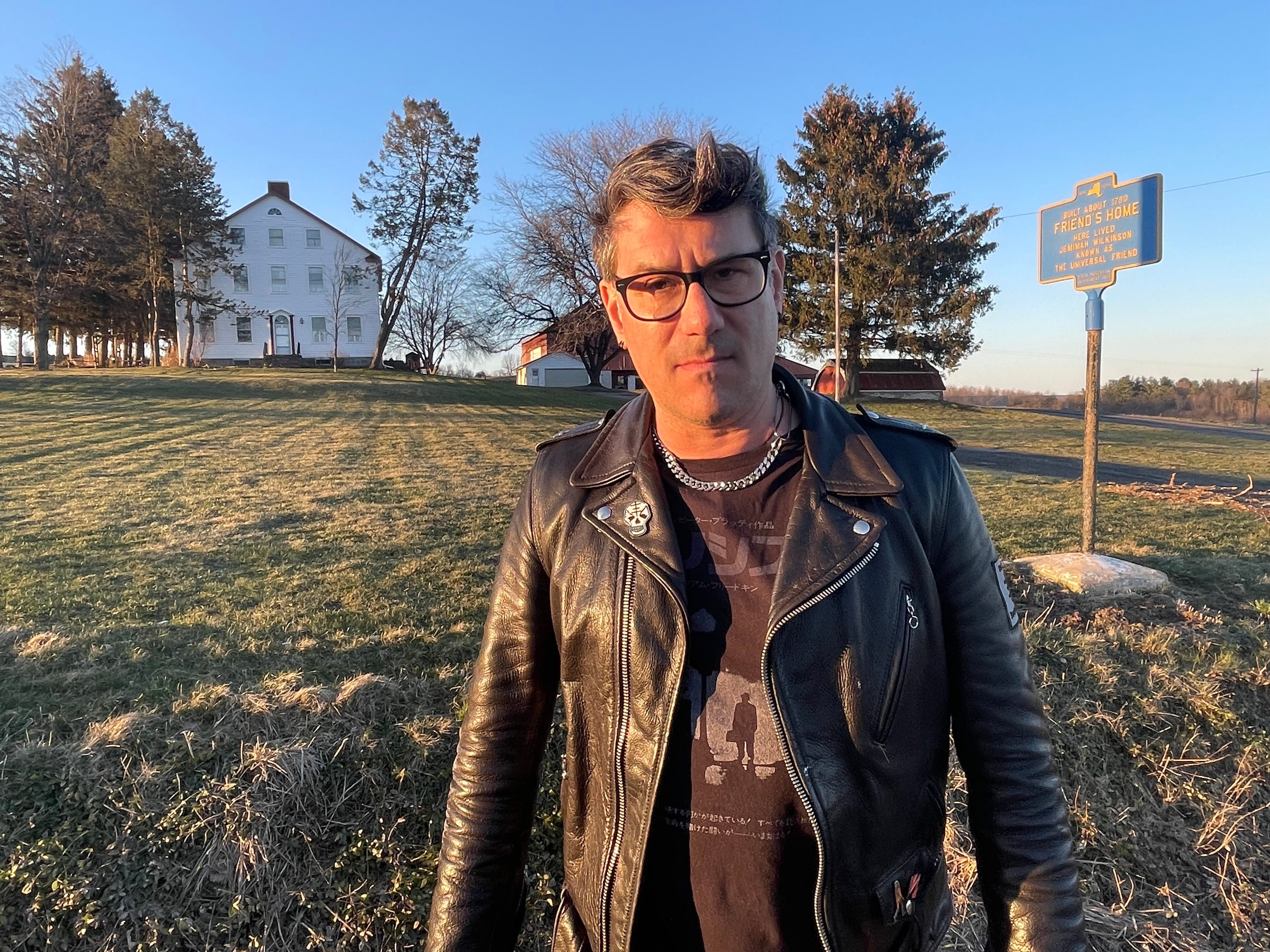
Jemima and her circle did a great deal to settle that part of New York State—although at the expense of Indian lives previously hounded from the soil—prompting historian Herbert A. Wisbey, Jr., to dub her the “pioneer prophetess.” [3] On my first visit to Penn Yan in 2008, ancestral names of the Friend’s followers still appeared in the local phone directory. On the tidy main street, you could encounter residents who traded stories about the Friend.
As one folktale goes, the Publick Universal Friend led followers to a local body of water—some say a canal off main street—where she declared her intention to walk on water. “Have ye faith that I can do this thing?” she demanded. “Yea, we believe!” followers replied. “Then if ye have faith,” the Universal Friend said, “there is no need for any vulgar spectacle.” With that, she got into her carriage monogrammed with initials U * F (a real vehicle) and rode off.
Not only were all of these seekers among key settlers of Central New York but they further opened Americans—and later Westerners in general—to the validity of intentional communities and women as religious leaders. I hope what I am describing gives an idea of the centrality of the breakaway colony in the development of religious experimentation.
In that vein, I recommend a 2021 documentary directed by Kier-La Janisse, Woodlands Dark and Days Bewitched, in which I participated in a small way. (I also met my wife, filmmaker Jacqueline Castel, on set; we were one of two marriages, the other in England, to emerge from that set. So, if you want to meet your partner—watch the movie.) It is a magisterial work that surveys folk horror, which not infrequently rests on fictionalized but culturally grounded stories of “strange colonies.” This theme animates movies like The Wicker Man, Children of the Corn, The Dark Secret of Harvest Home, The Village, and Midsommar.
Recent to this writing, a successful commune and retreat center still stands in New Lebanon, New York, on the site of the second Shaker Village. Founded in 1975, its future grew uncertain in 2022 following the financial crisis of the lockdown. Called the Abode of the Message, it is based in the teachings of Sufism, the mystical variant of Islam. I was briefly a student of its founder, Sufi teacher Pir Vilayat Inayat Khan (1916–2004).
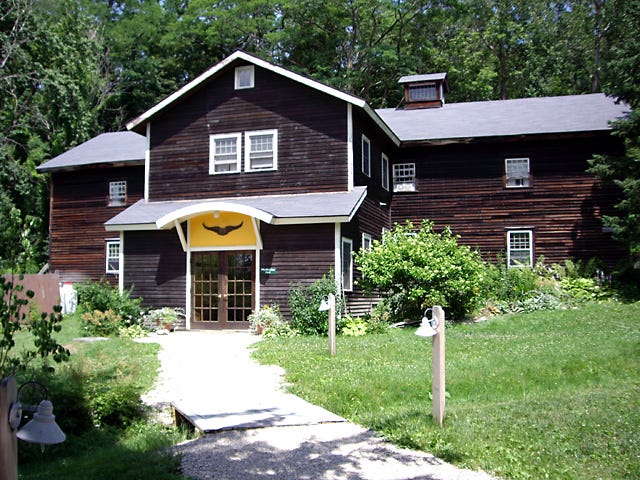
One of the Abode’s longtime members told me that when they were scouting land for their community in the early 1970s, the founders—filled with flower-power idealism and the same intrepid spirit that sustained earlier colonies—visited the remaining Shaker Village at New Lebanon. Two elderly practitioners still lived there.
“The spirits told us you were coming,” a Shaker woman told her Sufi guests. “We’ve been expecting you.” To the longhaired youths, it was the passing of a baton.
The Burned-Over District further gave birth to the religions of Mormonism and Seventh Day Adventism and to movements in perfectionism, biblical communism, and, most significantly, suffragism.
This narrow stretch of land in Central New York was, for about two generations in the first half of the 1800s, the springboard for nearly everything novel and radical in American life. This can be difficult to understand because if you visit the Burned-Over District today, including some of the towns I have mentioned—Jerusalem, Penn Yan, Watervliet—and those I will be mentioning—Palmyra, Batavia, Hydesville—you will see lush farmland and vineyards interrupted by occasional sprawl. Strip malls crop up here and there but the area remains one of rich greenery, lakes, and meadows. A visitor could justly ask, beauty aside, “What’s so magical about this place?”
I have provided some cultural and social background. There exist Native American legends: in particular, the Iroquois considered the area ancestral home to an ancient Indian tribe older than any known. Mormon prophet and Burned-Over District son Joseph Smith (1805-1844) considered it a lost tribe of Israel, a theme integrated into The Book of Mormon, published to the world in 1830. Some locals felt that the voices and spirits of this tribe endured as a world within a world. In 1811, New York’s seventh governor, DeWitt Clinton (1769-1828), delivered a talk to the New York Historical Society in which he affirmed his belief in this unknown tribe:
There is every reason to believe that, previous to the occupancy of this country by the progenitors of the present nations of Indians, it was inhabited by a race of men, much more populous, and much further advanced in civilization. The numerous remains of ancient fortifications, which are found in this country . . . demonstrate a population far exceeding that of the Indians when this country was first settled.
Clinton and others reported esoteric fraternities among nineteenth-century Iroquois, which some considered a form of “ancient Freemasonry.” These speculations were heightened when Seneca leader Red Jacket and other New York-area Indians were seen wearing Freemasonic-style medals in the shape of the square and compass, a fact well documented in a 1903 New York State Museum monograph, Metallic Ornaments of the New York Indians by archaeologist William M. Beauchamp.
Interpretations abounded. Smith himself, known as a local treasure hunter, said he received ancient golden plates buried in the Hill Cumorah near his home in Palmyra. The plates, he said, were written in “reformed Egyptian hieroglyphics” and translated by the young seeker through a pair of ancient seer stones, Urim and Thummim, matching those worn in the breastplates of ancient Hebrew priests.
Smith’s Book of Mormon promulgated a vast alternate history, involving a tribe of Israel fleeing the Holy Land for pre-Columbian America, experiencing the gospel directly from Christ, and later suffering fracture and vanquish in a “great and tremendous battle at Cumorah . . . until they were all destroyed.” (Mormon 8:2) The scale and scope of the Book of Mormon were extraordinary—seen by followers as buttressing the lore of Smith’s home district rather than derived from it.
Smith was also inspired by the rites and rituals of Masonry, which he considered fragments once practiced by the Hebrew priests. He aligned with Masonry in a surprising manner, marrying the widow of Masonry’s most famous apostate. It began in the mid-1820s, sparked by a violent episode that played out not far from Smith’s home.
In 1826, a disgruntled Mason living in Batavia, New York, William Morgan, threatened to expose Masonry’s secret rites in a manuscript he was readying for publication. Morgan was soon kidnapped and never seen again—possibly murdered at the hands of Masonic zealots.
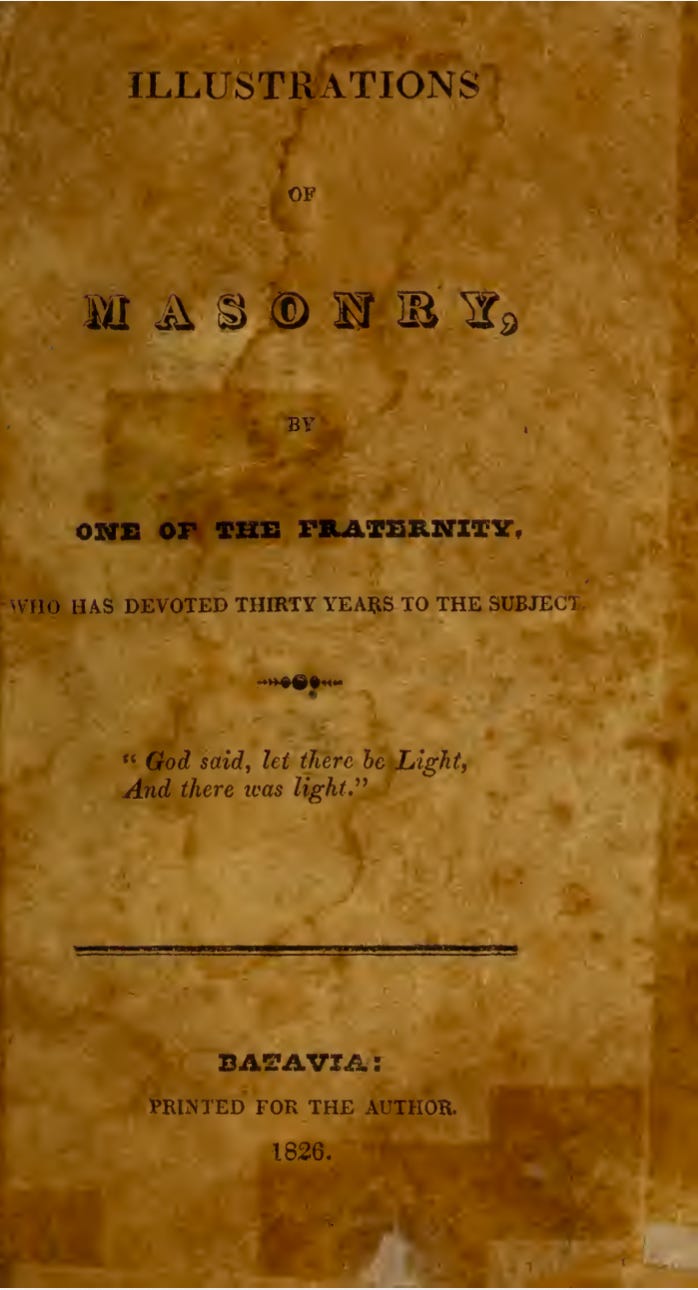
The presumed homicide and dead-end legal investigation raised suspicions about Masonry’s influence in law enforcement and the courts. The episode unleashed a torrent of anti-Masonic feeling stoked by a general mood of discontent over corruption in high places. In time, fifty-two anti-Masonic newspapers sprang up in the nation, with dozens of anti-Masonic representatives sent to state legislatures. While the waters soon calmed, Freemasonry would never again command the same level of prestige in American life.
Morgan left behind a widow, Lucinda. She eventually met a new husband with whom she trekked west to join Smith in his aim of relocating Mormonism. Around 1836, Lucinda, though remarried, became one of Smith’s multiple “spiritual wives.”
As the Mormons wandered the nation in search of a safe home, Smith founded a Freemasonic lodge at his large community at Nauvoo, Illinois. In the early 1840s, he introduced into Mormonism the symbols of Masonry, such as the rising sun, beehive, and square and compass. Smith conducted initiation ceremonies in a makeshift temple over his Nauvoo store. He also studied Hebrew and possibly elements of Kabbalah with a French-Jewish Mormon convert named Alexander Neibaur. It was a period of tremendous innovation within the nascent movement. It reached a sudden end.
In 1844, Smith surrendered to authorities at Carthage, Illinois, where he sat in a jail cell to await trial on charges arising from the destruction of an opposition newspaper at Nauvoo. Smith had sanctioned the burning of a critical news sheet. Although his act was indefensible, it served as an excuse for the state government to finally get its hands on the religious leader. Illinois’ frontier towns were increasingly wary of Mormon newcomers, who maintained their own militia and formed a political power bloc.
While the prophet and his closest colleagues waited in a two-story jailhouse in Carthage, they found themselves without protection that the state’s governor promised. Armed bands roamed the area. In early evening of June 27, a mob stormed the jail. Before diving from a window to escape, Smith was reported by witnesses to issue the Masonic distress signal, lifting his arms in the symbol of the square and beginning to shout, “Oh, Lord my God, is there no help for the widow’s son!” Musket balls tore through his falling body.
Descendants testified that on the prophet’s body appeared his old amulet of Jupiter derived from the Renaissance-era occult philosophy of Cornelius Agrippa (1486-1535), a topic explored in the article below.
In 1784, the Burned-Over District attracted an unusual visitor: the French hero of the Revolutionary War, the Marquis de Lafayette. He was both a Freemason and student of the Swiss-Viennese occult healer Franz Anton Mesmer (1734–1815).
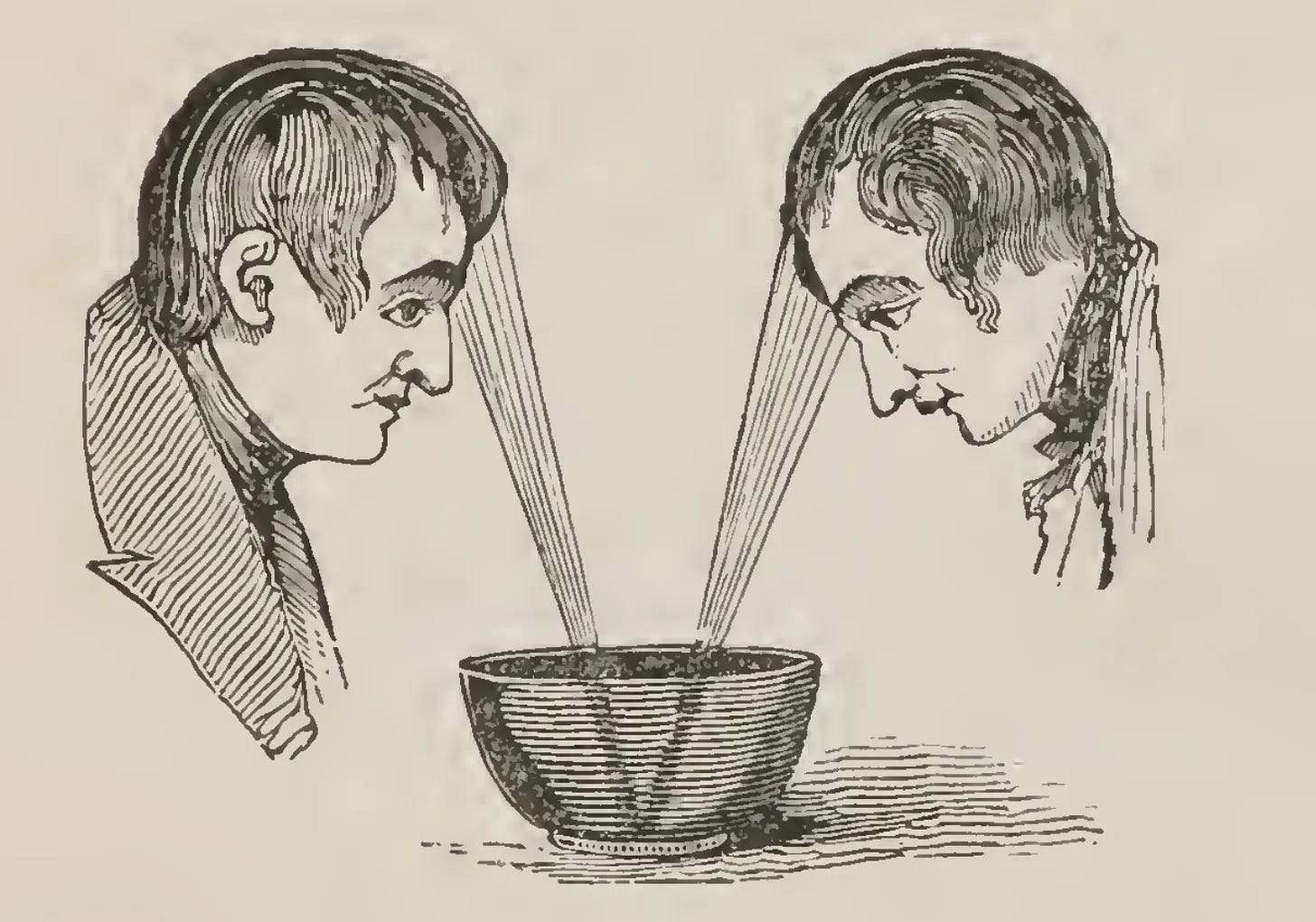
Mesmer considered all of life animated by an invisible etheric fluid, which he termed “animal magnetism.” The experimenter taught that if a magnetizer or Mesmerist places an individual into a trance, he could manipulate and realign the subject’s animal magnetism, healing the patient of physical or emotional maladies. Lafayette arrived to tour the area and study whether the dances and ecstatic states of the Shakers related to Mesmer’s theories of animal magnetism.
In the early 1940s, a story began circulating in American historical literature claiming that shortly before Lafayette departed for the U.S., he had an audience with King Louis XVI. The King teased him for being apprenticed to Mesmer and wondered what Lafayette’s close friend General Washington would think of all this. I could find no source and wondered, as a historian must in such instances, whether it really happened. And if Louis XVI said this, who overheard him?
The story turns out to be true. Following the French Revolution and Reign of Terror, a military officer who had spent years in Louis XVI’s court, Le Comte D’Allonville, wrote a ten-volume series on court intrigues published from 1838 to 1841, Mémoires Secrets, de 1770 à 1830. And there, in volume one, is Louis teasing Lafayette: “Que pensera Washington en apprenant que vous êtes devenu le premier apothicaire de Mesmer?”—What will Washington think when he learns that you have become Mesmer’s chief apothecary apprentice?
Lafayette was undeterred. While visiting, he handed Washington a personal letter from his occult mentor in which Mesmer requested Washington’s support to open an American branch of his Society of Harmony, the organization that taught the healer’s methods.
In his dispatch of June 16, 1784, preserved in the Library of Congress, Mesmer told Washington: “It appeared to us that the man who merited most of his fellow men should be interested in the fate of every revolution which had for its object the good of humanity.”
Mesmer was venturing a loaded point, attempting to place himself in league with democratic revolutions. It was not wholly farfetched. Some supporters interpreted Mesmer’s trance sessions or séances—a term he used—as revealing a deeper and common aspect of humanity; every entranced subject, from slave to noble, possessed an ethereal or inner self beyond rank or station, and, thus, was naturally equal. This interpretation united occult, revolutionary, and Enlightenment thought.
Toward the end of Lafayette’s tour on November 25, 1784, Washington replied to Mesmer, diplomatically—though guardedly—hailing the trance-healer and welcoming his teaching academy (which never opened):
The Marqs de la Fayette did me the honor of presenting to me your favor of the 16th of June; & of entering into some explanation of the Powers of Magnetism—the discovery of which, if it should prove as extensively beneficial as it is said, must be fortunate indeed for Mankind, & redound very highly to the honor of that genius to whom it owes its birth. For the confidence reposed in me by the Society which you have formed for the purpose of diffusing & deriving from it, all the advantages expected; & for your favourable sentiments of me, I pray you to receive my gratitude, & the assurances of the respect & esteem with which I have the honor to be Sir, Yr most obedt humble servt
Part of the basis of Washington and Lafayette’s friendship was their bond as Freemasons. The founders included many Masons, such as Benjamin Franklin, John Hancock, and Paul Revere. Among Signers of the Declaration of Independence, nine out of fifty-six were Masons, as were thirteen out of thirty-nine signers of the Constitution, and thirty-three out of seventy-four of Washington’s generals.
As explored in my previous article on secret societies, Freemasonry grew parallel to the radically ecumenical and esoteric thought movement called Rosicrucianism, as well as the fading but still-active occult experimentation of the Renaissance. Following on the Grand Lodge of England in 1717, the first Masonic lodge in the American colonies appeared in 1731 in Philadelphia. This date is based on lodge minutes. Since informality occasionally prevailed among nascent colonial lodges, the start date is sometimes set a year or more earlier while other lodges, including in Massachusetts and Virginia, claim precedence.
In any case, fraternal affiliation with an esoteric society was significantly defining of a member’s life in the colonies. For generations following the Philadelphia lodge, and well into the nineteenth century, America remained a largely rural environment. Dominant institutions were farms, granges, trading posts, forts, taverns, ports, and churches. There existed few libraries, teaching hospitals, and educational institutions.
To join Freemasonry meant undertaking a singular social bond. In an age of cultural church dominance—with notions of heresy very much alive—it was all-the-more remarkable to join a fraternal order that used occult and esoteric symbols as keys for ethical development, including the skull and crossbones, obelisk, all-seeing eye, serpent, ladder of wisdom, and pyramid—symbols that populated the ancient religious imagination and were now reconfigured, along with passion plays and initiatory rites, within Masonry.
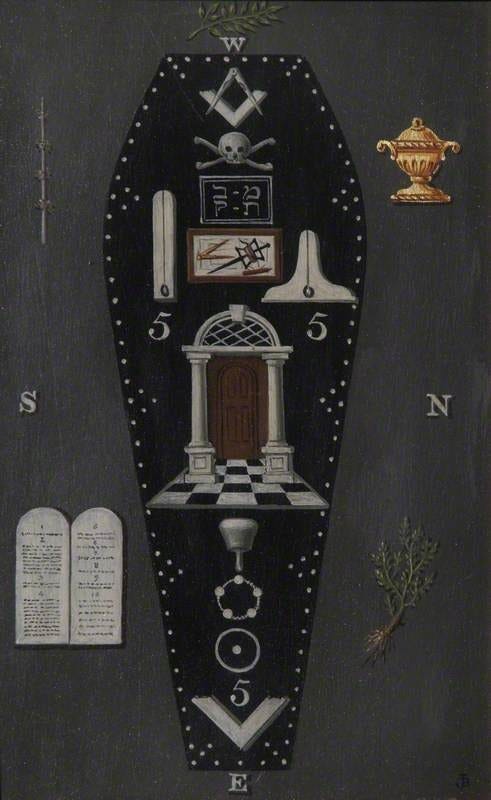
Freemasonry affirmed the basic soundness of all faiths, including pre-Christian religions. I cannot emphasize how radical a break that was. The basic bylaws and documents of Freemasonry, even in the colonial era, while extolling the existence of a Creator, stopped short of elevating Christianity as the sole means of salvation. This indirectly validated occult philosophy.
The religious neutrality codified in the Declaration and Constitution grew from the Enlightenment philosophies of Locke, Voltaire, and Rousseau. But how many in rural America read them? How many have today? Colonials, at least those of means, had the capacity to participate in a fraternal order that enshrined and protected the individual spiritual search—and believed that the search was not the property of any congregation, doctrine, or dogma. That was the radicalism of Freemasonry. That is also why Masonry has historically been considered threatening to established religious order.
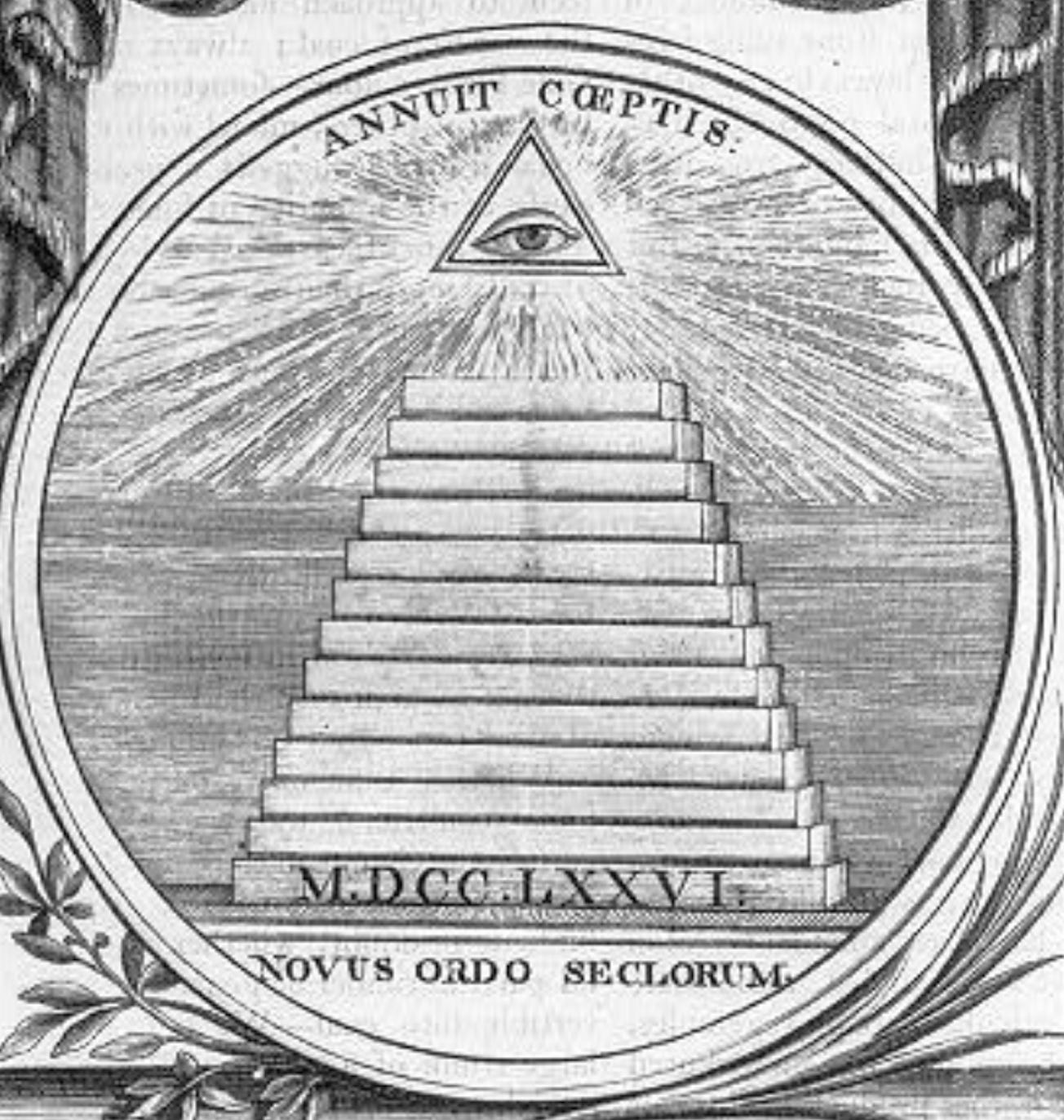
On July 4, 1776, the Continental Congress formed a subcommittee chaired by Benjamin Franklin charged with designing the Great Seal of the newly declared nation. The Great Seal, ratified in 1782, displays on its front the familiar American eagle grasping olive branches in its right talon and arrows in its left. But the reverse of the Great Seal tells a more esoteric story. It appears today on the back of the U.S. dollar bill, where it was not actually placed until 1935 by two Freemasons: Secretary of Agriculture (and later vice president) Henry A. Wallace and President Franklin D. Roosevelt.
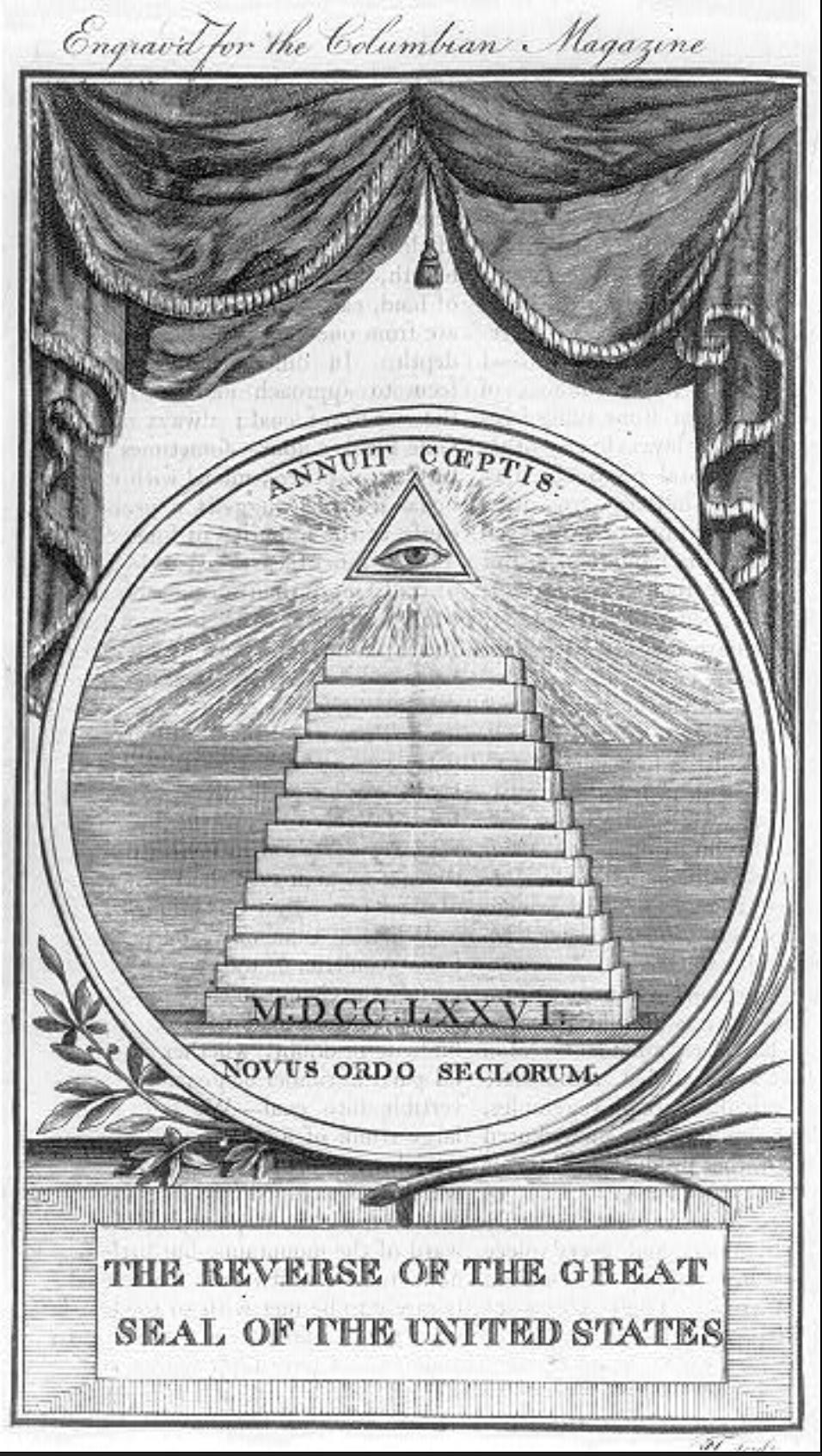
The reverse seal displays the pyramid and all-seeing eye or, ancient-classically, Eye of Horus, hovering above it. The incomplete pyramid is capped by the eye of providence to suggest that material work is incomplete without higher knowing. Surrounding it is the Latin maxim, Annuit Coeptis Novus Ordo Seclorum, roughly, Providence Smiles on Our New Order of the Ages. Alluringly, the earliest inspiration for this maxim may appear in Virgil (70-19 B.C.). The first phrase, Providence Smiles, is traceable to The Aeneid (c. 29-19 B.C.), book IX, line 625: Juppiter omnipotens, audacibus annue cœptis, or “All-powerful Jupiter, favor [my] daring undertakings.” [4] An alternative rendering is: “Jupiter almighty, give assent to my bold emprise!” from H. Rushton Fairclough’s 1916 edition for the Loeb Classical Library. The second phrase, Our New Order of the Ages, may be detectable in Virgil’s Eclogues (42-37 B.C.), IV.5: magnus ab integro saeclorum nascitur ordo, or “A great new order of the ages is born.” The Virgil passages were thought to be reworked into the Latin motto by Charles Thomson (1729-1824), an Irish-born classicist, former Latin teacher, and secretary of the Continental Congress.
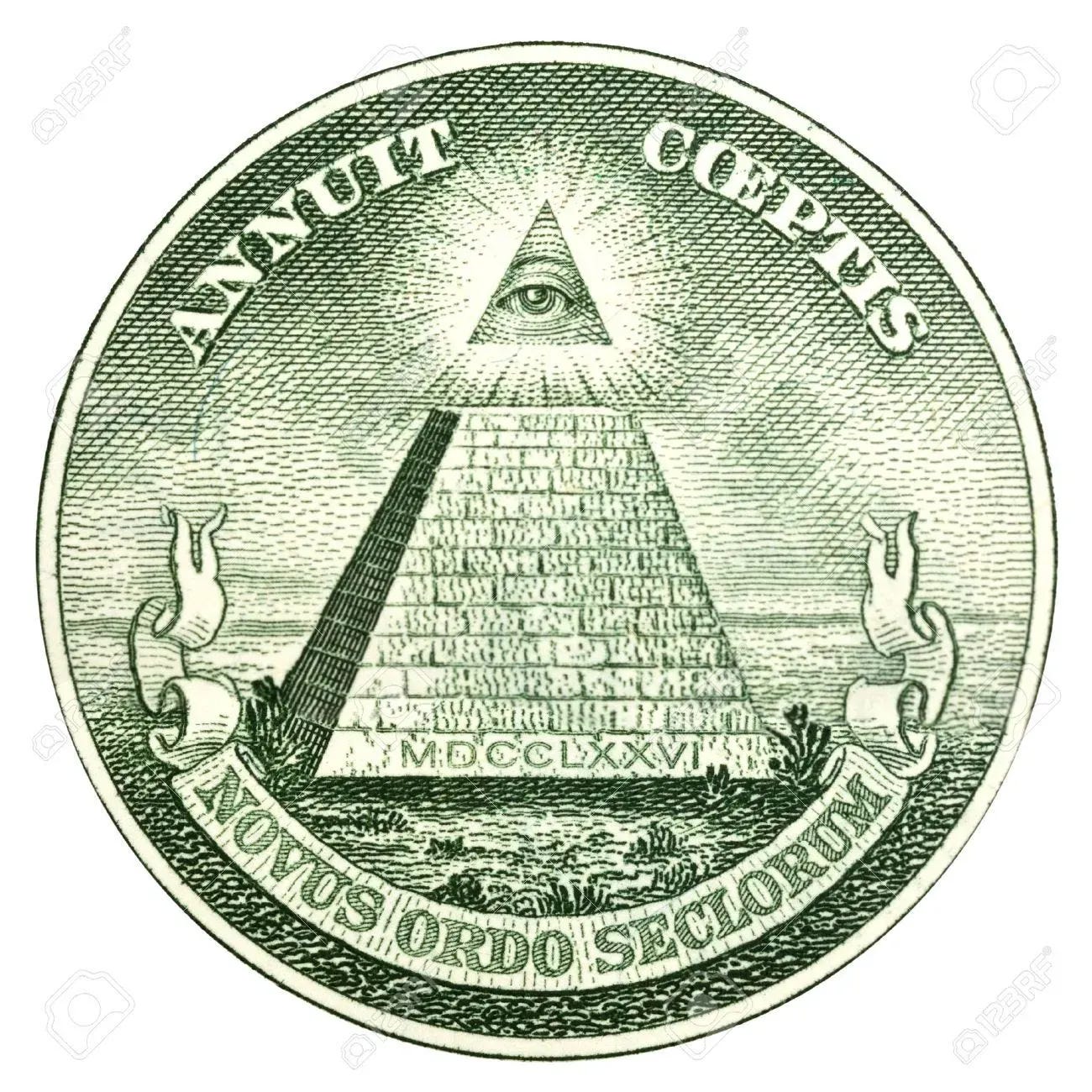
The eye-and-pyramid is not a Masonic symbol. But I think it fair to venture that the symbol is inspired by Freemasonry, which used the eye of providence in its lexicon. The symbolism is Masonic philosophy defined: earthly works are incomplete without the light of wisdom. As the more idealistic founders saw it, the new nation was part of a revived chain of great civilizations, including Egypt, Greece, and Rome, which saw their purpose intertwined with the eternal search and imprimatur of creation. This is similarly reflected in the Hellenic-Egyptian architecture that came to characterize the U.S. capital.
I wish to note a strand of Freemasonry that is important to American history but poorly understood. That is Prince Hall Freemasonry, a Black Masonic order. In the 1770s, a freed man of color named Prince Hall, a Boston leatherworker, assembled with fourteen Black colleagues to form a Freemasonic lodge. Refused entry to mainline Masonry, the men organized into African Lodge No. 1.
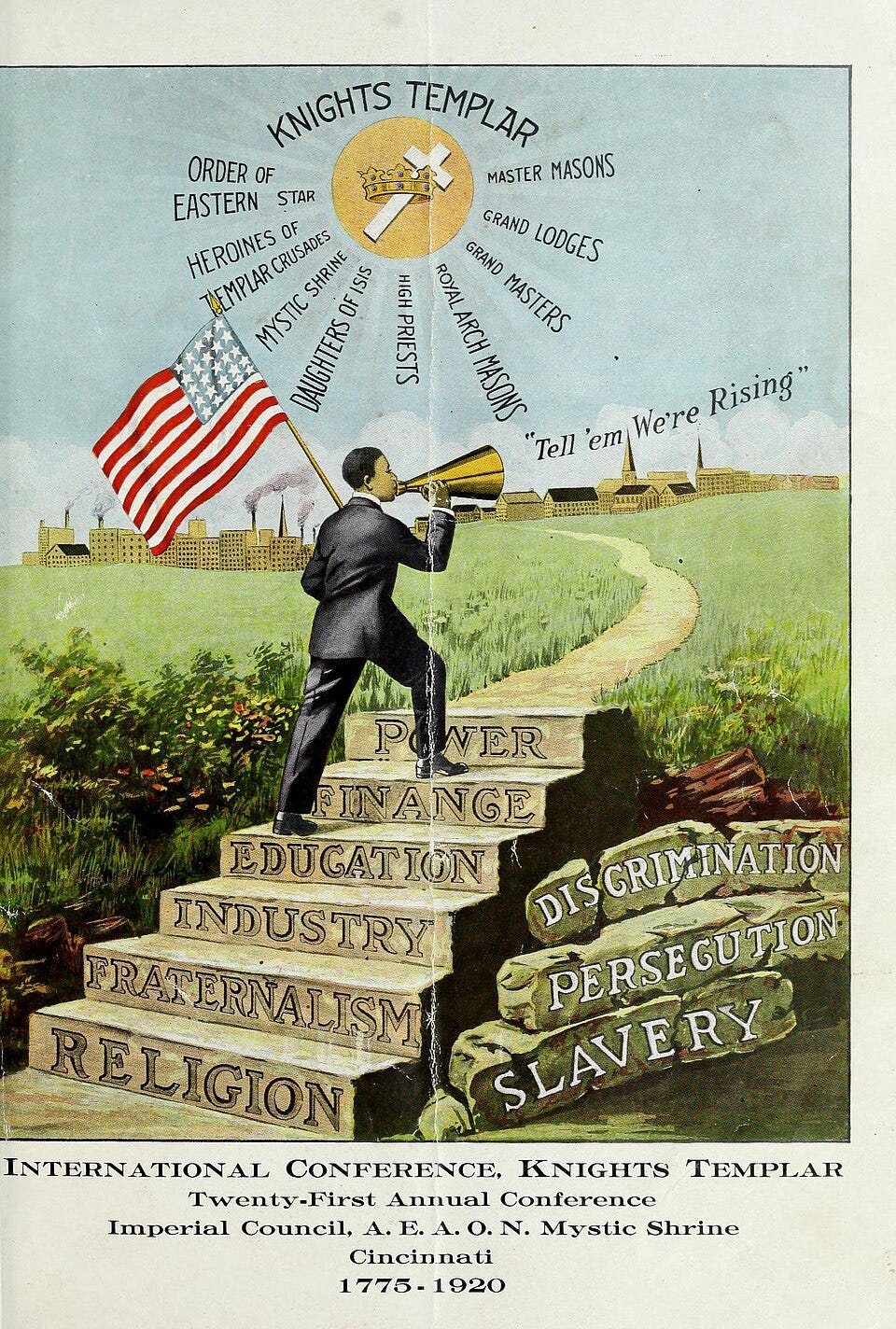
The historicism of Prince Hall Masonry has, until recently, been marred by mistakes stemming from documents of the late-eighteenth century. Much of traditional history records that Prince Hall Masonry was founded in 1775. It was not. That error got inserted into records of the Massachusetts Historical Society in 1795 and was thereafter widely repeated. Hence, even materials of significant vintage and familiar sourcing can be wrong.
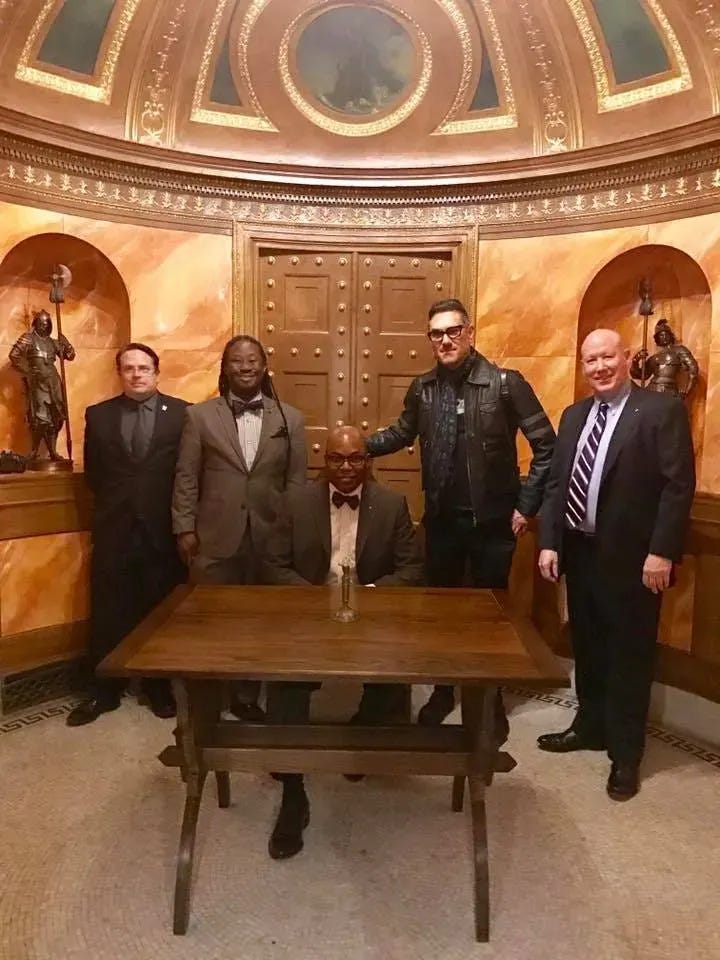
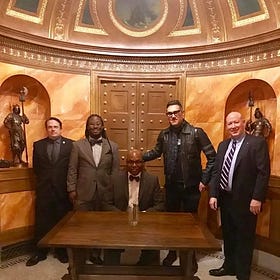
Two impeccable Masonic historians, John L. Hairston Bey and Oscar Alleyne—who appears second from left below—produced a clarifying monograph in 2016, Landmarks of Our Fathers. Revisiting original records, the authors determined that the founding of Prince Hall Masonry, or African Lodge No. 1, was not 1775 but 1778.
Prince Hall was the lodge’s first Grand Master and his branch of Freemasonry later took his name as a Black Masonic movement. Prince Hall Masonry is today increasingly recognized within traditional Masonry. Importantly, Prince Hall’s name appeared on two petitions opposing slavery in the American colonies: one in 1777 and one in 1778, the founding year of African Lodge No. 1. These are among the earliest anti-slavery petitions in the colonies. In effect, the first Black-led abolitionist movement in America was Freemasonic.
I am not saying that abolitionism arose from Freemasonry. Abolitionism had many thought-streams, including Quakerism and Enlightenment-era philosophy. But with discovery of Prince Hall’s signature on these early petitions, and understanding when Prince Hall Masonry was founded, the confluence is important to note.
Freemasonry is a traditionally male order. There exist recognized co-ed lodges, including in an ongoing movement called Co-Freemasonry, which originated in France in 1890. There is also a men’s and women’s adjunct group called The Order of the Eastern Star founded in Mississippi in 1850. Anglo-American esotericist Alice Bailey (1880-1949) also founded a Co-Masonic order.
One of the most significant American movements in occultism is the magical system called hoodoo. “The way we tell it,” wrote novelist and folklorist Zora Neale Hurston in her 1935 Mules and Men, “hoodoo started way back there before everything . . . Nobody can say where it begins or ends.”
Hoodoo is sometimes confused with Vodou. Vodou is an Afro-Caribbean religion with its own deities, priesthood, and liturgy, properly spelled Vodou in Haiti and Voodoo in the American South. Hoodoo has a lineage all its own. It was and remains a syncretic, spell-working system originated by enslaved people in the U.S.
Hoodoo began as a retention of traditional religious ideas from West and Central Africa which were combined with practices that enslaved people found in America, from Pennsylvania Dutch folklore to Catholic saint veneration to variants of Kabbalah.
Hoodoo is spelled lowercase. Its etymology is unclear. But hoodoo may come from huduba, a term used among the Hausa people of West and Central Africa meaning to arouse resentment against someone. In blues songs, singers would sometimes lament being “hoodooed”—i.e., crossed and tricked by spell casting.
In practice, hoodoo draws heavily upon botanical and household items—roots, plants, soaps, minerals, animal parts, perfumes, nails, pins—objects that a displaced people adapted to retain ties to old rituals and spirits.
Abolitionist hero Frederick Douglass (c. 1818–1895) placed hoodoo at the center of the defining incident of his life. Douglass did not use the word hoodoo. But the episode, which he recounts in all three of his memoirs across nearly fifty years [5], is marked by telltale occult references, for generations unnoticed by (and of little concern to) mainstream historians. I first documented its significance in Occult America. As I began researching Douglass’s life, including the cultural touchstones and language of his magical incident, it was as though a light switched on—and this neglected chapter began to emerge.
Douglass was born into slavery in 1817 or 1818, he did not know which. As a young child, he was separated from his mother—a woman who walked miles from another plantation for the rare occasion of rocking him to sleep or giving him a handmade ginger cake—and enslaved by a family in Saint Michael’s, Maryland. They later uprooted the adolescent Frederick to their home in Baltimore. Once more, in Frederick’s adolescence the family rearranged its household and took him back with them to the plantation fields in St. Michael’s.
But the man who headed Frederick’s household felt that a youth who tasted city life could no longer be counted on to work the fields. So, in January of 1834, Frederick, on the eve of his sixteenth birthday or thereabouts, was shipped off to work for a farmer in the Maryland countryside named Edward Covey, known as a “breaker of slaves.”
Covey was a sadistic slaveholder, proud of his reputation for beating and tormenting his charges. Covey subjected Frederick to regular whippings and harassment for any trumped-up reason. The beatings grew so severe that one night Frederick escaped Covey’s farm and returned to his old household in St. Michael’s, begging them to take him back in. He was refused. Terrified, bloodied, starving, and beaten, the youth trudged back to Covey’s farm. He hid in the woods outside Covey’s property, not knowing what to do.
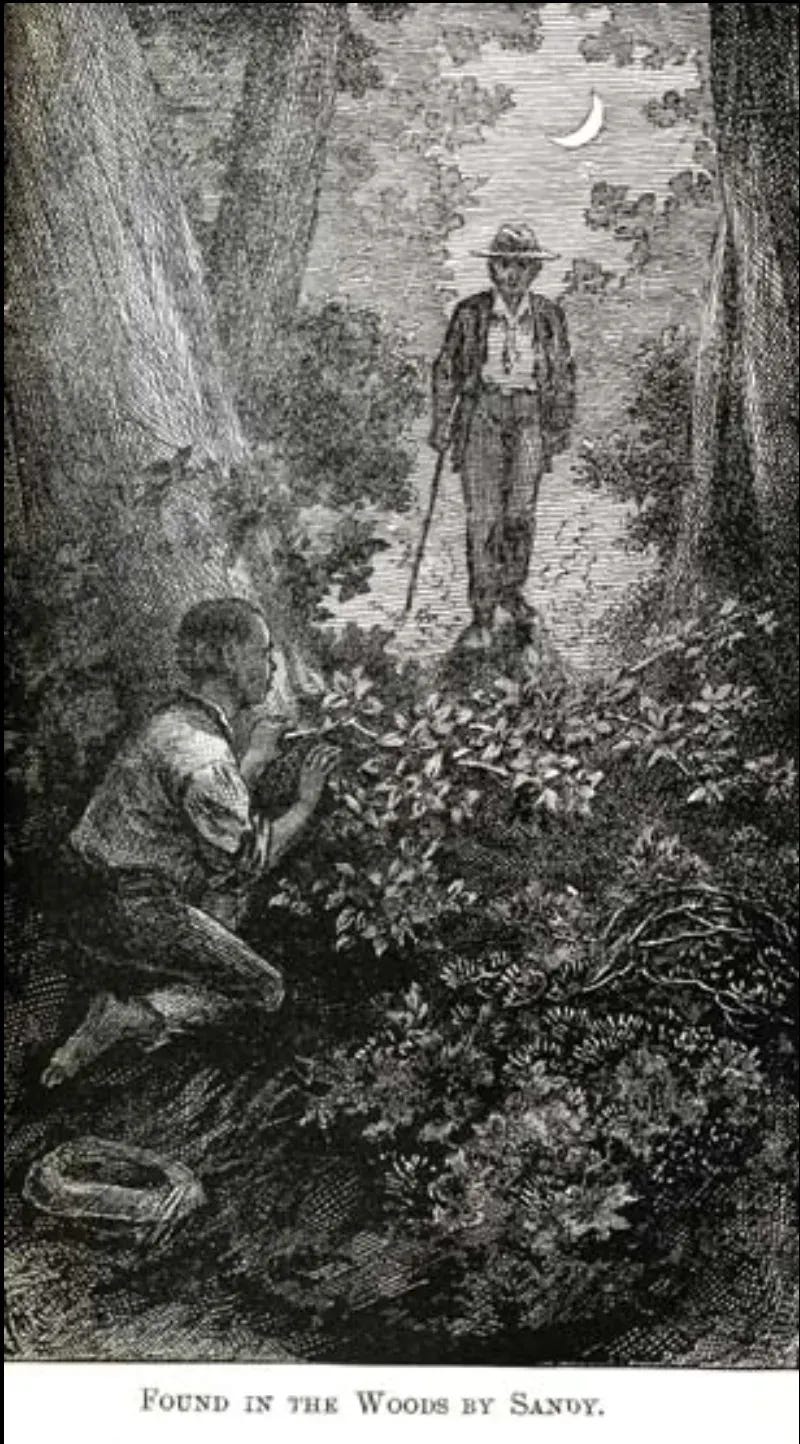
Just at that time, Frederick wrote, he was happened upon by a local man named Sandy Jenkins. Frederick wrote that Sandy, also a slave, was known in the area as a wise African spiritual advisor, someone who still retained some of the old ways. Sandy “was not only a religious man, but he professed to believe in a system for which I have no name,” he wrote in 1855. “He was a genuine African, and had inherited some of the so- called magical powers, said to be possessed by African and eastern nations.”
Sandy took Frederick back to his cabin, cleaned him up, fed him—and something more. Douglass wrote in 1845:
He told me, with great solemnity, I must go back to Covey; but that before I went, I must go with him into another part of the woods, where there was a certain root, which, if I would take some of it with me, carrying it always on my right side, would render it impossible for Mr. Covey, or any other white man, to whip me. He said he had carried it for years; and since he had done so, he had never received a blow, and never expected to while he carried it. I at first rejected the idea, that the simple carrying of a root in my pocket would have any such effect as he had said, and was not disposed to take it; but Sandy impressed the necessity with much earnestness, telling me it could do no harm, if it did no good. To please him, I at length took the root, and, according to his direction, carried it upon my right side.
There is no record to bear the matter out, but the object Sandy pressed upon Douglass was very likely a rock-hard, bulbous root known within hoodoo as John the Conqueror or sometimes High John. John de conker is the pronunciation in oral records and song. It is the ultimate protective object, used for everything from personal safety to virility, traditionally carried by a man rather than a woman. In the magical lore of “like bestows like” (echoing as above, so below), the dried root is shaped like a testicle. There is historical conflict over the root’s species; botanical drawings differ among catalogs of old hoodoo supply houses. But most careful observers and practitioners of hoodoo today agree that the likeliest source is jalap root, which dries into a rough, spherical nub.
Armed with what he warily called “the magic root,” Douglass set off for Covey’s farm. On arrival, he received a shock. Covey was downright polite. “Now,” wrote Douglass in his first memoir, “this singular conduct of Mr. Covey really made me begin to think that there was something in the root which Sandy had given me.” But then it struck him: it was Sunday; ever the upright Christian, even Covey took a day of rest. Come Monday, things darkened.
“On this morning,” Douglass continued, “the virtue of the root was fully tested.” Covey grabbed Douglass in the barn, tied his legs with a rope, and prepared to beat him.
“Mr. Covey seemed now to think he had me, and could do what he pleased; but at this moment—from whence came the spirit I don’t know—I resolved to fight.” Here began the historic turnaround in Douglass’s life: “I now resolved that, however long I might remain a slave in form, the day had passed forever when I could be a slave in fact.”
Douglass was no believer in magic. But in both his earlier and later memoirs, he proved resolutely unwilling to slam shut the door on the matter or to qualify the veneration he felt for Sandy. “I saw in Sandy,” he wrote in 1855, “too deep an insight into human nature, with all his superstition, not to have some respect for his advice; and perhaps, too, a slight gleam or shadow of his superstition had fallen upon me.”
Sandy, the “clever soul,” the “old adviser,” and the “genuine African,” provided a rare measure of counsel in a brutal world. His authority was grounded in an occult tradition that no slaveholder could enter.
The “magic root” episode framed the inner revolution of Douglass’s life. He knew that even though he was, for the time being, a slave in fact, he would never again be a slave in spirit. As he liberated himself in spirit, he determined to free himself physically at the first possible opportunity. In 1836, Frederick attempted to escape and was captured. Two years later, he made a second attempt and succeeded. He fled Baltimore to New York City and from New York to upstate New York, not far from the Burned-Over District. He became one of the critical voices of abolitionism in America and around the world.
In a sobering and sorrowful coda, Douglass noted in his latter two memoirs that Sandy Jenkins himself might have betrayed Douglass and his would-be escapees during his first attempt. He surmised in 1893:
Several circumstances seemed to point Sandy out as our betrayer. His entire knowledge of our plans, his participation in them, his withdrawal from us, his dream [foreseeing the capture] and his simultaneous presentiment that we were betrayed, the taking us and the leaving him, were calculated to turn suspicion toward him, and yet we could not suspect him. We all loved him too well to think it possible that he could have betrayed us. So we rolled the guilt on other shoulders.
Folklore from the German–American community of Pennsylvania—influenced by the Rhine Valley mysticism of the Kelpius and Ephrata communes—proved especially popular among hoodoo readers. A favorite was German-Pennsylvanian Johann Georg Hohman’s 1820 spell book The Long Lost Friend, a volume that appeared in English by 1850 and later bore the title Pow-Wows.
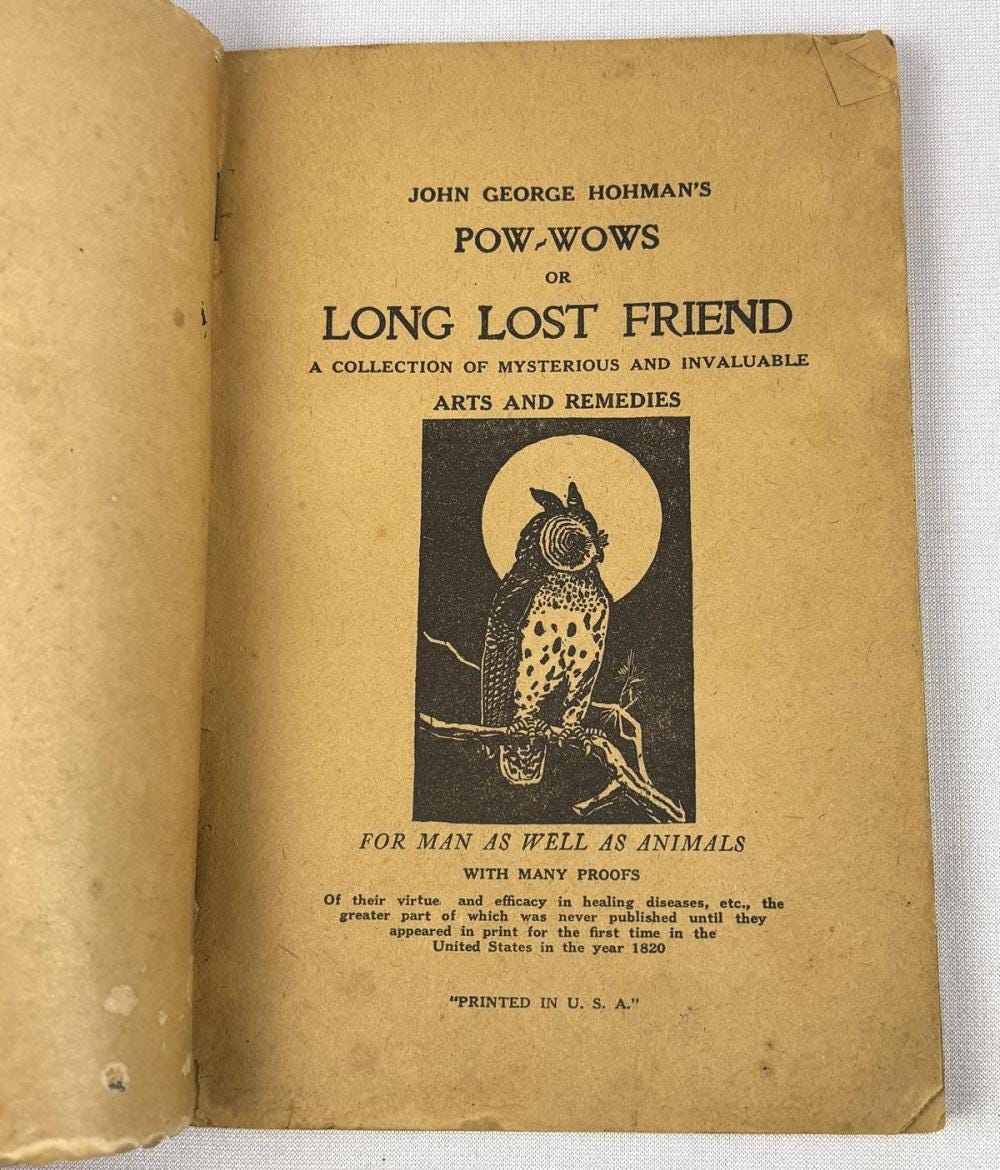
Pow-Wows was a haunting hodgepodge of myth, healing practices, and European folklore. The book referred to itself as a magic charm that would protect all who carried it. So seriously was this belief held that soldiers of German–Pennsylvanian background were known to carry Pow-Wows on them in Vietnam.
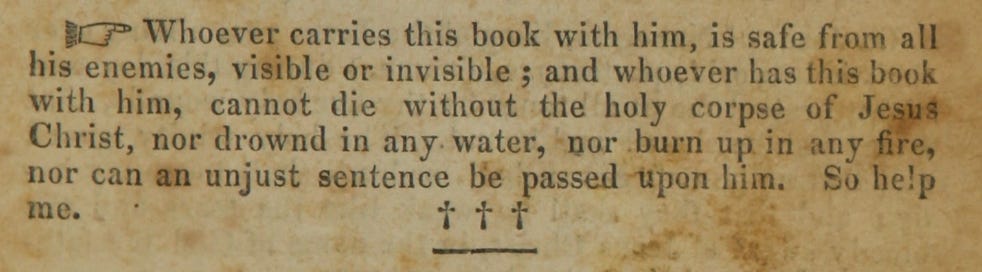
Far and away the most venerated book in hoodoo was another Germanic occult text, this one assembled from myriad sources in the mid-nineteenth century. Often considered the “hoodoo bible,” it was a beguiling patchwork called The Sixth and Seventh Books of Moses. The grimoire, or manual of magic, served up a mixture of Kabbalah (and pseudo-Kabbalah), supernatural seals, the “spells” used by Moses against Pharaoh, and—most popular of all—instructions on the magical uses of the Psalms. For hoodoo practitioners, who discovered the book in its first English edition in 1880, it became a source of endless fascination.
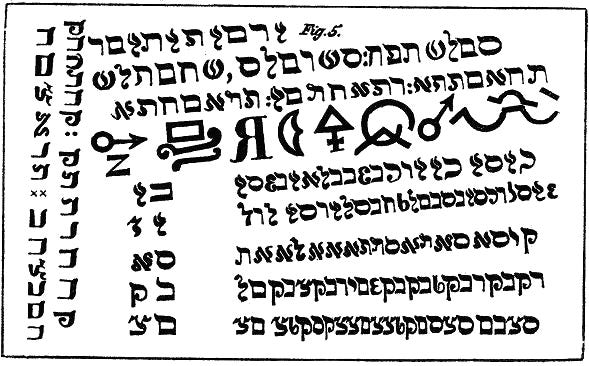
To many root workers, Moses himself was the great medicine man and conjurer of the ancient past—a savior from the African continent who used his divine powers to free and protect his flock. To hoodoo practitioners, Moses and Aaron’s spells against Pharaoh revealed the true purpose of Africa’s traditional esoteric crafts.
In a rare and valuable 1904 book, Shakerism, Its Meaning and Message, authors Anna White and Leila Sarah Taylor describe a wave of spirit visits at the second Shaker Village at Mount Lebanon, New York: “In 1842, there came at Mount Lebanon, and then through the other societies, a strange epoch of visitation by representatives of all nationalities. Indians, Arabs, Ancient Jews, Chaldeans, Persians, Hindoos,—people of remote lands and ancient times, thronged to the City of Zion.”
About ten years later, “the spirit visitors announced to the people that they were about to leave them and go out into the world. They would visit every city and hamlet, every palace and cottage in the land.”
Already in early 1848, some felt this prophecy coming to pass in a Burned-Over District village called Hydesville, outside Rochester. That winter, the log cabin of the Fox family was riddled with weird bangs, cracklings, and knocks. Two adolescent daughters of the household, Kate, 11, and Margaret, 14, told their shocked Methodist parents that the noises were spirit raps. Moreover, the girls explained that through the rapping they had worked out a system of communication with the invisibles.
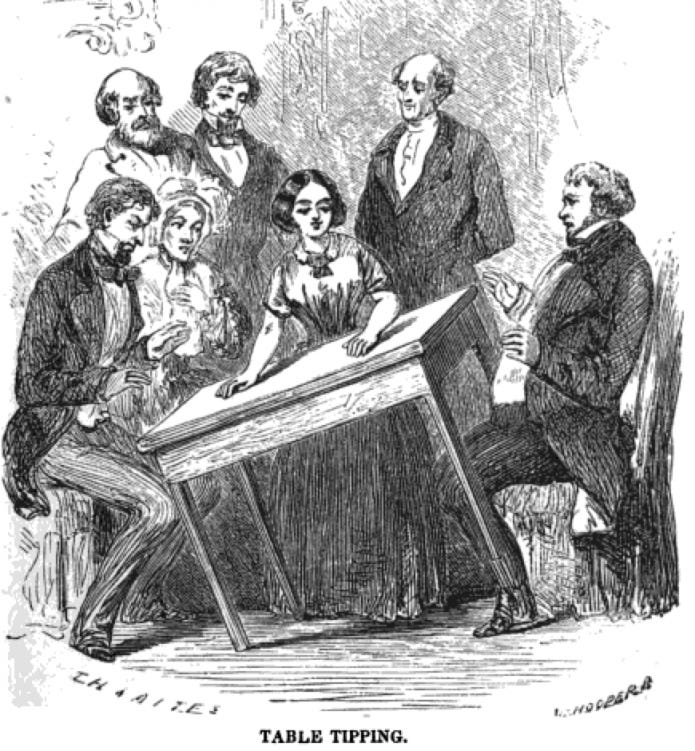
Various clergy, journalists, jurists, and scientists descended on the Fox family cabin to investigate Kate and Margaret. They included New York State Supreme Court Justice John W. Edmonds, abolitionist William Lloyd Garrison, and newspaper editor and publisher of the New-York Tribune Horace Greeley—all of whom validated the girls’ claims.
In 1850, Greeley hosted the Fox family at his New York City home. Later that year, the reformist editor installed the younger Kate to spend four months with his wife at the Greeleys’ gloomy, rambling house in Chappaqua, New York, where the lonely and unhappy adolescent made nightly efforts to contact the couple’s departed 5-year-old son.
Not all newspapermen were as taken with the Fox sisters. Some of “the New York press accused the girls of ‘jugglery’ and ‘fraud,’ and declared all who believed them were idiots, lunatics, or knaves,” wrote historian Ernest Isaacs. [6]
So was born the modern age of Spiritualism, or talking to the dead. Many Americans embraced the phenomena of midnight raps—they organized séance circles and Spiritualist clubs, soon expanding into newspapers and a wide array of newsletters and journals.
The movement’s reigning dean and prophet emerged from the modest environs of Poughkeepsie, New York, in the Hudson Valley, southwest of the Burned-Over District. A young farmhand and cobbler’s apprentice, Andrew Jackson Davis (1826–1910), at seventeen, with the help of an itinerant Mesmerist, began entering trances from which he produced voluminous lectures on unseen dimensions and “Summerland,” his term for the afterlife.
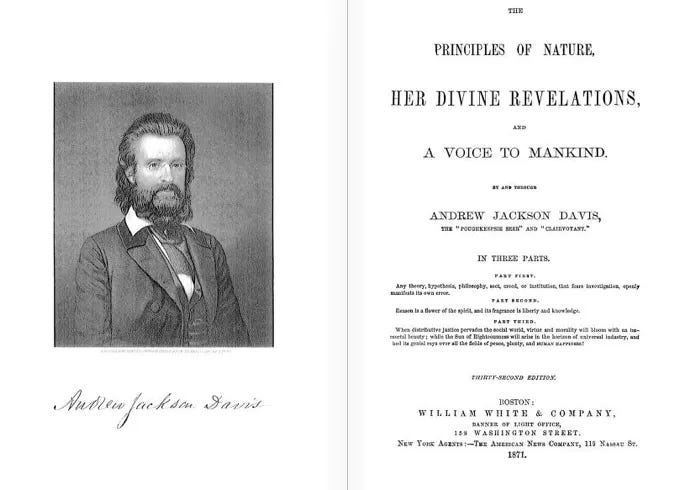
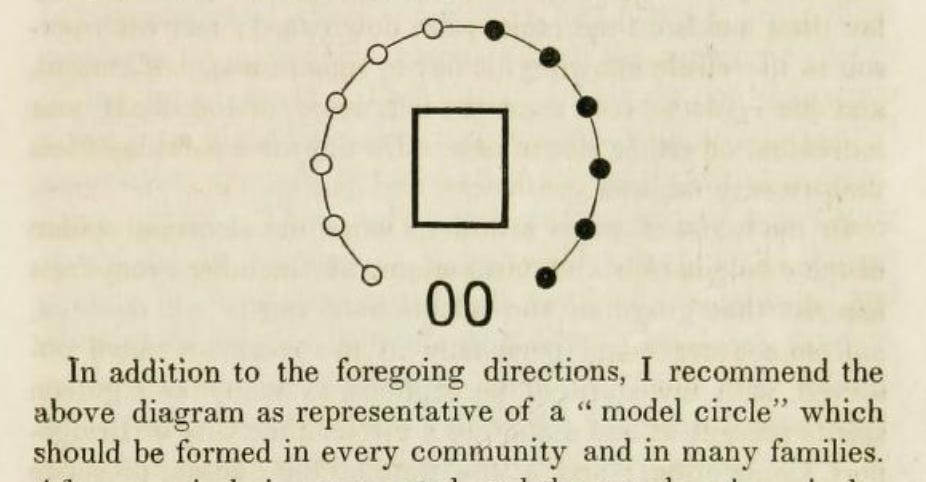
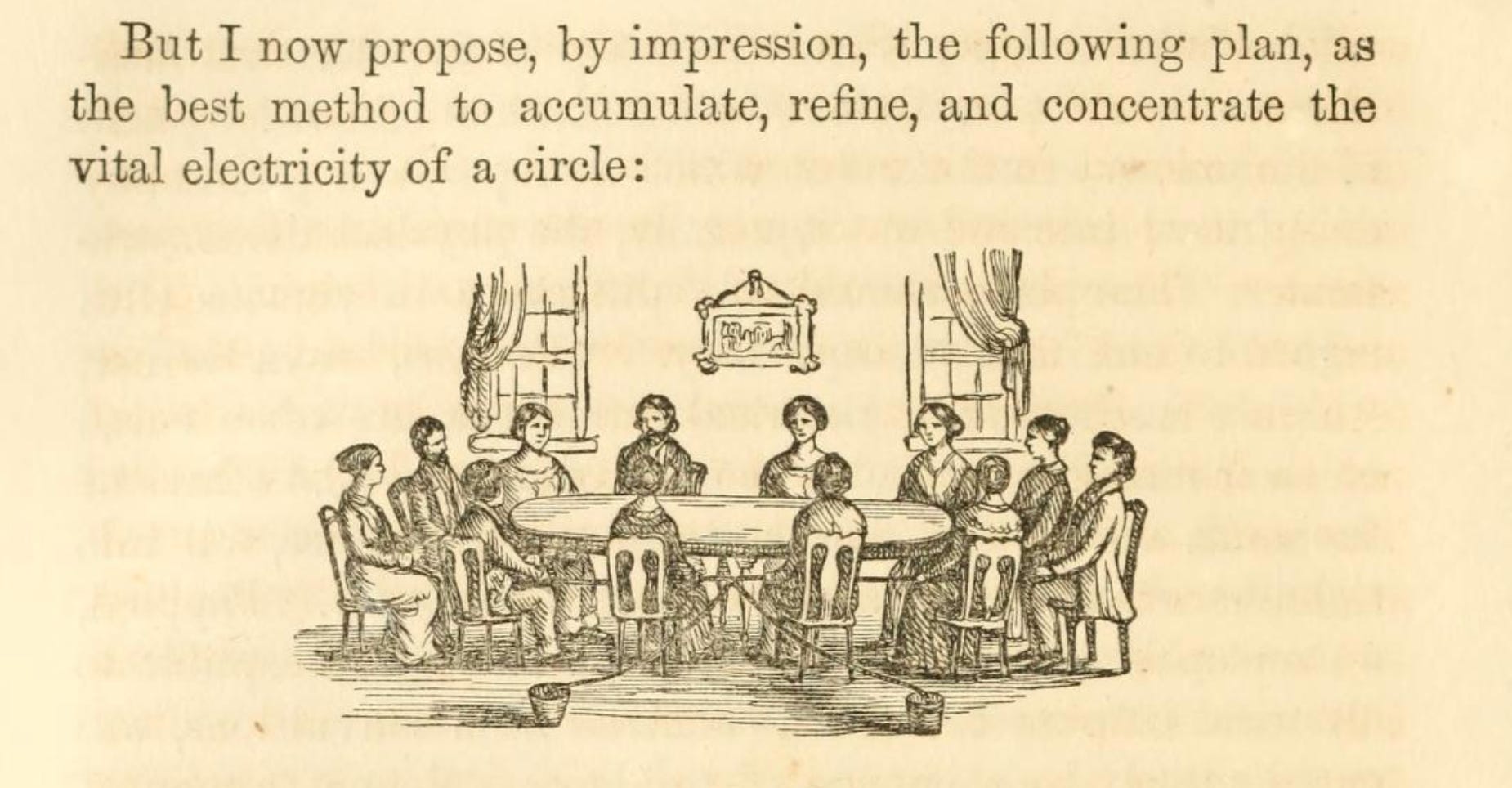
Dubbed by the press the “Poughkeepsie Seer,” Davis popularized the concept of “spiritual circles” or séances, the term used by Franz Anton Mesmer. In Davis’s 1851 book, The Philosophy of Spiritual Intercourse, the Poughkeepsie Seer taught Americans how to join hands around tables in kitchens and parlors to seek communication with the spirit world, just like Kate and Margaret.
Davis’s visions didn’t impress everyone. Edgar Allan Poe (1809-1849), then a struggling journalist and short-story writer, sat in on some of the seer’s New York trance sittings. Poe came to regard Davis with a mixture of intrigue and contempt. In 1849, Poe used one of his last short stories, Mellonta Tauta (Greek for “Things of the Future”), to lampoon Davis by mangling his high-sounding name as “Martin Van Mavis (sometimes called the ‘Tougkeepsie Seer’).” Poe’s crack appears in an epigraph often omitted from anthologized versions of his story. He is referencing President Martin Van Buren, who in 1837 succeeded Davis’s namesake, Andrew Jackson.
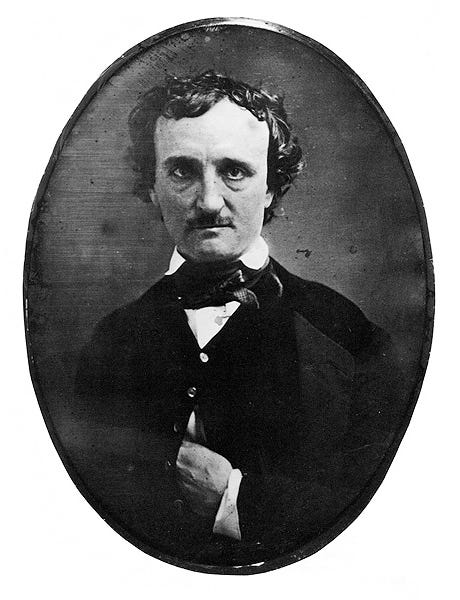
At the same time, Poe contributed to the popularity of Mesmerism by using themes from Davis’s trance sittings in one of his most popular stories, The Facts in the Case of M. Valdemar. It told of a Mesmerist who keeps an ill man from slipping into death by holding him in a magnetic trance. Poe completed the story in New York in 1845, the year he met Davis. Never explicitly billed as fiction and written like a medical case study, the story was initially taken as literal reportage by some in the U.S. and Britain. The Sunday Times of London reprinted it without comment in January of 1846 under the banner “Mesmerism in America: Astounding and Horrifying Narrative.”
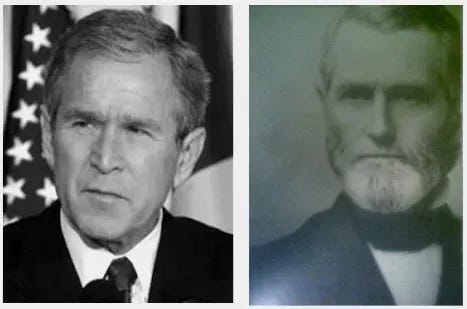
Davis was not without significant defenders. Among them was a Rev. George Bush (1796–1859)—a first cousin, four and five times removed, to Presidents George H.W. and George W. Bush. The latter and his ancestor, pictured above, bear resemblance. Though long forgotten, the Rev. Bush was a respected religious scholar and speaker who shared podiums with Ralph Waldo Emerson. Bush stirred enormous controversy in 1845 when he left the Presbyterian pulpit to become a minister in the Church of the New Jerusalem, a congregation based on the mystical ideas of Swedish scientist Emanuel Swedenborg (1688–1772). Bush was one of the Swedenborgian faith’s most prominent converts—and a stalwart defender of Davis.
“Indeed,” the bible scholar wrote of Davis in his 1857 book Mesmer and Swedenborg, “if he has acquired all the information he gives forth in these Lectures, not in the two years since he left the shoemaker’s bench, but in his whole life, with the most assiduous study, no prodigy of intellect of which the world has ever heard would be for a moment compared with him.”
In Davis’s most enduring coinage—if not its intended meaning—he employed the term “Law of Attraction” in 1855 in volume four of six-volume treatise on metaphysical laws, The Great Harmonia. The medium defined the Law of Attraction not as a principle of cause-and-effect thinking, the innovation of later adapters, but as a cosmic law governing the cycles and maintenance of life, including the nature of spirits attracted to the séance table based on the properties of its sitters.
Given Spiritualism’s nationwide range of clubs and publications—including a peak of sixty-seven newspapers—it is reasonable to estimate that the population ran into hundreds of thousands and, depending on how stringently one defines a follower, possibly a million or higher. In a nation that counted its overall population at thirty to thirty-five million in the mid-nineteenth century, it is likely that almost one in ten free adults considered themselves believers, of one degree or another.
The numbers proved so large that, by the close of the 1850s, the Burned-Over District was eclipsed by the movement it spawned and no longer served as the engine of mystical religion in American life. Chicago, Boston, New York, Philadelphia, and many towns and cities had Spiritualist societies, newspapers, and congregations and soon produced innovations of their own. Spiritualism was not a regional sensation but a national movement.
Part of Spiritualism’s appeal is that figures like Kate and Margaret Fox and Andrew Jackson Davis emerged from the ordinary environs of life. Kate and Margaret came from a poor farming family. Davis was a cobbler’s trainee. And yet they claimed to have parted the veil, to have broken through to the other side, to have worked out systems of communication with the unseen world. This appealed to the do-it-yourself instincts of everyday people who felt enthralled with the possibility that not only was the age of biblical prophecy more than a bygone past, but it was available within the trappings of familiar life. To those who suffered the staggering losses of childhood diseases—in New York City in 1853, nearly half of all reported deaths were children under five—the prospect of communication came as a salve within the strict environs of Calvinist Protestantism.
The world witnessed a different expression of occultism taking shape in America. It did not rely on illumined teachers, secret societies, or esoteric studies. It involved a young slave receiving a magic root. A local treasure hunter heralding a new scripture. The Publick Universal Friend showing the face of a reanimated—and female—avatar. A migrant fleeing charges of witchcraft to launch a new movement. Teenage girls claiming to work out a code with the spirit world. A cobbler’s apprentice entering psychical trances. To a significant extent, it was landless and working people seizing a greater life through their ability to claim compact with the unseen.
Spirit raps were soon heard at séance circles in the drawing rooms of Paris and London, where fashionable classes took a deep interest in things that went bump. Spiritualism, this movement that started in a log cabin, became, in effect, the nation’s first religious export.
Meanwhile, as Americans organized séances and consorted with mediums, it grew apparent that most spirit mediums were women. With Spiritualism’s development into a national movement with its own lecture clubs, newspapers, and eventually churches, there appeared, for the first time in modern life, a framework in which women could function as religious leaders, of a certain sort. Spiritualism, already developing a progressive politics, attracted a wide range of women who desired a voice in the civic culture.
In July 1848, about six months after Kate and Margaret Fox introduced the Rochester rappings, the gavel fell on the watershed Seneca Falls Convention for women’s rights, about forty miles east of the Fox home down Route 20, the “psychic highway.” Indeed, for about two generations in the nineteenth century, you could not find a suffragist activist who had not spent some time at the séance table or a séance habitué who was not active in or at least sympathetic toward suffragism.
Insecure in her public speaking abilities, the usually skeptical Susan B. Anthony wrote to her colleague Elizabeth Cady Stanton in 1855, “If the spirits would only just make me a trance medium and put the right thing into my mouth. You can’t think of how earnestly I have prayed to be made a speaking medium for a whole week.” [7]
In 1853, suffragist Mary Fenn Love convened the first New York State Women’s Rights Convention. “Spiritualism has inaugurated the era of woman,” she announced. Two years later, Mary married the movement’s reigning prophet, Andrew Jackson Davis. In 1885, after thirty years of marriage and public collaboration with Love, Davis divorced her, writing in his 1885 memoir Beyond the Valley that his spirit guardians told him the couple’s “‘central temperaments’ do not harmonize.” Davis remarried (his third time), and left Mary to raise four grandchildren placed in her care by her deceased daughter. Mary died of cancer the following year in West Orange, New Jersey.
Nonetheless validating Fenn’s 1853 declaration, the Spiritualist movement provided a unique springboard for women to enter politics in an era before suffrage. On January 11, 1871, Congress hosted the first woman to address a joint committee. That winter day, free-love advocate—and avowed trance medium—Victoria Woodhull (1838–1927) took the floor.
Poised and handsome, Woodhull delivered a rousing brief in defense of voting rights, known as The Woodhull Memorial. The medium, famous for her sittings with magnate Cornelius Vanderbilt, told journalists that the address was dictated to her in a dream by a ghostly, tunic-wearing Greek elder—a spirit guardian who guided her since she was little.
In 1872, the Equal Rights Party, a consortium of suffragists and abolitionists, named Woodhull the nation’s first female presidential candidate. That year, the proto-feminist found herself mocked as “Mrs. Satan”—complete with reptilian wings—by cartoonist Thomas Nast in Harper’s Weekly who depicted Woodhull holding a scroll reading, “Be Saved by Free Love.”
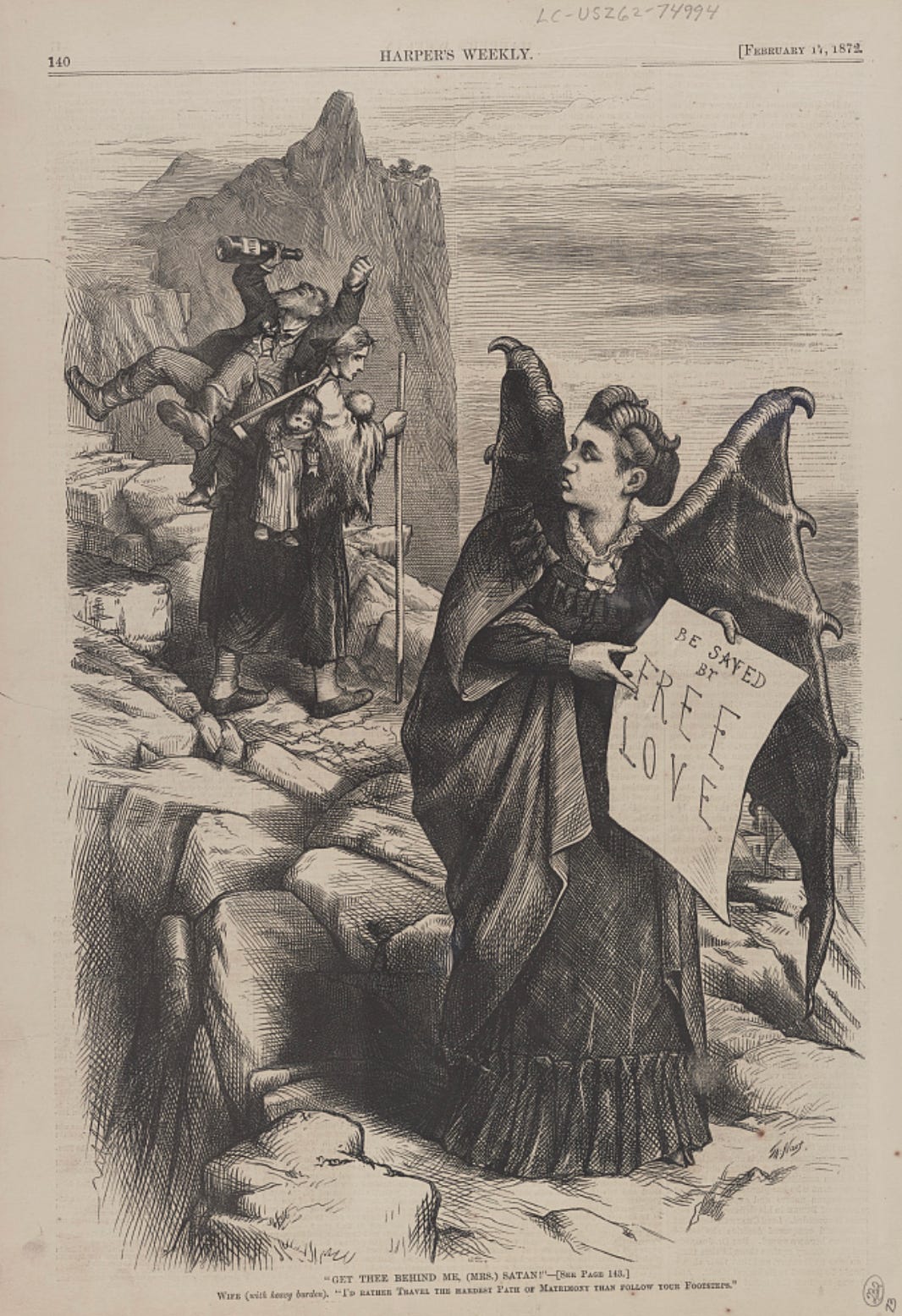
Woodhull’s protest campaign proved short-lived, eclipsed by her twin passions for publicity-mongering and political chicanery. The medium-activist selected Frederick Douglass as her running mate—but without asking him. “I never heard of this,” the abolitionist hero said. [8] Days before the election, Woodhull, along with her sister and second husband, were arrested on trumped-up obscenity charges and held for a month, preventing her from attempting to vote.
Occultism, in all its foibles and ideals, promises, possibilities, and pitfalls, was now an indelible element of the American—and by extension—the modern-world scene. With Renaissance mages like John Dee and Cornelius Agrippa long passed and the Hermetic writings in unjust disrepute (and neglected translation), occultism’s onetime garland of respectability was—perhaps forever—gone. But the thought movement’s popular cultural, spiritual, and social influence was dawning anew.
[1] Letter to The Spiritualist, December 13, 1874
[2] Listen For a Lonesome Drum: A York State Chronicle (Farrar & Rinehart, 1936, 1950)
[3] Pioneer Prophetess (Cornell University Press, 1964)
[4] “The Sign and Seal of Justice” by Rafael Alberto Madan, Ave Maria Law Review, Vol 7:1, 2008
[5] Narrative of the Life of Frederick Douglass, an American Slave (1845); My Bondage and My Freedom (1855); and Life and Times of Frederick Douglass (1893).
[6] “The Fox Sisters and American Spiritualism,” The Occult in America edited by Howard Kerr and Charles L. Crow (University of Illinois Press, 1983)
[7] Radical Spirits by Ann Braude (Indiana University Press, 1989, 2001). See Braude’s pioneering history of Spiritualism and suffragism for this and the quote that follows.
[8] Other Powers by Barbara Goldsmith (Knopf, 1998)
The Birth of Occultism
·
Aug 6
Western culture is occult-rooted. Occultism is the modern reencounter with—and adaptation of—late stages of polytheism in Egypt, Persia, Rome, Greece, and North Africa. These ancient traditions, which reach us frayed and fragmentarily, harbor practices and principles by which o…
Occult Renaissance
·
Aug 12
Occultism is modernity’s reencounter with the hidden world—its ventured schemas, signs, and symbols—by which our ancient ancestors once lived. As previously explored, the occult idea is…
"Come Here, Worthy!"
·
Aug 18
This story of modern occultism cannot be approached without understanding the role of what are popularly called secret societies. That understanding proves elusive. Perhaps no other topic within …
Comments
Nothing yet. Say the first thing.
Sign in to join the conversation.