
Cutting Through is only sustained by your support. This work is not the product of major donors, merchandising, or grants. We need your support. If you can help and are willing, please consider becoming a paid supporter at the “subscribe” links in this newsletter. You can also make a one-time donation at the “One-time donation” links. Any help is deeply appreciated, as the support of those who are able will continue to keep this service free for newcomers and those who can’t afford to sustain independent reporting and analysis. Thanks to all of you.
The political consensus forged in the 1990s has run its course. In this week’s edition of Globalists, Josh White and Mitchell Plitnick discuss the decline of Keir Starmer, the rise of Andy Burnham, and the fragmentation of Anglo-American centrism. Progressive politics cannot renew itself while remaining committed to the technocratic neoliberalism that defined the post-Cold War era.
The Battleground, June 27, 2026 (for video, watch here on YouTube)
Trump’s Memorandum of Understanding with Iran presents an unprecedented opportunity to reduce tensions and promote cooperation across the region. For this reason, progressives should stop denigrating the deal that Trump clumsily, but fortunately, stumbled into.
Mondoweiss, June 27, 2026
The bombing phase of the Iran war appears to be over. If the ceasefire holds, it may mark more than the end of a military campaign. It could also signal the beginning of the end for two of the most destabilizing forces in Middle Eastern politics: the enduring influence of America’s neoconservative war hawks and Washington’s “special relationship” with Israel.
The Battleground, June 26, 2027
I was pleased to be invited to share some thoughts on Donald Trump's contempt and trampling of democracy and international law on the South African talk show, Judge For Yourself, with Judge Dennis Davis.
Judge for Yourself, June 25, 2026
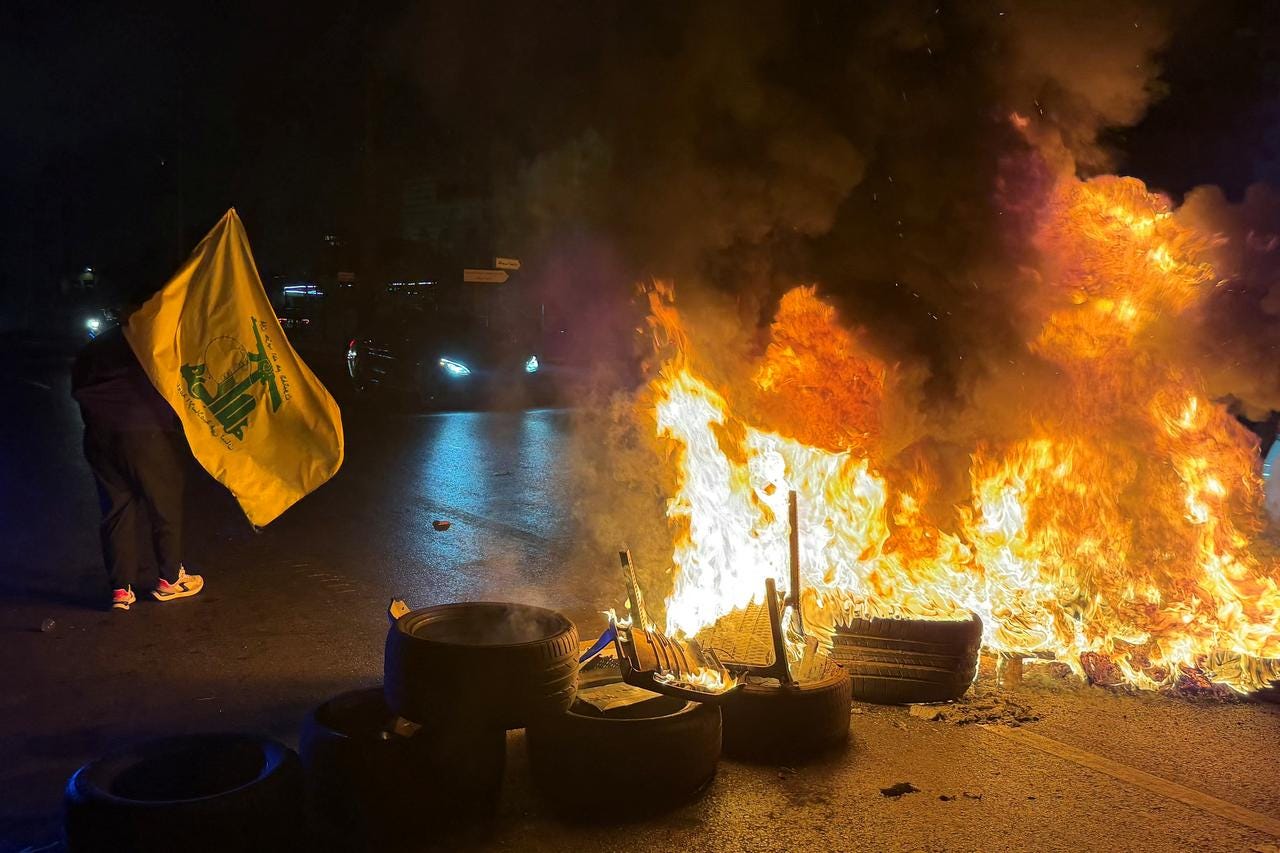
Yet the Lebanese government issued an order to “employ all necessary legal and field measures to clear vital transport routes, preserve public order, and deter any targeted acts of vandalism or civil disobedience.” The term “field measures” includes the use of force.
Reports uniformly call the protesters “Hezbollah supporters,” and doubtless that is most of them. Yet it hardly takes much imagination to recognize that there would be opposition form many sectors of Lebanon to the agreement its government reached with Israel on Friday.
That agreement sets out an abstract goal of peace and mutual respect for sovereignty between the states. But it also establishes Lebanese acquiescence to Israel’s continued control of southern Lebanon until such time as Hezbollah is disarmed. It does this by conditioning Israel’s withdrawal on that disarmament.
While the Americans who brokered this deal might very well be ignorant of the realities in Lebanon, the Israelis are not. They know very well that this agreement means an indefinite occupation and could very well even lead to annexation of Lebanese territory to Israel.
The Israelis understand that the Lebanese military is unable to disarm Hezbollah. Hezbollah is stronger and they have considerable support both among the Lebanese population—especially among the Shi’a—and in the Lebanese Parliament.
Marco Rubio, Donald Trump, and others in Washington may believe that they are sowing the seeds of a long-term project that will end with a quiescent Lebanese government in control of Lebanon and Hezbollah a memory. But Benjamin Netanyahu, Yechiel Leiter, and other Israelis involved know exactly what seeds they are planting: increased division in Lebanon which could culminate in renewed civil war, and even if it does not, it will leave the Lebanese incapable of resisting the Israeli occupation. Or so Israel hopes.
This agreement, in as much as it is an attempt to push Iran out of the issue of Israel’s invasion of Lebanon, presses in an opposing direction from the memorandum of understanding between Iran and the U.S. It therefore also serves Israel as a way to undermine that MOU, and from all indications, this, too, has been more than the Trump administration comprehends, although the more neoconservative voices, like Marco Rubio, probably understand it as well.
Hezbollah’s resistance
While Hezbollah obviously has self-interested reasons for rejecting the Washington talks (to which they were not invited) and regarding the agreement signed Friday as illegitimate, they also have broader reasons for that reaction.
The main short-term goal of the Washington talks for the U.S. and Israel was to sideline Iran and remove Lebanon from the center of the U.S.-Iran negotiations about ending the failed war the U.S. and Israel started. Both Israel and the United States claimed victory on that front with the signing of the agreement, although such declarations are extremely premature.
The U.S. tends to frame their efforts around Lebanese sovereignty, claiming that they want to eliminate Iran’s involvement so that the Lebanese government can make independent choices.
That’s nonsense. This isn’t about Lebanon’s independence. Rather, it’s about Lebanon taking its marching orders from Riyadh and Washington and eliminating Iran’s influence from Beirut.
The Saudis have re-engaged with Lebanon after pulling far back five years ago. They are engaging cautiously, not wanting to get too heavily involved in a country that continues to teeter on the brink of collapse and whose government remains in disarray, even though it has made progress over the past couple of years both politically and economically.
Hezbollah, and its political partners, are the main forces standing against Saudi influence in Lebanon.
It is often important to remind people in the west that Hezbollah is a political entity in Lebanon, not only a resistance militia. They have developed a strong political apparatus and are a major presence in the Lebanese parliament. Their base in the Shi’a community is guaranteed significant positions in the Lebanese government both by the structure of the Lebanese confessionalist system and by the great size of the Shi’a population.
That stands in contrast to Hamas, which, though it has a clear and, by now experienced political wing, developed entirely as a resistance movement and only reluctantly entered the system of Palestinian party politics.
In other words, this is not just about resisting Israel’s invasion. This is about the constituency that Hezbollah represents and their place in Lebanese politics.
Lebanese unity and sovereignty
As I’ve noted in the past, Lebanon, like any other state, should see its government in control of the use of force. Whatever one thinks of Hezbollah and its actions against Israel, it is inherently unstable and unjust for a group that does not represent the entirety of a country’s government and people to have the power to decide when and if that entire country goes to war.
One can debate the merits of Hezbollah attacking Israel back in November 2023 to try to affect Israel’s genocide in Gaza, as well as its decision, despite refraining from attacking Israel over the latter’s more than 10,000 ceasefire violations, to join the war against Israel after it attacked Iran and killed Ali Khamenei.
However one sees those actions, it is inescapable that those decisions had consequences for the entire country of Lebanon, and thus should be made by its government, not one party in it.
But Lebanon has been a fractured state for decades. The desire to end that situation is a good one. It’s a goal that should be pursued with a genuine resolve to improve things for the entire state of Lebanon.
That, however, is not what this deal struck on Friday does, nor is it what it is meant to do.
Freezing Hezbollah out, attempting to isolate it, is futile and provocative. It is also unhelpful. There is a path to consolidating decisions on the use of force into the hands of the Lebanese government. It’s not a quick path. It would take years of work, the building of trust, and a good deal of support from Lebanon’s allies, including both Saudi Arabia and Iran.
It is a path that leads to a national policy that reflects the will of the Lebanese people, including, but not exclusive to, the March 8 Alliance, which Hezbollah is the most influential part of.
Such a path requires compromise, trust-building, and mutual assurances that eventually culminate in Hezbollah’s militia being incorporated into the Lebanese armed forces.
That outcome is necessary for Lebanon’s stability, but stability in Lebanon is not what Israel wants. The United States might be more comfortable with that idea, but it is not high on their list of priorities.
Unlike any of the other players, including Israel, Washington’s priority is immediate. The Trump administration really doesn’t care what happens to Lebanon; what they care about is getting out of the dilemma Lebanon poses right now.
Iran has forced Trump into a position where he has to choose between ending the war—which he is desperate to do before the closure of the Strait of Hormuz makes the global economic crisis far worse—or kowtowing to pro-Israel forces at the moment when they are most powerful, just before the midterm elections.
Trump wants to find a way to get Lebanon off the table, sidestepping that dilemma. He is hoping, quite in vain, that this deal will do that.
Where to go from here
With the terms of the memorandum of understanding fraying under the weight of disputes in the Strait of Hormuz and tit-for-tat attacks between the U.S. and Iran, it may well be that the shooting war there will commence again. In that case, it’s a sure bet that Hezbollah will completely disregard the wishes of the Lebanese government and return to attacking both Israeli forces in southern Lebanon and Israeli sites, both military and civilian, in northern Israel.
If, on the other hand, the truce between the U.S. and Iran is reinstated and this agreement is maintained, the division in Lebanon is likely to grow deeper.
Aoun’s work with Washington on this issue isn’t abandoned lightly. Lebanon is in desperate need of funds, and the U.S. pledged to send $100 million in humanitarian aid to Lebanon immediately upon the signing of this agreement.
Aoun also is beholden to Riyadh for financial support, and the Saudis are much more concerned about blunting Hezbollah as an armed force than they are about Israel’s occupation, even if they might still work toward an Israeli withdrawal.
So Aoun will try to stick with the agreement. But the opposition in Lebanon is so strong, he may not be able to do it.
Beyond the protests and Hezbollah’s rejection of any agreement with Israel short of a full Israeli withdrawal, the deal itself faces powerful opposition in Lebanon.
Nabih Berri, the Speaker of Lebanon’s parliament and head of the Amal Movement called the agreement fitna, sedition. That is a very charged political word in Lebanon, and Berri does not use it lightly.
Berri, a Shi’a who is aligned with but not part of Hezbollah, is arguably the most powerful political figure in the country, and a statement like this from him carries enormous weight, which will have impact beyond Hezbollah’s constituents.
The deal itself does not even mention Israeli withdrawal, and Lebanon continues to reel from Israel’s invasion. Many people who fled from southern Lebanon are still barred from returning by Israel, and many others have no homes to return to anymore, due to Israel’s massive destruction.
There are some in the government who have expressed support for the deal, but there seems to be little enthusiasm in the public, even from sectors who are not supportive of Hezbollah. That is not surprising since Israel is continuing to attack civilian areas, despite the agreement.
Aoun will have to decide whether he wants to risk a civil war, one which he’s very unlikely to win, to defend this strategy of working with Israel.
Washington will, undoubtedly, continue to press Aoun to submit to agreements like this one, which promise Lebanon nothing and suck Aoun deeper into quisling cooperation with the Israeli government.
The real question will come back to Riyadh. Are they trying to establish a quiescent government in Lebanon akin to the Palestinian Authority, which will work with Israel to deepen the occupation while getting support from the Saudis and other wealthy Arab states?
Frankly, the model in Lebanon is not likely to succeed much better than the PA has. Indeed, there is every possibility that it will turn out much worse for Saudi designs if that is what they envision.
Even Iran seems to have recognized that pressing for an immediate Israeli withdrawal is unlikely to succeed, which is why they only placed a general statement of including Lebanon in the ceasefire in the MOU. While they certainly meant for that to imply a full withdrawal from Lebanon, it is not specified, giving Tehran wiggle room.
If the U.S.-Iran war can be resolved with an agreement, even the Saudis might be on board with demanding a full Israeli withdrawal from Lebanon, a stance which would lead Aoun to a different position, especially considering that, by the time such a deal is reached, this agreement signed on Friday will almost certainly be a relic of the past.
Riyadh will have to recognize that forcible disarmament of Hezbollah, like forcible disarmament of Hamas, is unrealistic, and only through diplomacy can these issues be resolved. Washington won’t understand that without it being told to them patiently by a source they will listen to. Israel is already aware of that reality, and they are completely uninterested in pursuing it.
It will be up to Saudi Arabia to make that case, and, perhaps, to eventually work with, rather than against, Iran to bring stability to Lebanon.
By Janan Abdu, Middle East Eye, June 28, 2026
Al-Mayadeen, June 28, 2026
Amwaj Media, June 26, 2026
By Lior Sternfeld, +972 Magazine, June 26, 2026
By Emran Feroz, Drop Site News, June 26, 2026
By Maram Humaid, Al Jazeera, June 27, 2026
Palestine Chronicle, June 27, 2026
The New Arab, June 28, 2026
By Fatih Kocaibiş, Responsible Statecraft, June 26, 2026
By Abdelmonem Makki, UN News, June 25, 2026
France 24, June 28, 2026
By Adam Chamseddine. Middle East Eye, June 27, 2026
For professional information and contact:
LinkedIn: https://www.linkedin.com/in/mitchell-plitnick-616ba5
Comments
Nothing yet. Say the first thing.
Sign in to join the conversation.