
Cutting Through is only sustained by your support. This work is not the product of major donors, merchandising, or grants. We need your support. If you can help and are willing, please consider becoming a paid supporter at the “subscribe” links in this newsletter. You can also make a one-time donation at the “One-time donation” links. Any help is deeply appreciated, as the support of those who are able will continue to keep this service free for newcomers and those who can’t afford to sustain independent reporting and analysis. Thanks to all of you.
American goals in the war on Iran were unclear from the start, driven by Donald Trump’s personal ambitions and the fantasies of pro-Israel neoconservatives. Now, however, there is a clear agenda: to prevent Iranian control of the Strait of Hormuz.
Mondoweiss, July 11, 2026
Israeli leaders, both in government and the opposition, have repeatedly threatened to turn Türkiye into the next #Iran. Since it's a NATO country and does not have a history of enmity with the west like the Islamic Republic, that will be a tough task, but, over the long term, it still needs to be guarded against.
The Battleground, July 10, 2026
Like many who supported Graham Platner, I'm ending that support now that a very credible allegation of sexual assault has been made against him. But it is important that the right lessons be drawn from this.
YouTube, July 7, 2026
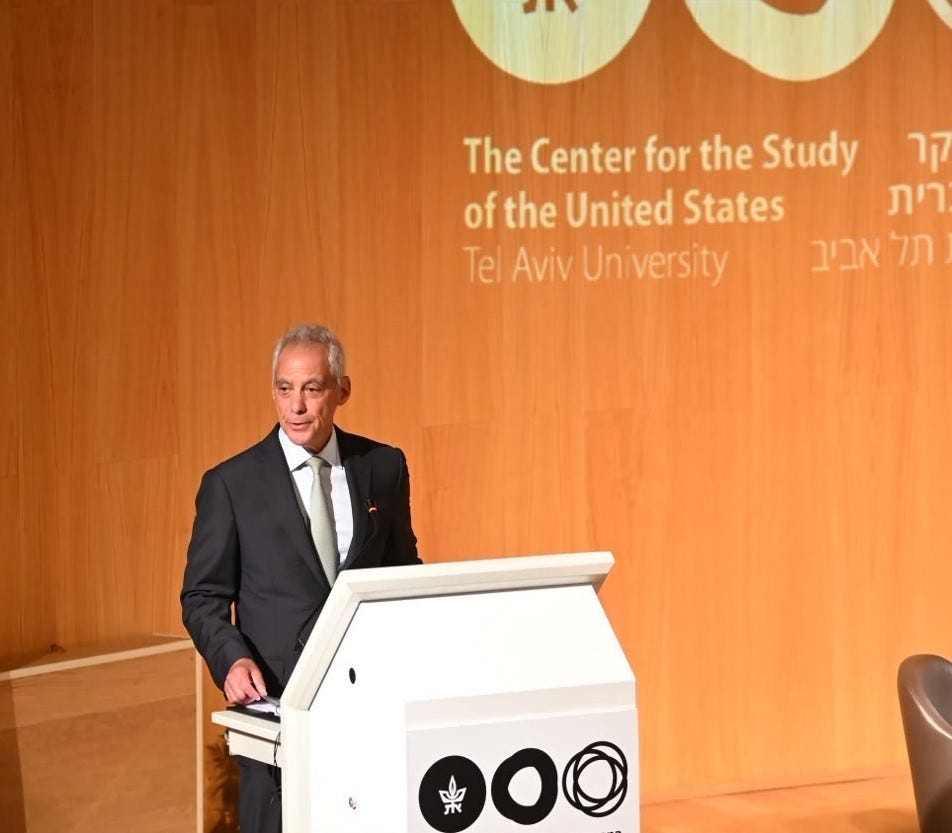
There was a great deal wrong with Rahm Emmanuel’s much-ballyhooed speech in Tel Aviv earlier this week. But it did one positive thing: it defined the new conservative Democratic boundary for Israel. And that definition is a welcome shift of the Overton window toward rational discourse on Israel and the United States’ relationship to it, to Palestine, and to the wider Middle East.
From his own point of view, Emmanuel was clearly laying the groundwork for a 2028 presidential bid—probably his own, but also potentially for some other candidate if he cannot gather the requisite support—and trying to find a space for conservative, pro-Israel Democrats in a party whose constituents have overwhelmingly abandoned Israel in the face of its genocide in Gaza and its long-awaited success in convincing the United States to launch what has been a disastrous war on Iran.
The disappearing pro-Israel Democrat
While Emmanuel’s primary audience was the American pro-Israel community, he was also talking to his audience in Tel Aviv, where he hoped to be heard by the Israeli opposition. He wants them to see him as the guy who can bring Democratic support back to Israel, just as much as he wants to see the pro-Israel crowd back in the States to see him that way as well.
The truth is, he’s probably the best chance they have of such an outcome, but it’s not a particularly good chance. The failures of his speech show this. The blank check the U.S. has given Israel may have exacerbated the problem, but its root is not the blank check; it is Israel’s intense nationalism, its settler-colonial nature (and denial of that reality as a society), and its apartheid regime.
American backing for Israel reinforced the negative effects of those conditions, and it has now become so blatantly horrifying, that liberal Americans can no longer look away. They have demanded a reconsideration of the support Israel is given and are no longer blindsided by phony questions about Israel’s imaginary “right to exist” (a right no state has, but if they did, one might well ask why Palestine has no such right).
Democrats who support Israel have hung their hats in recent years on Israel’s “democracy,” or its nature as a “Jewish state” surrounded by enemies. These arguments have completely lost their power among Democratic voters. Alienation had been building since 2008, when, for the first time, some liberal Americans reacted very badly to Israel’s wanton bombing of Gaza.
But the genocide, Israel’s unjustifiable invasion of Syria, and then the two Iran wars as well as its renewed occupation of southern Lebanon have pushed Democrats far away from Israel. When I co-authored the book Except for Palestine five years ago, there was still a significant portion, even a plurality, of Democratic voters who would put aside their liberal values when it came to Israel, or twist reality into a shape that could justify the “Palestine exception.” Those people are still around, but they now make up a distinct minority of Democrats and Democrat-leaning voters.
Emmanuel to the rescue?
Some pro-Israel Democrats will simply never abandon Israel, regardless of how monstrous it becomes. But they still must make a case to most Democrats, and in recent years, they have not been able to articulate one. Leading Democrats, who denied this was even an issue not so long ago, have been forced to recognize that they must make some kind of change. Kamala Harris’ 2024 defeat proved that.
The initial shift has been toward trying to argue that the problem is not Israel, but its Prime Minister. After all, they say, Benjamin Netanyahu has brought in the worst elements of Israel, the Kahanists, in the form of Itamar Ben Gvir and Bezalel Smotrich, and they hold significant power in his government. Moreover, Netanyahu has led an assault on Israel’s judiciary and its democratic structures more broadly.
While those arguments have the virtue of being true, they have not proven to be persuasive. This is where Emmanuel comes in with his strategy.
Emmanuel goes beyond merely saying that the problems are all due to Netanyahu, Smotrich and Ben Gvir. He argues that Israeli impunity has gone too far, that the U.S. must no longer indulge it, and that Israelis must come to grips with accountability.
That sounds good, but it is cloaked in language that is duplicitous, and it elides the deeper problems in Israel.
Emmanuel is not arguing for a regime of justice and accountability. He is arguing for the survival of Israel as an ethnocratic Jewish state. He is arguing that, to make that possible, compromises on Israeli impunity must be made.
In so doing, Emmanuel presents a false and tendentious version of history.
He starts off by blaming Palestinians for the current situation. “I understand that the corrupt Palestinian leadership has never lived up to the Palestinian people’s legitimate aspirations for sovereignty and self-determination,” Emmanuel began. “I understand that, for all that everyone acknowledges that the world changed on October 7th, the dynamics that prevail today were born well before Hamas murdered 1,200 and kidnapped more than 250 innocents.”
Emmanuel continues the American tradition of refusing to put any context around October 7. He reinforces the inflated figure of those killed in that attack. In fact, around 815 civilians were killed that day. That’s a horrific number, and their deaths were largely, if not entirely criminal, under international law. But Palestinians living under occupation, whether Americans and Israelis like it or not, have a legal right to fight against the combatants of the occupying state.
Still, one can be generous and make allowances for the fact that Emmanuel was trying to reach out to Israelis where they were and talk to them. But that doesn’t cover Emmanuel’s other excesses.
Emmanuel’s fictional history
“Three times since the early 1990s, you have offered the Palestinians sovereignty in exchange for your security,” he said, “and three times your offer was not only rejected, but you were attacked as a direct consequence. In the United States, we have a saying: “fool me once, shame on you. fool me twice, shame on me.”
He was referring here to the original signing of the Oslo Accords, the failed Camp David II summit of 2000, and the collapse of talks in 2007 under Ehud Olmert.
Regarding Camp David, Matt Duss of the Center for International Policy writes in The Nation, “To call this a tendentious presentation of history would be to give it too much praise. Given that Emanuel worked for the Bill Clinton administration…it’s not surprising that he’s still repeating it. The trope has its roots in the failure of Clinton’s 2000 Camp David negotiation, which Clinton laid squarely at the feet of PLO Chairman Yasir Arafat. Multiple observers and participants have challenged this, including American and Palestinian negotiators Rob Malley and Hussein Agha. ‘Since 2000, it is this narrative—Camp David as a metaphor for Palestinian rejectionism—that has ravaged the Israeli peace camp, distorted both US and Israeli policy and badly undermined confidence in a peaceful settlement of the conflict,’ Malley wrote in 2004.”
Duss is right. As to the other points, the Oslo agreements of 1993-1995 ushered in a massive expansion of settlement building and a tightening of the occupation by Israel. The Accords were deeply opposed by Hamas on the grounds that the PLO had recognized Israel and not gotten any concomitant recognition in return. Moreover, they criticized the fact that no limits whatsoever were put on settlement expansion, nor were there guarantees of Palestinian security.
One can certainly criticize Hamas for responding with the wave of suicide bombings that first brought Netanyahu to the Prime Minister’s office in 1996, but it’s hard to argue they were wrong about the Accords themselves.
Meanwhile, the 2007 talks were doomed before they ever started by the crippled status of the Israeli government and the Israeli-American plot with Fatah to launch a coup against a duly elected Hamas government. Emmanuel simply skips over all these details.
Emmanuel continues his detached narrative: “Like your 1979 treaty with Egypt and the Abraham Accords negotiated decades later, your peace agreements with other nations have endured because Israelis found in their counterparts’ true partners.”
The treaties with Jordan and Egypt are overwhelmingly unpopular in those countries and are a factor in the instability of the dictatorships that run them. Indeed, were they not dictatorships, there would be no peace treaties there. And those iron fists, wielded by King Abdullah II and Abdel Fattah El-Sisi, are only kept clenched by large sums of annual U.S. military aid to those countries and American pressure on them to integrate further with Israel.
Minimizing Palestinians
It is not an accident that this was the first mention in this review of Emmanuel’s speech of the Palestinian people. Emmanuel does mention them more frequently, but only as objects, and the subject of platitudes that have been worn out so badly over the years that they have lost all meaning.
Emmanuel discusses Palestinian aspirations and, indeed, Palestinian rights in condescending terms. He equates mainstream Palestinian positions with the most extreme pro-Israel ones. This reflects his perception of the relative merits of each side.
For example, Emmanuel stated, “Those chanting ‘from the river to the sea’ need to hear this loud and clear: they will never have their way. But those calling for a greater Israel must also hear this loud and clear: you’re never going to have your way, either. Both are fantasies chanted by fanatics.”
This is a key statement because it shows Emmauel’s approach and why it cannot succeed.
The dream of “Greater Israel” is, indeed, fanatical. For some it is a religious fever dream of expanding Israel’s borders to the idealized biblical boundaries of the Nile and Euphrates rivers. For others, it is simply a nationalist and expansionist dream that sets its sights on the next frontier, ever-expanding lebensraum. Today, that is Syria and Lebanon, and should they spread that far, their aspirations will continue to look outward.
By contrast, “from the river to the sea” has a completely different meaning. It is a broad call for freedom and justice for all Palestinians, be they in the West Bank, Gaza, or within Israel’s internationally recognized borders. It also includes the Palestinian diaspora, near and far.
As with most national slogans, it is about Palestine and Palestinians, no one else. It is not a declaration of a particular resolution to the question of Palestine; it is a slogan uttered by Palestinians who support a two-state solution, a confederation, a single democratic state, or other solutions. It is declarative of only one point: Palestinians in one part of historic Palestine are not going to abandon their struggle nor will they abandon one section of their people to achieve a limited goal.
There is nothing radical about “from the river to the sea.” It is heard by Israelis and their supporters as a threat, when it is not and has never been one. It is a declaration of a national aspiration for freedom and justice.
Someone might want to point out to Emmanuel that when early Zionists quoted Herzl’s phrase, im tirtzu, ein zo agada (if you will it, it is no dream) they were talking about Jews; they were not thinking about the Palestinian inhabitants of Palestine. Many leaders, at that time, were considering how, if a Jewish state were to form, they might manufacture a Jewish majority and imagining both the bribes and the force they would use to do it. Others, probably most of the regular immigrants who were not in leadership roles, were just thinking of their own nationalist dream.
That’s what “from the river to the sea” means. The fact that so many Israelis and pro-Israel people hear it as a threat has to do not with what Palestinians are saying but what their own ancestors did and they continue to do today in dispossessing Palestinians.
If Emmanuel can see in that phrase, as so many others do, the same fanaticism as the Greater Israel vision, he has no hope of improving on America’s failed policy in Israel and Palestine.
The 23-state solution
Indeed, Emmanuel’s grand design is what he and others have often called the “23-state solution.” This refers to the 22 states in the Arab League (which includes the State of Palestine) plus Israel.
Emmanuel makes this sound like something revolutionary and new. It’s not. It’s what the Arab League proposed at the Beirut Summit 24 years ago, an offer that is still on the table and which Israel, and the United States, have ignored all this time.
That deal offered full, normal relations between Israel and every one of the 22 Arab League states in exchange for:
· Full Israeli withdrawal to the 1967 lines, including southern Lebanon and the Golan Heights;
· A just and agreed solution to the Palestine refugee problem in accordance with UN Resolution 194 (III) and;
· Accepting an independent, sovereign Palestinian State in the West Bank and Gaza Strip, with East Jerusalem as its capital
But Emmanuel doesn’t reference that offer. One can perhaps argue, as I would, that a state on the West Bank and Gaza is no longer feasible (if it ever was), but the particulars can be negotiated. The principle of Palestinian freedom and the recognition of FULL Palestinian rights in exchange for Israelis being a fully integrated part of the Middle East has been on offer for nearly a quarter century, and Emmanuel continues thew American tradition of ignoring it.
He doesn’t stop there either. In keeping with the long American and Israeli tradition of treating the Palestinians as less than fully human, Emmanuel infantilizes them by saying that a key lynchpin in any Middle East strategy is realizing that “regional stability in the Middle East is predicated fundamentally on the Arab world’s assuming its rightful place as the adult in the room with the Palestinian leadership.”
Palestinians, Rahm is saying, are incapable of making their own choices. He makes no room for the fact that Israel has, consistently and strategically, disrupted Palestinian political life from the start: assassinating or imprisoning respected Palestinian leaders; intentionally fomenting rivalries (often to their own detriment, as when they nurtured the Muslim Brotherhood branch that broke off and became Hamas, and, again, when in more recent years, they supported Hamas rule in Gaza to keep Palestinians divided and to ensure the Palestinian Authority could not govern all the occupied territories); and engineering both isolation and a coup attempt (which failed) when the Palestinian election of 2006 didn’t turn out the way they wanted it to.
It is this fundamental disregard for Palestinians’ full humanity, much deeper than a mere disrespect of the people, which shows us what Rahm Emmanuel is really doing. It may seem like he’s advocating for change, and, in sense he is. He recognizes that the one-sided approach to Israel has been too extreme.
But it has not been too extreme because it ignores Palestinian humanity and rights. Rather it is because it has turned the liberal world against Israel. And for all of Netanyahu’s hubris and the arrogance of wealthy pro-Israel donors, Emmanuel knows Israel can’t survive without liberal support.
Yet without fully recognizing Palestinian humanity, we will end up right where we are again. It is conceivable that Emmanuel’s duplicitous approach could win some of Israel’s lost liberal support back. But all that will do is buy Israel a little more time, because without dealing with the fundamental rights of the Palestinians, without recognizing that those rights are as immutable as anyone else, and that the denial of those rights must not only be ended but compensated for, we simply begin the clock again, with a much shorter duration.
Emmanuel has recognized that progressive, pro-Palestine activism has moved the Overton window and changed the location of the most conservative boundary of discourse on Israel in the Democratic Party. But his planned next step will only lead to a brief respite before more horrors emerge.
By Enes Abuomer and Zsombor Peter. Al Jazeera, July 12, 2026
By Elis Gjevori, Middle East Eye, July 11, 2026
By Giorgio Cafiero, Amwaj Media, July 10, 2026
By Matthew Hoare, The New Arab, July 11, 2026
Palestine Chronicle, July 11, 2026
By Ali Rizk, Responsible Statecraft, July 10, 2026
By Gur Megiddo, Haaretz, July 11, 2026
The Arab Weekly, July 11, 2026
By Lubna Nadvi, The Post, July 12, 2026
Naharnet, July 11, 2026
Asharq al-Awsat, July 10, 2026
By Paola Caridi, +972 Magazine, July 10, 2026
For professional information and contact:
LinkedIn: https://www.linkedin.com/in/mitchell-plitnick-616ba5
Comments
Nothing yet. Say the first thing.
Sign in to join the conversation.