
Cutting Through is only sustained by your support. This work is not the product of major donors, merchandising, or grants. We need your support. If you can help and are willing, please consider becoming a paid supporter at the “subscribe” links in this newsletter. You can also make a one-time donation at the “One-time donation” links. Any help is deeply appreciated, as the support of those who are able will continue to keep this service free for newcomers and those who can’t afford to sustain independent reporting and analysis. Thanks to all of you.
I spoke with Ian Masters on Background Briefing about the political landscape in Israel and the settler attacks in the West Bank this weekend, including on Rep. Ro Khanna.
Background Briefing, July 14, 2026
I had the pleasure of speaking with Samaa Elibyari on her show, Sounds of Resistance on CKUT in Canada.
Sounds of Resistance, July 15, 2026
When Ro Khanna was asked some difficult questions by Jeremy Scahill it shed light on questions of double standards applied to Israel and Palestinians that are too often left unasked.
The Battleground, July 17, 2026
The War on Terror has a new name. If the pundits are to be believed, it’s the New Forever War. First emerging during last year’s Israeli-American-led Twelve-Day War, the conflict’s 2026 iteration has now stretched into its fifth month, fueling growing suspicions that it may become permanent. In this week’s Globalists, Josh White and I unpack the war’s complexities and explain why, despite Iran’s battlefield success, Benjamin Netanyahu and Donald Trump won’t stop fighting.
The Battleground, July 18, 2026
A video discussion of this article, content is slightly different.
YouTube, July 18, 2026
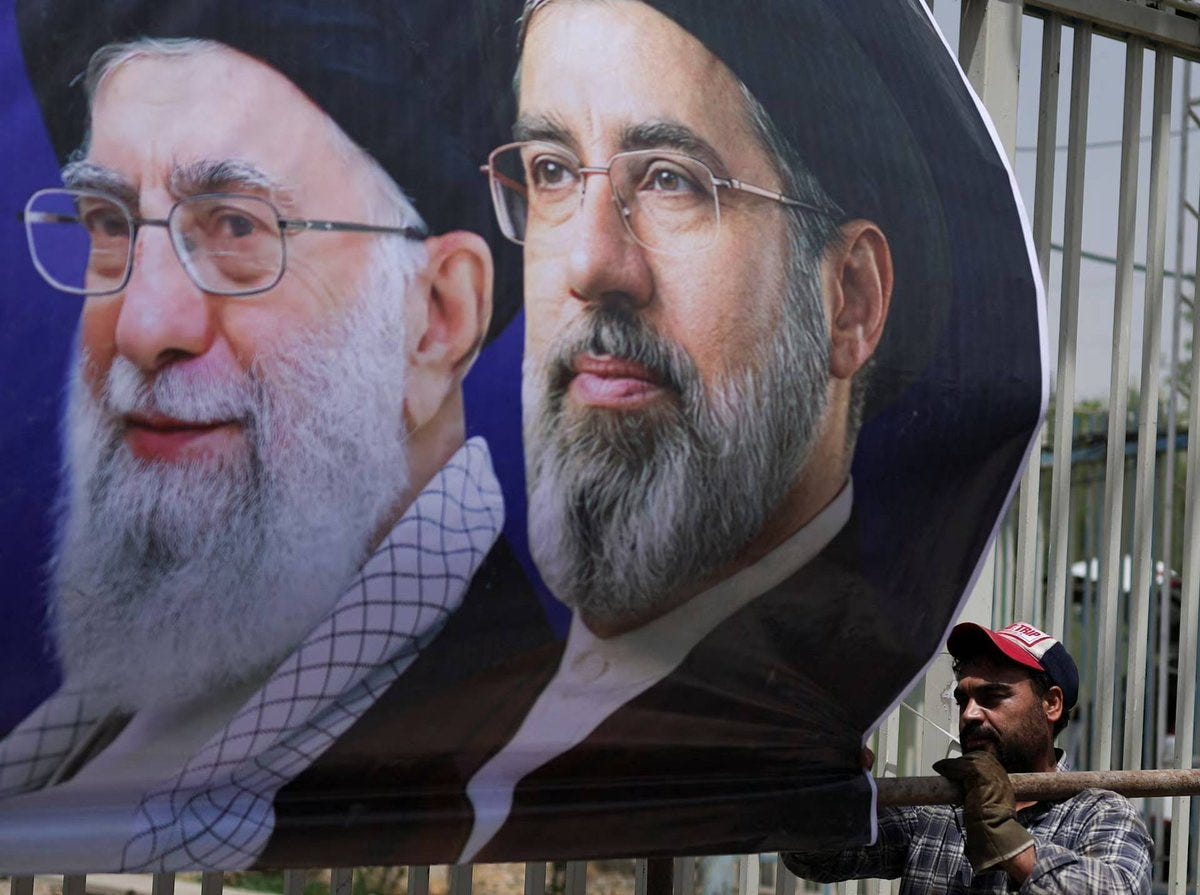
The war is escalating quickly. More Americans have died, more Iranian civilians have died, while infrastructure such as electrical grids, bridges and roads, and desalination plants have been increasingly targeted. Energy infrastructure is next, and that brings with it a whole new set of dangers.
The Trump administration is divided against itself. With no leadership, it is adrift between JD Vance’s attempts at diplomacy and Marco Rubio’s efforts to undermine it in Lebanon and in the Strait. That is the internal contradiction of the administration’s actions, and whether it is being intentionally orchestrated—which seems unlikely—or is simply the result of an incompetent chief executive who can’t get his henchmen on the same page really doesn’t matter.
Trump himself alternates between supporting diplomacy and calling Iran’s leadership “better,” smart, or even rational on some days and stoking war and calling them “crazy” liars, and worse on others.
The Memorandum of Understanding between Iran and the U.S. lays in ruins. It failed for several reasons.
It was not supported by just about anyone, left or right, in or out of government. Few acknowledged that it was the kind of deal that needs to be made. Most either didn’t want a deal at all or wanted some fantasy where “both sides get something,” ignoring the fact that all the U.S. really needs is stability in the Gulf. A deal that provides that is one where Iran is rebuilt, enjoys normal relations with Iraq and the GCC states, abides by the terms of Nuclear Non-Proliferation Treaty, and has come to an agreement on the administration of the Strait of Hormuz.
Most of that, aside from the nuclear issue, was contained in the MoU.
That outcome was good for everyone, including the US. The only one it’s not good for is an Israeli government that insists on belligerence, occupation, and militarism regardless of the consequences for the world, the Palestinians, the rest of the Levant and, indeed, the people of Israel.
The MoU was also beset by a mischaracterization of what it was. It was never meant to be more than a statement of principles and an accompanying agreement to stop shooting and start talking. It was not a peace deal and was never intended to be one.
For those reasons, and more, the MoU is dead, but there is no reason it can’t be revived, and very good reasons not only to do that, but to go much further with it.
There are still long-term ramifications of this war that have yet to be felt. Chief among these is the food crisis that is going to hit months down the road because harvests are thin due to the lack of fertilizer getting out of the Gulf region now, a matter that is getting far less attention than it should because the primary victims will be poor people of the Global South.
But if energy infrastructure is hit, as seems likely, the global economy is likely to face a recession or even a depression that will be difficult to reverse. IOW, we have only had a taste of what might come out of this war, complications that will become even worse if the Russian invasion of Ukraine is not ended, given its impact on both energy and grain markets.
Complicating matters further, the repeated American lies, insulting rhetoric, and lack of any kind of strategy has eliminated any trace of confidence Tehran might have had in the U.S.’ willingness to keep its word. That makes the already monumentally challenging task of diplomacy much harder.
So how do we get out of this?
The players and the process
Given the lack of trust, any resolution to this war is going to need to be facilitated by an international group of players. They should not be close allies of either Iran or the United States but must have credibility with both. This includes a number of key countries, such as Pakistan, France, Türkiye, Egypt, Oman, and, especially China. Since the US has breached its promises so often, while falsely accusing Iran of doing the same, only China would be powerful enough to hold the US to some degree of account. Iran also has the control of the Strait to fall back on, so between those two factors, that might be enough to entice Iran into an agreement despite the well-earned mistrust they have for the U.S.
There needs to be an explicit, time-bound process for ending the war. Neither side can realistically demand an immediate all-or-nothing agreement, but the process also cannot allow each stage to stretch indefinitely and create more openings for spoilers.
The issues will include the following: the Strait of Hormuz, the rebuilding fund for Iran, freeing all frozen Iranian assets, redeployment of American forces, lifting of sanctions on Iran, Iran’s obligations under the NPT, Israel’s numerous occupations, and a regional forum for settling disputes.
Certain presumptions must guide any functioning process.
1. Mutual respect of the other. This goes beyond mere rhetoric, but it starts there. The United States, and especially Trump, must desist from its denigrating language about Iran, and Iran must rein in its own bellicosity in response. Clearly, citizens cannot be forced to silence their rhetoric about the opposing country, but they need not be encouraged by their leaders to engage in it. Granted, this seems impossible with Trump, but any mediator will have to do their best to stop his obnoxious speech.
2. No return to the status quo ante. Iran was attacked without provocation. This should have triggered global outrage, but it didn’t. As such it is unrealistic to expect Iran to simply revert to the way things were. The world ignored its own principles on February 27, out of fear of or collusion with the U.S. and Israel. Iran can’t be expected to forget that.
3. You can’t argue with geography. Trying to mitigate the basic fact of Iran’s ability to disrupt traffic in the Strait of Hormuz is pointless. Geography gave Iran that power, and, since it has been facing off against two major nuclear military powers for 47 years, it is not realistic to expect it to agree to give that power up, even if they could. The location of the Strait makes any such commitment moot in any case.
4. International legal principles must guide the formation of new agreements. The US and Israel trashed international law by attacking Iran without UNSC approval, an instigating event, or an imminent threat. That was a blatant violation of the most basic founding principles of the United Nations. But that should not be taken as proof of the irrelevance of the law, so much as the need for its existence and for all states to abide by it. Applicable international law should guide every step of peace talks.
The peace
1. The first step is an immediate cessation of violence in all spheres: Iran, the Gulf states, the Gulf waters, the Strait, the Red Sea, and Lebanon. The US and Iran respectively will be responsible for their own actions and, to the extent possible, the behavior of their allies.
2. At this first stage, the US will reissue the waiver on the sale and export of Iranian oil to provide some immediate financial relief to address the damage to Iran’s infrastructure.
3. Also in the first stage, Iran will begin work to remove all mines from the Strait of Hormuz. Traffic through the Strait will be coordinated with both Iran and Oman without charge until a permanent arrangement can be put in place. Both Iran and the US will remove their blockades.
4. During this first phase, the terms of a permanent peace will be negotiated. All the terms will be agreed upon and a timetable for enacting each will be laid down, with a maximum of one extension, of negotiated lengths (they need not be the same for every phase), being an option if the ongoing diplomacy should hit snags.
5. During this first phase, the mediating countries will report to the UN Security Council and General Assembly on the compliance of each side. Subsequent, public reports will be made at each phase. If the deadlines are not met, the mediators will be expected to tell the UN bodies and the global public the reasons why. In response, individual UN member states would be encouraged to respond appropriately to convince the belligerents to meet their obligations.
6. Phase two will implement the first of the agreements. This will include the lifting of international and unilateral sanctions related to Iran’s ballistic missile program; a commitment from Ansar Allah not to interfere with international traffic in the Bab al-Mandab; the withdrawal of Israeli forces from Southern Lebanon; and an initial inspection by the IAEA of all Iranian nuclear sites. This last is a one-time inspection meant to establish a baseline for the IAEA and satisfy American paranoia. While Iran will not be happy about giving access to an international body, they will be able to relocate sensitive material before any further commitments, and chances are the Americans and Israelis already know the locations of anything that can’t be relocated. This would be a compromise, but not a major one for Iranian security in exchange for significant sanction relief.
7. Phase two will also include a redeployment of American forces out of the Gulf waters and the initiation of a series of bilateral talks between each of the Gulf states and the US to decide on future American presence in each state. While each state can make its own arrangements, all will agree not to increase American presence beyond the level that existed prior to the 12-day War of June 2025.
8. Phase three will see the declaration by Iran that it remains a party to the NPT and will commit to its principles, as well as those of the Additional Protocol, which will facilitate intrusive inspections. Iran will thereby be committing to enriching uranium only up to 20%, and no more than 5% under normal circumstances. It would need IAEA approval to enrich beyond 5%, and would be monitored constantly by the IAEA. This is Trump’s win, even though it is a less cumbersome inspection regime than the JCPOA. There are consequences both for bad decisions and for launching wars of choice.
9. At that point, nuclear-related sanctions will be lifted.
10. Iran, Iraq, and the GCC states will commit to develop a plan, by the end of phase three, for a new regional security architecture that treats all countries’ security needs as equal and commits to opposing attacks on any of the eight countries by outside states (this would stop short of committing to a NATO-style treaty, but would commit to opposing any such attacks on principle and with diplomatic means. No military commitments).
11. Iran, Iraq, and the GCC states will also agree to a regional tribunal which will be invested with the authority to hold any member state accountable for misdeeds against another and which will mediate disputes that involve the 8 Gulf countries directly or through allied governments or militant groups (this would apply to issues like Yemen, Sudan, Libya, et al), with the stated of finding diplomatic, rather than military/insurgent resolutions to such issues. This would address the concerns about allied militia groups, what are often, incorrectly, called proxies.
12. The GCC states and the US will finalize a plan for a $400 billion investment fund for rebuilding and investing in Iran as well as helping the GCC states and Iraq address damage to their infrastructure suffered during the war. None of these funds may be used to repair any American bases or property in the region.
13. The United States will commit to use all its economic and diplomatic resources to demand that Israel, after its withdrawal from southern Lebanon, will also withdraw from Gaza and Syria. The Eight Gulf countries will come together to construct a unified position on the broader question of Palestine.
14. At the end of phase three, the United States and Iran will exchange ambassadors to encourage bilateral relations and dialogue to avoid confrontation in the future.
A quick ending note on Palestine. It will not escape many readers’ notice that the question of Palestine is not the focus here. I believe that this plan will have enormous impact, not only on Gaza but on the entire question of Palestine. I believe that when and if Iran is truly integrated into the Gulf it will lead to the creation of a new power in the world, between Saudi Arabia’s, as well as a few others’ wealth and Iran’s position in a new global order.
I also believe if this plan, or something like it, is enacted, it will be a huge factor in changing the global political forces that Israel can currently withstand into ones they cannot. I believe that will combine with the shift in major sectors of American politics to force Europe, even Germany, into a position that finally supports Palestinian rights.
I am loathe to say Palestine must wait, and this plan does reflect, at least, ending the genocide in Gaza, which, combined with a curtailing of Israel’s adventurism in Lebanon and Syria will reap immediate benefits throughout Palestine.
I realize this will not satisfy Palestinians, or most of you. But I don’t see a better way to pursue Palestinian rights and pull the whole planet away from the brink of catastrophe that this war has led us to at the same time.
By Sondos Asem, Middle East Eye. July 18, 2026
Al Jazeera, July 18, 2026
By Ryan Grim, Drop Site News, July 17, 2026
By Liam Syed, +972 Magazine, July 16, 2026
By Bijan Khajehpour, Amwaj Media, July 17, 2026
Zeteo, July 18, 2026
The New Arab, July 18, 2026
By Mark Episkopos, Responsible Statecraft, July 17, 2026
Palestine Chronicle, July 19, 2026
Asharq al-Awsat, July 18, 2026
Naharnet, July 17, 2026
By Daniel Johnson, UN News, July 17, 2026
By Spencer Kimball, CNBC, July 17, 2026
By Julian Borger, The Guardian, July 16, 2026
By Norman Solomon, Informed Comment, July 18, 2026
For professional information and contact:
LinkedIn: https://www.linkedin.com/in/mitchell-plitnick-616ba5
Comments
Nothing yet. Say the first thing.
Sign in to join the conversation.