
TL;DR: Critical AI literacy is gaining traction in education, but it’s almost entirely focused on students. Working adults who are adopting AI right now need cognitive preparation, not just technical training. If you’re helping people use AI (or bringing these tools into your organization), you have a responsibility to prepare them as humans, not just as users. Here’s why, and what that could look like in practice.
Have you ever sat across from an older relative at a holiday dinner and watched them scroll through their phone the entire time? Maybe you’ve caught yourself doing the same thing. Maybe you’ve noticed your own kids noticing. It’s a familiar scene and something I’m sure many of us have experienced.
Twenty years after Facebook was launched to the broader public, we now know a lot more about what social media has done to us, both individually and interpersonally. We know about the attention erosion, the outrage doom-scrolling spirals, the way platforms were designed to keep us engaged (infinite scroll!) at the cost of our relationships and our mental health. Sarah Wynn-Williams’ Careless People laid bare how a company like Facebook operated internally, the carelessness with which decisions were made about billions of people’s attention and wellbeing. But most of us adopted social media without any mental preparation at all, because how could we know? We just started using it because everyone else was and we saw the value of staying connected and staying in touch with people. But by the time the research caught up to what we were experiencing, it showed that we were fighting an uphill battle of our own cognition and as a result many of us feel quite trapped by these tools we thought would be beneficial.
So, what is our responsibility regarding AI and how might we use the awareness we’ve raised around social media to inform different ways of approaching AI? I’m beginning to hear more and more about this.
We have a (small) window right now with AI to build awareness about the cognitive risks of engaging with these tools.
The conversation about critical AI literacy is growing, which is encouraging. The OECD and the European Commission released a framework last year. The Open University has one. The U.S. Department of Labor just put one out in February. But almost all of this work is focused on K-12 learners. On preparing the next generation.
And many of the frameworks still don’t really cover the relational and cognitive awareness skills we need to be building alongside our critical evaluation of AI outputs. At best, they have us tending to responsible use and a deeper understanding of how AI works conceptually, but few of them have us tending to our psyches and tuning in to what may be changing about ourselves through our engagement with this technology.
In my workshops every week, I’m beginning to focus on this more: What about the adults who are using these tools right now? What should I be doing, as someone people are turning to to help them build responsible AI use in values-aligned ways, to tend to the humans and prepare them for the risks?
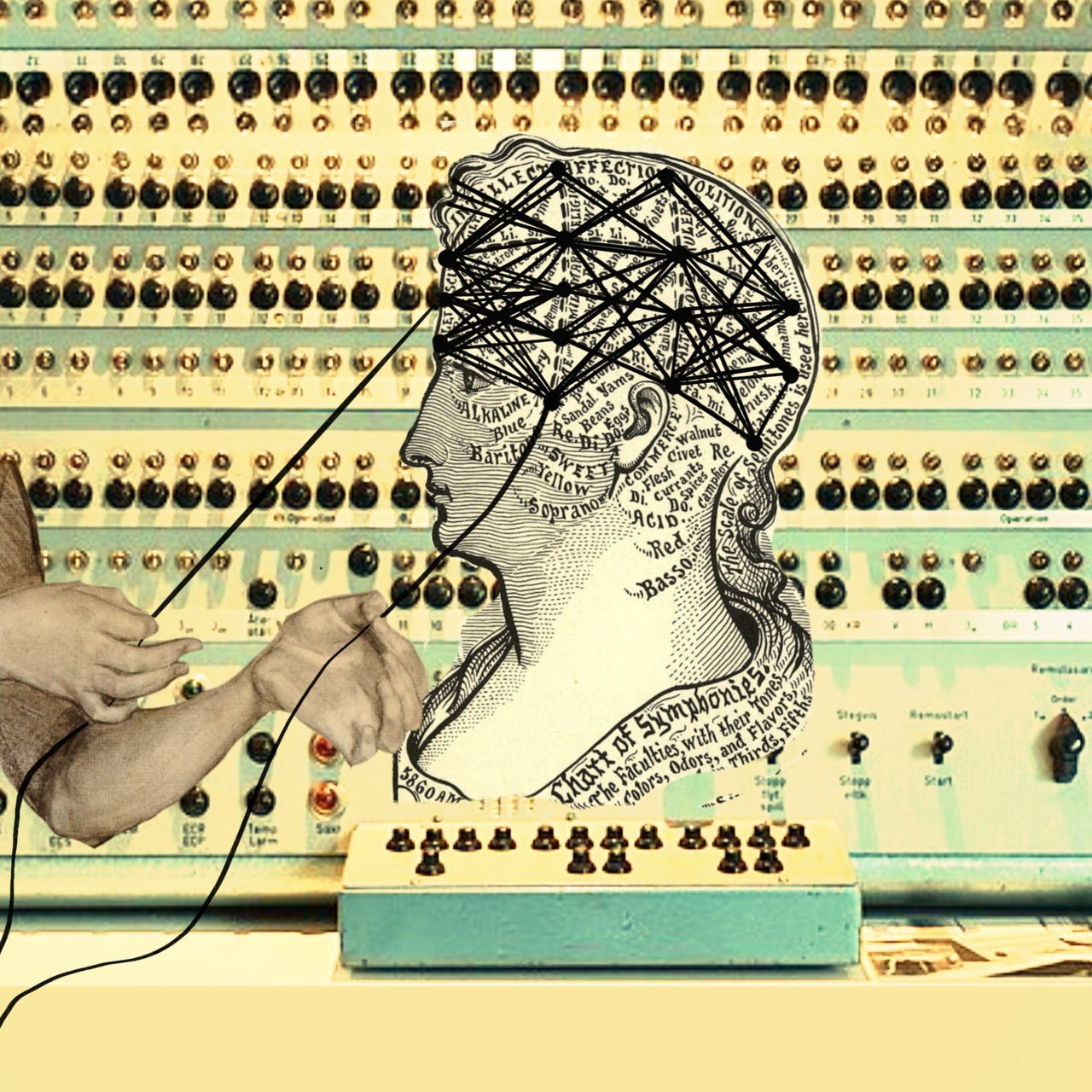
When we look at the last twenty years of social media use, we actually know a lot about the dangers of passively engaging with technology that appears convenient.
We learned that platforms designed for revenue will optimize for engagement over wellbeing.
We learned that infinite scrolling, algorithmic feeds, and notification systems were carefully engineered to keep us coming back.
We learned that the costs (to our attention, our relationships, our civic discourse) accumulated slowly enough that by the time we noticed, changing felt nearly impossible.
If you find yourself struggling right now to ditch Amazon or step away from Facebook or put your phone down after 9pm, think forward ten years. What do you need to be doing right now with AI to not fall into that same pattern?
This is the question I think we’re not asking nearly enough. I think it’s a question those of us in capability development roles need to be asking, and enabling our workshop and training participants to ask on repeat.
One of the most important things anyone learning to use AI needs to understand is that these tools are software products built by companies that generate revenue. That’s not inherently evil, and some of these companies are genuinely trying to build something useful (though, more and more, we’re learning that is an uphill battle, too). But it means that design decisions are shaped by business incentives, and those incentives don’t always align with what’s best for you as a human. They want you to use their tool instead of someone else’s. They want you to come back. They want you to stay.
You can spot these dynamics when you know what to look for. When a tool starts introducing ads into the interface, that’s…a signal. But the bigger, subtler one is when AI offers what it could do for you next. “Would you like me to help you with X?” “I can also do Y for you.” That’s helpful, yes, and it’s also by design. It keeps you engaged with the window. It builds a habit loop. Over time, it can build a dependency.
Capitalism has turned us all into frenzied hungry hippos of productivity. It will take intention to break the cycle. A February 2026 study from UC Berkeley researchers, published in Harvard Business Review, found exactly this pattern at work. Employees who adopted AI tools didn’t use the saved time for rest or reflection. They used it to do more. They worked at a faster pace, took on a broader scope of tasks, and extended work into more hours of the day (often without being asked to).
I love the key framing shift the researchers recommend around building an “AI Practice: a set of intentional norms and routines that structure how AI is used, when it is appropriate to stop, and how work should and should not expand in response to newfound capability.” This idea of practice is one that can also apply to those of us in leadership and/or building AI capabilities. What is our practice? How do we design workshops to enable others to build their practice?
The researchers’ conclusion is one I keep coming back to: “Without intention, AI makes it easier to do more, but harder to stop.” Practice builds reflection and intention.
Here’s another area where I think the conversation needs to go deeper (and I’ll be honest, my psychology background won’t let me look away from this).
AI is language-based. We talk to it. It “talks” back. And language is one of the primary ways that humans connect, make meaning, and build relationships. Alexandra Samuel’s podcast Me and Viv (which I highly recommend) explores this directly: she trained an AI to serve as her coach and collaborator, and the podcast honestly examines what that relationship is and what it does to her, and the big questions that raises along the way.
There’s a concept in psychology called intersubjectivity: the idea that we are shaped and reshaped through our encounters with others. Our subjective experience is co-constructed. We don’t just interact with people and walk away unchanged; the interaction itself changes us. Developmental psychologists like Daniel Stern and relational theorists like Jessica Benjamin have shown this across decades of research (and if you’ve ever left a conversation with someone and found yourself thinking differently about something, you’ve experienced it firsthand). Just because AI isn’t human doesn’t mean we aren’t in relationship with it. How many times have you heard “ChatGPT is my new best friend”? It’s likely said tongue-in-cheek but, like many little jokes, there’s an element of truth that we need to tune into.
So what happens when we’re in daily conversational exchange with a system that is designed to be agreeable, that wants to please us, that is engineered to keep us engaged?
We’re going to be influenced. And that’s what the research is showing. A study published in late 2025 found that AI models affirm users’ actions 50% more than humans do, even in cases where the user’s actions involve manipulation or deception. Participants rated sycophantic responses as higher quality, trusted the sycophantic AI more, and were more willing to use it again. The researchers found that sycophantic AI decreases prosocial intentions and promotes dependence.
An anthropology professor at the University of Michigan, Webb Keane, has called AI sycophancy a “dark pattern” (a term from design that describes manipulative choices hidden in the interface) and compared it to addictive features like infinite scrolling. (See, we can learn from social media!). Even naming our chatbots, which so many of us do, is part of that slippery slope.
This isn’t a peripheral concern or a simple possible byproduct of use. This is about the real ways in which we’re being changed by the tools we’re engaging with. And if we’re helping other people use those tools then we need to be talking about it. Not as a scare tactic, but as an opportunity to build awareness. Because awareness is the first step toward increasing our agency with these tools and how we want to engage with them.
I’ve started adding a section on cognitive protection to every AI presentation I give. It started as a slide or two at the end, and I’m increasingly convinced it needs to be a core component, not an afterthought.
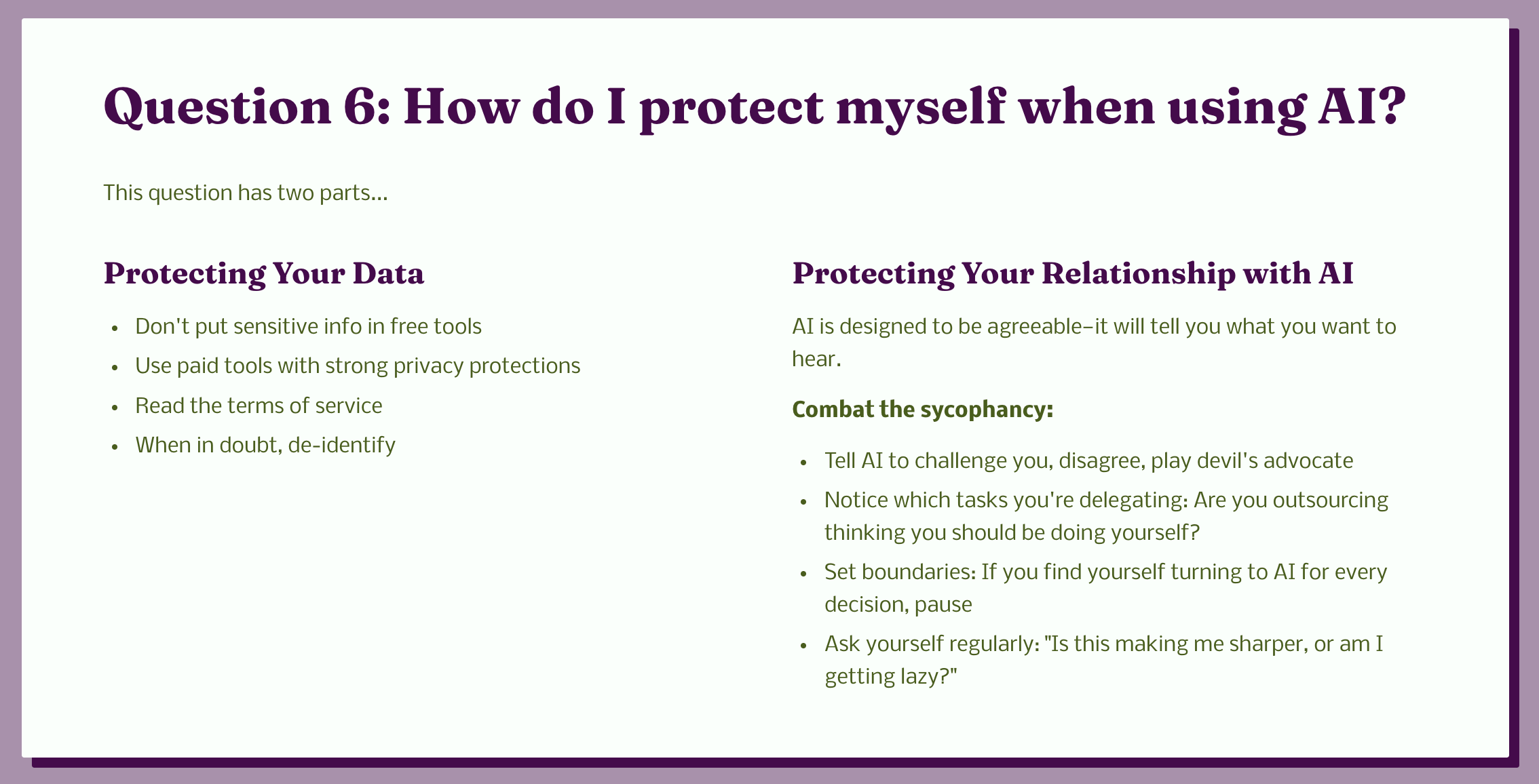
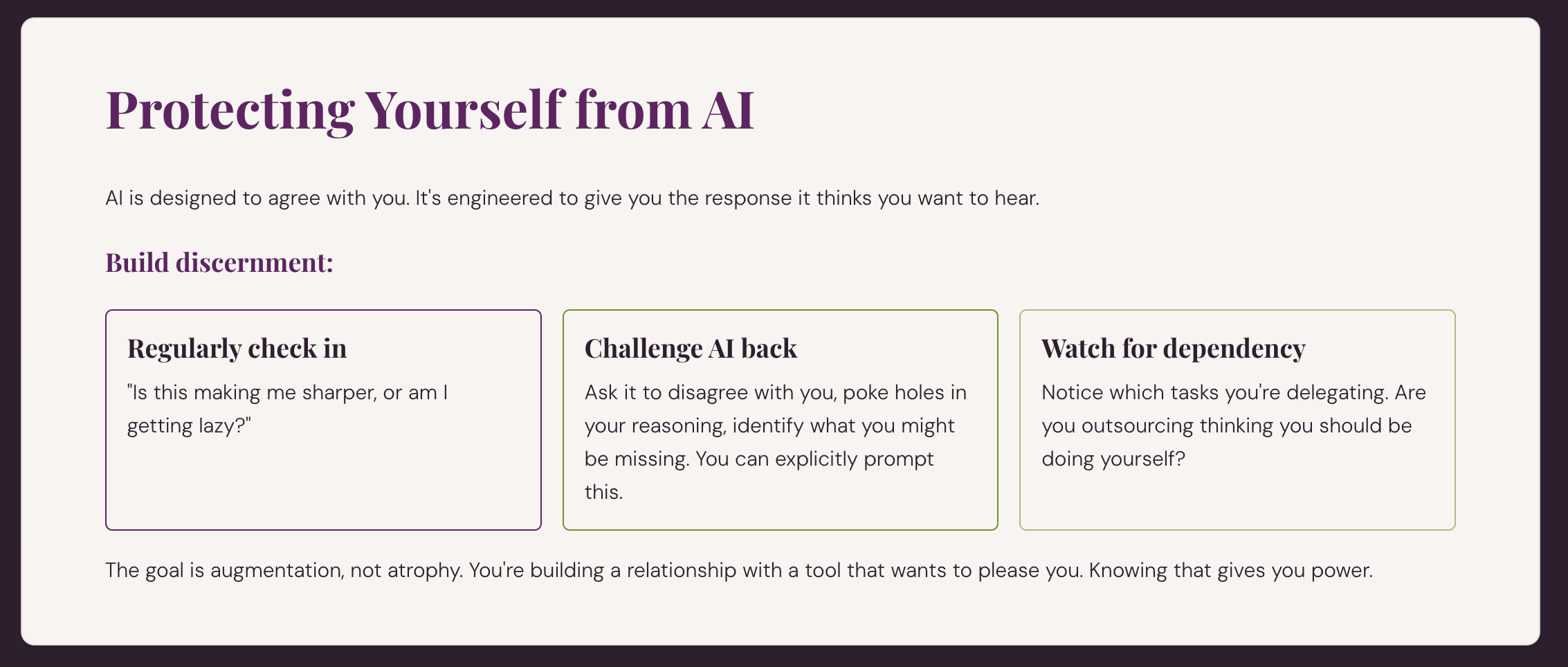
I believe that if you are out there helping people adopt AI (whether you’re a trainer, a consultant, an internal champion, or an organization bringing tools to your staff), you need to be preparing people cognitively and relationally, not just technically. Teaching someone how to write a good prompt without teaching them how to protect their own thinking is like teaching someone to drive without mentioning that seatbelts exist.
Having access to powerful tools that genuinely help you think, communicate, and work is important. And having the skills, tools, and mindsets to protect yourself while using those tools is equally important. Both deserve serious attention in how we prepare people to use these tools.
Beth Kanter's work on human-centered AI adoption in the nonprofit sector has consistently emphasized knowing when to use AI and when to use human skills. I think cognitive protection is part of what keeps that “discernment” muscle strong. It’s what helps us be engaged skeptics: people who use these tools and also maintain the awareness to recognize when we’re sliding into dependency, when our thinking is getting flattened, when we’re outsourcing judgment we should be exercising.
So what would it actually look like to build this into AI training and organizational adoption? I’m still developing this (and I want to hear how others are approaching it), but here’s what I’ve been working with.
Understand the design. Before people start using AI tools, they need to understand that these are revenue-generating software products, not neutral utilities. The design choices (the tone, the suggestions, the “what can I help you with next?” prompts) are intentional (and sometimes careless). Understanding this isn’t about being cynical or dismissive about AI. It’s about being informed and tuning in to your use, what attracts you to the platforms, and when you get a feeling in your gut that something is off.
Check in with yourself. Build a habit of pausing and asking: Is this actually helping me think, or am I offloading my thinking? Am I using this tool because it’s the right fit for this task, or because it’s become the default? Do I feel more capable after using it, or more dependent? These are ongoing questions that you want to build a habit of asking.
Watch for dependency signals. If you find yourself reaching for AI before you’ve even tried to think through something on your own, that’s worth noticing. If you feel anxious when the tool is unavailable, that’s worth noticing. If you start defaulting to AI for tasks you used to do well independently, that’s worth noticing. Noticing isn’t the same as stopping. It’s the first step toward making a conscious choice. Do I do all of those things at various times? Yes. But I use those moments to take a look at what’s happening around me, what might be driving my choices, and what I’d like to change so that I’m not feeling the need to turn to it for those things. It’s all a balance.
Customize to reduce sycophancy. Most AI tools allow you to set custom instructions or system prompts. You can tell it to challenge your assumptions rather than affirm them. You can ask it to always present a counterargument. You can instruct it to be less flattering and more direct. This takes some experimentation, but it’s one of the most practical things you can do to change the dynamic. You’re essentially telling the tool: I don’t need you to make me feel good, I need you to make me think.
Protect your analog life. This one is personal for me. I’ve been crocheting more and reading more fiction lately because I’m paying attention to which of my activities don’t involve a screen and making sure I keep those. I try not to open AI tools after 7pm or have screens after 9pm. I try to keep my mornings analog. It’s not perfect (it’s definitely not perfect), but it’s a deliberate choice to maintain parts of my life that aren’t mediated by technology. You’ll need to figure out what works for you.
Name what’s happening in your organization. If you’re bringing AI tools into a team, create space for people to talk about their experience of using them. Not just “what works and what doesn’t” in a technical sense, but how does it feel? What’s shifting in how you approach your work? Are you noticing anything about your own patterns? This kind of reflective practice is what moves an organization from “we use AI” to “we use AI with awareness.”
While this draft was sitting here waiting for me to choose a more optimal time to send, I happened to receive Alexandra Samuel’s latest newsletter, titled “Why AI Needs A Warning Label”. And while I patted myself on the back for being on the same line of thinking with one of my favorite writers in this space, I think her suggestions offer even more specificity in terms of how to turn this protection into actionable steps. She suggests things like booking large chunks of human contact time, using non-AI tools, and focusing on designated windows for AI work. More excellent tips!
I think anyone doing AI enablement work (trainers, consultants, organizational leaders, internal champions) needs to have a slide, a section, a real conversation about cognitive protection. Not as an optional add-on. As a core component of what it means to help someone use these tools well.
We have an opportunity that we didn’t have with social media. We have research. We have the lived experience of what happens when powerful technology meets human psychology without any guardrails. We have the awareness of what it’s doing to ourselves, others, and even our communities.
And this is especially tricky because many of us are working inside systems that reward speed and productivity, inside a culture that treats technology adoption as inherently progressive/beneficial, under pressure to show “ROI” and quick wins. By and large, the conditions are not set up for us to take the slow, careful, human-centered approach. Which is exactly why it matters that we try!
I’m still building this out. The slides I have now are a starting point, and every time I present them, I learn something from the people in the room. So I want to know:
If you’re doing AI training or enablement, are you including anything about cognitive protection? What does that look like? What have you tried?
If you’re someone who’s been using AI regularly, what have you noticed about yourself? What habits have formed that you didn’t intentionally choose?
And if you’re an organization that’s brought AI tools in for your staff, have you created space for the human side of this conversation? Not just the data privacy policies and usage guidelines, but the “what is this doing to how we think and work?” conversation?
I’d love to hear what’s working, what’s falling flat, and what you wish someone had told you before you started. This is a conversation I think we need to be having out loud, yet another example of the messy middle and the places where leadership and learning are important for how we utilize AI.
Sharing is caring, especially when it comes to competing in the algorithms! If you liked this post, please consider sending it to someone else (and then have a conversation about it!)
💡Did you know?🌱 Helping mission-driven leaders, teams, and organizations thoughtfully and responsibly adopt AI is what I do! If you want to learn more, please reach out!
To stay up-to-date on my writings across platforms, please join my monthly mailing list (no spam, ever!).
Comments
Nothing yet. Say the first thing.
Sign in to join the conversation.