
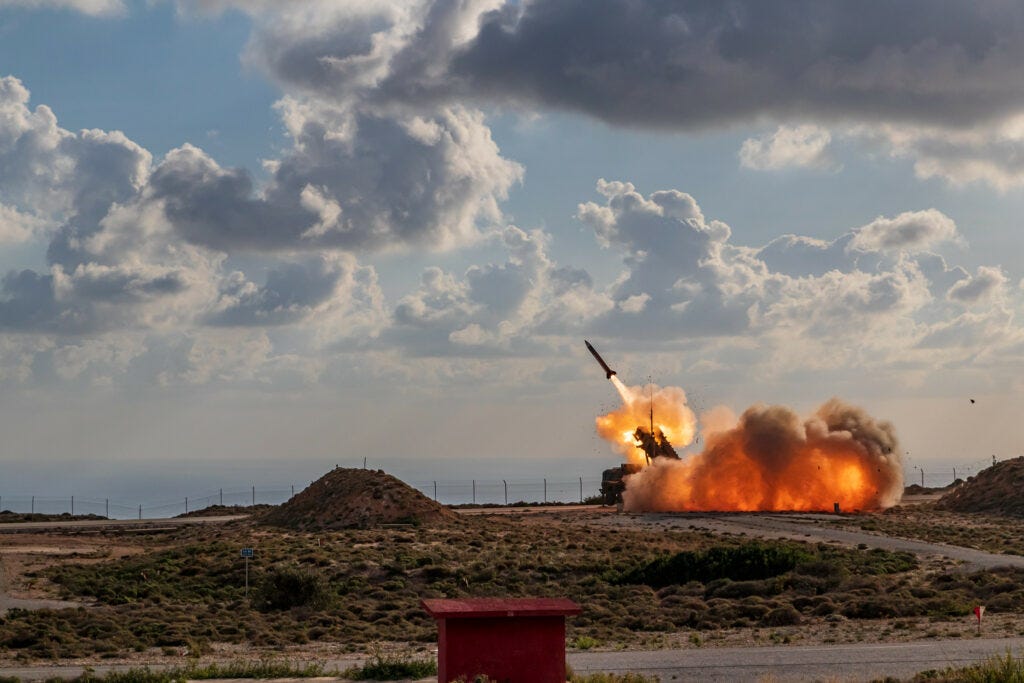
Picture: Bundeswehr / Lars Koch
Over the last six weeks, Ukraine has suffered heavy missile bombardment from Russia, arguably the most severe since the war began.
In contrast to previous attack episodes, current Russian missile salvos cluster heavily around high-velocity missile systems, notably surface- and air-launched ballistic missiles. Ukraine’s depleted missile defense stockpile appears no longer able to sustain an effective defense.
This post examines the causes and consequences of Ukraine’s missile defense crisis and outlines what to expect over the coming months, including whether the situation can be expected to improve.
Russia's ballistic missile threat: Iskander, Kinzhal, and Zircon
In recent months, the primary Russian missile threat has shifted toward the high-velocity spectrum. At its core are Russia’s ballistic missile capabilities, notably the 9M723 short-range ballistic missile used in the Iskander-M system and the Kh-47M2 Kinzhal, an air-launched ballistic missile.
The 3M22 Zircon increasingly features in these salvos as well. Officially unveiled in 2019 and originally advertised as a scramjet-propelled hypersonic cruise missile, it appears in practice to be another type of aeroballistic missile, fairly similar in its capability profile to the 9M723 and Kinzhal. Around 15 were launched in June and July, respectively.
Russia complements these ballistic missile attacks with launches of S-400 surface-to-air missiles repurposed for ground-attack missions. While less accurate and lethal, they still represent a threat to civilian infrastructure, particularly when launched against densely populated areas.
Ukraine’s defense is failing to keep pace. Data from the Ukrainian Air Force, compiled by my colleague Pavlo Krasnomovets, suggests that 180 ballistic and quasi-ballistic missiles (9M723, Kinzhal, Zircon, repurposed S-400 interceptors) were launched by Russia in July, of which 143 could not be intercepted. August looks worse still. Out of 52 ballistic missiles launched, only one successful interception is reported so far.
Why ballistic missile defense is difficult
Ukraine appears increasingly unable to defend effectively against the growing numbers of ballistic missiles Russia is launching. In many ways, this is unsurprising and the natural consequence of the structural reality the high-velocity missile domain imposes.
First, defending against ballistic missile threats is technologically challenging. Ballistic missile defense requires highly optimized interceptor missiles capable of generating a defendable footprint against targets approaching from high altitude at speed and actively maneuvering to evade defenses. This means the interceptor must gain altitude very quickly while retaining high maneuverability and extreme accuracy in its terminal approach.
Second, because defending against these threats requires high-tech solutions, ballistic missile defense is expensive, with individual interceptors costing millions of dollars. In addition, because the demands placed on individual components of these systems are so high, scaling the supply chain to produce large numbers of interceptors is inherently difficult, particularly without long lead times.
Third, unlike with other types of missile systems, operational ingenuity cannot compensate for a lack of technology. Without access to the high-tech systems needed, even the most operationally proficient defender will be unable to mount a credible defense. This is fundamentally different from long-range drone defense, for example, where Ukraine's operational experience has enabled a highly effective defense even without the most advanced technology. In the ballistic missile defense context, this cannot be replicated.
Fourth, velocities, and as a result closing speeds, are so high that defenders must launch interceptors according to a so-called “ripple-fire” doctrine to ensure a higher chance of success. Shoot-look-shoot approaches, by contrast, are only possible against slower threats, where engagement windows are significantly longer. Over the medium to long term, this makes the cost disadvantage of ballistic missile defense particularly daunting.
As such, the difficulties Ukraine experiences in defending against Russian ballistic missiles are neither temporary nor the result of an unfortunate set of circumstances (though short-term developments, such as the Iran War further compressing global interceptor availability, exacerbate the problem). They are the result of the structural reality that the ballistic missile domain imposes on defenders.
Short-term solutions: passive defense and deep strikes
What, if anything, can Ukraine and its partners do to alleviate the pressure? Over the short term, improving the situation will be difficult, and expanding Ukraine’s options for active defense (the means to effectively engage incoming ballistic missiles) appear largely unavailable.
European Patriot interceptor arsenals have reached the point where military and political officials find it more or less impossible to justify giving away additional stocks. The last confirmed PAC-3 MSE delivery of only 35 interceptors around March 2026, reportedly requiring a major political effort by the German Ministry of Defense to secure, illustrates how scarce available European supply has become.
As such, the best defensive effort Ukraine can likely make in the short term is to strengthen its passive defenses. This means improving the resilience of high-value targets by dispersing and hardening them against attack, including by accelerating efforts to move critical infrastructure underground. Ordering and stockpiling spare parts to rapidly restore destroyed infrastructure will similarly be crucial.
Beyond that, Ukraine can only continue to expand and advance its own deep-strike efforts, focusing on destroying critical targets inside Russia to keep attrition mutual rather than unilateral. Wherever possible, Ukraine will continue to target Russian production capacity, but it is unlikely that any single strike, or succession of strikes, will fundamentally disrupt Russian production of ballistic missiles.
Longer-term solutions: PAC-2 GEM-T production and SAMP/T NG deliveries
By 2027, the situation could improve, even if only relative to the admittedly disastrous baseline of mid-2026.
Later this year, MBDA Germany’s license-production facility will begin producing PAC-2 GEM-T interceptors for Patriot, working to fulfill a 1,000-unit order placed in January 2024 through the NATO Support and Procurement Agency on behalf of Germany, the Netherlands, Romania, and Spain.
At the capacity originally planned, the German facility will likely produce between 120 and 170 PAC-2 GEM-T interceptors per year, though efforts to expand that capacity may already be underway. In any case, once the facility begins delivering all-up rounds to customers sometime in 2027, this will create a stream of newly built interceptors that can be drawn on instead of increasingly scarce existing stocks. Even then, however, Ukraine could likely expect only a high double-digit to low three-digit number of additional interceptors per year (compared to the 700 to 800-plus ballistic missiles Russia may currently produce).
Beyond PAC-2 GEM-T, Ukraine has ordered four fire units of the SAMP/T NG, the next-generation system of the Franco-Italian competitor to Patriot, which will begin arriving in 2027. France has also pledged to bridge the delivery gap with two current-generation SAMP/T fire units, likely arriving by the end of this year.
With the SAMP/T NG, Ukraine will also take delivery of the improved Aster 30B1NT interceptor, which could offer enhanced capability against ballistic missile threats, notably through a Ka-band radar seeker that provides higher resolution and terminal accuracy than that of the current-generation Aster 30B1.
Beyond 2027, longer-term projects such as Project Freya and other European low-cost ballistic missile interceptor programs may come to bear, though their status remains unknown and difficult to assess at this stage. Quick fixes should not be expected here either.
Conclusion
Ukraine’s missile defense crisis is structural. Ballistic missile defense currently favors the attacker in cost, production speed, and scale, and no short-term delivery or operational fix can offset that imbalance. Until new interceptor supply arrives, passive defense and sustained deep strikes into Russia remain the only meaningful levers Ukraine retains.
In case you have missed it: Missile Matters has started offering a paid tier. You can read more about the reasoning and benefits here. Next week’s post, which will focus on the export potential of Ukrainian long-range drones and missiles, will only be available to paid subscribers. You can upgrade your membership here if you don’t want to miss it. Thank you for your support.
No posts
Comments
Nothing yet. Say the first thing.
Sign in to join the conversation.