
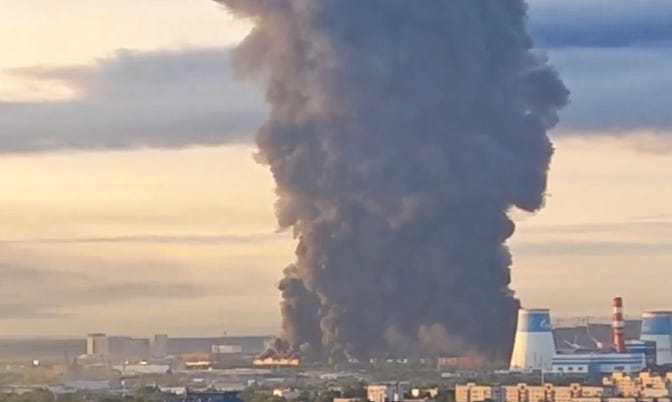
Picture: screenshot via X
Between 18 and 24 July, Ukrainian drones struck several Wildberries logistics hubs, Russia’s largest online retailer, in a series of attacks. Russian analysts estimated the economic damage at up to 1.3 billion USD, with separate assessments valuing destroyed goods still higher.
The attacks intensify Ukraine’s already expanding long-range strike campaign. But beyond the attritional logic of these strikes, they reveal something about the transformed nature of the Ukrainian state. Charles Tilly famously argued that war made the state and the state made war.
Ukraine’s case suggests a contemporary variant: the state makes the missile, and the missile makes the state.1 Ukraine’s deep-strike capability has done more than expand its military options. In more than one way, it has transformed what Ukraine is on the international stage.
The state makes the missile
The first part of the story is industrial history, and I have covered it in detail before. Early in the war, Ukraine made it a priority to develop, build, and expand its deep-strike capability. What began in 2022 as a crash program to convert existing Neptune anti-ship cruise missiles into a land-attack capability had grown, by mid-2026, into what can reasonably be described as one of the world’s most powerful and diverse deep-strike arsenals.
The 19th Separate Missile Brigade, which in 2022 fired hastily reinstated, previously decommissioned Soviet-legacy Tochka-U ballistic missiles at targets no more than 120 kilometers away, now launches cruise missiles and long-range drones at ranges of thousands of kilometers.
Of course, acquiring this arsenal meant building more than just missiles. It required an industrial base, a planning bureaucracy, targeting infrastructure and processes, and financing arrangements. That is the material precondition the Ukrainian state created. The more interesting question is what this machinery created in return.
The missile makes the state
Deep strike, especially at the scale Ukraine is able to muster, confers what Thomas Schelling famously called the “power to hurt”. A state that can credibly and sustainably hold an adversary’s economy at risk, seemingly at will and with the adversary having only limited means to defend against or respond to the strikes, occupies a different category of actorhood in the international system.
Nuclear weapons offer perhaps the closest precedent. They created a social category, the nuclear weapon state, that exists through recognition and reorders how every other actor treats members in this category. Ukraine has not suddenly become a great power, nor anything akin to a nuclear weapon state. What has emerged is qualitatively different, arguably less dramatic, but still meaningful. Sovereign deep strike has granted Ukraine a level of recognition and agency it did not have before.
No less consequential is what Ukraine’s deep-strike arsenal does to Russia, and how it operates not only on state capacity but on Russian and Ukrainian self-understanding. As commentators have correctly pointed out, the Wildberries strikes destroy the last illusion of a comfortable peacetime existence for Russian society. Increasingly, the crucial variable appears to be what Ukraine wants to target rather than what it can target. Destruction that ran in one direction at the start of the war now runs in both directions four years in. Ukraine’s deep-strike campaign cuts directly against Russian society’s image of itself as powerful, protected, and untouchable, and against its sense of superiority in relation to others, particularly Ukraine.
This is also why the argument does not stand or fall on battle damage assessments. From the perspective adopted here, the extent to which the strikes actually degrade military logistics, supply chains, or Russian state capacity as a whole is of secondary importance. Ukrainian deep strike has a constitutive effect, and that effect persists as long as Ukraine demonstrably possesses and exercises the capability, independent of how quickly destroyed depots are rebuilt, or a damaged refinery is brought back online.
The state the missile made
This constitutive effect has observable implications.
Permission politics, it appears, has ended for good. The Wildberries campaign was, by all appearances, planned, justified, and executed by Kyiv alone. No Western capital was asked. Zelensky publicly answered for the target selection, stating that the facilities supply components for Russian drone production. If anything, the causal chain has reversed: Wildberries’ banking arm was sanctioned by the EU after the strike campaign began, with Western policy following a target set chosen in Kyiv. This sequencing would arguably have been unthinkable for most of this war.
Even more concretely, the campaign is framed as coercion intended to force Moscow into negotiations: pain applied today, relief offered in exchange for concessions tomorrow. The capacity to inflict and withhold pain is a key factor turning Ukraine into a party to the bargaining over the future of Ukraine, Europe, and the wider world, rather than a subject of it. For much of the war, Ukraine’s future was shaped, or at least feared to be shaped, by Western capitals reacting to Russian manipulation of risk. Ukraine now holds the power to manipulate that risk itself. Ukraine has turned from a coerced state into a coercing one.
There is, of course, an irony in how this transformation came about. It was Russia’s full-scale aggression that created Ukraine’s demand for deep strike, ultimately laying the foundation of what Ukraine is today. And it was Western refusal, and at times inability, to meet Ukraine’s demand for deep-strike capabilities, including political authorization for target selection, that greatly accelerated Ukraine’s indigenous long-range drone and missile efforts, ensuring that Ukraine would eventually field a sovereign capability in the fullest sense. Moscow, Berlin, and Washington are therefore co-authors of Ukraine’s missile arsenal and of the state it has become, even if in different respects and to different degrees.
The missile at the table
The implications extend to the negotiating table. Capabilities can be capped on paper, and production can, in principle, be limited by agreement. Actorhood is harder to regulate. Once the international system has come to recognize a state as one that holds the power to hurt, that recognition is unlikely to be withdrawn by treaty. Any settlement that seeks to constrain Ukraine’s deep-strike arsenal would, in negotiating over it, tend to affirm the very status the arsenal created and that Russia will seek to limit.
This is worth keeping in mind as pressure for a negotiated end to the war grows. The Ukrainian state that enters those talks differs in important respects from the state Russia invaded in 2022: a missile power in its own right, retaining the power to hurt, bargaining in its own name. Russia will be negotiating with the missile on the table and state the missile made.
Credits to Benjamin Tallis for coining this sentence.
No posts
Comments
Nothing yet. Say the first thing.
Sign in to join the conversation.