
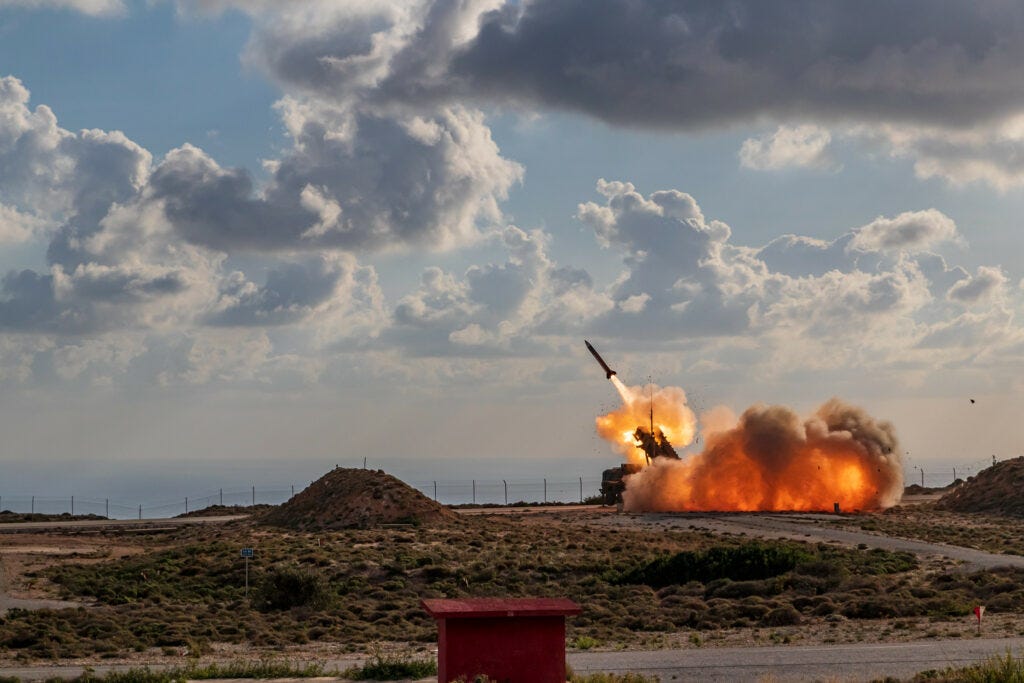
Picture: Bundeswehr / Lars Koch
The annual NATO summit in Ankara has resulted in an unusually large number of license production agreements for missile systems.
Two license production deals deserve particular attention: the American-Ukrainian announcement to license-produce Patriot interceptors in Ukraine, and the German-Ukrainian agreement to license-produce Bars mini cruise missiles in Germany. Both cases are illustrative, as they occur under very different structural conditions, both in terms of the technological complexity of the licensed missile system and the industrial environment in the producing state.
This post explains the logic behind licensed missile production before discussing the two licensed production agreements.
License production of missile systems
Licensed production agreements grant a foreign government or firm the right to manufacture a weapon system domestically under license from the original developer, typically involving significant technology transfer and local assembly using imported or co-produced components. In return, the licensor receives royalties or fees for access to the intellectual property.
In principle, such agreements benefit both parties. The licensee gains domestic industrial capacity, technological know-how, and reduced procurement costs. The licensor secures market access and profit. Licensing can also expand the missile system's global supply, potentially increasing the licensor’s revenue and market share more broadly.
Beyond the economic logic, license production agreements have historically served as political tools. Given the often significant intellectual property transfers involved, governments and manufacturers are typically selective in granting them, and doing so signals a degree of trust and political alignment.
For example, at the turn of the 1960s, Belgium, France, Italy, the Netherlands, and West Germany agreed under a NATO memorandum of understanding to co-produce the U.S.-origin MIM-23 Hawk surface-to-air missile in Europe, embedding American missile technology into Europe’s industrial base. From the late 1950s, under Sino-Soviet military-technical cooperation, China obtained the S-75 (SA-2) system and began producing it as the HQ-1. After Soviet advisers were withdrawn in 1960 amid the Sino-Soviet split, Moscow suspended assistance, and China reverse-engineered and progressively indigenized the design.
License production of Patriot interceptors in Ukraine
The license production agreement that has received the most attention is Trump’s announcement to grant Ukraine a license to manufacture Patriot interceptor missiles — desperately needed as Russia’s ballistic missile barrage of Ukraine intensifies. Details on the agreement remain murky. It is not even clear which Patriot interceptor Ukraine will be licensed to produce, though the PAC-2 GEM-T is the most likely candidate.
Currently, only Mitsubishi Heavy Industries (MHI) is licensed to produce PAC-3 MSE interceptors, at a low rate of around 30 units per year, though discussions to increase this rate are ongoing. Japan has produced Patriot interceptors under license since the late 1980s, beginning in the PAC-2 era and moving to the PAC-3 after a 2005 US–Japan licensing agreement, with MHI-built PAC-3 rounds fielded from around 2009. Only in December 2025 did MHI contract to produce the newer PAC-3 MSE domestically
Outside Japan, the only other country granted a license to produce Patriot interceptors is Germany, which will begin producing PAC-2 GEM-T interceptors at a new facility operated by MBDA Germany later in 2026. In June 2024, Lockheed Martin and Rheinmetall signed an MoU to localize advanced military technologies in Germany. In May 2025, Rheinmetall stated its ambition to produce PAC-3 MSE interceptors in Germany as part of a proposed joint venture with Lockheed Martin. Rheinmetall CEO Papperger cited European demand for 250–300 PAC-3 MSE per year, which Rheinmetall’s production capacity could meet. Since then, no further progress has been reported, and it now appears that licensed production efforts related to the PAC-3 MSE have been effectively discontinued.
It remains unclear why negotiations over PAC-3 MSE production in Germany stalled, whether the American manufacturer opted to prioritize domestic expansion instead, or whether the U.S. government effectively vetoed the technology transfer. Whatever the reason, it is unlikely to be overturned in Ukraine’s case. Patriot PAC-2 GEM-T license production, therefore, remains the most plausible course of action.
In addition, even localizing production of the less advanced PAC-2 GEM-T interceptor will be anything but easy. License production only makes sense for Ukraine if it expands the global supply chain for Patriot interceptors, meaning qualified Ukrainian suppliers must be identified and certified for components such as the IMU, battery, warhead, fuze, solid-rocket motor, and seeker. Given that Ukrainian manufacturers have little to no experience in air defense missile production, this process would take considerable time.
For comparison, the license production process for Germany, from the announcement of the PAC-2 GEM-T production line in January 2024 to the delivery of the first interceptor scheduled for 2027, will have spanned over three years. That timeline was aided by the vast network of potential suppliers already available in Germany, which, as far as can be assessed, does not currently exist in Ukraine. Ukrainian industry, while world-leading in long-range drone defense, has limited to no experience in ballistic missile defense.
Any license production agreement and technology transfer will therefore require a longer-term effort, one further complicated by the need to disperse component production and final assembly, or even move them underground, given that any such facility would constitute a high-value target for Russian strikes. An alternative could be to rely, at least in part, on a broader network of European suppliers to supply a Ukrainian final assembly facility. The extent to which this will be pursued remains to be seen.
Even if a license production agreement does not yield short-term success, it remains an important step and a win for Ukraine. Should the war end before any Patriot facility comes online, Ukraine would still become part of the global Patriot supplier network, which could be highly lucrative and would advance Ukraine’s own defense-industrial ambitions in this space.
License production of Bars mini cruise missiles in Germany
A different license production agreement, but no less consequential, concerns plans to license the production of Bars mini cruise missiles in Germany. An agreement to that end was signed between the German Minister of Defense and the Ukrainian Foreign Minister in Ankara.
The name “Bars” refers to a family of ground-launched low-cost one-way effectors used by Ukraine. The baseline Bars reportedly has a range of 700-800 kilometers and an unspecified payload. Its existence was first publicly revealed in April 2025, with its appearance unveiled in December that year. A modified version, the Bars RS, was exhibited at Eurosatory 2026, extending the missile’s range to 1,000 kilometers and carrying a 22-kilogram payload. Variants with 60- and 105-kilogram payload capacities are also reportedly available, with the increased payload presumably coming at the cost of a proportional reduction in maximum range. The Bars RS was involved in Ukraine’s recent successful strikes against Moscow and is generally reported to have seen significant combat use.
The Bars missile family is equipped with a small, top-mounted turbojet engine. Past imagery of the missile depicted the Kingtech K-450, a small, lightweight turbojet manufactured in Taiwan. That engine has a relatively low thrust of 0.44 kilonewtons, which, together with the missile’s somewhat clunky design and correspondingly higher drag, is the main reason for the Bars’ comparatively low average speed (around 400 to 450 kilometers per hour). That said, given the engine’s top-mounted design rather than integration into the fuselage, replacing it with an alternative, potentially higher-thrust engine, should be fairly straightforward.
Similar to the undisclosed Ukrainian manufacturer of the Bars, the German license production partner is unknown. That said, there are several plausible candidates in Germany. Among them is Diehl Defence, which already has extensive engagements with Ukrainian missile manufacturers and could feasibly produce the majority of components — including the warhead, sensors, and fuselage — in-house, while sourcing the rest from external suppliers. Diehl could, for instance, either continue importing the Kingtech engine previously seen on the Bars or localize the supply chain by sourcing from German engine suppliers such as ADW (recently acquired by MTU) or Jetcat, should they be able to offer suitable products in this class.
The license production agreement is significant for two reasons.
First, the missile’s relatively simple design, combined with German manufacturers’ experience in the field, means substantial numbers could likely be produced quickly. In many ways, this low-tech, high-experience combination is the opposite of the high-tech, low-experience dynamic described above for Patriot. Under the current agreement, all Bars missiles built in Germany will initially go to Ukraine, providing the potential to boost output and employment for the system in the short- to medium-term.
Second, even though the entire German supply will initially go to Ukraine, there is the potential to divert some output to German stocks if desired. Short of that, the agreement still contributes to Germany’s industrial resilience by building a low-cost cruise missile supply chain for a system that currently has no domestic equivalent. Should it become necessary, the resulting experience and supply chain infrastructure could be redirected to other programs to quickly scale the output of this weapon class.
No posts
Comments
Nothing yet. Say the first thing.
Sign in to join the conversation.