
Before children, I didn’t clock how tacitly (and peacefully) the workplace is divided between parents and non-parents. In my 20s and early 30s, I saw parents say no to happy hours, look more tired some mornings, or seem distracted after getting a text. Sometimes they talked about their kids, especially if you asked, but mostly tried to Severance themselves from their home life a bit.
Better, easier, and more likable to have a work self. Although I wished they could have just played hooky from bedtime obligations to join us for karaoke more often, their matter-of-factness and ability to just say “no” somehow made them cool, above the too-tipsy time we were all about to have.
I never understood how they could do that.


See, when I became pregnant with my son, I worked at a startup where my role was becoming increasingly superfluous and ambiguous by the day. As a result, I somehow manifested the most ideal situation possible. My role was eliminated, I was let go, but still paid my salary. In fact, the very words I had uttered weeks before, while commiserating with coworkers on an afternoon walk, were, “Can’t they just let me go but still pay me?”
Apparently, they could, and they did. In an effort to get rid of their squeaky wheel, without the legal ramifications of eliminating the role of a pregnant person, they offered to let me ride out the rest of my pregnancy, fully paid as an employee for two months, and then through three months of maternity leave. At the end of the year, our contract would end.
It was pretty much as great as you can imagine it would be, to be honest. I was miserable at the job, and set free with no strings attached. It was summertime, and I lived at the pool for my twice-a-week prenatal swim class, lounged around, had long lunches with friends, and took on as much freelance work as possible to set myself up for a long maternity leave. My husband was finally working in TV, and everything felt bountiful and easy.
When I was ready to come back to work six months postpartum, the world had other plans. Suddenly, my FOMO disappeared with everyone else stuck at home too in quarantine. Another full-time job, let alone an office, would have to wait. Though I’d always been a side-hustler, I was surprised to find myself flush with freelance opporunity. With my husband able to provide our insurance through his union, I happily rode a wave of steady retainers, big projects, and short-term gigs for several years.
Parenting, housekeeping, and work all became intertwined into one amorphous schedule. His naptimes dictated my meetings, and sometimes my calls happened from a playground. Becoming a working parent during the pandemic sure had its perks. I never had to lug a breast pump to an office or cry over the guilt of putting him in daycare before he could crawl. I never had to question whether my salary was worth the high cost of childcare or missing out on his first year of life. I was there for every minute of everything, at work and at home––because they coexisted in the same mental and physical space. You don’t really need to construct many boundaries with work when you’ve designed it around parenting responsibilities. I was blazing a different path as a working parent that had been modeled for me.
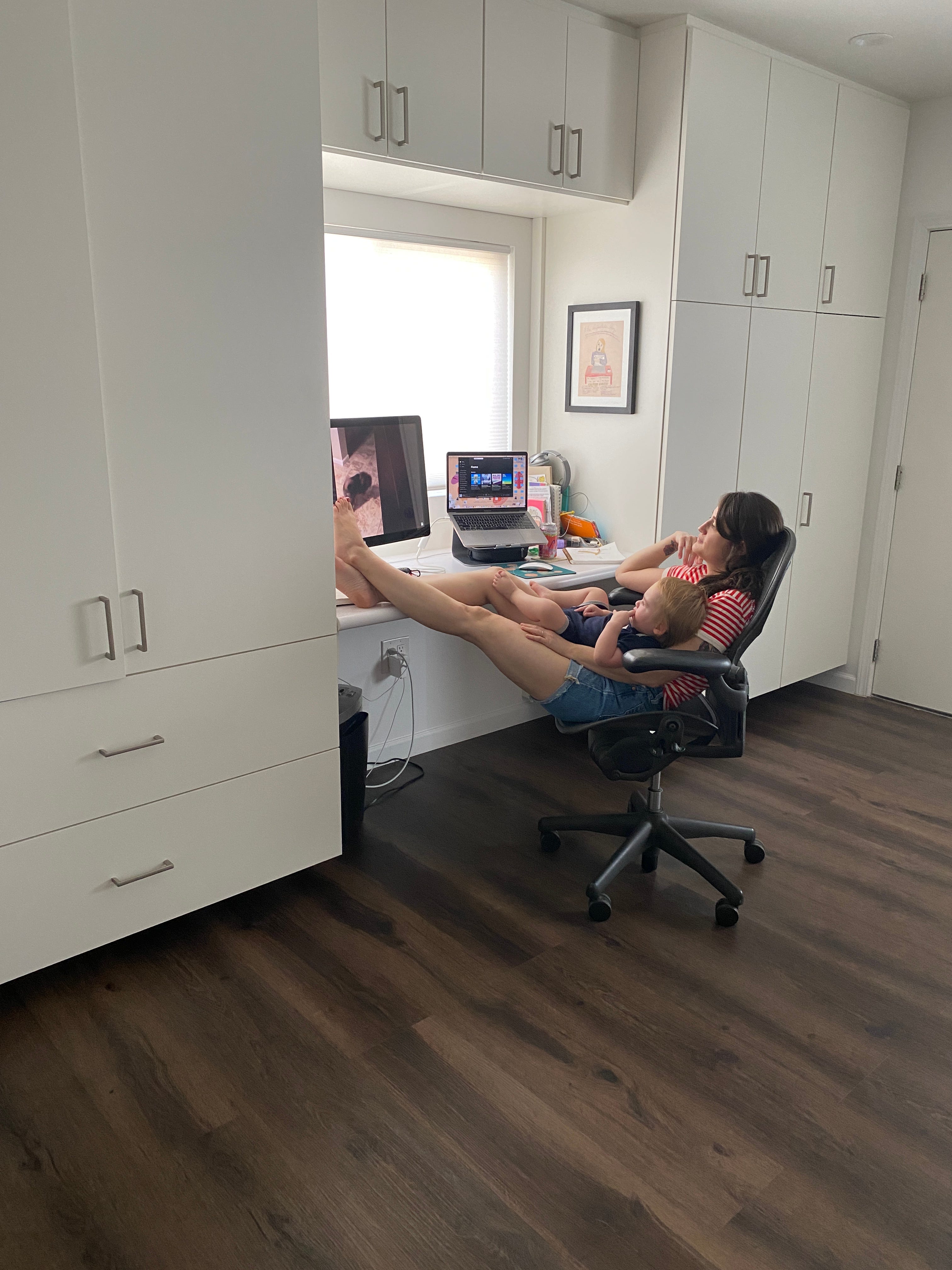
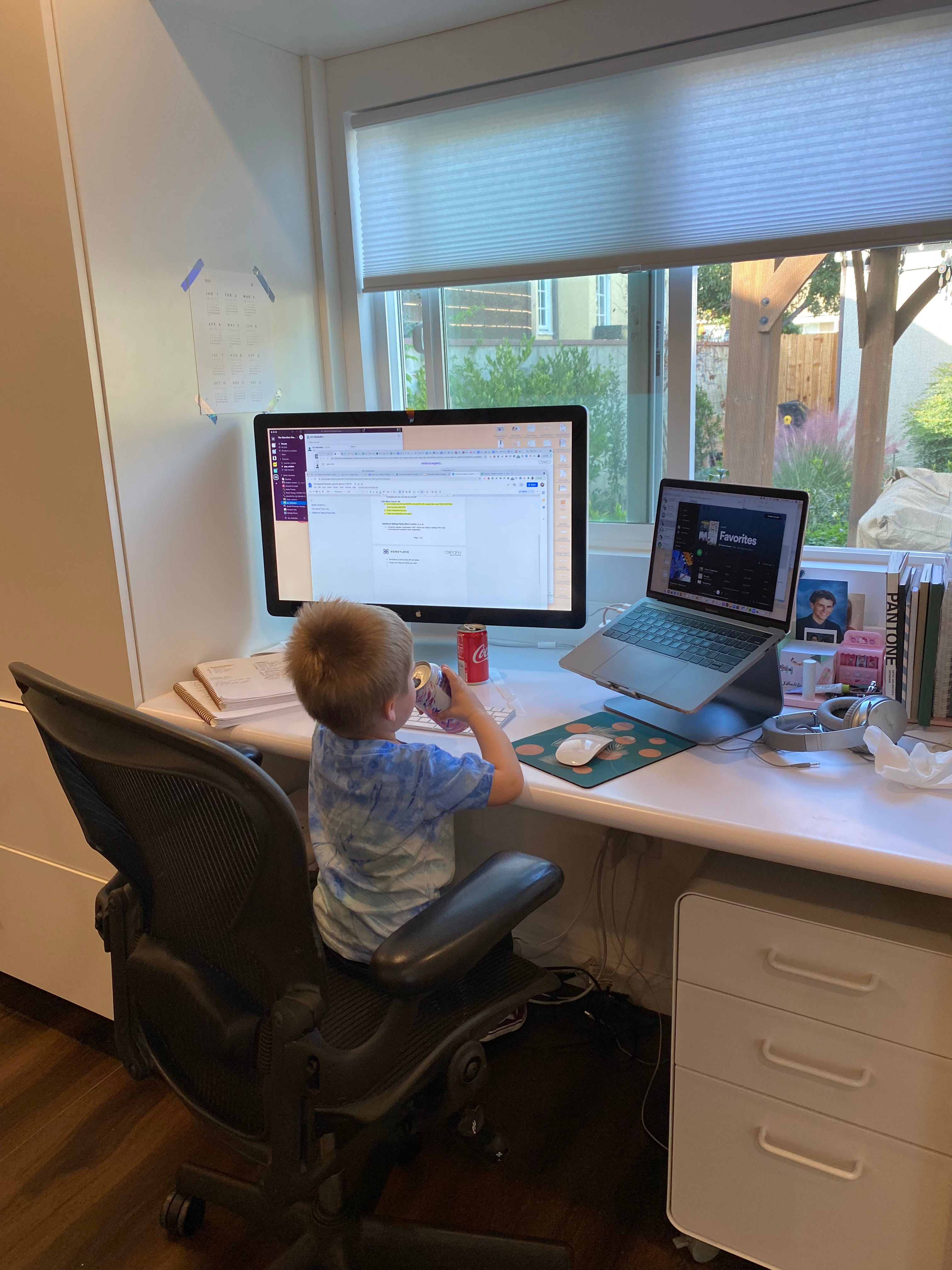
When I had my second child, it was an even less conventional experience. I was a full-time freelancer and could only afford a 6-week maternity break, which was as stressful as it sounds. Not shockingly, only one of my retainer clients (the smallest) agreed to the maternity leave pay structure I had proposed. Actually shocking, that client was the only one who wasn’t a parent themself. But that bureaucratic hypocrisy is a newsletter for another day.
Postpartum work was hard. Trying to maintain a freelance career and then a full-time role, all while adjusting to a baby and a toddler, made me feel like I didn’t know myself, which is perhaps the most frightening sensation. Maybe I wasn’t as good at any of the big life roles I had taken on. Maybe I wasn’t good at work anymore (or was ever). Maybe it was a myth that you could be a working parent and do any of it well.
How had all my colleagues achieved what I had perceived to be not easy, but doable? I didn’t know. What I had gained in freedom with remote and freelance work, I had lost in the social support and mentorship from more seasoned working parents who come from being in an organization as I ventured into my own working-parent identity.
I was nervous about taking another full-time role, especially at an agency, after being back to a full-time employee in a proper organization for a year and a half. I’ve been an agency rat for most of my career because the work is exciting, and you meet coworkers who become friends for life. But the thought of trying to juggle motherhood and school, with the pressure-cooker that is client services, made me nervous.
Turns out it’s possible to execute, and within reach to stay sane. This is because parenthood surprisingly has built-in safeguards.
In my experience, the general paradigm behind the shift from employee to working parent is something along the lines of… “My children are the most important thing in my life. They have to come first.” Or maybe even, “My priorities have changed. Work just isn’t as important as it used to be.”
Perhaps this is true for some, or even many, but it is not for me.
Six and a half years in, and I still care plenty! It’s not exactly the same as before, but I still have pride in my work, want to show up like a badass expert, and look for opportunities to challenge my skills. But, overall, I’ve recently reflected on how much the intensity has dialed down. That’s all to say, while my work is still very much a part of my internal and external identities, we don’t seem to be quite so enmeshed as we once were.
I don’t take microaggressions personally anymore, or feel bad for logging off when I have to pick up the kids. I’m not seething over blatant injustices in decision-making. I’m generally not hungry to climb a big ladder or go beyond delivering high-quality work with a good attitude. In fact, I actively rejected a leadership role. I try to find opportunities to imprint and make change, but have no interest in overhauling systems that don’t seem to want revolution.
“Yes, chef” is my new mantra. It isn’t because I’ve given up or fallen in line. It’s a survival tactic. Parenting has created this convenient, yet involuntary emotional shunt that prevents me from hating my job or being disgruntled. I simply cannot afford (literally) to be any other way about it. The sheer scarcity that parenting imposes encourages me to go with the flow more often and pick my battles more judiciously. Plus, running on broken sleep, quelling multiple tantrums, and preparing, making, and cleaning up several meals before 9 am makes dealing with work bullshit seem like a little relaxing break. At least you get to sit down!
I’ve become somewhat zen about it all.
I want to be very clear: work is still massively important to me and my identity. I just have much less time for it, so I'm now allocating my energy to more strategic places. It’s not so much about me putting my kids before my work, but about the inherent daily responsibilities they bring. Kids do need to be picked up from school and fed several times a day! FOR YEARS, I am told.
I also want to be clear that I would often rather be editing a document than trying to extricate kids from school who don’t want to leave, but absolutely begged you to pick them up early at dropoff. I love spending time with my kids, but most of the time I am not. I AM TAKING CARE OF MY KIDS. Please note the difference!
In other words, it’s less about the emotional, primal pull of wanting to be with your children 24/7, and more so that having kids gives you a buttload of non-negotiable obligations that impose clear, external boundaries on every other area of your life, including career.
If your algorithm has been infiltrated with therapytok, as mine has, perhaps you’ve learned that boundaries are the personal rules, limits, and expectations you set to define what behavior you find acceptable and to protect your physical, emotional, and mental well-being in relationships. They clarify your needs, values, and personal space, empowering you to maintain autonomy, ensure respectful interactions, and distinguish your own feelings and needs from those of others.
To simplify even further, we have described boundaries to our son as an invisible fence you put up around yourself.
In theory, this all works very well, but we don’t operate in theory. We live in reality, which is constantly pushing on your invisible fence. Fences are good, but composition matters. There are advantages to building a fence out of something like bulletproof glass versus a lovely woven grass. You keep more crap out, but you’re less likely to let in fun surprises and advantageous opportunities.
The hard part is that most boundaries are your responsibility to construct. You need to do the work to identify what they are, how porous they are, and to whom the boundaries apply. That’s a lot of work. In fact, a therapist might say that IS the work. It’s an exhausting task, and even once you’ve established your boundaries, every time a person or situation bumps up against them, you are met with more decisions about how hard to hold the line. That’s tiring.
But not all boundaries in place are on you to create. The act of caregiving populates some pretty hard boundaries without you having to think much about whether they need to be there or not.
Things like parenting, caregiving, and even school impose external boundaries that are tougher, clearer, easier to define–– and perhaps most importantly, socially acceptable. I don’t need to justify to myself or my boss why I need to take care of my children or attend class. These are well-understood and accepted obligations that transcend (most) deliverables.
While parenting makes the relationship with work more difficult in many ways (looking at you, random days off school, and the entirety of summer break), this is one instance where it greatly simplifies the whole thing. While adding to the mental load with juggling doctor’s appointments, after-school activities, client calls, and deliverables, it also subtracts in other ways. There is much less room for gray areas, for porousness, and for general decision fatigue. Plus, as I said, you get to sit down–– a real luxury!
In other words, parenting responsibilities (not the kids themselves or the state of parenthood) make your life a lot more tiring, but a trade-off is that work becomes a lot more cut-and-dry. That’s kind of nice!
Is it matrescence that has caused these shifts in my attitude and approach to work?
No, it’s never just one thing. Confounds abound! I’m significantly older, which means I am somewhat senior, and now the same age as much of the leadership, which creates less intimidation and spiraling that I’m going to get fired. I have (mostly) learned from past experiences and purposely seek out or circumvent specific situations that play to my strengths and position me well. I have a good understanding of what is in my control and what is not, allowing me to focus my attention on areas where I can make an impact and avoid the ones that will just suck my energy and emotion. And, I’ve job-crafted my role into something that really works for me.
Lastly–and this is maybe the biggest one–I went back to school four and a half years ago, giving myself a much bigger calling and goal to work toward. This, coupled with the purposefulness of parenting, provides eudaimonic happiness, or true fulfillment, through the realization of one's full potential. Both are incredibly grounding and not to mention humbling.
When I look back at my pre-parenting work life and around at my colleagues' current experience, I finally see that the nonchalant control I was once intrigued by was a structural gift: the ability to operate within the sturdy, pre-built fences that caregiving provides. Parenting didn't diminish my drive or emphasis on work; it just clarified my boundaries, giving me the freedom to say 'Yes, Chef' when I need to and a guilt-free 'no’ to the politics that don't.
In the weirdest, most unexpected way, it sort of prevents a certain (not all!) type of burnout through diversification of responsibilities. I’m never doing one thing (parenting, school, work, socializing) to full capacity because all my obligations compete with one another like a stock trading floor.
“Mommy!!! Your next assignment is due in one week! Did you feed the cats? Where’s the deck? I need a wipe!”
I can’t always stay late. I can’t go the extra mile. I can’t give it my 110%. I don’t have to burn extra energy deciding what those work boundaries should be, and then evaluating every situation that bumps up against them.
I’ve been told I’m a freak (yes, that word, multiple times by different people), and this doesn’t apply to other people, and perhaps that’s true. But maybe it’s about putting language to behavior, or simply reframing a resource deficit into a strength of strategy. We are designed to expand, but how and where is up to you, I suppose.
One thing is objectively true: being a working parent is a complicated and dynamic experience that’s different for everyone. Some days it’s harder, and others are easier, but every day is fucking exhausting.

No posts
Comments
Nothing yet. Say the first thing.
Sign in to join the conversation.