
From the moment they're born until—I don't know, I'm not there yet—parenting is a constant mental ping-pong between thinking, “I feel like they’ll never…” and “I can’t believe they…”
I feel like they’ll never: stop crying, sleep, nap, sleep longer, nap longer, sleep through the night, stop breastfeeding, crawl, quit the pacifier, eat real food, walk, talk, say “I love you,” pee in a toilet, drop the nap, go to bed, poop in a toilet, ride a bike, read a book, graduate…
And for every “they’ll never,” there’s a “can’t believe.”
I can’t believe they: already rolled over, are done with bottles, out of a high chair, pick their own clothes, read chapter books, need a child psychologist (LOL)…
The other day, as my almost 7-year-old struggled through swim lessons, I thought in frustration, “I feel like he’ll never learn to swim.” And then I remembered that after over a year of saying, “I feel like she’ll never use a toilet,” my daughter does. It’s our new normal, but sometimes I am reminded of the past year, when it felt so out of reach, and I think, “I can’t believe she did it.” In retrospect, it all feels equally visceral and fuzzy.
They say the days are long but the years are short. The first Montessori enrichment box from my Lovevery subscription (IYKYK) even included a mug with it printed on the side. And perhaps that’s just a more succinct way to express what I’m feeling. But I don’t think it quite captures the paradox and may push some toxic positivity.

The days CAN be excruciatingly long. Friday afternoon meetings on Zoom pose the inevitable, “Up to anything fun this weekend?” Fighting for my life! That’s what I want to say, but I don’t want to kill the vibe on concert tickets, weekends away, and even the luxury of “laying low.” Sleepless, tedious, frustrating, screaming, body aching, and mind-numbing, washed away only by brief but potent rushes of oxytocin from a smile, a new word, or a skill unlocked, or a very serious face framed by a very ridiculous amount of hair clips—another ever-present paradox that permeates the long days and short years.
The years DO feel short. “Can you believe they’re actual KIDS now?” I said to my husband in disbelief as we trailed behind them on an evening walk. We both really can’t.
And, if my child-free readers are still with me, I want to be clear that this tension absolutely exists outside the walls of parenthood. “I’ll never find a partner…,” “I’ll never finish school or find a job…,” “I’ll never travel anywhere…” and, of course, “I’ll never afford a car or a house…” suddenly turns into, “I can’t believe he’s real…” “I can’t believe I graduated…” “I can’t believe I’m looking at the Eiffel Tower in real life,” and, of course, “I can’t believe I own this…”
But why?
Turns out, our silly little minds systematically overweight whatever is happening right now and struggle to vividly imagine a future state that doesn't exist yet. Your brain predicts the future by imagining it and then literally gut-checking to see how your body reacts (Gilbert & Wilson, 2007). The problem is, it builds the simulation based on whatever you're feeling in that moment. So if you're already hanging on by a thread and cold brew, your preview of the future is contaminated by the frazzled moment. You can't cleanly imagine a version of life that doesn't feel like this, because right now, it does! When your kid wakes you up three times a night, your brain can't simulate a version of this child who sleeps, since it only has access to the version who doesn't.
And it doesn’t help that our decisions are powerfully shaped by whatever we are feeling in the moment, such as extreme stress, frustration, or sleep deprivation (Loewenstein, 1996). In fact, they temporarily overwhelm our ability to think or act clearly, like earnestly believing your child will go to high school in a diaper. (She said that she was fine with it!)
Research even suggests that it’s more than the gravitational pull toward the present. It's that you overindex whichever moment is closest (O'Donoghue & Rabin, 1999). So when you're experiencing a day from the depths of hell, you cannot see beyond this terrible feeling. But even a week from now, the day’s events feel abstract enough to forget. This is why a placating "it'll get better soon" doesn't land when you're in it, because "soon" is still the future, and the future doesn't feel real yet!
It doesn’t matter how calm, cool, and collected you are generally. The present feels permanent even when your rational mind knows it isn't. A parent who is fully aware that this phase will logically end might paradoxically even experience more anxiety about it than the parent who believes it really will last forever because they know there’s an endpoint that isn’t accessible yet. You can know something is temporary in your mind and still be unable to feel it. Being a human is hard!
See, we live in a perpetual state where we think we've just arrived at our final form. And, of course, that version is always changing based on new information and lived experiences. Research on over 19,000 people shows that at every age, we can easily see how much we've changed in the past but can't imagine changing equally in the future (Quoidbach et al., 2013). Remembering is easy because you’re reconstructing a memory from existing materials. Imagining the future is harder because you’re having to construct something from scratch, based on an unreliable model. It’s less about making an accurate prediction about your child and more about hitting the limits of your own imagination and calling it reality. You can’t emotionally access a version of your child that doesn’t exist yet, because the brain only has the data it’s living with right now. It makes sense that I can really only ever imagine my child as old as they are on any given day. It takes work to recreate a memory, and even more power to construct something entirely new.
People choose experiences based on how they remember them, not on how they actually felt in the moment (Kahneman et al., 1993). One reason parents can look back fondly on the newborn years is that our memories aren't faithful recordings of our experiences. We aren’t convincing narrators when it comes to every sleepless night, diaper change, or meltdown equally. Instead, our memories are disproportionately shaped by the emotional high points and by how an experience ended––did we push through a tantrum or give up and let them have the goddamn cereal bar? As the exhaustion fades and children become more interactive, affectionate, independent, and reciprocal, those later positive moments soften the memory of the difficult early months. What 45-minute knock-down, drag-out meltdown that left one of us naked and both in tears??? HA. HA. HA.
Instead, we remember their first well-constructed joke more vividly than the bedroom door being slammed with a well-timed, “You're the worst mom in the world!” We recall the ease of leaving the house without a diaper bag more than the weeks—or, in my case, a year—of stubborn refusal, and the pride in a thriving little person more than the relentless demands it took to get there.
It’s how we easily do a 180 and find ourselves at, “I can’t believe they…”
In many ways, parenting is less the sum of its hardest moments than an open-ended story that keeps getting more satisfying. That doesn't mean the challenges weren't real or any less difficult, but it's our internal edit of the experience that makes it feel more meaningful and, often, worth repeating.
How else would anyone ever have more than one child? Your brain is a top-notch editor.
So, among many other things, parenting causes your brain to toggle between two different cognitive modes: prospection (imagining a future you can't see, which feels impossible) and retrospection (recognizing a past you lived through, which feels obvious). The cruel irony is that every "I can't believe they..." was once an "I feel like they'll never..." And these two truths can never coexist.
So, what do we do about it other than lament in the group chat, scour Reddit threads, and learn to live with uncomfortable tension?
One of the first psychological concepts I learned in grad school was savoring, which is the capacity to attend to, appreciate, and enhance positive experiences (Bryant & Veroff, 2007). Instead of coping by managing a negative experience, the idea is to capitalize on the positive to gain perceived control over the situation. And it's not just a mindset. Research comparing different savoring strategies shows that deliberately attending to positive moments measurably boosts well-being, whereas habits such as distraction or fault-finding dampen it (Quoidbach et al., 2010).
I think one of the coolest things about savoring, particularly from a parenting perspective, is that it takes on temporal dimensions, meaning you can savor through anticipation (the future), the moment (the present), and reminiscence (the past). Perhaps that’s why the concept stuck out to me at the onset of my grad school journey; my son was only 3 years old, and my daughter 6 months old. My professor was (absolutely not) like, “Who needs to hear this??”
Savoring introduces a behavior that doesn’t feel super intuitive. To stay in the moment, we often tell ourselves not to think about the destination, but instead focus on the journey. But positive psychology research shows that thinking about the end of a positive experience can actually help us enjoy it more in the present. Rather than avoiding thoughts that something good will end, deliberately recognizing its temporary nature increases appreciation, engagement, and well-being.
To test this, researchers asked college seniors to repeatedly write about their college experience (Kurtz, 2008). One group was reminded that graduation was just around the corner, while another was told to think of graduation as far away. Over the next two weeks, the students who viewed college as ending soon became happier and more engaged by spending more time with friends, appreciating campus more, visiting favorite places, and generally making more of the time they had left. Simply recognizing that the experience was finite motivated them to savor it rather than take it for granted. The researchers argue that this happens because scarcity creates value. When we realize our time with something is limited, we naturally pay more attention to it, become more present, and invest more intentionally in the experience.
By recognizing that a stage won’t last forever, parents become more intentional about noticing, participating in, and appreciating it while it lasts. Parenting is made meaningful when we are reminded that time is passing. The awareness that “this won’t last forever” doesn’t diminish the irritation of a child screaming MOMMMYYYYYYYYYYY in your ear, but it does help us savor it before it becomes a memory. It’s the closest we’ll get to closing that gap in the tension, connecting those present and future realities.
Much of parenting is lived under the illusion that there will always be another bedtime, another story, another request to be carried, another Saturday spent cleaning up an obscene amount of messes. When you’re in the trenches, these moments feel so abundant, they become invisible fibers in the fabric of your daily routine. But the reality is, they’re deeply finite. Enter the pervasive (and toxic, in my opinion) social media meme: “You only have X amount of summers left with your child,” and the unsolicited comments from older people in public: “Enjoy this time. You’ll miss it someday.” It’s almost always in a moment where you have sweat dripping down your face, a screaming toddler, and a diaper to change in a public restroom with no changing table. I don’t want to hear it, Susan!
There must be a way to hold two truths simultaneously.
Research suggests that imagining the end of a parenting season doesn’t actually make us sad, but rather more present and happier in that moment (Kurtz, 2008). Thinking about the ending doesn't steal joy from today; it creates it. That’s why we get so lost in iPhone photo memories that pop up. Photos and videos of my children as babies and toddlers make me smile and giggle, even if perhaps a little wistful, though they’re from a time that's long gone.
There's a reason parents post so many pictures of their children. Part of it is proximity—they're the view most in sight, and the camera is always in our pocket. But it’s also because photography works by interrupting hedonic adaptation, or our tendency to stop noticing the good things that become familiar (Kurtz, 2015). It might seem superficial and ubiquitous at this point, but looking through the lens of our iPhone camera actually encourages us to search for beauty, novelty, and meaning in places we’ve begun to overlook. Using a camera can be a savoring tool to deepen attention, not replace it. For parents, it’s not about the photo but about how searching for the shot changes their perception of their own children. And when the memory pops up on your homescreen, it helps you reminisce about that perception at that time.
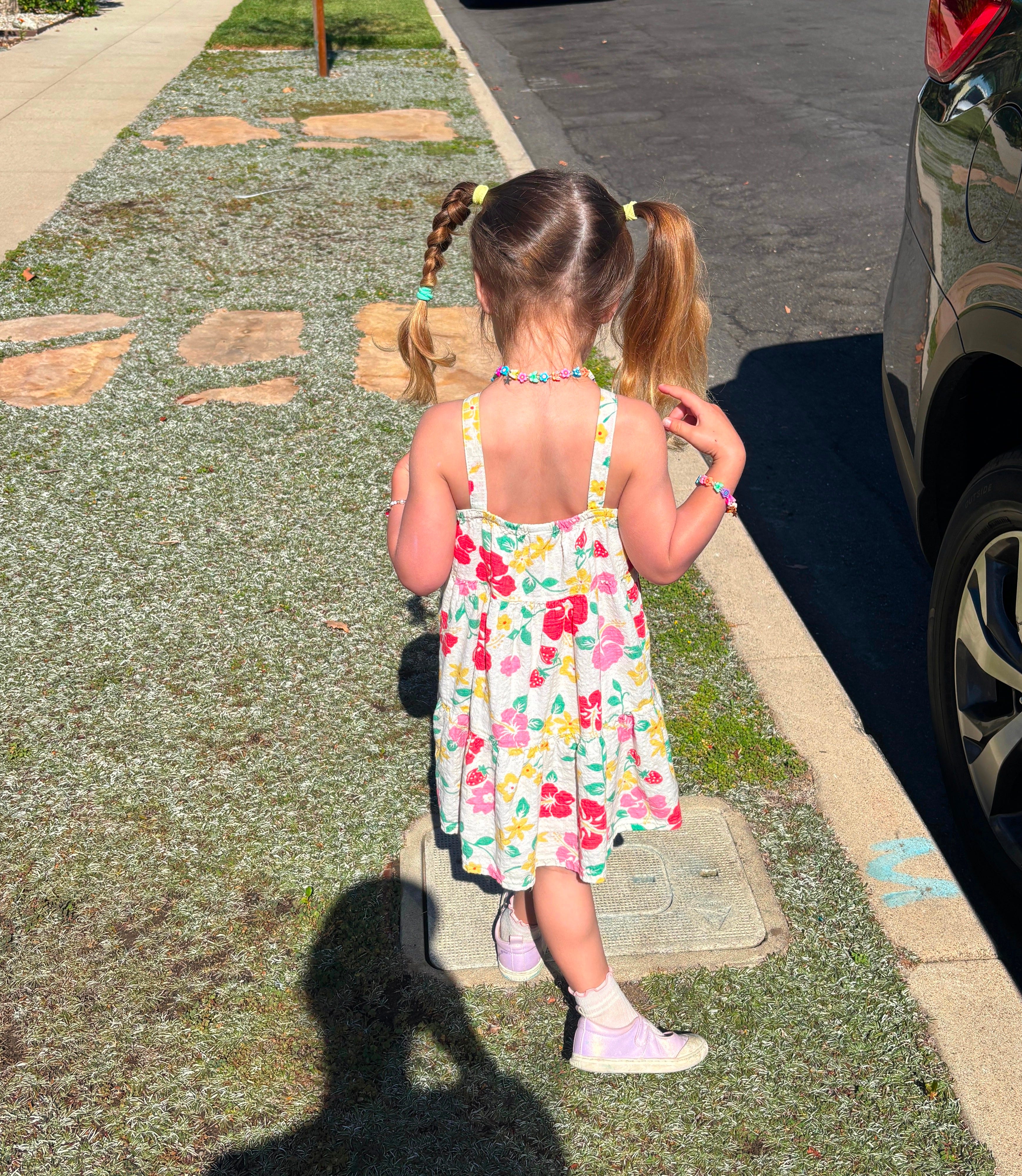
The same cognitive architecture that traps you in "They'll never" is the exact foundation that makes savoring possible. The reality is that you can't rewire your brain to stop prioritizing the present and get better at visualizing an abstract future. But you can choose what you put in front of it. Science shows that the awareness of impermanence—that very thing that makes parenting feel like a constant losing battle—is actually the ingredient that makes present moments richer if you let it.
The ping-pong doesn't stop. But savoring turns the "I can't believe they…" from a retrospective ache into a real-time practice.
My son still can’t swim independently. I’m still sitting on the bench at swim lesso ns, watching him cling to the wall, thinking, “I feel like he’ll never...”
But I also know that one day, he’ll just do it. He’ll let go of the wall and kick across the pool, and I’ll be sitting there not even ready for it. And I won’t remember how many lessons it took or how many times I almost gave up on signing him up again. I’ll just think, “I can’t believe he...”
And that’s it. All the frustrations of today are a blur for tomorrow.
By the way, I broke the Montessori parental affirmation mug a long time ago. It’s OK; by the time I’m pouring coffee in the morning, I already know it’s going to be a long day.

References
Bryant, F. B., & Veroff, J. (2007). Savoring: A new model of positive experience. Mahwah, NJ: Lawrence Erlbaum Associates.
Gilbert, D. T., & Wilson, T. D. (2007). Prospection: Experiencing the future. Science, 317(5843), 1351–1354.
Kahneman, D., Fredrickson, B. L., Schreiber, C. A., & Redelmeier, D. A. (1993). When more pain is preferred to less: Adding a better end. Psychological Science, 4(6), 401–405.
Kurtz, J. L. (2008). Looking to the future to appreciate the present: The benefits of perceived temporal scarcity. Psychological Science, 19(12), 1238–1241.
Kurtz, J. L. (2015). Seeing through new eyes: An experimental investigation of the benefits of photography. Journal of Basic and Applied Social Psychology, 37(4), 187–199.
Loewenstein, G. (1996). Out of control: Visceral influences on behavior. Organizational Behavior and Human Decision Processes, 65(2), 272–292.
O’Donoghue, T., & Rabin, M. (1999). Doing it now or later. American Economic Review, 89(1), 103–124.
Quoidbach, J., Berry, E. V., Hansenne, M., & Mikolajczak, M. (2010). Positive emotion regulation and well-being: Comparing the impact of eight savoring and dampening strategies. Personality and Individual Differences, 49(5), 368–373.
Quoidbach, J., Gilbert, D. T., & Wilson, T. D. (2013). The end of history illusion. Science, 339(6115), 96–98.
No posts
Comments
Nothing yet. Say the first thing.
Sign in to join the conversation.