
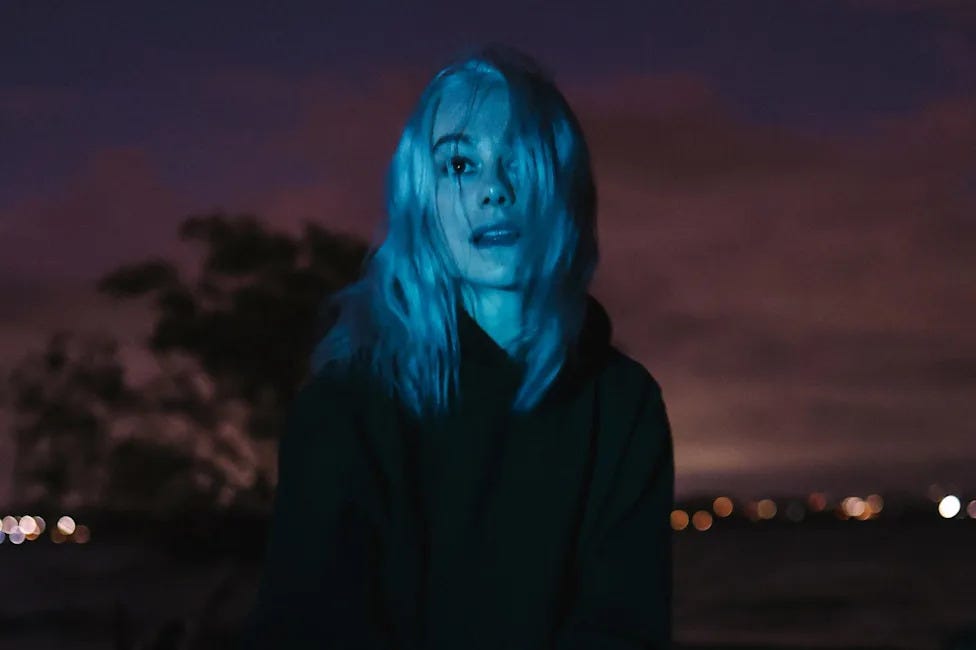
Early in the morning of Friday 14 August, I pressed play on Phoebe Bridgers’ new album Lost Weekend on the way to work. Because new albums always come out on Fridays, I am always listening to them while commuting. Then I’m often the only person in my office, letting my eyes unfocus out the window, looking down over a car park and allowing the new lyrics to settle into my brain. Time goes fuzzy and I can’t tell how fast the day is passing. The album is urgent and dissassociative. Getting to the ‘real meaning’ of songs is like trying to make your friend who’s had too much to drink accept a glass of water, work out what she’s sad about when none of her sentences have verbs in anymore.
Lost Weekend is an album that plays with your ideas of time, both personally and out in the world. The Guardian’s five star review of the album calls it a ‘study in dislocation’. The Lost Weekend, the 1945 film whose title the album borrows, is a story about lost time — both in the literal sense of an alcoholic blacking out and in the wider sense of realising a weekend or your whole life have got away from you when you weren’t looking. The first song on the album, The Outside, describes a moment of double consciousness, living the same moment twice. Phoebe is raising her fist onstage at the same time as she’s looking at that moment and wondering what’s going on.
Whatever Phoebe Bridgers released, it would have been about time in some way. Her second album Punisher was a defining 2020 pandemic album. For many people, it was the first time they fell in love with her music and they will always feel their pandemic self sitting with them when they hear it. Your own experiences of 2020 will always be bound up with the album, and whatever Lost Weekend turns out to be about for you, it will be a sequel to that.
I don’t know yet what it will turn out to be about for me. But I do know August 14 was my anniversary with my secondary school girlfriend. We actually celebrated it twice and then I’ve felt indefinably odd the following thirteen August 14ths. It was a weird relationship that still gives me weird dreams sometimes. One time in about 2012, we discussed our anniversary in 2026 and how when we celebrated that day we’d have been together more than half our lives. Without wishing to be too parasocial with Phoebe Bridgers, I have a feeling she’d like that association.
On Friday August 14th 2026, too, London was at the crest of its fifth heatwave of the year. I had to take a different route to work because of line closures and I waited on the platform at Oxford Circus for fifteen minutes waiting for a westbound central line train, looking around at the commuters and wondering who would be the best bet to help me if I fainted. I was playing Haunted at that moment. I got to work, cracked open my monster energy ultra and opened the news to see that Nigel Farage got 65% of the vote in the Clacton by-election. At that moment, Lost Weekend (Reprise) was cycling back round into The Outside.
As the album circles round and round in my headphones, I listen for references to weird time, circular time and time that runs backwards, double and inside out. I think there’s a lot I’m missing and failing to comprehend in the album. I don’t know all the ins and outs of Phoebe Bridgers’ life and I’m not a great player of the ‘who is this song about’ game. I’m good at listening to an album with my eyes closed, using my intense visual imagination to hallucinate vividly, and summoning up figures from a TV show I didn’t finish five years ago to act out the themes that interest me.
Here’s what I picked out to conjure with during my office daydreaming:
Turning twenty one. I’m not but I was once. Kill Me.
Back when no one could tell us apart and I’d turn down the music to parallel park. Lost Weekend.
dancing ourselves clean, late new year’s eve. You deserved better. You wanted me. The Governor’s Ball.
I had the thought you would outlive me. Lost Weekend.
learning the same lesson over and over again. Lost Weekend.
just to be thrown in the street when you dressed like a girl. Still Standing.
I can’t remember what I said but I didn’t mean it. I wasn’t too young to understand, I just didn’t think it was all bad, and it wasn’t in a way. And now there is nothing. Still Standing.
I remember the day I created the world. I got blood on my favourite shirt. Other Plans.
That night I had a dream that I was sleeping. Other Plans.
Time here always demands to be looked at multiple times over. Running it through your hands once isn’t enough. You might replay a memory from a new perspective three feet to the side and find everything looks different, your old emotions don’t make sense, and you aren’t in love after all.
Tiny moments become symbolic of ages of your life. Would Phoebe (or the Phoebe-shaped speaker of the title track) have thought that a van breaking down on the side of the freeway would become an icon of a past time, a medium-comprehensible past time? Not in the moment, but the second Phoebe who looks back can understand a little more and become baffled by the web of symbols she couldn’t understand before.
When the van broke down in the heatwave, you took your pants off on the side of the heatwave. You took your pants off on the side of the freeway. I had the thought you would outlive me. I loved you and you couldn’t forgive me for that. Lost Weekend.
The language here is blunt and indicative. We don’t get bogged down in metaphors here or construct any imagery. I think there are more metaphors in my review so far than in the whole album. Phoebe Bridgers’ lyrical style has always been characterized by simple sentences that tell us exactly what happened, where people were standing and what they were looking at. She doesn’t use big words or paint castles in the air; four perfectly pitched sentences in the indicative mood or reported speech can have a deeper effect than all the purple prose in the world. It reminds me of how my year nine English teacher described Hemingway’s style, except that I like it when Phoebe does it.
That blunt style does strange things to how we perceive time and the meaning of the past in this album.
I’ve seen a lot of discussion around the line in The Governor’s Ball that is quite easy to link to Phoebe’s ex’s new partner. I don’t know I’ve got anything interesting to contribute to that conversation — I’m no better at zooming in on bedsheets in concert footage than any number of other social media users who’ve already done it. But what if we read this ‘other Phoebe’ as a weirder kind of doppelganger? In a whole album about double-consciousness, reinterpreting, rumination, double reading, I don’t think the image of the ‘other Phoebe’ sitting on her old bedsheets onstage at a concert can be read only one way.
Now let’s see how far I can run without stopping
And she can pretend to be me.
Since she took my place in my bed on that stage
I have not lost any sleep.
Being myself wasn’t easy.
Do it for me.
The Governor’s Ball.
After all, we started the album with the image of one Phoebe performing onstage while another looks on without being quite sure what’s going on. By the time we get to this verse, we have already encountered a couple of other bits of metaphor and imagery about Phoebe becomin gother people — rare in her lyrics. In the first verse she hid in the bathroom ‘like Shelley Duvall’. Phoebe Bridgers’ selfhood, particularly the selfhood of her stage persona, is always at risk of drifting off and becoming someone else without her noticing. If someone else picks part of her up and becomes it unstage, is is automatically fake? Or is it alchemy?
Perhaps it’s because I don’t know any of the gossip that surrounds these lines, but I don’t interpret much bitterness here. ‘Being myself wasn’t easy — do it for me’ is more than a little melancholy but it’s not very mean. If I found out someone was impersonating me, sitting in the corner desk at an old office job of mine I didn’t like much, my response would be ‘sure’. I’d be keener to wonder what that said about me and all the Emily Spinaches I’d been than I would be to stop someone sitting in the place I used to sit. The current Phoebe, after all, will become a mask shed and left on the floor in the end.
And where is the future?
Appeals to the future are always plaintive and hollow in this album.
Baby, baby if you leave me
Can you take me with you?
I can sit in the back seat.
Sometimes when the night is quiet
I’ll turn all the lights on
Like the end of the movie.
I Can’t Wait.
Every reference to the future is a reference to an imagined future that a past version of you hoped might come true. We can look back on it now and wonder what we were thinking when we ever dreamed that up. It’s as hazy as the past is, which is to say, it’s very hazy. The present is an island we stand on looking into an indistinct, cloudy landscape that surrounds us in all directions.
The only reference to the future that we are left feeling real is a statement of unfindability, something that can’t be puzzled out. ‘If I ever come out of hiding, you won’t have to know how to find me again’. Perhaps there can be something comforting as well as baffling in that haze of unknowability. No predictions ever come true and no one can poke you for symbolism yet. The future is safe because it can’t be interpreted yet — by you or anyone else.
No posts
Comments
Nothing yet. Say the first thing.
Sign in to join the conversation.