
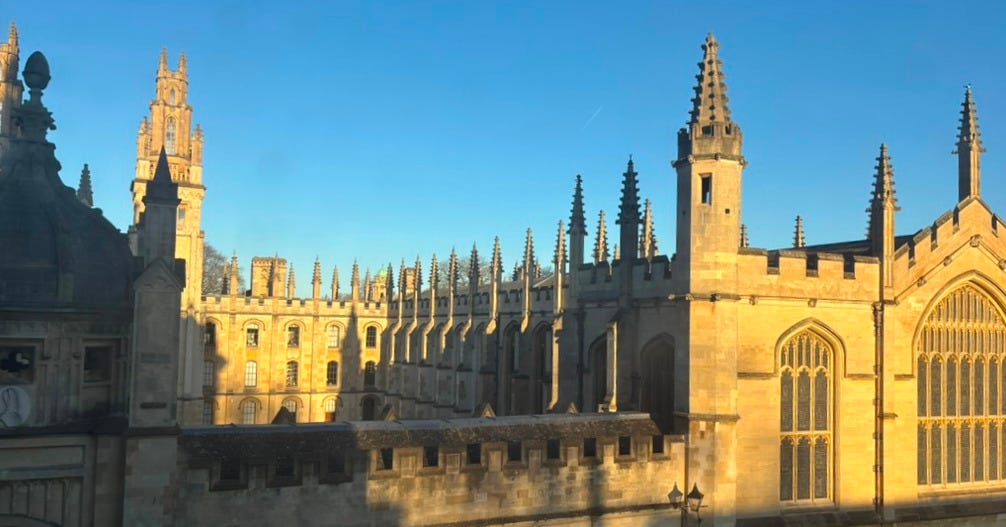
If there’s one thing that’s permanently true about British higher education, it’s that it’s always changing. ‘Changing’ here must be understood as a euphemism for ‘getting worse’. I’ve been either a student or a staff member in the world of universities since 2014. And every year I’ve read headline after headline about different things dying and falling away, the way things aren’t what they used to be. I’m even old enough now that I can start to say ‘things were different in my day’ to other adults, which makes me feel very strange. But from the perspective of the humanities, and from the perspective of someone who believes higher education should be an viable option for everyone in the country, I do think where we are now might actually be the end of days.
So I want to take a minute today to talk about the current system of humanities education in the UK, where it’s heading, and how that impacts classism in academia.
The state of the humanities in UK higher education has never been great, but it is now dire. I’ve consumed a lot of fascinating and deeply moving pieces in the last few weeks about the threatened redundancies at the University of Exeter. Exeter has put around five hundred people at risk of redundancy, overwhelmingly in the humanities, and this has become the shot heard around the world for this issue. Exeter is far from the first university in the UK to receive this treatment. But as a beautiful, historic, research-intensive Russell Group university with famous alumni, it is a clear candidate for main character of this issue. There was significantly less public outcry when London South Bank University completely closed down its history and geography courses in 2021, for instance — lower in the rankings, with fewer pretty buildings. There is something similar happening at Goldsmiths in London. But right now, the fight for humanities at Exeter is a proxy war for the fight for humanities everywhere. It’s likely a losing battle but it’s worth fighting all the same. YouTuber Ruby Granger collages together video message from a couple dozen academics, staff members and ex-students at Exeter in this very moving video. It very literally stirred me to tears to see professors trying to construct quotable soundbites of why their work should be allowed to exist, and I recommend watching it.
Universities have very little money at the moment. They have been trapped for years in a system where the only way to budget the books is to try to recruit ever-increasing numbers of international students paying exorbitant fees. But they are now hitting the ceiling of the number of lucrative international students they can attract and fit in their buildings. The only way to guarantee healthy finances as a university is to close your eyes and wish you were Oxford or Cambridge — and if that doesn’t work, things aren’t looking good for you. I understand that universities have to make difficult decisions.
But I also know that when university bigwigs sit around conference tables to discuss those difficult changes, they talk about what they want their institution to be. Every restructure comes from a conversation about what kind of place senior management believe they should be designing with the resources they have. You can read the senior managers’ priorities in the places where they choose to make the cuts, the same way you can read an AI-generated piece of text and divine the prompt it was working with. Choosing to set fire to the humanities department isn’t only a consequence of having no money. It comes from having no money and also having a vision for what you can do with your budget that doesn’t include the humanities.
It would be very easy for me to write a paragraph here about the inherent beauty and power of art and literature. But this is Substack, and you either clicked on this essay on the internet or subscribe to a newsletter by a Medieval Studies PhD student, and I’m sure we’ve all seen Dead Poets’ Society. Another argument in favour of allowing the humanities to exist is that the economy falls to pieces when people don’t have diverse skills. It’s not a very Mr Keating point to make, and I fear you can read my work-self speaking a bit there. But I really do believe this.
A university system obsessed with measurable metrics will always funnel people into a very small number of areas. If every prospective student makes the objectively-most-sensible decision for what to study, the job market in four years’ time will be saturated with people able to do a very small number of things, all passing the same certificate around between them. I certainly don’t think every student in the UK should do Medieval Studies. Weirdly, I have been accused of believing that — ‘So you think everyone should be medievalists? How would that work? Where would the engineers be? There wouldn’t be any sewage!’.
All the data I’ve ever viewed, across multiple jobs in higher education, has shown me very clearly that diversity of skills and experience makes everything better. I want an education system that can create doctors, lawyers, medievalists, puppeteers, translators, priests, teachers, civil servants, and people who can build wind farms. But all the time, universities are closing humanities faculties and opening shiny new business studies and AI research centres next door. Man cannot live on business studies alone.
Much has been made recently of the high employment rate for computer scientists in the UK (here’s a 2025 BBC News piece about it). A lot of people chose computer science because they’d been told, very directly, that it was a sensible choice to invest in their future. The more people get funnelled into a single discipline for years and years at a time, the more you realise a single profession can’t absorb that many workers, no matter how skilled they are. The rise of AI and its being widely used for coding is undoubtedly a main driver of this. But I think it was always going to be something — if one subject area is the ‘sensible choice’ for everyone, that comes with a time limit. My medieval studies degrees have a different set of pros and cons.
Students are trying very hard to make good choices against a backdrop where nothing feels like the right move. You have to go to university, but not to do something stupid, but not to do something everyone is doing, but not to do something that can be replaced with AI, to network, but not to spend the whole time drinking and hanging out, to study hard, while also paying for everything the most responsible way possible. My favourite dataset in all of British higher education is the HEPI/AdvanceHE student academic experience survey dataset. In the supporting documents section of this page you can download all the source data they used to make the report, and it’s a vast ungainly hideous spreadsheet, but there’s so much in there. If you want to win arguments about ‘what education is like now’ in the pub based on more than your memories of your degree, these spreadsheets are how you do it.
In the 2026 data, we can see that two thirds of full-time undergraduates in British are doing paid work during term time. 9-10% of students are working more than 20 hours per week regularly during term time in a job unrelated to their studies. That percentage is lowered by the 20-hour-per-week cap on international students being allowed to work during term — many international students would like to work more if they could. It was only very recently (I think the last two or three years) that the number of students working during term rose higher than 50%, but it is the new normal now. Students today are acutely aware of the cost of their studies. At the time they start their degree, they know they will be paying for it well into their sixties with the current forty year repayment terms on government loans. In those circumstances, it’s hard to tell 17 year olds they should consider studying theology or Old Irish.
But if the computer scientists can’t find jobs anyway, why not? In all my medievalism degree choices, I’ve been bearing in mind the Jim Carrey quote reminding us that ‘you can fail at what you don’t want’ too. We have to bear in mind our answers to ‘what kind of institution do we want this to be?’ and ‘what kind of higher education system do we want this to be?’. You can’t get diversity of approaches, skills and disciplines by shooting all the historians in the face and building another AI building. A university that was prepared to take a stand and back that kind of diversity of thought would be really unique, a real outlier, and a clear leader rather than a follower of trends.
A policy initiative I tried very hard to get underway in a previous job, with absolutely no success, would have focused on the benefits of studying languages as part of a larger degree course. Many universities offer joint honours degrees where you can combine a traditionally employable and sensible subject with a language that will open up a lot more jobs and travel opportunities for you. In the UK, you could study Financial Administration or Financial Administration & Chinese Language and Literature for the same sticker price. If anyone ever reads this random Substack essay and wants my advice on what to study, then I think you should do medieval studies. But if you don’t wanna do medieval studies, follow exactly 50% of your dad’s advice and do the sensible choice + language combo. Be an economist who can speak Portuguese. Go on. It’ll be great.
Now onto the classism.
Classism in the UK university system is something I’ve wanted to talk about on here for a long time, but also not wanted to talk about. My personal experience with classism is similar to how a surprisingly butch straight woman experiences homophobia. Working class identity has fuzzy and porous boundaries and it is hard to draw defined lines around it. But also every possible outline of working class status in the UK excludes me. I went from private school to Oxford, my name is Emily, and I am from Surrey. But as I progress from degree to degree, with less resource at my disposal every time, I find myself in new rooms and communities. The effects of classism on students who have no choice but to work full time, commute to study, and can’t go to 90% of the opportunities and events that are apparently ‘for’ them, become obvious. So I end up taking friendly fire from my fellow poshos. I notice more and more with time how working class students get shut out of the humanities. It’s tragic. It makes me really angry. And it’s an essential element of the ‘what do we want this higher education system to be?’ conversation.
People talk a lot about the ‘death’ of the humanities or the ‘death’ of languages. I understand where it comes from but it’s also an unhelpful phrase in several ways. Humanities and languages will never die because there are spaces where they will always exist that no government funding cuts can touch. Oxford and Cambridge will always teach classics, so classics will always exist. Cambridge’s Anglo-Saxon, Norse and Celtic degree and associated track into academia will also probably always exist. When I have been trying to learn Old Irish the last few months, I’ve had a very hard time finding resources, but that doesn’t mean resources don’t exist. The subject exists, the people exist, the training is there — I just can’t get to it. Every subject you can think of that seems to be dying or fading away is thriving somewhere behind a door you can’t open.
What is dying isn’t the humanities, it’s the idea that anyone could enter them. In fifty years’ time, Oxbridge graduates in the House of Commons will make quips to each other in Greek; the number of people who can understand and join in the conversation will just be smaller. In the UK, where education in languages is generally dreadful, a lot of what you get from a highly elite education is the option to get good at multiple highly prestigious languages. I include myself in this — I studied German, Spanish, Latin and Greek at secondary school and had the option of picking up Italian, though I didn’t take it.
I’ve had a lot of conversations about classism at university which centre around exclusionary and/or insulting things people say in conversation. I don’t think that’s an invalid conversation to have. One of my friends who studied French was told that her spoken language skills would probably better if she spent more time in France — had she considered just doing that? Another friend went to an event for graduate students and got told it was ‘actually very impressive’ that she could read both Old English and Latin without ever having been to Oxbridge. There are a lot more shitty conversations people I know have had that I could repeat if we all had more time.
These exclusionary remarks are extremely shit. But the way I think this links in with the humanities conversation about is the many ways in which ever-larger numbers of students get literally excluded. The one third of students who do no paid work during term will be the most privileged students, and they will be able to turn up to more extra events, more office hours, more extracurriculars. Humanities and language courses really reward extra time to read, think and mull on the material. Within the same university, students with greater and lesser levels of class privilege have massively different amounts of time to throw at their degrees.
But the real class issue here is the variation across universities. Pipelines into and through the humanities are constricting and constricting. Oxbridge remains a very inaccessible world; if they increased their proportion of state schooled students by the 30 percentage points they need to, they are still quite small institutions. Even if they became egalitarian places, they couldn’t take everyone. A healthy population and a healthy landscape requires people to be qualifying into all kinds of subjects from all kinds of areas, in larger numbers. Humanities have to exist at every level, in every part of the UK.
Every year, more and more students aren’t able to consider moving out of the family home to move away and go to university. There are a lot of reasons for that — often it is cost related, but UK’s changing demographic profile also means there are more students who would prefer to live in their family home. Moving to the other end of the country shouldn’t be something we assume everyone is able to do. So any course shutting down is a loss of opportunity for the people for whom that was their best option. The University of Exeter isn’t that near many other universities. Its nearest university is probably Plymouth, which doesn’t offer many of the courses likely to be affected by the Exeter redundancies. If Exeter shutters courses, there will be whole disciplines for which the whole South West has gone dark — looking at a map of British universities, the nearest universities which I know to offer a wide range of humanities and languages are Bristol, Southampton and Cardiff.
Every degree course that closes makes the UK higher education landscape less varied, less deep, and capable of less. The University of Exeter is just one institution, that I have never studied at, in a city I have never visited. I am not defending Exeter because these courses at this university are particularly important to me. I’m agonised by everything I’ve read about it because if it can happen at Exeter it can happen anywhere, and it’s a tragedy when it happens anywhere. When I ask that question, ‘what do I want education to be?’, I want the widest possible range of skills and materials to be available to absolutely everyone.
The UK has a deep, dark, entrenched class system and humanities education should be breaking those walls down rather than building them up higher. I’m terrified of literature and languages, the things I love most in the world, becoming a secret code shared by the privileged rather than a fluid and common cultural heritage for everyone. Fighting for the right to study the humanities is hard and disheartening. I would love to be able to end this essay with a stirring call to action about what we can achieve if we keep Exeter in the ring, if we keep Goldsmiths going, if we bring back the history department at LSBU. I can’t particularly imagine a world where this works. But studying literature is about learning to imagine other and possible worlds — so let’s try.
No posts
Comments
Nothing yet. Say the first thing.
Sign in to join the conversation.