
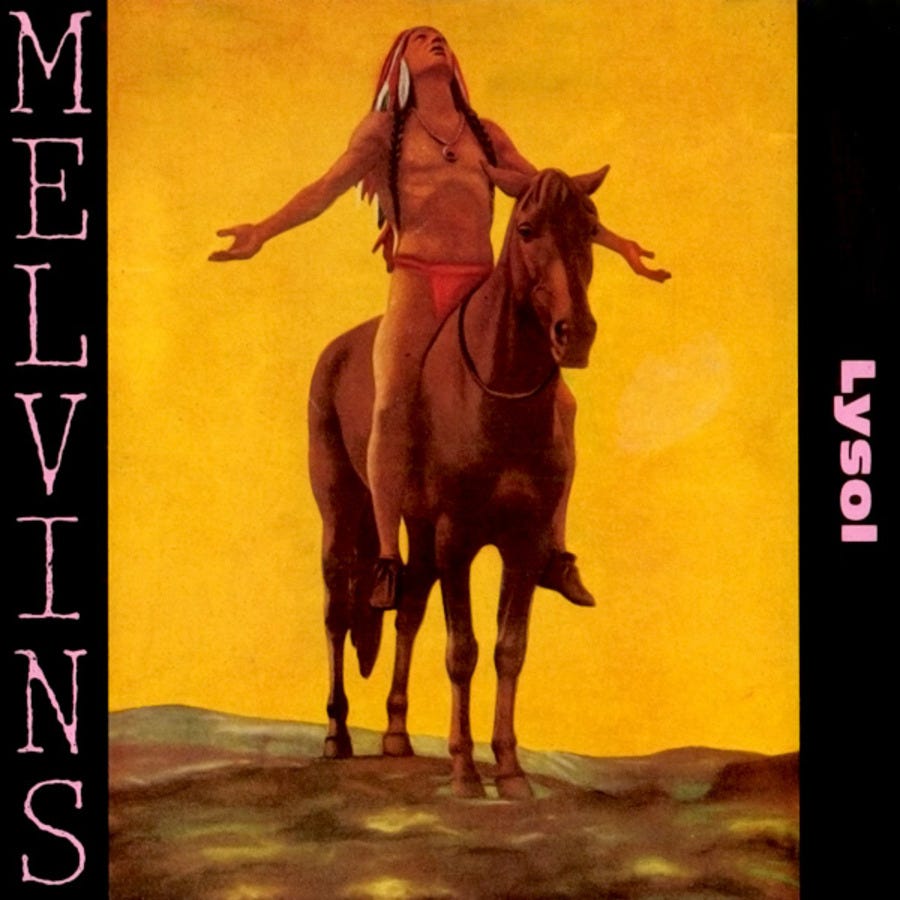
Where can one start when talking about Melvins? (Note, no “The”!). To most, they may be best known as Kurt Cobain’s supposedly favourite group (or one of them), and to others they are somehow hailed as Godfathers of Grunge, a title I’d imagine must slightly irritate the band.
Nonetheless, aspects of this are true. Melvins formed in Washington State, and they were releasing their first music by 1985. So yes, they pre-date the Grunge phenomenon by a little while.
But were they a grunge band? Fuck no. Any similarities there are just coincidental to my mind. Equally, this band were there before Seattle became ground zero for alternative rock, and unlike almost all of the bands emerging from that zeitgeist, they remain a functioning, active band to this very day, with a prodigious discography to boot. They’ve gloriously failed to mellow with age too, remaining every bit as ferocious an act now as they were 30+ years ago.
I first came across Melvins in 1991, via John Peel, whose show was a continuous pipe of mind-blowing music from all over the place, the larger portion of which I absolutely adored. Peel had Melvins in for a session, and one song in particular stuck in mind and has remained there ever since: Euthanasia.
(NB - this version above is from the actual Peel Session, and yes, like any fanboy, I have the bootleg 7” it later featured on!)
A slow, grinding dirge, it was brutal, brittle, heavy as fuck and just… everything I wanted to hear at that point in time.
Make no mistake: from that point on, Melvins were my band.
From there I grabbed Eggnog, their mini album, and worked backwards to arguably their first proper album, Gluey Porch Treatments. All of it was amazing.
Defining why Melvins were so amazing to me takes some doing. At the risk of sounding like an old man, I think to appreciate it requires you to understand the music that was going on around that time. You had hair metal still holding on, albeit in its dying gasp. In the UK, you still had pop in full flow, not that any of it troubled my ears unless I chanced on Top of the Pops on TV. Even the grunge movement was showing the benefits of major label investment, with the polish of Nirvana’s Nevermind or Smashing Pumpkins Siamese Dream being cases in point.
Melvins, however, sidestepped all of that. Their sound combined a kind of edge normally heard in punk, fused with the low end weight of the heavier, darker ends of metal. The end result was a raw slab of distortion, coupled with the heaviest drums since Keith Moon propelled The Who; primal, thundering, brilliant.
By the time Lysol dropped then, I was buying anything the band put out. However even as a diehard Melvins fan, this album was to be something of a shock. On vinyl, side A was an immense, seventeen minute masterpiece of pure riff worship, delivered - for the first 8 minutes anyway - with no drums. A slow, dirge-like drone, it is coupled only with a vocal that is almost religious in its tone and delivery. Wordless, at least at the start, this is like a monastic primal howl (if such a juxtaposition can exist), with your mind focusing only on the immense guitar sound and those borderline-worshipful vocals.
Something I should also point out: when I bought this album on vinyl, it had no song titles. Anywhere. In fact to date, no official version of Lysol contains any kind of tracklisting. So as far as I could determine, side A was just one massively long song, whilst side B sported what seemed to be three songs (plus one brief nod to another). It would take me a year or more to realise that two of the B sides were cover versions. More of that in a moment.
Side A of Lysol blew my tiny mind. It was a wholesale rejection of rock music standards, devolving the structure down to just a riff and a howl. However the pace here draws you in; that absolutely blunt refusal to break out into a ‘traditional’ song forces you to re-tune your synapses. As the song progresses, you feel your own rhythmic id slowing down to match the pace, and when it does, something incredible happens. For me it was, and still is, a kind of weird spiritual enlightenment, and as I used to play this album over and over in my bedroom, it was almost like getting high without getting high. The effect genuinely was that strong on my teenage mind.
Some eight minutes in, drums do eventually join the song, and when they do, in typical Dale Crover style, they absolutely thunder through, providing a release you didn’t know by then that you were even expecting. It is a truly astonishing moment.
Many years later (and I’m talking by the time Spotify and DSPs were a thing), I would learn that actually Side A was two songs: Hung Bunny and Roman Dog Bird. Honestly, to me they’re still the one track. In typically obtuse Melvins style, the band also insisted that on CD this entire record would just play as one track, further ensuring the fact it contained multiple songs remained somewhat irrelevant. This was to be consumed in one sitting, wherever possible. I’m glad to say that’s exactly what I used to do, too.
There is an argument that by the time Side A of this album closed, Melvins had unwittingly spawned a whole other movement in rock. I’d argue that albums like Sleep’s mighty Dopesmoker, or Electric Wizard’s Dopethrone would have been far less likely to exist had Lysol never been released. Yes, another Washington state band, Earth, would play a huge role in defining this space too, but Melvins were there first.
And we’re only halfway through the album!
On Side B of Lysol, Melvins delivered three (well, two-and-a-bit) covers and closed with one original song. Pre-internet, I only clocked that one of the songs - The Ballad of Dwight Fry - was actually by Alice Cooper, and that was only because I’d chanced upon the original being played on a friend’s stereo. It took me until only a couple of years ago to clock that even then, the band had stuck a quick homage to another Cooper track from the same album (Second Coming) immediately before it.
After originally learning of the Alice Cooper cover(s), it would be a few more years before I would learn that the first song on Side B was a cover of Flipper’s Sacrifice. The original is a punk rock gem, but in Melvins’ hands, it was slowed right down to match the mood of Side A of Lysol, creating another slab of heavy intent. Feedback squalls as the song opens, before dropping into the main riff. Slowed down, it is almost celebrated here; the original hid it beneath the raw attitude that Flipper were so known for, but on its cover, the sheer weight of the track is fully revealed.
As Sacrifice fades out, the band returns to its own composition rather than a cover to close the album. With Teeth is oddly optimistic; the chords all feel more uplifting and perhaps a little less brooding. It’s a welcome lighter touch to close out what has been a meditation on heaviness, and a rejection of the concept that punk and metal so relied upon, namely that speed was intrinsic to the vibe. Granted, Sabbath and others explored this space decades before, but few bands devolved the sound to its logical conclusions in the manner Melvins did.
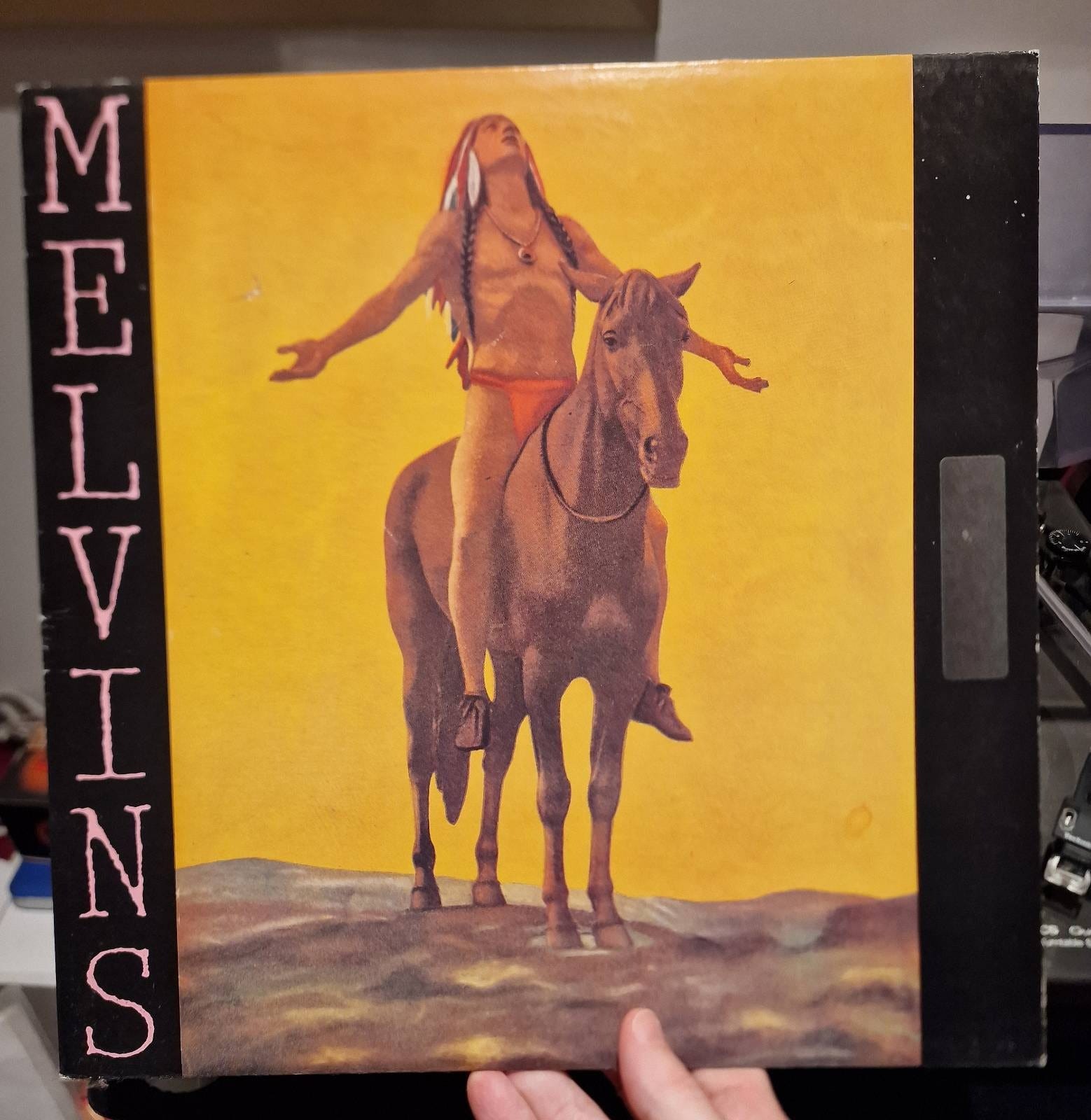
Random sidenote: when Lysol was released, it instantly fell foul of the company who make Lysol, a bleach product sold in the US. That company threatened legal action, and so Boner Records, the bands label for this release, swiftly recalled all copies and stuck black tape over that part on the right where the album’s title is. I have an original copy with the black tape still stuck on it, which - to the right Melvins fan I’m sure - would now be worth a pretty penny.
After releasing Lysol, Melvins went on to experiment with signing to major labels, dropping three albums on Atlantic (the first, Houdini, featuring some production work from Kurt Cobain, which certainly helped sales) before being dropped. After that, they signed to Ipecac Recordings, the label co-founded by Mike Patton of Faith No More, and they’ve remained fairly exclusively on that label ever since. Ipecac, to its credit, has always given the band full creative control, and that has ensured a constant stream of Melvins albums in which they did whatever the hell they wanted. We’ve had covers albums, live albums, collaborations - you name it. Granted, some of it is a tough listen (the Pigs of the Roman Empire collab with Lustmord is definitely challenging) but I just love that this is band operating with absolute freedom. Sadly I doubt many bands can make such a claim these days.
Make time for Lysol. It’s a challenging listen at first - all the more in today’s ADHD, everything-all-at-once life tempo. However that is precisely why it is necessary. That blunt refusal to play to norms is what makes it so special, and I’d argue that like some of the greatest albums out there, this was a release whose sales figures entirely fail to reflect just how influential this record was. If anything, I love it even more now than I did when I first heard it, aged 16.
No posts
Comments
Nothing yet. Say the first thing.
Sign in to join the conversation.