
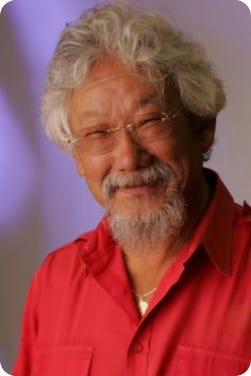
‘He’s given up!’ Social media is abuzz with people posting their take on some recent comments by Suzuki. It seems that these people feel that a ‘superhero saviour’ has thrown in the towel. A closer examination, rather than a knee-jerk reaction to a sensationalist media post, reveals a different picture. As is so often the case.
It seems that he has come to some major conclusions:
He has switched from a ‘it’s not too late to tackle climate change’ narrative to ‘it’s too late.’
Mitigation is no longer an option; we have to adapt.
Our elected leaders have failed to address climate change, and they will continue to fail.
"For me, what we’ve got to do now is hunker down. The units of survival are going to be local communities, so I’m urging local communities to get together."
In many ways, it’s amazing that Suzuki has managed to remain hopeful for so long that working with politicians and getting legislation in place was the way to go. Apparently, the election of Trump to the White House put the tin hat on that. I’m not denigrating Suzuki and all that he has done, quite the opposite. I admire his long-held optimism that politicians would get off their backsides and do something. I respect the fact that he has decided to change strategy.
Bill Mollison was perhaps more cynical about politicians from the start. The approach that he promoted was a sort of pincer movement, replacing politicians with people who would restructure our systems. Their objective would be to ‘give back responsibility to life and people’. This can be formulated as ‘I am responsible for my acts and their consequences. Whether this is about what I choose to buy, the job I do, how I behave, or what I do to try and sort out our polycrisis.’
Getting going and sorting stuff out ourselves is core to what Permaculture as a movement is about. Permaculture design and engineering is about how to do it. The ethics that are at the heart of Permaculture are about replacing legislation and laws with internalised ethics. I cannot hurt or abuse someone, not because some law says I’ll get punished if I do so, but because it goes against these internal ethics. I don’t need legislation that stops me flying, I don’t because I know it is harmful to both the Earth and people.
In Permaculture, we talk about working with people’s innate nature and not against it. People, even when they are in a situation where someone tells them it’s ok to kill the people in front of them, find it very difficult. Soldiers require a lot of training to do this, especially when it’s one-on-one. Bombarding or bombing them from a distance is ‘easier’ because the soldier isn’t face to face with the people they are killing or maiming. Even when they know there are children there. People have built-in stuff, and the Permaculture ethics are an expression of this.
Back to the pincer movement, the other part has always been about sorting out our local communities. Making them resilient, equitable, beautiful, and abundant. This is what Suzuki is now promoting. It’s also about making them carbon negative by eliminating waste, reducing inputs, and the like. Sometimes people feel that reducing needs and inputs means going back to some sort of ‘medieval poverty’. In fact, it’s the opposite. This is an example and one I keep going on about:
Eating isn’t about getting the calories in; it’s about being nourished. Politicians and industry lobbies bang on about quantities, never about quality. (On top of that, we currently produce enough to feed more than 10 billion people. The problem with the status quo isn’t one of quantity; it’s about access and equity.) Over the last few decades, the crops we produce have become less and less nourishing. Modern varieties contain fewer vitamins and essential minerals than crops grown in the 1950s and before, not just fruit and vegetables, it’s the same for wheat. Eating so-called less productive older varieties means we need to eat less because they are more nutritious. We reduce needs and live better.
I wrote an article a while back in which I posed the question, ‘do we need a permaculture political party?’ I would contend that we do, or at least a political party that would very rapidly give responsibility back to people and their communities. One that would break away from our current political top-down, one-size-fits-all, piecemeal, and failed approach.
The other side of the pincer is what MAX13 is about.

Comments
Nothing yet. Say the first thing.
Sign in to join the conversation.