
“Is Claude better than Chat GPT?”
This is the question I get asked more than any other, and it comes up in every food blogger Slack channel I’m in at least once a week.
Which AI tool should I use? Is Claude better than ChatGPT? What about Gemini? Someone told me to try Perplexity. DeepSeek is free, should I just use that?
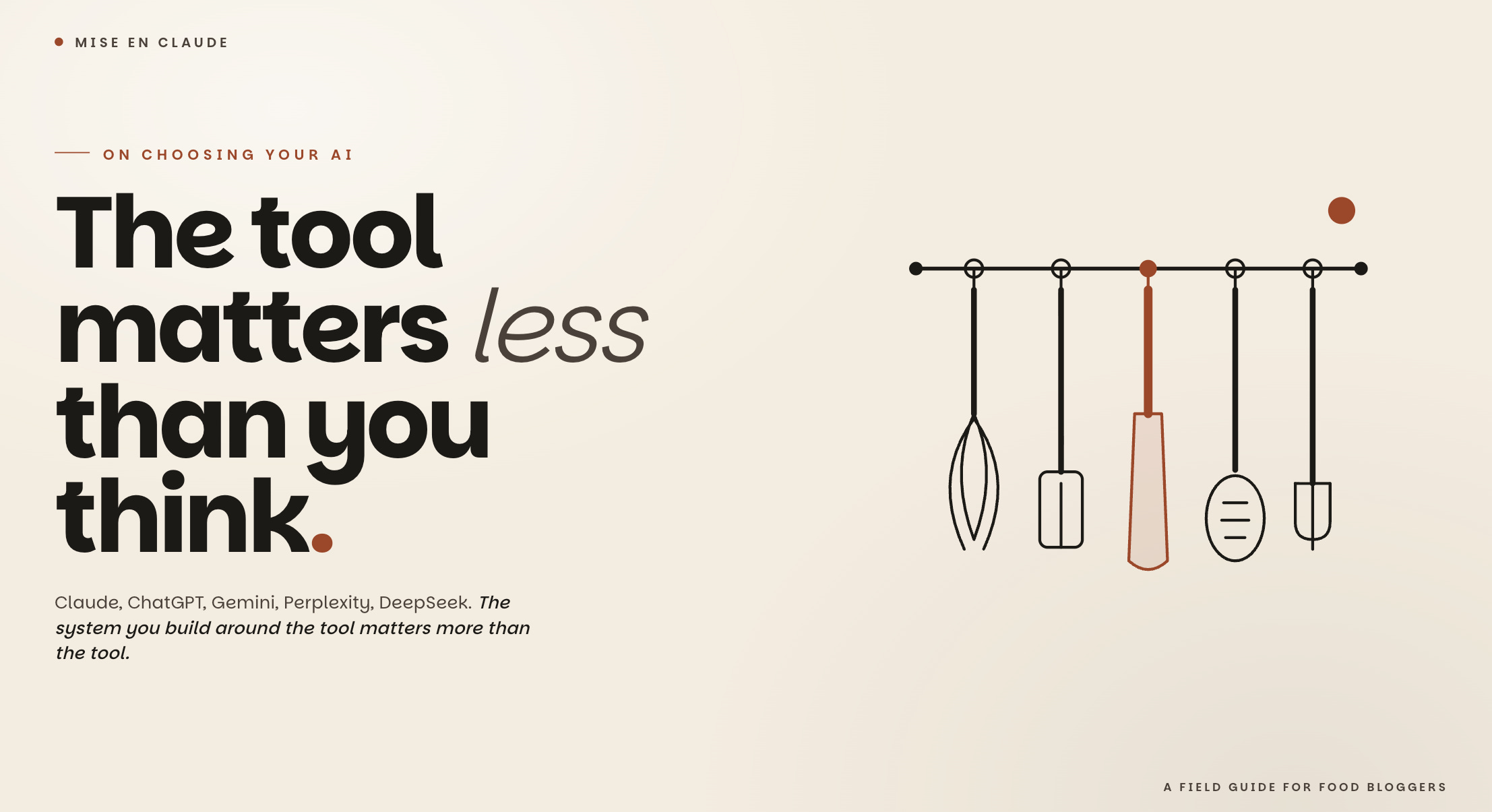
I’m going to give you the honest answer, and you’re probably not going to love it: the tool matters less than you think. The approach matters more than any of them.
But since you’re asking, here’s how I think about each one and why I landed where I landed.
Thanks for reading Mise en Claude! This post is public so feel free to share it.
Claude is my primary tool. It doesn’t need to be yours though. I’m on the Max plan because I also use Claude Code heavily for building workflows and skills, but that might be overkill. For most people, the Pro plan is likely enough. If you want to read more on the Claude house to get the most out of it, check out this post.
Here’s why Claude is my operating system, not just my writing tool:
Projects let me configure separate workspaces with their own voice rules, audience profiles, and reference files. I have one for blog content, one for email, one for social, one for business ops. Each one knows its context the moment I open a new conversation. No re-explaining.
Cowork lets me do file-aware work. Think of it like a friend sitting next to you, able to access your laptop. Drafting first pass of posts. Analyzing a spreadsheet of traffic data. Generating a CSV of content ideas from my keyword research. Anything that produces or edits an actual file.
Connectors are the part people are just starting to talk about. Claude connects directly to my business tools. Google Drive, Gmail, Google Calendar, Semrush, Google Search Console (this one took a lot of manual coding but there are third party tools you can pay to connect easily), Airtable, Kit, and Canva. That means I can say “pull my last 10 email broadcast performance stats from Kit” or “check my Google Search Console for pages with declining traffic” or “look at my Airtable content calendar and tell me what’s due this week” without leaving Claude. My entire business stack talks to one AI tool. That’s not a writing assistant. That’s an operating system.
Skills let me build reusable workflows that Claude runs automatically. I built these in Claude Code and they run inside my Projects and Cowork sessions. A skill for generating Reels hooks. A skill for checking my writing against my voice rules. A skill for producing recipe card metadata. Build once, use forever.
The output itself tends to be more measured and less eager-to-please than ChatGPT, which I personally prefer for food writing. Longer context window means it holds more of my configuration in memory at once. But honestly, the output quality between Claude and ChatGPT is close enough that it wouldn’t be the deciding factor on its own. The infrastructure is the deciding factor. No other tool gives me Projects + Cowork + Code + connectors + skills in one place.
ChatGPT (by OpenAI) is what most people start with and what most food bloggers I know are using. $20/month for Plus. The ecosystem is enormous: Custom GPTs, plugins, DALL-E for images, a massive user community sharing prompts. If you’re looking for “someone has already built a GPT for exactly my use case,” ChatGPT probably has it. The output tends to be more enthusiastic and more willing to just go for it, which some people love and some people find exhausting. I re-subscribed recently after a break, mainly to stay current on new features. It’s worth keeping an eye on even if it’s not your primary.
Gemini (by Google) is more useful than most people give it credit for, but not for the reasons Google markets it. I use Gemini for actual search queries, the kind where I need real, current, indexed information. If I’m looking for something technical (a specific WordPress function, a CSS fix, a food science question with recent research), Gemini’s search integration gives me better results than asking Claude or ChatGPT, which are working from training data that has a cutoff.
I also use it constantly on my phone for quick utility tasks: adding things to my calendar by voice, setting reminders, quick lookups while I’m cooking and my hands are covered in turmeric. The writing output is adequate but not where Claude or ChatGPT are for long-form food content. Think of Gemini as the assistant that’s always in your pocket and always connected to Google, not the one you sit down with to write a blog post.
Perplexity is a different animal entirely. It’s not really a writing tool. It’s a research tool that cites its sources. When I need to fact-check a claim, verify a food science question, or research a cultural context for a recipe, Perplexity is where I go. It won’t write your blog post. It will tell you whether the claim you’re about to make in your blog post is actually true, and show you where it found the answer. For food bloggers, that’s genuinely valuable. I wouldn’t use it as my primary AI tool, but I keep it open alongside Claude constantly.
DeepSeek is the open-source option from China that got a lot of attention in early 2025 when it matched some of the big models on benchmarks at a fraction of the cost. It’s capable, and if cost is a real barrier, it’s worth trying.
The tradeoff: less polish on the interface, a smaller ecosystem, and some legitimate questions about data handling given the jurisdiction. For food blogging specifically, the output quality on creative writing tasks is a step below Claude and ChatGPT. Good for structured tasks. Less good for voice-sensitive work.
Most AI-for-bloggers advice frames this as an either/or choice.
Claude or ChatGPT. Pick your fighter. That is not how I use AI.
I use Claude as my primary brain, then I bring in the others when they are better suited for a specific job.
Claude is where my Projects live. It is where my voice rules are configured. It is where my content workflows run. It is the place where I draft, revise, analyze, and build.
Claude is the kitchen.
Gemini is the pantry with the freshest ingredients: live search, current information, quick utility.
Perplexity is the reference library: citations, fact-checking, source-backed research.
ChatGPT is the neighbor I occasionally ask to taste something and tell me what they think.
That is the mental model that has worked best for me.
If you are just starting, pick one and go deep. But I want to name it because the usual question is “which one is best?” when the better question is “which one is best for this specific job?”
On my phone, Gemini is the one I talk to most.
On my laptop, Claude is where the production work happens.
That split — phone for utility, laptop for content production — has been the most natural division.
A lot of people think a new tool is better because the new tool starts clean.
You have been using ChatGPT for a year. Your custom instructions are bloated. Your GPTs are stale. Your conversation history is full of conflicting signals. You have old prompts, old positioning, old tone rules, and weird one-off instructions buried everywhere.
The output slowly gets worse, and you do not notice because it happens gradually.
Then you try Claude.
Fresh setup. No baggage. Clean slate.
The output feels sharper, so you think: Claude is better than ChatGPT.
Maybe it is.
Or maybe your ChatGPT setup needs a hygiene audit.
I have seen this happen in the other direction too. Someone uses Claude for months, accumulates cruft, tries ChatGPT again, and suddenly thinks ChatGPT has gotten better.
Sometimes the model changed. Sometimes the setup is just cleaner.
That is why I care less about the tool and more about the system around the tool.
Pick one primary tool.
Go deep on the configuration.
Build your voice rules, audience profiles, content workflows, and repeatable prompts there. Stop splitting your main content work across three different tools because someone on the internet said each one was “best.”
If you care most about voice protection, long-form writing quality, and building a configured setup that compounds over time, I would start with Claude.
If you care most about ecosystem, community, image generation, and having a pre-built GPT for almost everything, I would start with ChatGPT.
Either way, I would add Perplexity as your research companion. It does something the writing tools do not do as well, and I think every food blogger should have some kind of source-backed fact-checking tool in their workflow.
Use Gemini for quick utility: calendar, reminders, quick searches, voice queries, and lookups while you are cooking. It is very good at that.
If you cannot afford a paid tool right now, try DeepSeek for structured tasks and use the free tiers of the other tools where you can.
Once you have your primary tool locked in and configured, you can layer in others for specific jobs.
The gap between these models is closing every few months. The “best” model today may not be the best model six months from now.
But the system you build — your voice rules, project configuration, content workflow, research process, and clear boundaries around what AI does and does not do — transfers across tools.
That is what is worth investing in.
If you do not have that yet, start with the Claude stack post or the AI hygiene post. The specific tool matters less than building a setup you can trust.
No posts
Comments
Nothing yet. Say the first thing.
Sign in to join the conversation.