
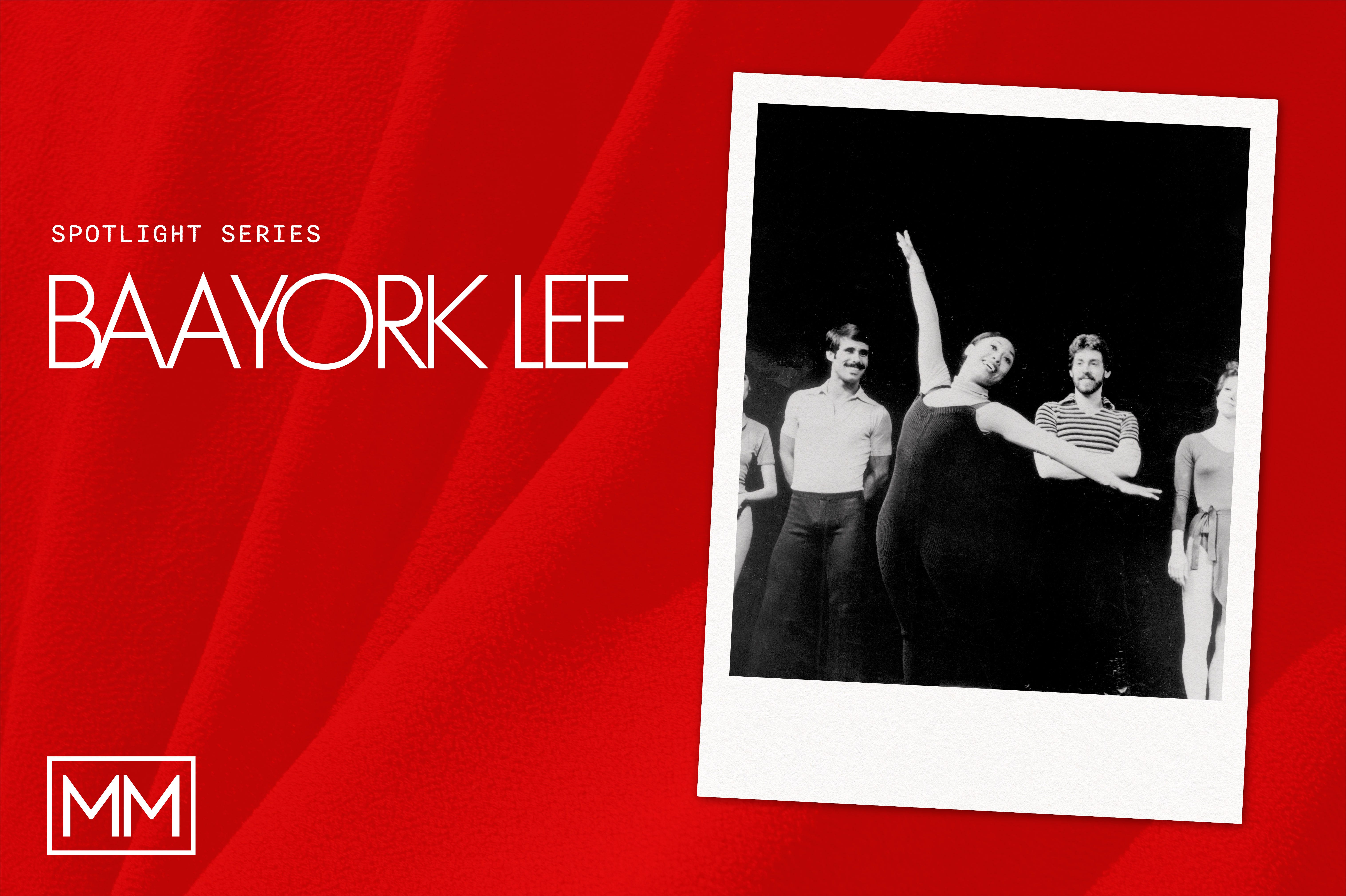
When Baayork Lee was still a child but already a Broadway veteran, she took dance class in Manhattan alongside an ambitious kid from Buffalo who moved like he’d invented a new language. That kid was Michael Bennett. Decades later, Baayork is still the person most responsible for keeping his defining work alive.
Baayork originated the role of Connie Wong in A Chorus Line in 1975, drawing directly from her own experience as an Asian-American dancer navigating Broadway’s unforgiving audition circuit. Back then, Broadway chorus dancers were referred to as “gypsies” because they moved from show to show (the term hasn’t been used for a couple of decades now, at least). Baayork first danced alongside Michael in the early ‘60s when they were both Broadway gypsies, then for him in his chorus once he became a choreographer. She later served as his and Bob Avian’s assistant choreographer and original dance captain on A Chorus Line, while also standing on the titular line.
But Baayork Lee is no stranger to prolific multitasking.
For more than 50 years since, she has been its worldwide supervisor, directing and restaging productions across the globe, in every language, on every kind of stage imaginable. Most recently, she helmed the sold-out ACL 50 gala performance on July 27, 2025 at the Shubert Theatre, marking the show’s Golden Anniversary. It was the culmination of two years of persistent effort to make the celebration happen, during which she approached numerous producers and institutions before finding the right partners in Christopher Ketner and Hunter Regian (who recently launched Origin Story Productions, a global live entertainment company).
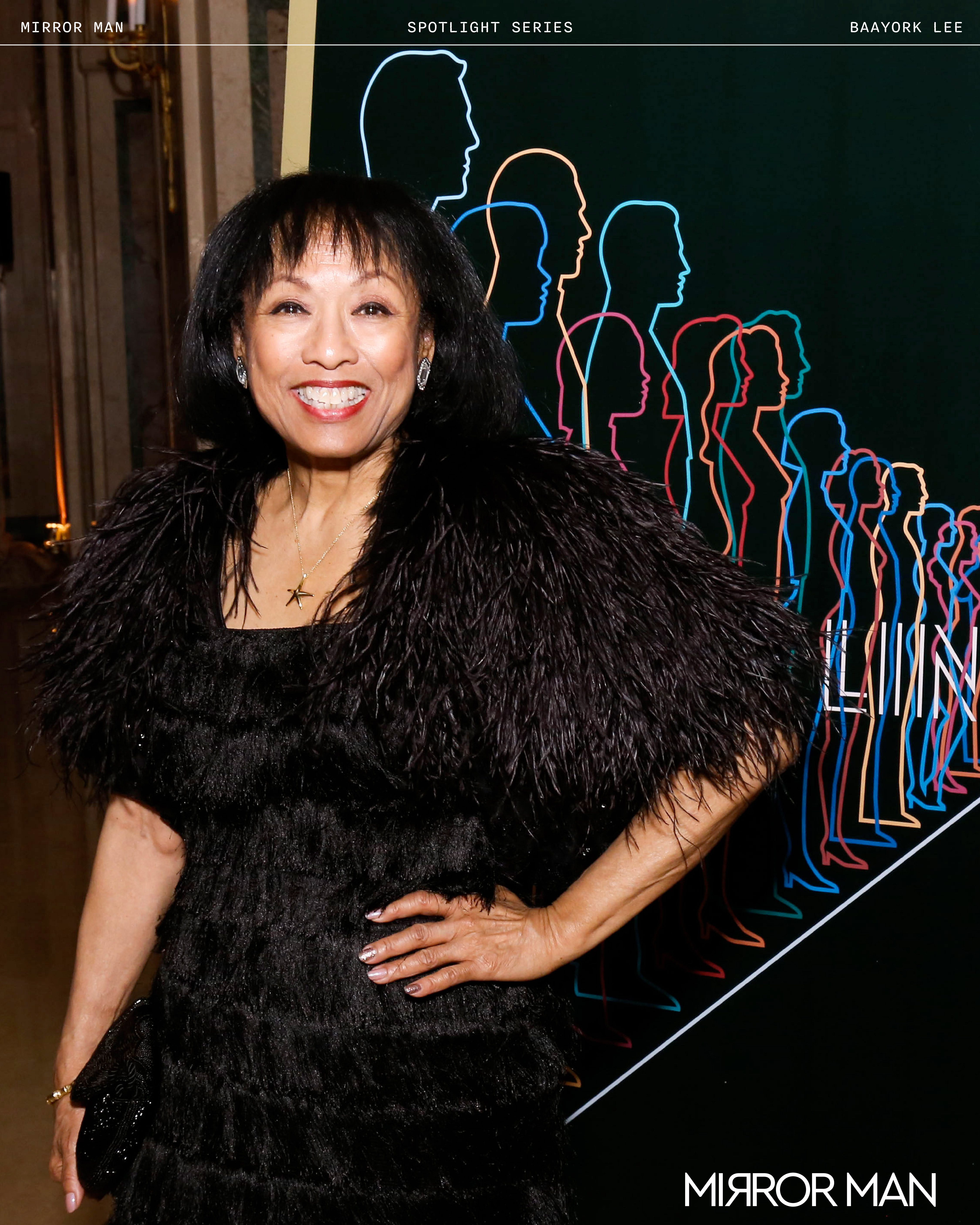
Through her non-profit National Asian Artists Project (NAAP), Baayork has spent years cultivating and amplifying Asian-American artists and audiences, producing acclaimed all-Asian-American productions of classic musicals. A director, choreographer, educator, and author, she is the recipient of numerous honors, among them the Isabelle Stevenson Tony Award and the Paul Robeson Award presented by the Actors’ Equity Foundation.
I spoke with Baayork in September 2025 about Michael Bennett the dancer, the early shows that announced him, and the lifelong creative partnerships that made everything that followed possible. This is Part One of an ongoing Spotlight on Baayork’s work with Michael.
This Mirror Man: A Portrait of Michael Bennett interview with Baayork Lee was conducted by me, Natalie Guevara, on September 3, 2025. Our conversation has been lightly edited for clarity.
Thanks for reading Mirror Man: A Portrait of Michael Bennett — The Substack. This post is public. Spread the word — and the work — of a Broadway legend.
People know Michael Bennett the director, the choreographer, the producer, the owner of 890 Broadway. But you knew him first as a dancer. What was he like to watch in class?
Michael had a freedom. I’m from the [George] Balanchine school, Jerome Robbins, School of American Ballet — everything’s very structured. And then I started going at a very young age to Syvilla Fort. If you find out a little bit about her background, she danced with Katherine Dunham. So there were drums. There was a freedom.
And that’s what I found in Michael: the freedom. He would just come in and dance. And I’d go, Where did that come from? How did you know what to do? He just danced. And it just amazed me. The creativity was there. I mean, it was like he was from outer, outer space to me, because I’m used to standing at the barre with named steps and a structure. But Michael would just dance. And that amazed me. It really did — the freedom he had.
And also the influence of West Side Story (1957), the groundedness, that Jerome Robbins style of dancing — I think that influenced Michael, too. The drums would play and he would just — I can’t describe it. There were no steps. He just danced. And it was exciting. But at that time, you also had Lennie Dale — look him up — and JoJo Smith.
JoJo Smith, who actually worked with Michael. When I spoke with Margo Sappington, she mentioned a 1967 West Side Story tour that Michael had choreographed — a bus-and-truck tour — with her, JoJo, and Michael Peters, among others. And then he worked with JoJo again on A Joyful Noise (1966). Tell me more: What was the New York dance scene like in the ‘50s and ‘60s? Who were the popular teachers to take class with?
Oh gosh, it was so different. It was Jaime Rogers. He was the most popular dance teacher. Ronn Forella… But Jaime, Jaime was it. And Michael was taking class with him. When Jaime would go off to do a television show or something, Michael would take over his classes — I just remember Michael saying that.
Jaime Rogers came from Martha Graham. He’s in the [1961] film [adaptation] of West Side Story. He just passed away last year out in California. He was the most popular. Donna [McKechnie] took class from him. I would watch her in his class.
Ronn Forella’s class… Frank Pietri, who was from the Matt Mattox school. Mattox had his own [style], and Frank carried that on. Jaime carried on Syvilla Fort, Martha Graham — he combined both. At that time you could do that, because there was no single style yet. [Bob] Fosse was still forming his. But, yeah — Jaime Rogers was the big one.
And I know you went on to work with Frank Pietri on Seesaw (1973).
And Promises, Promises (1968).
And Promises, Promises, yes. At that time, because you were at the School of American Ballet, you brought that balletic technique. Was there any crossover between the Broadway gypsy world, ballet, and modern in those years?
No, but there was Agnes de Mille, and she’d been out there with Oklahoma! (1943). Agnes de Mille came from the modern background and the ballet background, and I think she combined both. I think she was the only one who was combining all that.
You were one of Michael’s first friends in New York City. You were taking classes together, and then he began teaching… We were 12 years old, and then years had gone by and I went my way and he went his way. Then we met again in Here’s Love (1963), and by that time he was dancing for Michael Kidd.
[Natalie’s editorial note: A favorite story of mine: Baayork has recalled Michael telling her, years later, that he remembered her announcing she'd booked Flower Drum Song (1958), her second Broadway show after The King and I (1951). He had yet to make his debut.]
Very athletic, that Michael Kidd style. And when Michael told you he wanted to be a choreographer, I imagine your response was like, Okay, let’s see. But then he actually became one. Well, you have to understand: at that time, choreographers had their posse, their group, and you worked with them. If you found your choreographer, you did everything together: television, Broadway, commercials, industrials. I was a bit of a freelancer because I was so tiny, and I’d worked as a kid.
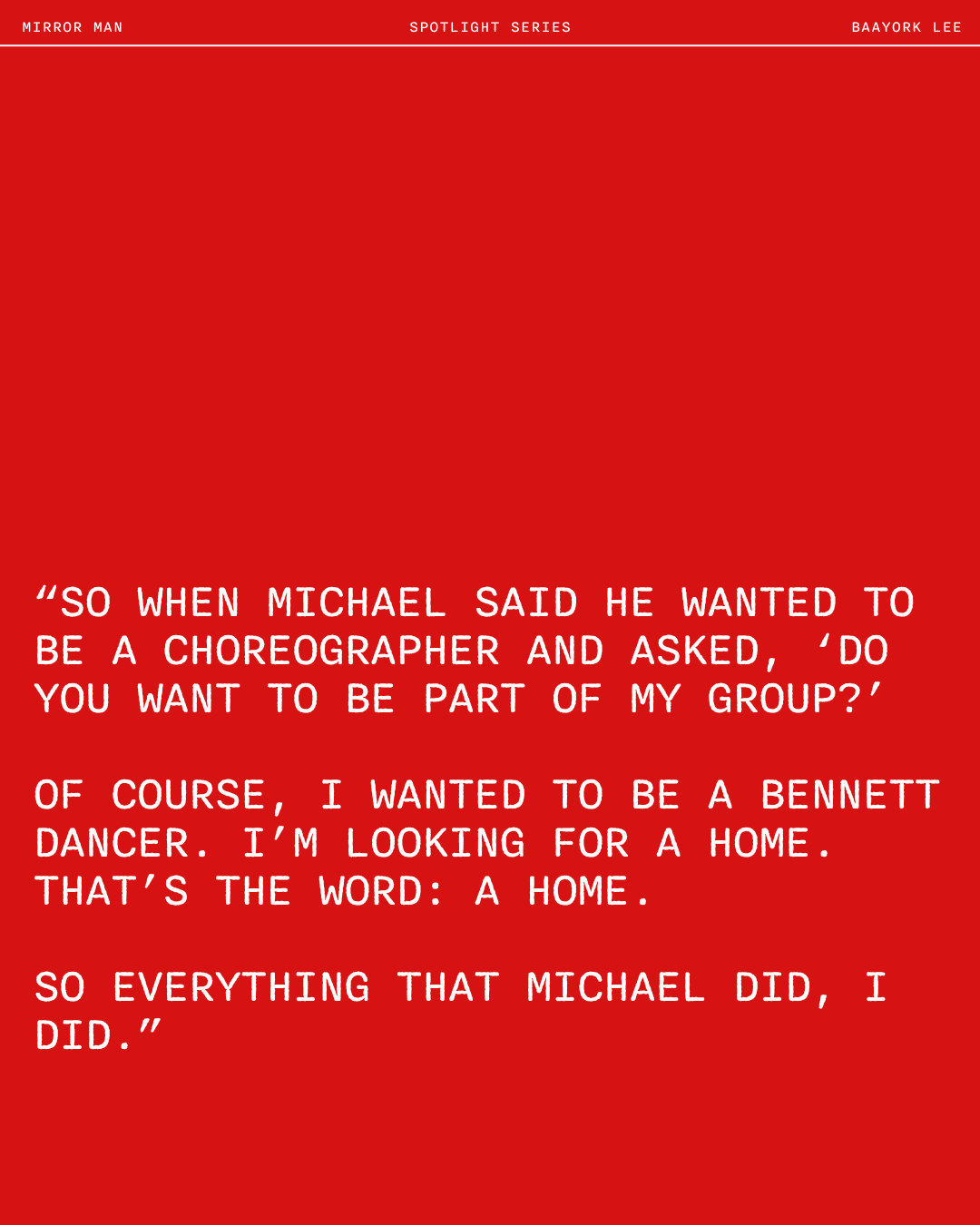
So when Michael said he wanted to be a choreographer and asked, Do you want to be part of my group? Of course I wanted to be a Bennett dancer. I was looking for a home. That’s the word: a home. So everything that Michael did, I did. I did the Milliken Show — you have to write about the Milliken Show.
[Natalie’s editorial note: The starry Milliken Breakfast Show, and Michael’s work for it, will be covered in a future Mirror Man piece. Stay tuned.] I spoke with Graciela Daniele about the Milliken at length, because she was involved as a dancer when choreographers like Michael would come in, and she later went on to choreograph the show. I know she encouraged you to choreograph the kids’ sections as well. I’ll definitely be writing about it.I was very, very happy to become a Michael Bennett dancer. That was… Oh my goodness. Oh my goodness. Because I knew Fosse wouldn’t hire me: I’m not six feet tall with those legs. A lot of the other choreographers, I had worked with — but as a kid; I was so small.
But there was something about Michael. If you talked to Michael today, he would be your best friend, I would say. He had multiple personalities. He had a personality for everyone he met, and we were all his best friend. And he was very truthful. Very truthful.

One thing that has come up a lot in my interviews with Michael’s collaborators is that he was so generous of spirit. When you were part of his crew — his posse, as you say — he really looked after you and wanted you on his next production as much as possible.Absolutely. Absolutely. We all said it.
When you were doing A Joyful Noise, Michael’s first Broadway show as a choreographer, what do you think it was about his choreography that made people sit up and take notice?I think Michael put every step he’d ever done in his life into that show. So yes, you would have to stand up, because it was everything. Everything he’d done in the mirror, every step he’d taught in a dance class, everything was in that show.
I don’t know if a style was formed, but the wonderful thing about Michael’s style is that every show is different. A Chorus Line is different from A Joyful Noise, which is different from Promises, Promises. Whereas with Fosse or any of the other choreographers, you can always tell their style is there. Michael adjusted: he tailored the choreography and the style to what he was working on.
Yeah, we loved that as dancers. We loved that.
It keeps things pretty interesting when you’re playing a Country Western clog dancer, as in A Joyful Noise, and then you go on to Henry, Sweet Henry (1967) and you’re playing a school kid.Yes. And I don’t think Michael ever repeated choreography. Everything was fresh and new.
Regarding Henry, Sweet Henry, I’ve read that you have a lot of affection for that show. I’ve seen The World of Henry Orient (1964), the film it’s based on. I’ve seen “Poor Little Person” and read about a few other numbers in the show. They have so much personality, in large part because of the young performers. All of you were so young: you, Pia Zadora, Alice Playten. What qualities was Michael looking for? What did he value in the performers he hired for shows?
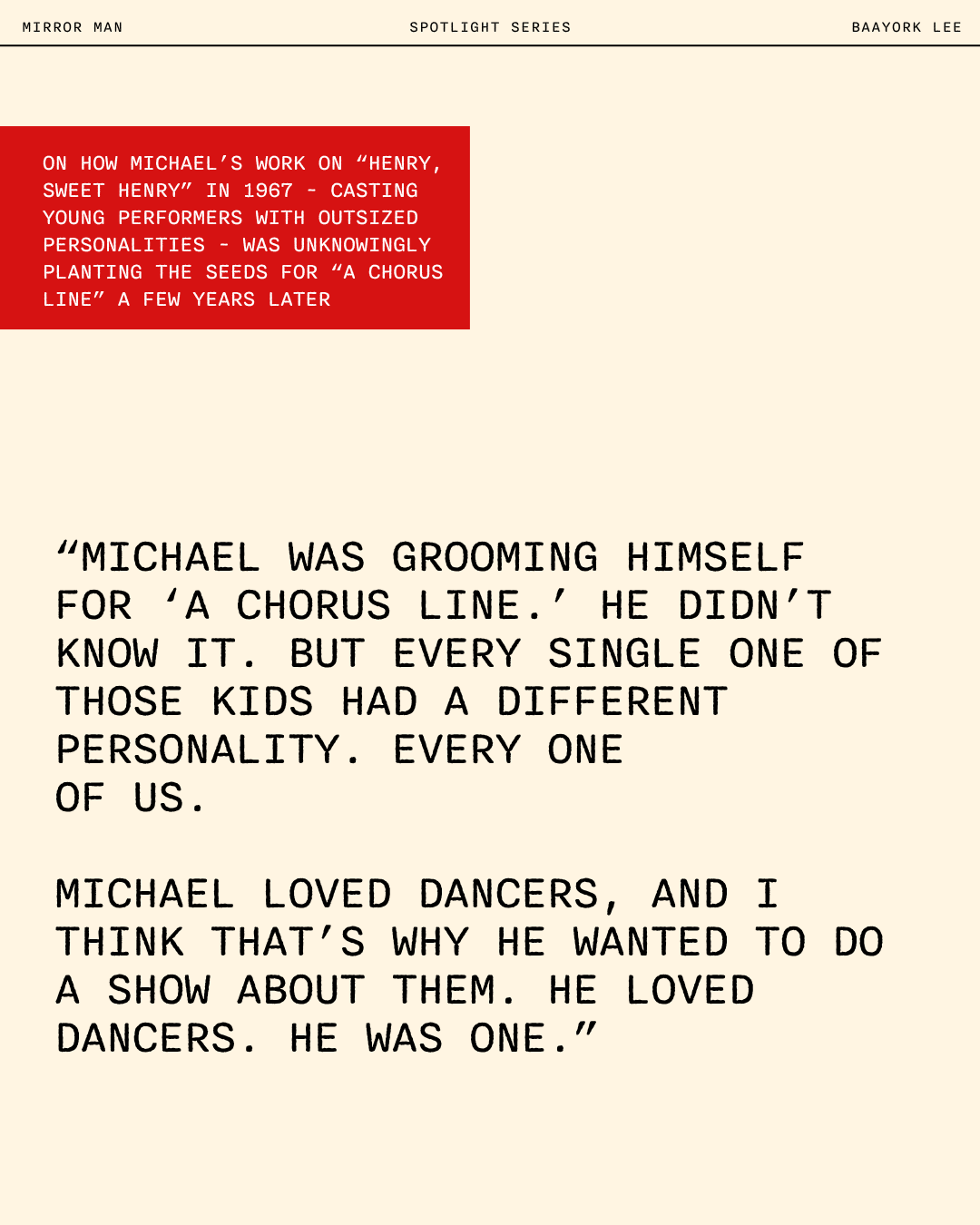
Michael was grooming himself for A Chorus Line. He didn’t know it. But every single one of those kids had a different personality. Every one of us. Pia Zadora, come on. She was already flirting. She was the flirty one. We all had different personalities, and we all could dance. Alice, of course, had the voice. She wasn’t there to dance. But all of us who played kids in the school danced.
Michael loved dancers, and I think that’s why he wanted to do a show about them. He loved dancers. He was one.
Is there a number in Henry, Sweet Henry that was your favorite to perform? We were playing hippies [in “Weary Near to Dyin’”], and Bob Avian was our dance captain. And because I danced, Michael put me in the number, and Bob Avian had to carry me on his back, and Chrissy Bocchino was blowing bubbles and tickling feet. I mean, we were hippies — all the kids were doing their own thing. But that was my favorite number.
[Natalie’s editorial note: This number is even more remarkable when you realize that Hair, the quintessential hippie rock musical that signaled a watershed moment in theatre, debuted that same year Off-Broadway. You couldn’t experience two more different shows if you tried. But Michael strived for accuracy. In Kevin Kelly’s book One Singular Sensation: The Michael Bennett Story (Doubleday, 1990), Bob Avian noted: “Michael was always heavy into research. In Henry, Sweet Henry, there was a hippie number, so we went down to Tompkins Square Park in the East Village, watching all these acidheads freaking out on soap bubbles, things like that.”]
And there was another number I wasn’t in, but it was all the adults. It was a massage number. Henry was this avant-garde musician, composing, and Michael came up with this idea: everybody on massage tables, just beating each other to the rhythm of Henry Orient. That was actually my favorite number.
I wish we could get a revival or even a concert version of Henry, Sweet Henry with the original choreography. Just from the few clips that exist, it looked like something else.
I just remember Michael put five of us in a bag and we were supposed to be an amoeba. I mean, he had the craziest, most wonderful ideas. We were the Merrill Mitkin Dancers. I don’t know where he got that name, though I think it may have been his first dance teacher. But we were all in that bag, punching and kicking each other as we rolled around trying to be the amoeba.
Did that last throughout the show’s run?
Oh, no. That went out, I think, in 24 hours. I mean, Michael had so many ideas. So many, many ideas.
Moving on to Promises, Promises, I’m not going to ask you to repeat the story of “Turkey Lurkey Time” again, since it’s well-documented. But do you remember the original number that it replaced, “Tick Tock Goes the Clock”? It was cut out of town during the show’s Boston tryouts.
Oh, yes. It was Donna McKechnie and Adrienne Angel and somebody else: they wore turkey tutus, turkey heads, and they put the desks together. Donna will tell you about it; she was in it.
It was for the Christmas party scene, and they were going to do this number, and I guess it lasted 24 hours again. Michael was in the back of the house [as it was being performed], and he ran down and said to [Promises, Promises director] Bob Moore, I can fix this. I can fix this. And I think he and Margo [Sappington] went down to the basement and choreographed the new number.
Part Two of my conversation with Baayork Lee follows this Sunday, April 19. Next up: the '70s. Michael Bennett assumes Broadway auteur status, and Baayork had a front-row seat. Subscribe free so you stay in step.
Comments
Nothing yet. Say the first thing.
Sign in to join the conversation.