
On May 5, UnitedHealthcare announced it will eliminate 30 percent of its remaining prior authorization requirements. My book Coverage Denied: How Health Insurers Drive Inequality in the United States shows why it is critical for more insurers to follow suit to not only protect access to care, but address America’s physician workforce shortage.
UnitedHealthcare CEO Tim Noel stated on this policy shift, “Eliminating these requirements is one more way we are working to make it easier for patients to get the care they need when they need it and ensure doctors can spend more time with their patients.” Though it is not entirely clear yet which care will no longer require prior authorization – UnitedHealthcare has specified only “select outpatient surgeries,” “some diagnostic tests, such as echocardiograms,” “some outpatient therapies,” and “some chiropractic care” – this announcement is welcome news to physicians and patients alike.
Prior authorization, or required insurer pre-approval for prescribed care, has long frustrated patients and physicians. A January 2026 KFF tracking poll finds it is the greatest burden that patients face when accessing their health benefits, and American Medical Association (AMA) surveys consistently show high levels of physician burden associated with it, along with risks to clinical outcomes.
This practice began as a cost control tool aimed at preventing overtreatment. Following the explosion of managed health care, prior authorization now extends to most costly care – from prescription drugs to high-tech imaging to wide-ranging tests and procedures – far beyond its original, narrow scope. Guarding against low-value care is appropriate in a country whose health spending dwarfs that of peer nations. But ballooning prior authorization requirements have intensified physician burden and burnout even as health care spending continues to climb.
Rather than effectively controlling costs, prior authorization often shifts costs onto patients and their physicians, who must support substantial staffing to offset the proliferation of paperwork burdens.
Surveying 1,340 patients across the country, analyzing health plan data, and interviewing 111 patients, physicians, and others, I found widespread delays and denials of health coverage – often, though not always through prior authorization – that thrust patients and physicians into the red tape of modern medicine. By necessitating cumbersome, multi-layered appeal processes, prior authorization drives barriers to health care not through outright denial, but through rationing by inconvenience.
When care requires prior authorization, physicians must submit documentation – for example, description of failed drug trials. If denied, they may undergo a “peer-to-peer” review with an insurer-employed physician who is often outside the relevant specialty, increasing the likelihood of erroneous denials and additional layers of appeal.
One physician interviewee reflected, “It’s frustrating because you’re going to win in the end. You know the criteria. You know the patient qualifies for it. Yet you’re battling week after week, delay after delay for what you know they qualify for.”
And while the streamlining and expediting of electronic prior authorization outlined in the recently proposed Centers for Medicare and Medicaid Services (CMS) rule may speed up coverage decisions, it will not pare back the denials that necessitate those appeals that drive widespread paperwork burden and coordination hassles with insurers. As that same physician interviewee noted, “I don’t need a timelier denial. I need an acceptance.”
As physicians juggle these burdens alongside clinical duties and protracted insurance battles, patients may be untreated or receive suboptimal treatment that is less burdensome to obtain. I find that less affluent patients are significantly less likely than others to appeal denials and are more likely to delay medical care and non-medical purchasing while navigating coordination among their physician, insurer, and pharmacy.
These processes occupy non-billable hours for clinicians. It is little wonder why AMA surveys reveal that 40 percent of physicians have staff who are dedicated to prior authorization administration – support more available in large systems than in less resourced or smaller practices.
In fact, one pulmonologist employed at a major university hospital whom I interviewed reflected on this, “If they’re making somewhere around $60,000 a year to be a mid-level administrative professional, we’re talking $300,000 a year in salary alone to deal just with prior authorization, and it still takes two days, and the patient has to go to pharmacy twice. It’s a huge number of resources. And we’re just one department spending this.”
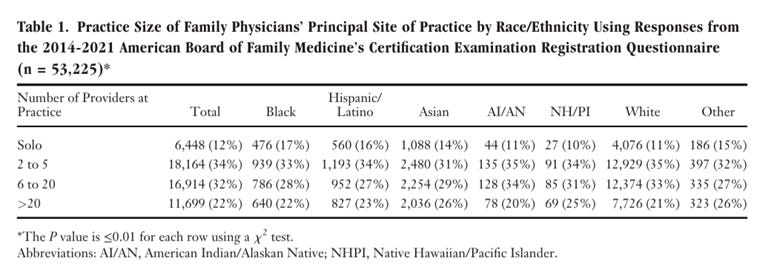
Inequity in physicians’ staffing support is understudied but critical. Black and Hispanic physicians are especially underrepresented in academic medicine and especially likely to work in solo practices, where paperwork burden will fall more on their own shoulders. A policy brief published by the Journal of the American Board of Family Medicine highlights racial disparities in these practices, such that Black and Hispanic physicians are more likely than their white counterparts to operate a solo practice, and less likely to work in a practice of 6-20 providers (see Table 1).
This is no accident. Minority physicians experience lower rates of promotion, contributing to departures from academic medicine that might offer burden reduction. The result is heightened burnout that spills over to their disproportionately marginalized patients.
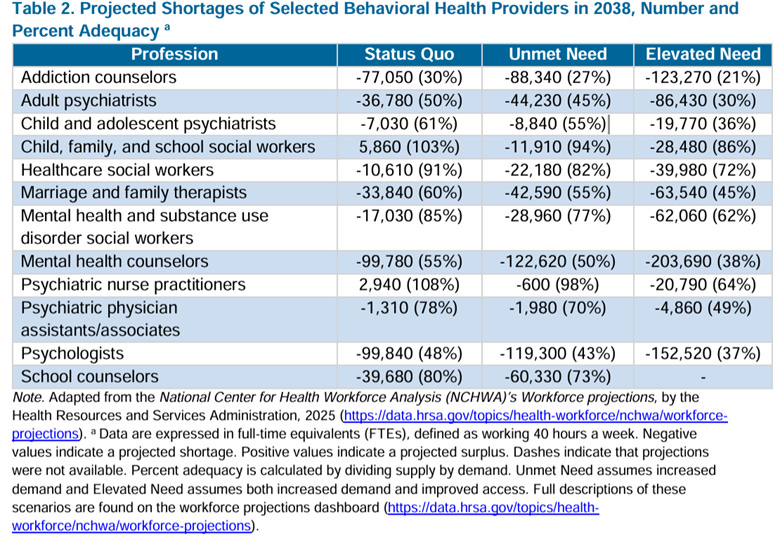
All of this unfolds amid a severe physician shortage. The American Association of Medical Colleges estimated that an additional 86,000 physicians will be needed by 2036, and when restrictive immigration policies further compromise the nation’s ability to meet the growing health demands of its aging population. 137 million Americans, or 40 percent of the U.S. population, already live in mental health professional shortage areas, and psychiatrists are especially likely to work in solo or two-person practices that lack administrative infrastructure. With this added burden, prior authorization risks making this field less sustainable precisely when demand is surging, leaving a growing share of the population to experience unmet health needs (see Table 2).
One good bit of news through this lens is that geographic disparities in physician burden due to staffing issues may not fall neatly along geographic lines, because hospitals are currently 2.5 times more likely to acquire rural physician practices than urban practices (though this is in reaction to pronounced disparities preceding this shift).
Physicians currently complete an average of 39 prior authorizations per week. This burden increases burnout, adverse mental and physical health consequences, and they may be at greater risk of making medical errors. They may even push clinicians out of the practice of medicine altogether, further eroding access to care as Americans’ health outcomes continue to pale in comparison with high-income peer nations. As one physician interviewee reflected, “Much more often than not, we can get the drugs we need, but only after we jump through all the hoops, thereby delaying care.”
It is thus especially striking that one claim reviewer for Elevance stated in an interview, “We’re told denying things is okay because people can appeal.”
There are undoubtedly reasons to curb low-value care, and appeal processes exist when incorrect decisions are made. But the cumulative effect is widespread patient and physician burden that destabilizes health care delivery.
And given that some denials are driven by administrative error, some of this burden is unnecessary – failing to contribute to appropriate guardrails, instead contributing only to physician and patient burden that is borne disproportionately by those with fewer resources. To take just one example, a neurologist whom I interviewed prescribed an in-lab sleep study for their patient, who was then denied on the grounds that they had not yet had a home sleep study, which they had under that insurance.
“You just paid for this two weeks ago. How is this not in your record? How do you have such little information in your system that you’re not even looking to see that you just paid out that code? Of course, they could. They choose not to. Then I have to get on the phone and call them, I tell them the patient had a home study on this date, and they, say, ‘Okay, we’ll approve it.’ It’s literally a 30 second conversation. But how much delay was there, and what are the chances I don’t call? Maybe I don’t call and I just let the denial go. They do this all the time with drugs too. You’re paying for these drugs. Why don’t you track what they’ve tried and failed?”
To be sure, this is not the modal experience with prior authorization, but it is certainly not anomalous either, And this physician at a well-resourced university hospital often came back to the question, “What if someone can’t incur these costs?”
UnitedHealthcare’s announcement of reduced reliance on prior authorization by the end of 2026 is a welcome step in the right direction, eliminating the application of this process for select outpatient surgeries, certain diagnostic tests, and certain outpatient therapies. The precise scope of these changes is not yet clear, as the full list of affected treatments has not yet been published, but it builds on ongoing efforts to streamline and pare back these requirements that have generated widespread backlash.
Though major insurers have pledged to reduce reliance on prior authorization and have announced an 11 percent reduction thus far, the scale of America’s physician shortage and its ripple effects to patient care demand more than incrementalism, especially at a time when CMS is introducing new prior authorizations to traditional Medicare. UnitedHealthcare’s announcement is important, but this insurer accounts for 15 percent of America’s health insurance market (and, for example, it is Blue Cross Blue Shield that has the largest market shares in most metro areas), and many more patients and physicians need relief from barriers and burdens to which these processes contribute.
Without broader efforts to substantially reduce prior authorization requirements, red tape will continue to undermine both the physician workforce and patients’ ability to obtain timely care.
No posts
Comments
Nothing yet. Say the first thing.
Sign in to join the conversation.