
The market capitalisation of Tata Group companies more than tripled in less than 10 years of Natarajan Chandrasekaran at the helm. What’s more significant is the shift in the ownership of Tata stocks.
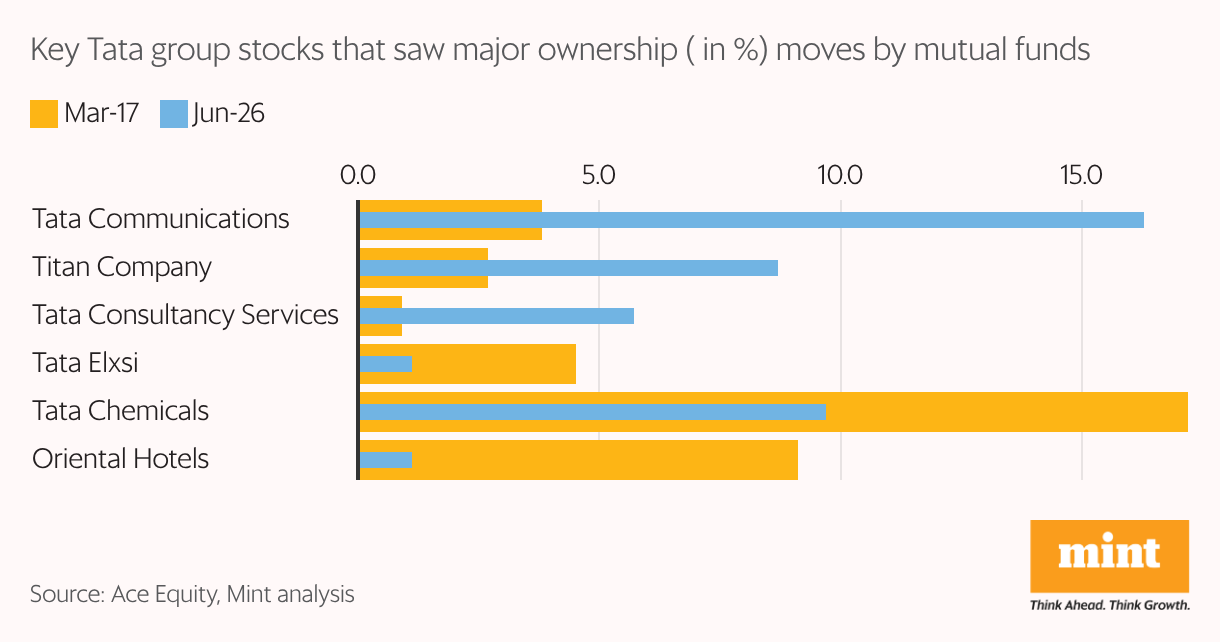
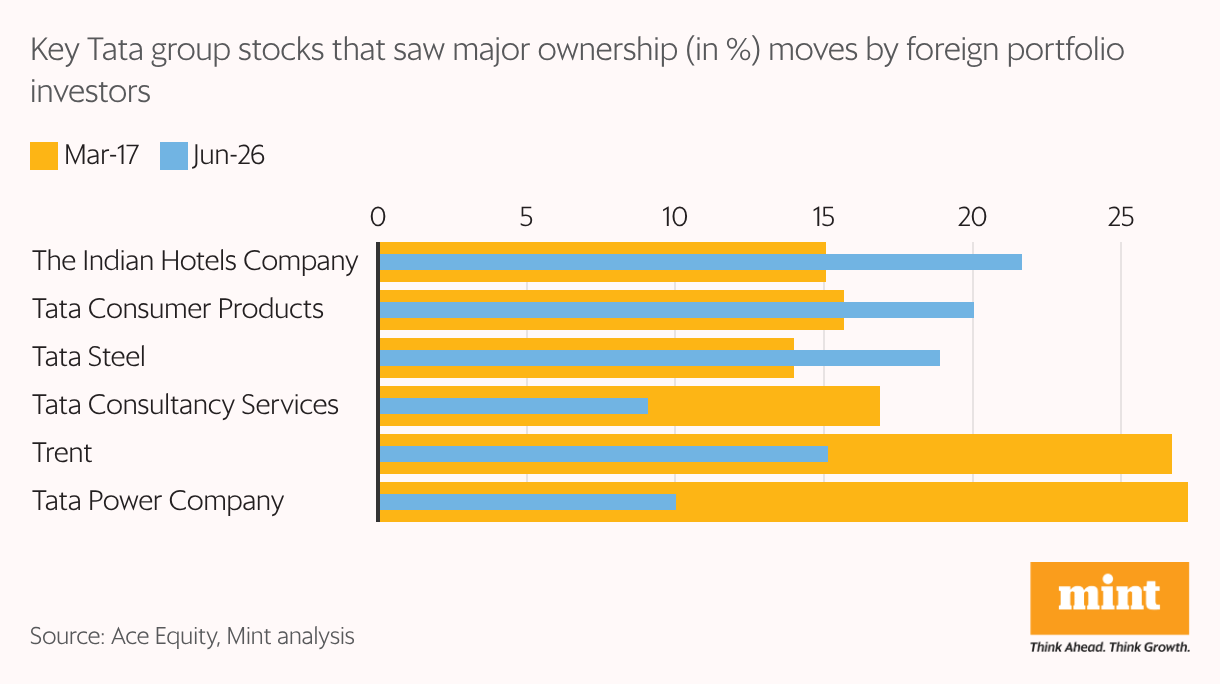
According to a Mint analysis, domestic mutual funds piled into Tata stocks linked to the technology to telecom and auto sectors—Tata Consultancy Services Ltd., Tata Communications Ltd. and Tata Motors—while foreign portfolio investors (FPIs) rotated into consumer-focused companies, even as retail investors bought into the Tata trust.
Domestic mutual funds increased stake in TCS from 0.94% in March 2017 to 5.68% by 30 June 2026.
Mutual fund holdings in Tata Communications increased by 12 percentage points over the same time period.
Mutual funds doubled their stake in Tata Motors PV from 4.82% in 2017 to nearly 10% in June 2026.
And while foreign investors rebalanced exposure to TCS and Tata Motors, they bought heavily into Tata Consumer Products Ltd. and Indian Hotels Co. Ltd.—up 5 and 6.6 percentage points in 10 years, respectively—even as Titan Co. Ltd. and Trent Ltd. emerged as outsized favourites.
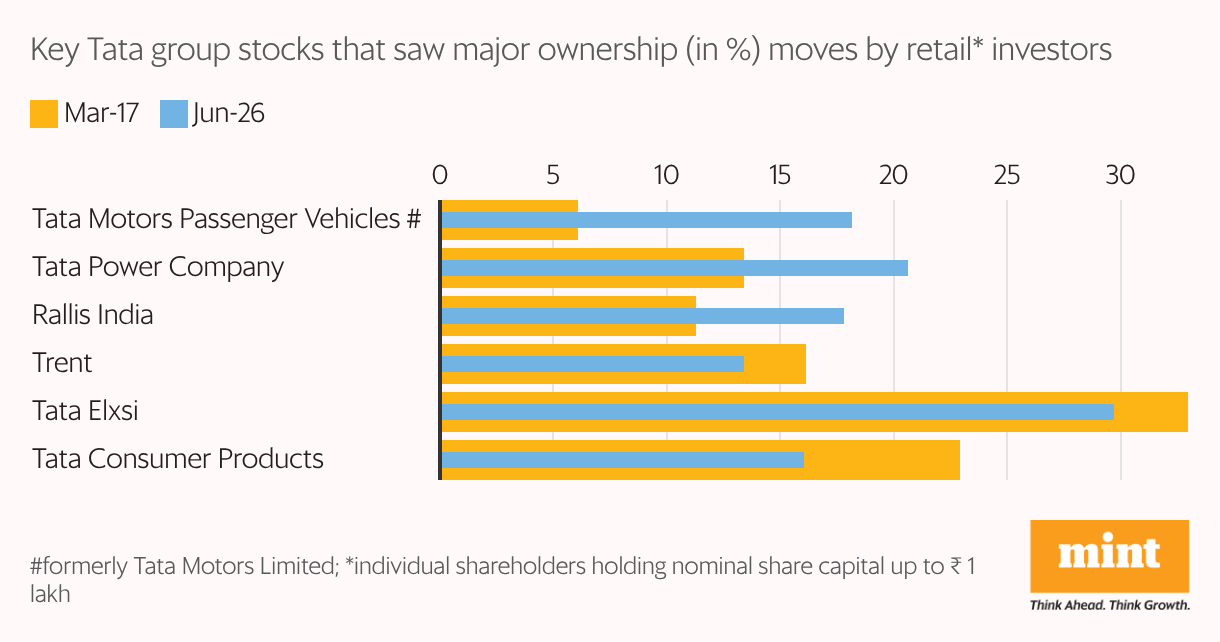
All these stocks delivered multi-bagger returns during Chandra’s tenure. That signals institutional confidence, something his successor would’ve to live up to.
Tata family members and a handful of senior executives, including Tata Steel Ltd.’s Thachat Viswanath Narendran, are emerging as contenders to lead the 158-year-old conglomerate, Bloomberg News reported, citing people aware of the matter.
Besides Narendran, chief executive officers of group companies such as Tata Power Co.’s Praveer Sinha, Tata Motors PV’s Shailesh Chandra and Tata Chemicals’ R. Mukundan are in the early list, as is 32-year-old Neville Tata—the only son of Tata Trusts Chairman Noel Tata.
The Sir Dorabji Tata Trust, one of the trusts controlling Tata Sons, has started the process of selecting Chandrasekaran’s successor, saying in a statement Thursday that it seeks “a smooth, timely, and orderly transition of leadership, consistent with the values and long-term interests of Tata Sons and the Tata Group”.
The board also hasn’t ruled out an external candidate to guide the conglomerate through its ongoing multi-billion-dollar investment plans.
India’s equity benchmarks retreated this week after two consecutive weekly gains, as lingering uncertainty in the Middle East and elevated crude oil prices tempered risk appetite for stocks in the world’s third-largest crude importer.
The NSE Nifty 50 fell 0.8% this week to 24,366 and the S&P BSE Sensex lost 0.6% to 78,009.25. On Friday, they ended little changed. Fifteen of the 16 major sectors fell, with broader midcaps rising 0.5% and small caps dropping 0.7%. Financials stocks lost 1%, while metals led the losers among major sectors with a 1.9% drop.
The week also marked the end of the quarterly earnings season, which has largely been ahead of expectations, according to analysts.
🔗 Pulse of the Street: Tata jitters, metal rout weigh on Indian equities
Supreme Court pulls up BCI over action against Nalsar students
Is India’s fast-food sector seeing a turnaround after Iran war disruption?
NSE aims to launch IPO in mid-September, list by end of month
Bonds are becoming easier for retail investors to access, with minimum investments falling to ₹10,000 and online platforms offering higher yields than fixed deposits. But chasing the highest yield within a credit-rating category can be risky. A AAA rating, while useful, does not eliminate default, liquidity or market risks.
Experts say investors should dig deeper, checking rating history, outlook, whether the bond is secured, the issuer’s sector and cash-flow strength. Government backing can also matter. The key takeaway—a credit rating is a starting point, not a guarantee of safety. Read more.
Comments
Nothing yet. Say the first thing.
Sign in to join the conversation.