
This is a follow-up article. If you wish for more context and an introduction to the topic, you can read the first part here:

We centred the question “Why are we refusing to be eaten”?” in a Seismic Question gathering in March 2026. Almost to the date, a year after we started our collective journey to bring the book Seismic Questions to life. The year was a rope dancing act between frustration and appreciation. Balancing a deeply ingrained desire to produce tangible outcomes with the recognition that the practice of space holding requires, unsurprisingly, space.
When I closed my laptop after the gathering, I felt in my whole body that we made the right choice. Not to push for outcomes, not to push for letters on papers and outlines neatly filled out. To write this book, we needed this year’s meandering experience. Not on paper but in the dynamic joy and discomfort of dancing with questions together; expanding perceptions, embracing uncertainty, nurturing tolerance, and widening our ability to recognise plurality. It all requires and deserves time and practice.
It’s one thing to fully live a specific Seismic Question and expand your ability to evolve and expand the realm of this question. It’s a whole other matter to embody this practice for all the questions that want and need to emerge in decolonial, collapse, reconnecting, re-indigenizing, healing and hospicing work. Including the questions that scare, confront or disarm us. “Why do we refuse to be eaten?” feels like one of those questions. It is a question that does not allow us to go full Ostrich. It is a question that touches us in our spirituality, religion, ego, culture, materiality and discomfort.
Before diving into exploring a question together, I like hearing from people about how it landed in their context. How did they initially understand the question? Insights and learnings emerge when we have different understandings of something. The words, the question, land in different contexts. These transcontextual learning moments never cease to be a beautiful source of insights and shifts. How we understand a question tells us so much about ourselves and our relationships. We could have written a whole book solely on the different initial responses to this question and what these responses might tell us about the stories we live, the language we use and the ontological foundations of our being. This is an incomplete list of initial responses signalling the many contexts in which we can explore our unhealthy dynamic with the metabolic whole.
Does this have something to do with the Epstein files?
Context: Hyper-perpetuating Patriarchy
Is this a pro-vegan question? A moral question of why we should eat them if we don’t allow them to eat us?
Context: Industrial big-agri & food cultures.
Isn’t this a good thing? I thought we transcended cannibalism.
Context: Human separation & exceptionalism. (Initially, only considering that humans can be eaten by other humans signals how deeply the illusion of separation is ingrained.)
How is this a question? Of course their is no refusal, we actively embrace returning to the soil. “From the Earth we come, and to the Earth we return.” - Context: Religion. In many religions, returning to the soil and to the metabolic whole is of utmost importance. (This makes me wonder if the refusal to be eaten may be a symptom of hyper-individuality and the disease of modernity.)
Someone’s inner child stepped in and brought the realisation that, as a child, they very often thought about being eaten, and it always felt like a violation. Now they realised how much these thoughts were shaped solely by Western media.
Context: Media. (Made me wonder how transcontextual conversations can help us to unlearn the stories that shape our ontological foundations as children.)
Refusing to be eaten by the capitalistic system
Context: Activism and Counter-culture
Refusing our learnings, insights, and ideas to be nutrients for someone or something else, instead, we are holding on to them, and we are becoming unnecessarily heavy and weighted down in the process.
Context: Our Egos
I have been holding this question in various forms for close to a decade now. It emerged during an innovation Design Sprint for a waste management facility based in the Netherlands seeking novel solutions for their monostreams of waste. No need to say they weren’t managing the collection and disposal of human bodies, but somehow this is where our conversation landed.
Throughout our lives, we dispose of our garbage, domesticate animals, attempt to control land and extract resources and then even after our death, we hold on to our material bodies and continue to extract and claim. Coffins are chemically treated to avoid decomposition. A literal refusal to be eaten by all the little buggers in the soil and return to the circle of life. In addition, the soil is covered with a concrete or marble slab, once again a refusal for life to thrive. Cremation practices require tremendous amounts of energy, and in some countries it’s not even allowed to then set the ashes free in the wind for them to return to the soil. We realised, and this is not a subtle realisation, that we felt as if we, as humans, were also a sort of mono waste stream that needed to be managed and disposed of. Life knows no waste. Waste is a human construct, and by holding on to our materiality and refusing our bodies to return to the cycle of life, we felt we were giving them the ‘waste management treatment’.
In the last ten years, a lot has changed in the burial ‘industry’ (because that is what it is, especially in the Global North, an industry). Eco-burials have become more mainstream. We can now be buried in mycelium coffins or under the seeds of our favourite tree. The more widespread emergence of all these options did calm my worries a bit; I now know that I may return to soil and fulfil the honour of being eaten. Despite these more aligned options, I can still not let go of the question. It stands for something more all-encompassing. By holding on to our bodies, our individual entities, even after our death, we are deepening the illusion of disconnection and separation. If I truly, wholly felt to be a consciousness of life, a changing node in the entanglement of life, a part of the metabolic whole, not alone, not an individual, not a separated being, if I truly, wholly felt this to be true, would I refuse my body to be eaten? To be metabolised? To return to the soil? If I understood myself to be a cyclical part of the whole, would I be so afraid of death that I lived my life in refusal of its presence? If I felt to be among a collective practice of grief, ceremony and wailing, would it still be so hard to let go of the material body?
Our initial response in the Design Sprint was linear and solutionistic. We ended up suggesting, on stage, in a business pitch, that we should recycle human bodies into plastic and energy. This idea was based on existing technology designed to ‘process’ other life forms. Talking about this pitch and writing it down makes me highly uncomfortable. It is hard to imagine that this mechanistic linear solution ever truly appealed to me. But it did. I was so frustrated with humanity and the way we disconnect ourselves from all other beings that I felt we needed an absolute shock to the system. A shocking reminder that forces us back into recognising that we are a part of the metabolic whole. I didn’t consider that by accelerating and mechanising this process, I was denying our material bodies to metabolise and decompose at the speed of life. Quickly after I abandoned this direction, recognising it as intrusive, aggressive, solutionistic and impatient. A pushing of the timeline of decomposition without consent, replacing or attempting to tackle one industrial logic with another.
I now hold a gentler and slower stance, and I am curious how my relationship with death and my material self will continue to evolve. The question remains. I am still deeply worried about the all-encompassing illusion of disconnection. Our refusal to take part in the metabolic whole shows up in so many forms. We broke the nutrient cycle of poopies, bodies, ideas, grief, energy and stories. The stronger the illusion of separation becomes, the more we try to box, hold on and capture. We pour so much energy into holding systems, things and bodies in place that we don’t realise we are refusing ourselves to fulfil the fundamentals of a living being. To live, to flow, to eat, to be eaten, to die, to dance, to sprout, to mourn, to be among, among the metabolic whole.
I started to explore the full range of burial traditions and talked, over the last decade, to people from many different identity backgrounds about their refusal or willingness to return to soil. The question of grief emerged as a recurring pattern. In cultures that hold strong collective grief practices and traditions of ceremony, there is way more willingness, and often it’s a matter of honour, to return to the soil. It’s in the absence of shared grief practices and ceremony that people hold on to the material body. This notion of grief extends to letting go of the material body. Cultures that have forgotten or decentred rituals, rites of passage and ceremony seemingly have weakened their ability to let go, to live cyclically and in deep relationship with other beings. Living in a deep relationship always means nurturing flow; one can’t be in a relationship and hold everything to themselves.
We can’t be in deep relationship whilst refusing to be part of the metabolic whole.
We can’t be in deep relationship with the food we eat and the soil it comes from if we don’t feed the soil in return.
We can’t be in deep relationship with our ancestors if we hold on to the material body, refusing them to return to the whole.
We can’t be in deep relationship with the rivers if we hold water hostage in dams.
We can’t be in deep relationship with each other if we individually hoard resources, energy and ideas.
My partner’s six-year-old niece is a beautifully inquisitive being with an infinite stream of questions. Somehow, our conversations keep returning to religion and spirituality. It was a pivotal moment for me when she asked me why I didn’t want to be cremated or buried in a coffin. I realised that the only way I could really explain it was that I would find it an absolute honour to be eaten by all the life in the soil, and to return to the earth as food for the next cycles of living beings. I realised that I fully share the belief that returning to the soil from which we came is a tremendous honour. And I don’t want any chemically treated coffin or cremation to get in the way of that honour. To be alive means to feed life, to be part of the metabolic whole. I already feel that we separate and disconnect ourselves from the metabolic whole in so many ways throughout our lives that I can’t stand the thought of dying in a separate and extractive manner.
We try to hold on to so much. We use our energy to keep broken systems in place, so the pieces won’t fall out. Our efforts are poured into ‘fixing’ the cracks through which life seeps in. We hoard, gather and store to get a sense of security. Oblivious that no security can ever exist in a system that tries to defy the laws of nature. Life must cycle, life must flow, life must metabolise, life feeds life. We are not individual beings. We are one big planetary buffet, and nobody sits untouchable at the throne.
The world is changing. The ways we show up in life are changing and have been doing so for a long time. As the illusion of separation deepens, we drift further and further away from living in alignment with life on Earth, living as healthy beings part of the metabolic whole. Being eaten has come to mean something far larger than what happens to our decaying bodies. Being eaten, the refusal to play our parts in the metabolic whole, it reaches into how we live, what we release, what we hold on to, what we allow to be composted, what we hold hostage, and what we are willing to metabolise?
At one point during the call, we landed on a shift in perception that shook me to my core. I didn’t know and still don’t know how to respond to it. I considered our disconnection from the metabolic whole mainly as a refusal problem. Meaning that if we work on our refusal, we can return to the soil, we can feed life, as long as we just want it. Then it was pointed out that with climate change, extreme weather events and wars, people are increasingly ending up in unwelcoming soil, arid lands, flooded lands, and the rubble of buildings crumbled by war. Feeding the soil with our bodies isn’t just a matter of willingness; it has become a privilege for those who live in areas that still cradle healthy soils. For me, this has added a whole new layer of responsibility to care for the land. We need to care for the land so the land can welcome future generations in her eco-system and fulfil one of the fundamental roles of all beings on earth, to feed the soil. I am deeply grateful for this shift in perspective. During the session, I didn’t know how to respond to this realisation, or for now, how to compost the whirlwind of feelings that have come with this perspective shift, and that was okay. Coming together to hold Seismic Questions also means holding space for each other’s overwhelm, confusion and silence.
Whilst reading this meandering article, what happened in you? How did your body feel? What came to life? Or perhaps became numbed? Where did you feel the question? Did it stir something in you?
I want to invite you to map the lines and circles of your life. This is a sense-making exercise that doesn’t require perfection or completeness. It is not an attempt to be precise or accurate; just let it flow and see where the invitation brings you. When engaging our hands in a sense-making inquiry, we can’t anticipate what will happen.
The invitation is to visualise parts of your life with circles and lines. This list may help you get going; feel free to add anything that comes up.
Food / Sustenance
Water
Mental / Creative / Artistic Flows
Energy
Your Body
Love
Ideas
Inspiration
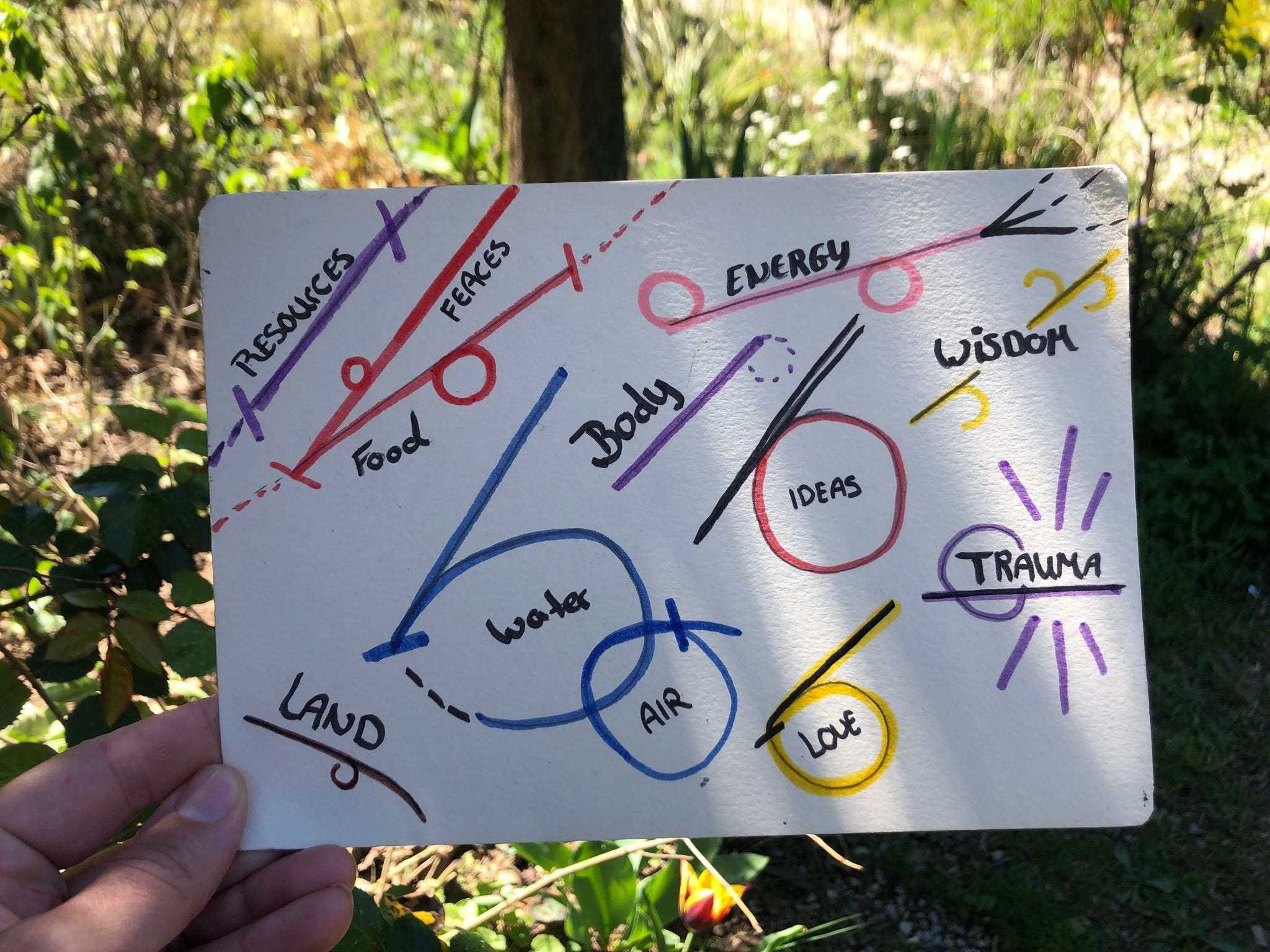
What did you notice whilst drawing your map? How do you feel about seeing the metabolic dynamic of your life mapped out on paper? Did any realisations or questions emerge?
What if you slowly started bending some of the lines into circles? How can you show up to life in a way that you are both
metabolising and being metabolised?
Both taking and giving energy? Both eating and feeding?
I want to close this article with a poem that emerged in the space holding. It’s a poem that deepened a realisation in me that I am still struggling to accept. The realisation that I have to return to where the soil mirrors my biome and take my responsibility to care for and honour the land that I was born from. As long as I keep travelling far and wide, I am refusing a responsibility, I am refusing to be part of the metabolic whole of the land that sprouted me. Many cultures and people across the world have lost this opportunity, and as long as we do not take care of the land of our ancestors, many more will continue to do so.
Text within this block will maintain its original spacing when published
One Day
It will break my heart to leave home
One Day
I will stop longing for adventures
wandering far and wide
One Day
I will be better at returning home
then leaving her
One Day
My love
for the land
will overshadow
my frustration
with the country
Yesterday
I was in love with the world
In pain with the Netherlands
Today
I deepen my love
For the forests of Utrecht
The hills of Limburg
Tomorrow
I remember
the long lost cultures
living in harmony
among the Rivers of the North Sea
This Life
I dedicate to rooting in place
Once I am ready
I return home
Fully
To love and heal the land
where the soil
mirrors my biome
where my being
nurtures life
Thanks for reading Shifting Horizons for Regenerative Futures! This post is public, so feel free to share it.
Comments
Nothing yet. Say the first thing.
Sign in to join the conversation.