
I would generally be cautious about post-election punditry. Everyone is sleep deprived, no one has had much time to think, and most of the data we have is unofficial county-level results. That said, I was on KARE 11’s morning show1 and had to develop an initial take, so I thought that I’d share it here.
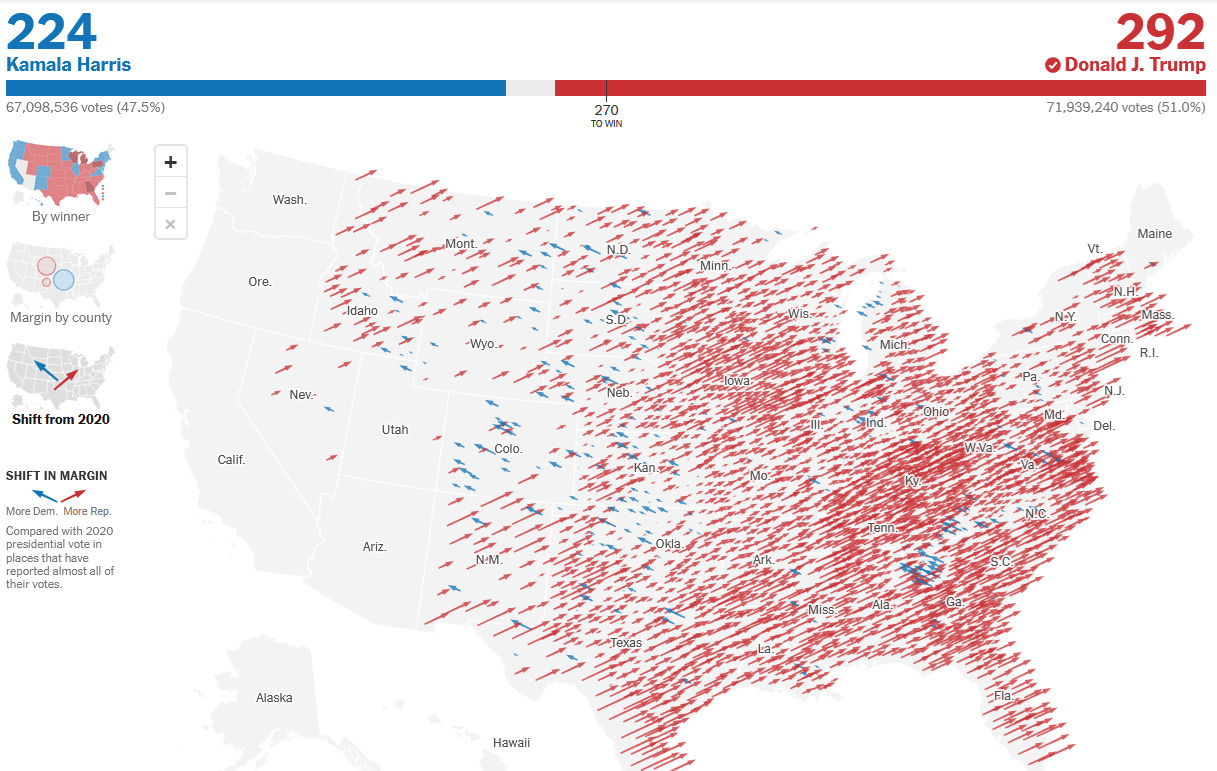
In the end, this election was basically a uniform swing of four or five points away from the Democrats. This map from the New York Times shows how the vote in each county changed between 2020 and 2024 (taken from this page at 1 PM on Nov 6):
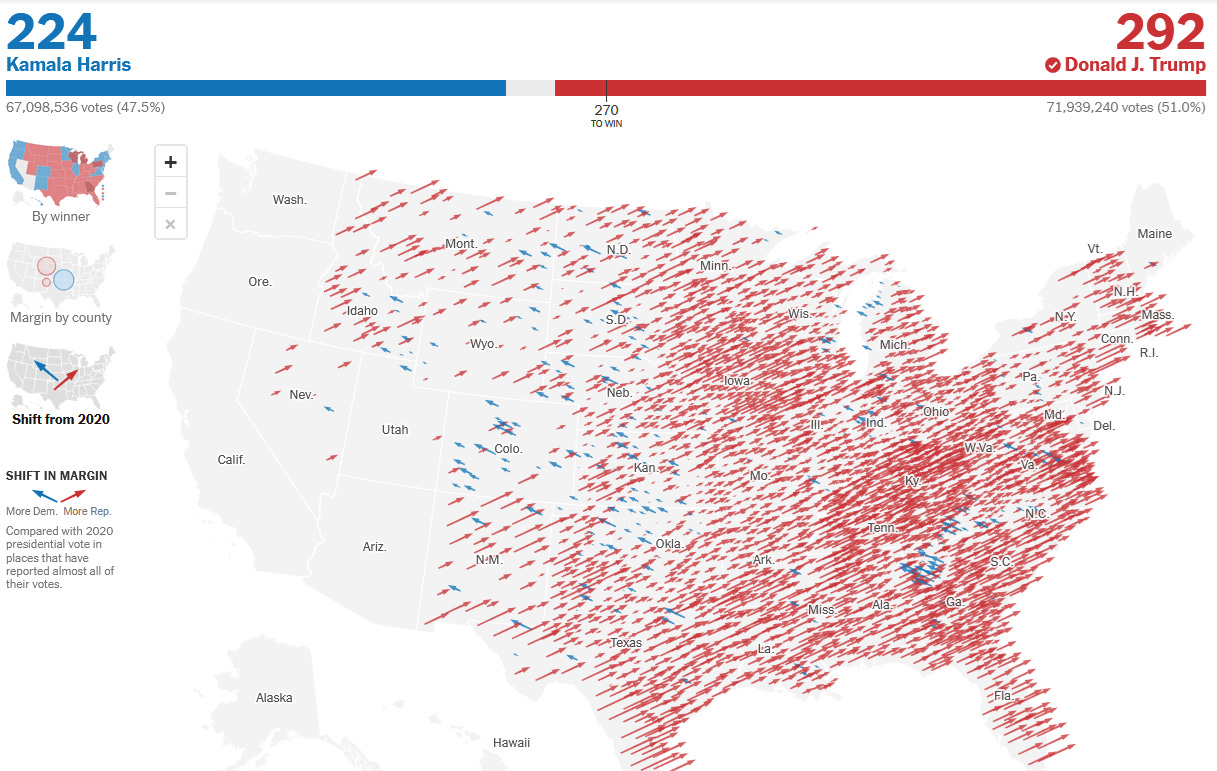
Cities, suburbs, rural areas – they all shifted towards Trump by roughly the same amount. This cuts against explanations for Trump’s win that rely on shifts in a particular group (e.g. young voters, Black and Hispanic voters, college or non-college educated whites), and towards broader explanations (e.g. general unhappiness with inflation and immigration).2
Minnesota saw basically the same uniform swing, tempered slightly by Walz’s presence on the ticket.3 This filtered down to State House races, and the Republicans probably should have won the State House. However, they failed to recruit high-quality candidates in key suburban swing districts, and DFL incumbents won these by extremely slim margins.
(I’ll do a more thorough review of my State House predictions in a future post. At first glance, I did pretty well. This seems like a good place to put these buttons:
Know someone interested in Minnesota politics? Share this post!
All of this points to an extremely ordinary election.
This ordinariness can be difficult for highly-politically-engaged people to believe – Trump is not an ordinary candidate. But consider this story told from 40,000 feet:
After winning a relatively close election, an incumbent party governs during a sharp spike in inflation, a period of global turmoil (the migrant/refugee crisis at the border, Israel-Hamas, Ukraine, the Afghanistan withdrawal), and enters the next election with low approval ratings. The opposition party gains a few percent of the vote and as a result wins by a relatively narrow margin.
Nothing in this story is unusual – in fact, it’s exactly what we’d expect to happen in a basic retrospective theory of voting. Trump’s unusual qualities as a candidate don’t really enter into it.
The fact that Trump’s unusual qualities as a candidate don’t enter into it is infuriating to many highly-engaged citizens4 – how can people vote for him after January 6, the civil and criminal trials (and conviction), his various offensive/threatening/autocratic statements, etc.? The positive spin on this is that Trump’s unusual qualities as a candidate aren’t some magic strategy to win elections. The voters who are deciding these elections aren’t voting for Trump because of these things, but they also aren’t voting against Trump because of these things. Trump wins and loses according to ordinary political forces.
A corollary to this: At least right now, small-d democratic norms depend on elite consensus, not support from the masses.
A lot of people, particularly though not exclusively liberals,5 thought of the last eight years as an aberration. They weren’t. This is the country we live in. The sooner everyone realizes this, the better.
At 5 AM! So count me among the sleep-deprived.
One possible exception is predominantly Hispanic areas in Florida and near the Texas border - but I’m waiting on better data to say that there was a sizable Hispanic shift towards Trump.
The DFL is extremely lucky that the one place that did not see this swing is Senate District 45, the site of the special election that will determine control of the State Senate. Biden in 2020 and Harris in 2024 won it by 16 points. The DFL candidate won the special election here by 5 points. If the district had seen the same shift as the rest of the country the race would have been very, very close.
Liberals, but also anti-Trump conservatives, the slew of former Trump staffers who came out against him, the Republican former and current elected officials who refused to support him, and so on.
Again, thinking of the aforementioned never-Trumpers, former Trump staffers, etc.
No posts
Comments
Nothing yet. Say the first thing.
Sign in to join the conversation.