
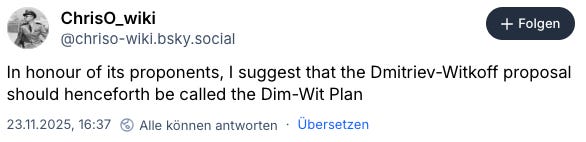
ChrisO_Wiki won the internet on Sunday by suggesting that the latest 28-point “peace plan”, in honour of its conceptual fathers Kirill Dmitriev and Steve Witkoff, should be called the “Dim-Wit Plan”.
And indeed that would be a fitting name for an astonishingly comical series of events the US government presented last week. The Russian input side was quite curious, as some of the points were simply too ludicrous to have really served Russian interests. That, among the conduct of the US government, underlines the inherent unseriousness of the plan as a basis for diplomatic negotiations. It is a wonder - and a sign of the Ukrainian delegation’s patience and professionalism - that the Geneva talks on Sunday actually ended up being somewhat productive.
So much happened in such a short time that it’s quite hard to even still remember all of the plot twists, but I tried to keep track and here are some of my personal highlights (also recommend reading Michael Weiss’ lowlights on his substack Foreign Office):
The fact that it was the Russian cook of the plan, Dmitriev, who did the leaking. As if Russia wasn’t serious and just wanted to create a major information operation…
The 28 points included a provision that “If Ukraine launches a missile at Moscow or St. Petersburg without cause, the security guarantee will be deemed invalid.” So other cities are fair game. And also Moscow and St. Petersburg are fair game if Ukrainians have a cause. I have no idea why we keep guessing about Russian red lines, they tell us it’s only Moscow and St. Petersburg that matter…
Russia greenlit the use of $100 bn frozen Russian assets for the reconstruction Ukraine (with 50% of the profits going to the US).
The plan also included a point about returning children, which amounted to Russia admitting it has kidnapped Ukrainian children. Also the point about “all Nazi ideology and activities must be rejected and prohibited” might have turned out a Russian own goal.
The Kremlin denied that they had received any official information from the US on the 28-point plan, which nicely contradicted the idea of a “secret US-Russia plan”.
JD Vance’s (who seems to hate Ukraine the most) homeboy, the apparently clueless Army Secretary Dan Driscoll whose initial purpose to visit Kyiv seems to actually have been to talk military-industrial cooperation with Ukraine, was sent to brief Ukrainian and NATO officials about the plan.
The Leaders’ statement from the sidelines of a G20 meeting used the phrasing “we reiterate” to emphasise that this is, indeed, not the first rodeo of its kind.
US Secretary of State and National Security Advisor Marco Rubio denounced the whole document as a Russian plan, not drafted by the US, to US senators.
A few hours later, Rubio did a full u-turn and stated that the plan was, in fact, authored by the US - not by Russia after all. (At this point I already thought that the Geneva trip would be cancelled because this is not how anything works.)
The latest revelation that, according to a phone call record between Dmitriev and Yuri Ushakov, Putin’s senior foreign policy adviser, the plan very much was “informally passed along” by the Russians.
In a phone call with Ushakov in preparation of the Trump-Putin phone call earlier in October (leading to Trump suggesting a meeting between the presidents in Budapest, which never happened), Witkoff said the following:
“Now, me to you, I know what it’s going to take to get a peace deal done: Donetsk and maybe a land swap somewhere. But I’, saying instead of talking like that, let’s talk more hopefully because I think we’re going to get to a deal here. And I think Yuri, the president will give me a lot of space and discretion to get to the deal.”
It is fascinating to read how little Witkoff understands of the peace deal he is trying to negotiate - which, given his background, is no surprise, of course. Mark Urban summed up nicely why you can’t force a peace deal.
Despite the inherent unseriousness of the whole plan and everyone involved in it, Ukrainians managed to turn the ominous Geneva meeting into a productive day with their American counterparts. The 28 points were allegedly reduced down to 19, and according to Sergiy Kyslytsya, Ukraine’s first deputy foreign minister who was present at the negotiations, the new points “bore little resemblance to the earlier leaked version of the peace proposal”. The harder questions, such as about territorial concessions, were left to the US and Ukrainian presidents to solve. That bears an inherent risk that Trump will flare up at Zelenskyy again.
Even though the Ukrainian delegation managed to turn the plan into one that takes Ukrainian interests into account, I still doubt that it will amount to much. Europeans, together with Ukraine, made clear that they will not acknowledge territorial concessions, accept restrictions on the size Ukraine’s defence forces, or agree to provisions on Ukraine’s EU or NATO membership to be negotiated without the relevant organisations. Unfortunately for Trump, the EU has quite a strong hand to play, as it is Ukraine’s main arms supplier and also keeps Ukraine financially afloat. The EU Commission is expected to present a legal draft for the use of frozen Russian assets for Ukraine’s financial needs in the coming years. That may prove a more efficient incentive for Russia to engage seriously in peace talks than anything Trump has been able to conjure up.
So far, however, nothing has happened this year to make Russia want to agree to conditions that would be acceptable to Ukraine. Equally little has happened that would either force or incentivise Ukraine and Europe to agree to the disastrous conditions that Russia always pushes. That is why I remain fairly confident that the stalemate won’t be solved and this will end up yet another mere media hype. Predictably, the Kremlin already - after initially having denied any official input to the 28-point plan - insisted that they will not agree to any modifications to the plan.
The mind-boggling aspect of all this is that the US government keeps throwing such diplomatically unserious drafts at Ukraine and Europe, who then duly have to engage with them in good faith and try to make something reasonable out of it. While the grovelling strategy was justified to keep Trump from doing greater harm, it always had an expiration date. Now it is time for Europe to take a more proactive stance, stop wasting time jumping through the same hoops with Trump, and start focusing on squeezing Russia until it has to start negotiating seriously.
P.S. It says something that the New York Post, of all media, has the best analysis of this latest farce.
No posts
Comments
Nothing yet. Say the first thing.
Sign in to join the conversation.