
(Phrase coined by James Carville which explained by the Presidential incumbent, George H. Bush was behind in the polls to a nationally unknown Governor from Arkansas)
The following commentary is from the March 23rd issue of my Short Seller’s Journal. I provide weekly economic analysis and short-selling ideas. I also closely follow TSLA 0.00%↑ and NVDA 0.00%↑ plus the housing market. You learn more about this newsletter here: Short Seller’s Journal information
"I am concerned about manufacturing as a whole this year because people can’t afford to buy groceries, so people aren’t going to buy a $70,000 car," said a local UAW leader. "I am telling my people to start saving their money. Dealers are down 50% on sales and inventory is stacking up. I think manufacturing as a whole this year will be down."
That quote is from a local Detroit United Auto Worker union leader. It parrots the statement from a Ford dealer in Dearborn who told the Detroit Free Press that foot traffic at his dealership is down 50% - "people just aren't looking at cars right now...it reminds me of 2008 when the mortgage crisis hit."
Of course, notwithstanding the comments from nine-figure net worth Jay Powell at his post FOMC presser about the economy being strong, for the majority of households it feels like a recession. Households’ financial situation outlook has fallen to a record low.
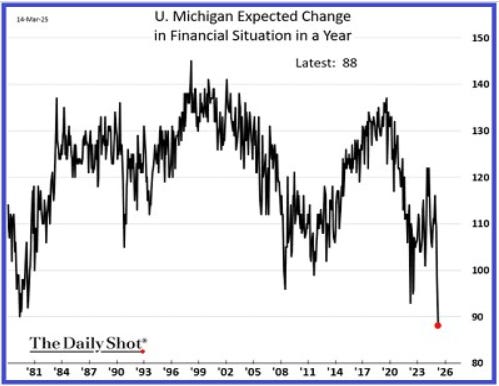
That's the product of a much higher than admitted rate of inflation that has eroded household financials and an economic backdrop that has introduced a high degree of uncertainty about the future.
This is why the U of Michigan consumer sentiment survey for March registered a 10.5% decline from February (57.9 on the index from 64.7 in February and vs 63.1 expected). The expectations index plunged 15.3% from 64 to 54.2. No doubt the sell-off in the stock market was a factor but fear about higher inflation intensified. While the index reading can be skewed along political party lines, the survey officials said that sentiment declined across partisan lines and all demographics. It's the economy, stupid.
As evidence of a slow economy, the SONAR National Truckload Index has shown a rapid slowdown in U.S. freight demand after a "Trump election" bounce:
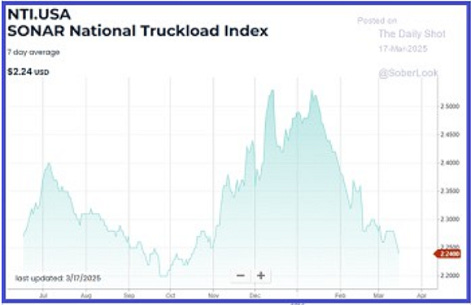
The SONAR national truckload index is a seven-day moving average of freight spot rates that measures the for-hire over-the-road dry van trucking market. It's considered a real-time proxy for the health of the demand for freight transport services and thus a great proxy for the health of the economy.
I think my view that the real economy experienced by most households is in a recession that's getting worse is validated by the freight data and the plunge in consumer future expectations. The implication here is that the stock market is extremely overvalued based on economic fundamentals and, therefore, earnings growth generation fundamentals.
The NY Empire State Manufacturing Index plunged 26 points this month to -20 from +5.7 in February. The Street expected an index level of +2. I suggested last month that the bounce would be short-lived. New order and shipments tanked hard. Inventories continued to rise reflecting falling demand. It also means that production levels in the region will be cut until inventory supply/demand is balanced.
It was my thesis in response to the bounce last month that end users increased their orders in anticipation of a stronger economy/consumer. It would appear that's not happening. The most troubling statistic - and one which reinforces my assertion last week that the PPI is b.s. - is input prices, which rose at the fastest pace in more than two years. Selling prices also increased Stagflation.
The Philly Fed Manufacturing Index declined to 12.5 this month from 18.1 in February. 31% of firms reported increases in general activity (down from 41%), while 18% reported decreases (down from 23%), and 47% saw no change (up from 35%). The new orders index fell 13 points to 8.7 and the shipments index plunged 24 points to 2. The prices paid index rose to 48.3, the highest level since 2022. Future expectations indices also declined by significant amounts.
The Philly Fed survey spiked to 44 in January. It declined by large chunks over the next two months. Both this survey and the Richmond Fed survey fit my thesis that business optimism after the election stimulated a jump in new orders by companies at all tiers of the economy, part of which replenished inventories. But an increase in the demand side of the equation at the end-user tier - final goods distributors and businesses and households which buy the final goods - has not materialized. In other words, despite the nonsense about a strong economy espoused by the Fed Chair and Wall Street "experts," the real economy is growing weaker. More troubling is the fact that manufacturers continue to report that prices are rising relentlessly.
This view is reinforced by Fed Ex, which reported its quarterly numbers last week, missing estimates and lowering full-year guidance for the third quarter in a row, citing inflation and uncertain demand for shipments. Fed Ex is an economic bellwether because its business reflects economic activity at every tier of the economy. When businesses and consumers are not spending money, package shipments decline. As an example, the Company said that weakness from industrial customers is a factor in the current results and with its forward guidance. Fed Ex's situation is consistent with the data coming from the regional Fed manufacturing surveys.
Amazon announced that it plans to layoff 14,000 employees this year representing 13% of its global management workforce. The layoffs will affect its retail operations, web services (AWS) and human resources. While the Company narrative is that this is a move to cut costs and improve efficiency, I believe it's more being driven by the expectation that the company will face tough business conditions for the foreseeable future, particularly from consumers.
Retail sales in February were said by the Government to have increased 0.2% over January though January was revised down from -0.9% to -1.2%. The Street expected +0.5 in
February. Note that the "increase" in sales MoM may have been an arithmetic product of the big downward revision to January. However, inflation-adjusted - even if +0.2% was the real nominal number - real retail sales declined MoM. On a YoY basis, retail sales rose 3.1% vs 3.9% in January. The Street expected 3.5%. Also, on a not-seasonally-adjusted basis, YoY retail sales in February declined. The economy is much weaker than advertised.
Finally on the economic front, the Conference Board's Leading Economic Indicators index declined for the third consecutive month, as it declined 0.3% in February. Overall the index has declined 1% in the six-month period ending in February. The LEI index is at its lowest level since mid-2016.
With regard to the stock market, as predicted it bounced - sort of. The Dow fared the best, up 0.9% from the prior week. The SPX was up 0.5% for the week. And the Naz was up 0.1%. I am a bit surprised by this because the technicals and Wall Street hype had everything set up for a strong bounce. And I'm not saying that's not coming. But the market action this week suggests that, regardless of the technicals, the tape may be telegraphing more downside action.
The best indicator that a bottom has not yet been found is retail buying. Apparently retail is feeding hungrily at the stock market trough. Bloomberg described the retail buying during/after the latest sell-off as "aggressive buying potentially suggesting that stocks haven't found the bottom yet" (in truth, the bottom will be found when no one wants to buy stocks).
The economic data tells me that economic activity is quickly contracting, with consumer spending, which represents 2/3's of GDP, rapidly slowing. My bet is that the aggressive retail speculators who obviously did well over the last two years are doubling down their bets as the stock market heads lower. This is a repeat of 1999. By late 2002, 95% of retail traders were wiped out
Comments
Nothing yet. Say the first thing.
Sign in to join the conversation.