
I was looking at a specimen of vivianite with ludlamite from the Sapucaia mine, Sapucaia do Norte, Galiléia, Minas Gerais, Brazil the other day. The vivianite is a typical dark blue, and the ludlamite a pale green.
The the saying “blue and green should never be seen” popped into my head.
This saying is an old piece of folk fashion advice with no real basis in colour theory. It likely emerged as a superstition in the early 1900s. The full saying “blue and green should never be seen, except with something in between” tended to be used in Australia, the UK, and Ireland.
There is an old theory (without supporting evidence) that sailors avoided painting their hulls green. Apparently they worried that the green hull of a capsized boat would be hard to see against the blue water.
So what about colour science? Some suggest the saying came about because blue and green sit next to each other on the colour wheel, making them similar in tone and sometimes hard to contrast pleasingly. They are analogous colours, and are naturally harmonious.
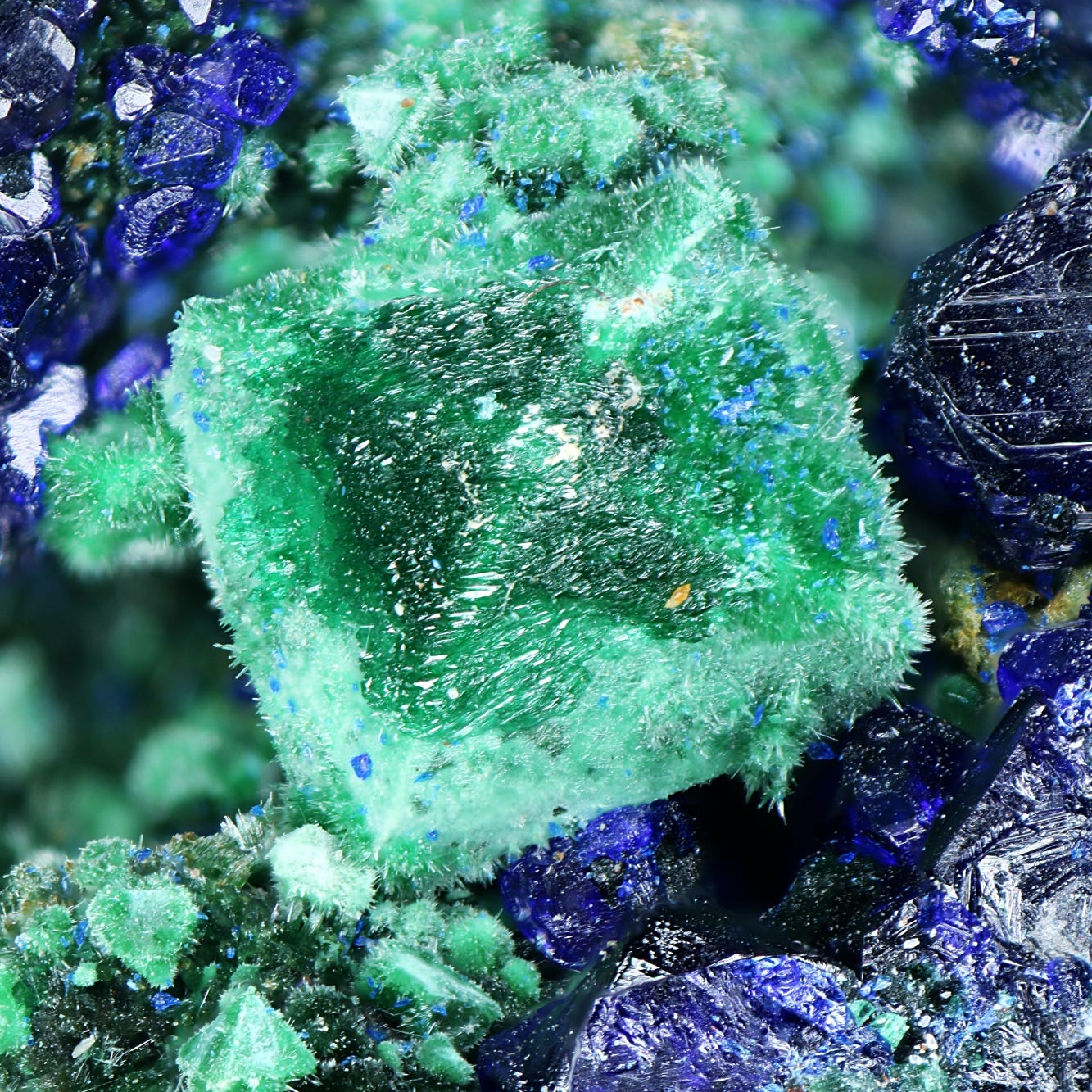
There are many examples in nature where the two colours make a pleasing combination, trees against a blue sky, blue flowers with green leaves, and of course, in the mineral world, combinations such as malachite and azurite.
Below: Azurite, malachite (after cuprite), Triako Open Cut, Mineral Hill, New South Wales. Width of view 5mm.
Comments
Nothing yet. Say the first thing.
Sign in to join the conversation.