
I like to think of motherhood as leading the ultimate nonprofit; it is often a thankless, messy job with the tightest of budgets whose mission can change the world. I’ve been seeing a lot of funny mom sayings as Mother’s Day draws near, and as I giggle to myself, I also realize much of a mom’s life advice also applies to business—both for-profit and nonprofit. There are so many good Mom-ism lists out there, I couldn’t pick just one. So, I compiled some, mixed in my own mother’s wisdom, with a pinch of things I’ve found myself saying to my kiddos.
In this issue of Jani’s Journal, we’ll unpack my favorite mom-isms and take a look at the most recent research around working moms.

Don’t keep Jani’s Journal to yourself! Subscribe for more insights and forward this newsletter to colleagues who might benefit. Let’s grow our community and enhance our collective impact.

Share Jani's Journal: Where Nonprofit Heart Meets Business Mind
On June 10, the Ausherman Family Foundation and the Delaplaine Foundation are partnering to hold the 2025 Frederick Nonprofit Summit. This year, I’ll be presenting tools to turn logic models upside down and inside out help nonprofits create actual impact measures (instead of outputs and outcomes disguised as impact measures). Hope to see you there! Click here for more information and to register today!

The 2024 report Productive, Purposeful, and Profitable by The Mom Project explores how hiring and investing in moms can give all types of organizations a powerful competitive advantage. Drawing from a survey of 4,000 moms and 235 companies, the report shows that moms are not only high-performing and efficient, but also bring exceptional emotional intelligence, loyalty, and productivity—especially when employers support them with flexible, inclusive policies. While the traditional job market continues to fall short in meeting caregivers’ needs, forward-thinking companies like Etsy demonstrate how policies centered on humanity and equity can drive both cultural and financial success. For nonprofits, this research highlights the value of championing working moms not just as a moral imperative, but as a strategic opportunity to advance mission impact, employee engagement, and organizational sustainability. Key takeaways from the report include:
Moms deliver outsized returns: 72% of employers say moms are high performers; investing in them can yield return on investment (“ROI”) up to 425%—especially relevant for budget-conscious nonprofits.
Flexibility is essential, not optional: Moms prioritize flexibility—even more than compensation. Nonprofits offering remote work or adaptable schedules can attract and retain top talent.
Mission-aligned leadership: 80% of companies surveyed have at least one mom in senior leadership, and 42% have a mom CEO—showcasing the leadership potential nonprofits can tap into.
Emotional intelligence as an asset: Moms excel in interpersonal “power skills” like conflict resolution, time management, and empathy—skills nonprofits rely on for community impact.
Support drives engagement: Companies with employee resource groups (“ERGs”), mentorship, and parental leave policies see higher retention and employee satisfaction—practices nonprofits can adopt to deepen commitment.
Happy moms are vocal advocates: Moms who feel supported become enthusiastic promoters—especially relevant for donor, client, and volunteer engagement in mission-driven work.
Prevent burnout, increase capacity: Respecting family commitments strengthens resilience and productivity—a critical insight for nonprofits managing limited staffing and high demand.
It’s one of those classic mom sayings that turns out to have real wisdom behind it. When we sit too close, we lose the ability to see the full picture — and the same is true in our work. This Harvard business Review (“HBR”) article argues that our constant obsession with productivity and to-do lists keeps us locked in “doing mode,” crowding out the space we need to reflect, think strategically, and lead effectively. Especially in the nonprofit sector, where urgency is high and resources are tight, making room for “spacious mode” is essential for mission clarity, better decision-making, and sustained impact. Leaders must step back regularly to regain perspective — not just for their own well-being, but to guide their organizations with vision, empathy, and intention. So yes, mom was right (of course!); step back with these key practices and you’ll see things more clearly:
Give Yourself Permission: Break the guilt loop and acknowledge that slowing down is not laziness — it’s good leadership.
Train Your Mind: Practice mindfulness and brief body check-ins to create mental space between your initial gut reaction and your response.
Make It Safer: Use “guerrilla spaciousness” by quietly embedding moments of reflection into your workday — like asking bigger questions or trying a walking meeting.
Schedule Pauses: Reclaim space on your calendar for strategic thinking and shorten meetings to make room for breath.
Keep Good Company: Surround yourself with reflective, curious people who help expand your view and refresh your thinking.
This classic HBR article presents a five-phase model of organizational growth, demonstrating how companies evolve through predictable cycles of stability (evolution) and upheaval (revolution). Much like human development, each organizational growth phase—Creativity, Direction, Delegation, Coordination, and Collaboration—solves the crisis of the previous phase but eventually creates new challenges, requiring a shift in leadership style and organizational structure. The key insight is that past decisions and existing power dynamics often block necessary transitions, leading to stagnation or failure unless leaders adapt. Just like the mom-ism “act your age, not your shoe size,” the article emphasizes the importance of organizational maturity—knowing which phase you're in and behaving accordingly, rather than clinging to past practices that no longer fit.
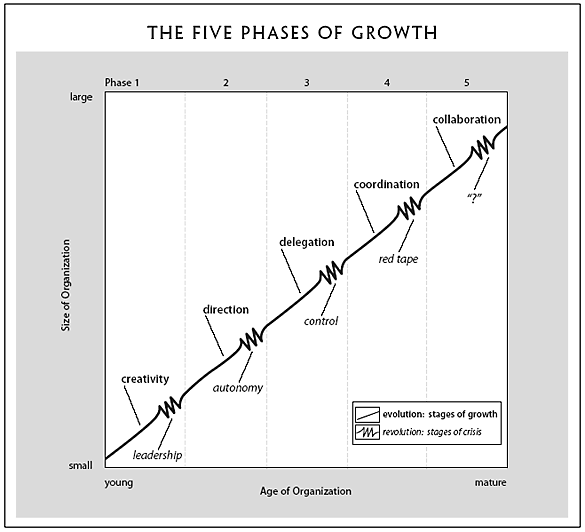
(Greiner, L. (1998). Evolution and Revolution as Organizations Grow. Harvard Business Review.)
For nonprofits, this guidance is especially relevant as mission-driven organizations often resist structural change in the name of values. Growth demands intentional evolution; failure to do so risks mission drift, staff burnout, loss of impact, and unsustainability. Key takeaways include:
Know your stage: Understand where your organization is in the growth cycle to choose the right leadership and structural strategies.
Expect growing pains: Revolutions (crises) are not failures but necessary shifts that drive the next phase of growth.
Avoid nostalgia traps: Leaders must be willing to let go of the practices that made them successful in one phase to succeed in the next.
Build self-awareness: Recognize when your leadership style is outdated and be open to stepping aside or adapting.
Growth requires change: Even mission-based organizations must evolve their systems, roles, and practices to sustain impact over time.
A candidate’s journey with a nonprofit doesn’t begin on their first day—it starts the moment they interact with your hiring process, and often well before that when they interact with your programs or services. According to this Gallup article, the quality of the candidate experience strongly predicts not only whether someone will accept a role but also how they’ll view the job long-term. Like the mom-ism about kissing frogs to find your prince, a thoughtful recruitment process helps both candidates and nonprofits discern frogs from toads and princes with minimal kissing. For mission-driven organizations where culture and purpose matter deeply, aligning expectations from the start helps find true fit, avoids costly mismatches, and builds lasting engagement and satisfaction. Key takeaways for candidates and hiring managers to consider include:
Exceptional candidate experiences lead to better hires: New employees with a great recruitment experience are more likely to feel aligned with the role and be satisfied in the long run.
Culture previews matter: Transparent, values-based interviews help candidates assess whether your nonprofit’s mission and environment are a good fit.
Timeliness shows respect: Efficient communication during the hiring process influences candidate decisions and keeps momentum strong.
People over paperwork: Interactions with hiring managers and teams weigh more heavily than job descriptions or materials in shaping perceptions.
Reinforce your value proposition: Highlight opportunities for growth, relationships, and meaningful work—what makes your nonprofit truly shine.
Moms of toddlers and teenagers often find themselves saying this, and in the nonprofit world, choices can make or break your mission. This Harvard Business Review article reframes what “good decisions” actually look like—not as the product of consensus or caution, but of clarity, ownership, and strategic thinking. For nonprofits balancing limited resources, urgent community demands, and complex needs of a wide variety of impacted and interested parties, this framework offers a powerful blueprint. Rather than agonizing over perfection or popularity, strong decision-makers focus on accountability, timeliness, and long-term impact. Making better choices, faster, isn’t just a leadership skill—it’s a service to your mission. Eight key elements of good decisions include:
Diverse Perspectives – Seek input from people with relevant expertise, not just consensus.
Proximity to Action – Consult those closest to the work or issue.
Root-Cause Focus – Address the underlying issue, not just the symptoms.
Clear Accountability – One person must own the decision and its consequences.
Holistic Impact Analysis – Weigh all risks and cross-functional implications.
Balance Short- and Long-Term Value – Avoid short-termism; think mission sustainability.
Transparent Communication – Share the why and what clearly to ensure alignment.
Timeliness – Don’t delay; use a structured, risk-informed approach to act decisively.
This one wins my award for most hated by children around the world and most often repeated from generation to generation despite their own childhood hatred…myself included. Mom knew sometimes the best solutions were the most obvious and simple solutions, but Mom’s short-sighted budget consciousness sometimes got it wrong (what?!). This Forbes article describes an interesting middle ground: “plausible cause analysis” as a leadership mindset that helps nonprofit leaders slow down reactive decision-making and consider a wider range of possibilities. In complex nonprofit environments—where people bring diverse experiences, motivations, and communication styles—leaders often face ambiguous situations without clear answers. Rather than jumping to conclusions or acting on assumptions, plausible cause analysis encourages curiosity: What might be going on here, and what responses will work best across multiple plausible explanations? For nonprofit leaders, especially those managing teams or community stakeholders, this approach fosters empathy, adaptability, and better-informed decisions. Key takeaways include:
Plausible cause encourages considering multiple “maybes” to explore a range of possibilities rather than assuming certainty in unclear situations. Ask questions like:
“What might have caused this?”
“What could have been the factors that led us here?”
“What are the possible things that lead to this result?”
This approach builds trust with staff, board members, and clients by avoiding snap judgments and modeling thoughtful leadership. Explore intention and motivation with questions like:
Why else might they have done it?
What are other possible things that could have led to their action?
What might have been their goal?
What could have been their intention?
What could have been their positive intention, even if it doesn’t appear that way?
Explore silence. In meetings or emotionally charged group dynamics, silence doesn't always equal disengagement or agreement. Leaders should explore other plausible causes before reacting.
For nonprofits navigating change, this MIT Sloan Management Review article is a powerful reminder that impact often comes not from who started an idea, but from who supports and nurtures it. Like Mom said, “I don’t care who started it!”—what matters is who steps up to solve the problem. Outsiders—those operating on the margins of systems—often drive the most groundbreaking innovations because their distance from conventional thinking enables them to see possibilities others overlook. But it also makes gaining recognition and support more difficult. Successful innovation requires not just new ideas but environments willing to support and amplify them, and MIT Sloan shares some strategies to foster them:
Look Outside, but Act Inside: The most creative teams blend insiders and outsiders, combining legitimacy with novelty—just as nonprofits thrive when they balance operational stability with fresh thinking from diverse partners and stakeholders.
Fight Groupthink, and Find an Ally: Even one supportive voice can transform a fringe idea into mainstream action; nonprofit leaders should model allyship and create space for unconventional ideas to be heard and supported.
Translate the Outside Into Inside Language: Innovative outsiders must learn to communicate in ways that insiders understand; in the nonprofit sector, this means aligning new ideas with mission, vision, and values, funder language, or strategic priorities.
Nurture a Receptive Culture: Create an organizational culture that welcomes outside perspectives and allows good ideas to surface from all levels—this helps nonprofits respond to evolving needs and avoid stagnation.
Ride the Inflection Points: Moments of crisis or disruption can become powerful entry points for bold ideas; nonprofits should stay alert to opportunities to innovate and collaborate when traditional systems are strained.
This Bridgespan Group article presents a case study of Boys Town using RAPID, a project management framework that helps organizations clearly see who is responsible for what. RAPID eliminates confusion, delays, and frustration, and ensures everyone is looking with their eyes open to foster trust and accountability with smarter, faster decisions.
Boys Town’s journey to more effective, faster decision making offers valuable lessons for nonprofits navigating growth and complexity. With a bold strategic plan to double the number of youths served, CEO Fr. Boes realized their traditional centralized model was holding them back. Enter the RAPID decision-making tool—a structured approach that clarified roles, empowered local site leaders, and aligned decision authority with action. The RAPID Model includes:
R = Recommend. Recommenders initiate the decision process, shepherd it forward, keep things moving, and ensure follow-through.
A = Agree. Those in this role have veto power and must approve the recommendation before it moves forward (e.g., CFO approval for financials).
P = Perform. Performers execute the decision once made, often working closely or overlapping with those providing input.
I = Input. Those providing input provide feedback and information before a decision is made; they have voice but no vote.
D = Decide. Deciders have final authority to commit the organization to action. They also own the outcome.
Much like looking for something with both eyes wide open, using the RAPID decision-making model provides clarity in complex, distributed service models, builds trust and responsiveness, reduces bottlenecks, and fosters accountability.
This HBR article explores why return-to-office mandates have triggered such backlash and what they reveal about a deeper problem: the broken psychological contract between employers and employees. It argues that traditional, rule-based policies (the “ethics of justice”) fail to acknowledge individual needs, and suggests that companies adopt an “ethics of care” approach rooted in relationships, empathy, and context. Just like when Mom insisted you say you’re sorry—whether or not you thought you were wrong—this shift reminds us that caring about someone else’s experience matters more than just proving your point. For nonprofits, whose missions depend on trust and person-centered values, adopting a culture of care isn’t just nice—it’s essential to retaining staff and staying mission-aligned. Key steps to creating a culture of care include:
Relational Proximity: Foster empathy and emotional connection—even in remote or hybrid settings—through regular, informal check-ins and human moments.
Transparent Principles: Communicate workplace expectations clearly and with rationale, ensuring policies are explained before, not after, decisions are made.
Attentive Adaptability: Recognize that one size doesn’t fit all; adapt policies to individual needs and contexts to build trust and reinforce shared values.

Enjoyed this issue? Don’t keep it to yourself! Subscribe for more insights and forward this newsletter to colleagues who might benefit. Let’s grow our community and enhance our collective impact.
Know a colleague or friend who would like at least one of the articles in this edition of Jani’s Journal? Sharing IS Caring!
Share Jani Consulting: Where Nonprofit Heart Meets Business Mind
Comments
Nothing yet. Say the first thing.
Sign in to join the conversation.