
A week after U.S. President Donald Trump and Iranian President Masoud Pezeshkian signed a memorandum of understanding designed to bring the four-month-old Iran War to a close, the two sides can’t agree on what they’ve agreed on. Notably absent also: negotiations to secure thousands of political dissidents and religious minorities held in the Islamic regime’s prison network.
On Sunday Iran’s top leaders walked out in an unprecedented diplomatic rebuff an hour into discussions, which included Vice President JD Vance, after Trump on social media and in a televised interview threatened to “hit hard” Iran. Iran’s delegates said the president’s statements violated Article 1 of the agreement, which calls for the “immediate and permanent termination of military operations.”
On Wednesday the two sides clashed over UN inspections of Iran’s nuclear enrichment sites, with Trump announcing they would move forward while Tehran said inspections would be allowed only “within the framework of a final agreement.”
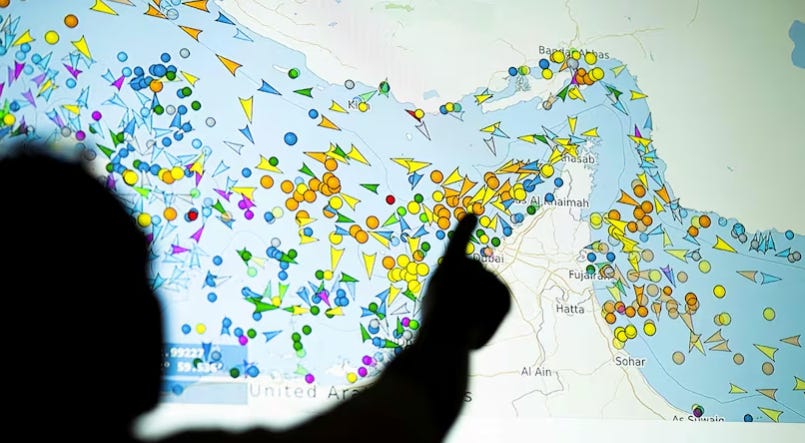
On Thursday Iran reasserted its control of the Strait of Hormuz, attacking a commercial vessel it said violated Iranian control just after President Trump declared the waterway open to unrestricted navigation. Iran also announced separate joint talks with Oman, which shares coastline along the strait, and with “littoral States in the region.”

Robert A. Pape@ProfessorPape
Iran wasting no time consolidating control over Hormuz Issued a joint statment with Oman about arrangements for maritime safety and "costs associated with them" Immediately contradicting Trump promise of "no tolls" Iran's global power rising in real time

3:34 PM · Jun 24, 2026 · 95.9K Views
70 Replies · 566 Reposts · 1.63K Likes
Those moves came in response to a joint statement by the United States and six Gulf states rejecting Iran’s insistence that it could charge tolls on vessels transiting the strait.
“Safe passage through the Strait of Hormuz cannot be guaranteed under ambiguous arrangements, parallel routes or decision-making that does not take Iran's role as a coastal state into account,” said Deputy Foreign Minister Kazem Gharibabadi.
Far from vanquished, Iran with this week’s skirmishes shows how it’s seizing the upheaval brought by war and disagreement over the MOU, along with conflicting statements within the Trump administration. By gaining an upper hand in negotiations, it may engage U.S.-allied Gulf states, and further isolate Israel.
The MOU does effectively end the fighting that began Feb. 28 and offers a step-by-step plan to reopen the Strait of Hormuz over 60 days. Vice President Vance outlined the negotiations in a June 18 briefing, with talks continuing in Switzerland even after Sunday’s walkout. Vance announced today an agreement to establish a coordination channel between Iran’s IRGC and U.S. Central Command to prevent the escalation of tensions, and operating out of Qatar.
But conflicting statements by President Trump, and guarantees for Iran’s restitution that are at once vast and vague, have confounded members of Congress and leave pundits even on the right calling the deal a “surrender.”
“There seems to be a vast chasm between what the parties have agreed to and said thus far,” said Mike Nelson, a retired Army Special Forces officer and a member of the Atlantic Council’s Counterterrorism Project. “We have given up much more than the Iranians have.”
Nelson’s assessment and comments here are a helpful summation.
Thanks for reading GlobeTrot! This post is public so feel free to share it.
The MOU says little about securing human assets, despite a vocal history of U.S. presidents championing the rights of political dissidents jailed by the Islamic regime. They are most likely to ally themselves with U.S. interests, plus to include religious minorities like Christians and Baháʼís.
The MOU is explicit only in its call for silence. Article 2 states, “The Islamic Republic of Iran and the United States of America undertake to respect each other's sovereignty and territorial integrity and to refrain from interfering in each other's internal affairs.”
President Donald Trump notably pledged in January that “HELP IS ON ITS WAY” after Iran massacred an estimated 30,000 protesters. Yet the agreement leaves intact Tehran’s repression apparatus with no visible improvement in human rights and religious freedom.
The war that began less than a month later has brought months of internet blackout and prison lockdowns. Tehran officials repeatedly have denied access to prisons and named prisoners. There’s been no apparent attempt by U.S. or Israeli forces to gain access. In fact, Israeli airstrikes damaged Evin Prison on the outskirts of Tehran multiple times, the most notable political prison holding up to 15,000 inmates.
Families of jailed Iranian Christians say they have not heard from them since the start of the war. An estimated 250 Christians arrested on “national security” infractions for converting from Islam were imprisoned in 2025. Dozens were known to be in prison at the start of the war. One well-known political activist and Christian convert, Mohammad Nikbakht, has in recent weeks been threatened with execution.
Besides the silence from U.S. negotiators is the absence of advocacy from religious freedom organizations, including faith-based groups, or the U.S. Commission on International Religious Freedom (USCIRF). In a report issued earlier this month, the Congressional Research Service highlights the Trump administration’s failure to fill key roles monitoring religious freedom and combatting antisemitism. Funds designated to support international religious freedom, it found, were ultimately terminated.
One religious freedom expert who held positions at the State Department and other U.S. agencies, said the White House “is hoping its religious base won’t notice the way it’s ignoring religious minorities in Iran who’ve been left to their fate.”
Venezuela, hit by two earthquakes on Wednesday at 6:04 pm local time, saw its death toll tick above 900 today with at least 3,000 injured. The quakes, known as a doublet, came with an initial magnitude 7.2 on the Richter scale that rocked buildings in downtown Caracas, the capital. Five minutes later, another 7.5-magnitude aftershock triggered building collapses and havoc in the city and surrounding areas. The toll could climb, and also with the country’s political upheaval and longstanding sanctions: the US Geological Survey estimated on Wednesday that the number of casualties could range anywhere from 10,000 to 100,000.
Across Europe, an unprecedented heatwave continues, with record-setting highs. On Tuesday, Paris experienced its hottest day on record, with a high of 85.6°F (29.8°C). Europeans have dealt with rising temperatures in recent years, but many are not equipped for the heat with residential air conditioning. Spanish researchers already attribute to the heat more than 210 fatalities between Sunday and Wednesday.
The heatwave comes as expert meteorologists predict that this year’s El Niño, the pattern of ocean currents off the Peruvian coast that affects global weather, could be the most extreme and deadly in history.
In Ukraine, the near-destruction of the Dormition Cathedral at the Kyiv-Pechersk Lavra in a June 15 Russian assault on Kyiv should have shocked the world.
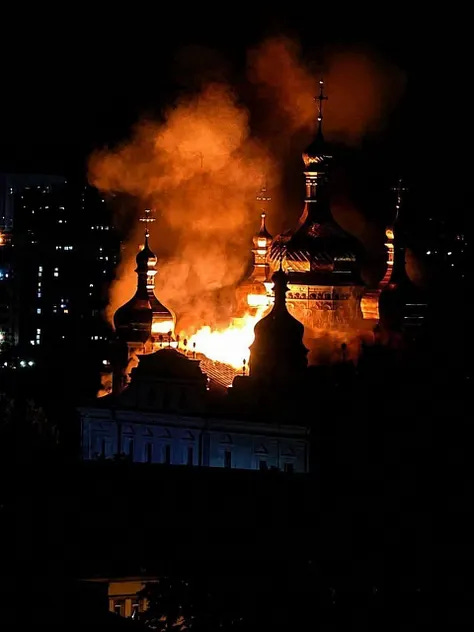
The landmark, founded in 1051, is one of Christianity’s oldest and most revered monasteries, with ancient caves where generations of monks are buried. But the Lavra has survived Nazi occupation, Soviet bombings, and previous attacks in this war. Metropolitan Eustratius, a spokesperson for the OCU and deputy head of its external church relations, told me just days after the attack, “The start of restoration work is happening right now,” and he provided video images showing the repair work underway.
Some Albertans believe their province, the 4th most populous in Canada, would be better off on its own. Residents in recent months show increased support for the province’s secession from Canada due to climate taxation and political underrepresentation as the province absorbs an increase in carbon taxes used to subsidize other, less independent provinces like the Northwest Territories. Alberta will hold an initial referendum in October.
As World Cup rounds continue in North America—
Iran and Egypt face off this evening in Seattle, two storied teams with long pasts who have faced one another only once before. For Iran, this is its first World Cup match against an Arab country, and amid heightened Arab-Iranian tension in the Middle East. That didn’t stop local organizers from designating the game a Pride Match with drag performances and LGBTQ-themed watch parties across the city, even though homosexuality is illegal in both countries.
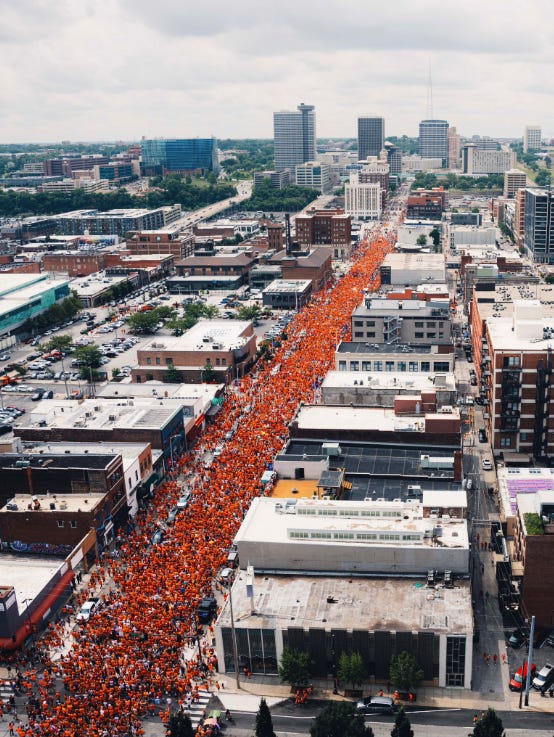
Dutch fans took over Kansas City on Thursday in a decade-long tradition, the Oranje Fanwalk, as thousands turned out to watch the Netherlands beat Tunisia 3-1, advancing to the knockout round.
The U.S. Supreme Court on Thursday cleared the way for the federal government to remove protections for citizens of Haiti and Syria under a federal program that allows foreign citizens to stay in the United States when the U.S. government believes that it is not safe for them to return to their homes. In a vote of 6-3, the justices paused rulings by federal courts in Washington, D.C., and New York that had barred the Trump administration from ending Temporary Protected Status for Haiti and Syria, saying the 1990 law creating the TPS program generally bars courts from reviewing the determinations by then-Secretary of Homeland Security Kristi Noem.
No GlobeTrot this upcoming 4th of July weekend, as I will be celebrating America’s 250th birthday by attending a naturalization ceremony at Monticello, a longstanding tradition to welcome new citizens in the shadow of the study where Thomas Jefferson penned the founding documents. May the long and winding experiment in democracy continue.
No posts
Comments
Nothing yet. Say the first thing.
Sign in to join the conversation.