
If you spend any time following AI developments, you know that autoregressive Large Language Models (LLMs) are dominating the conversation. But beneath the hype of next-token prediction, a much deeper, more profound shift is happening in artificial intelligence.
In a recent podcast interview, Meta’s Chief AI Scientist Yann LeCun has heavily criticized the limits of LLMs, pointing instead toward World Models and JEPA (Joint Embedding Predictive Architecture) as the true path to reasoning AI.
When you listen to LeCun describe these systems, something remarkable becomes clear: AI engineers are no longer just building statistical text generators. They are actively engineering the exact cognitive blueprints that philosophers and neuroscientists have been describing for decades.
To understand where AI is going, we have to look at the convergence of three wildly different fields: philosophy, biology, and silicon engineering.
For a long time, the dominant metaphor for the human brain was a computer: a passive CPU sitting in your skull, receiving sensory inputs from the eyes and ears, processing that data, and outputting an action.
In my recent review of Andy Clark’s book The Experience Machine, I explored why cognitive science has entirely abandoned this metaphor. We do not passively perceive the world. Instead, our brains are “prediction machines.”

Our minds constantly run a top-down simulation of reality—what Clark calls a “controlled hallucination.” Your brain predicts what it expects to see, hear, and feel next. When you reach for a coffee cup, your brain isn’t just calculating the distance; it is predicting the weight, the temperature, and the texture. Sensory data from the outside world merely serves to correct those predictions when they are wrong.
If Clark gives us the philosophy, Karl Friston gives us the biological and mathematical engine room.
In Active Inference (which I also recently reviewed on my blog), Friston, Parr, and Pezzulo outline how biological systems stay alive by minimizing “Free Energy”—which, in cognitive terms, translates to minimizing prediction error or surprise.
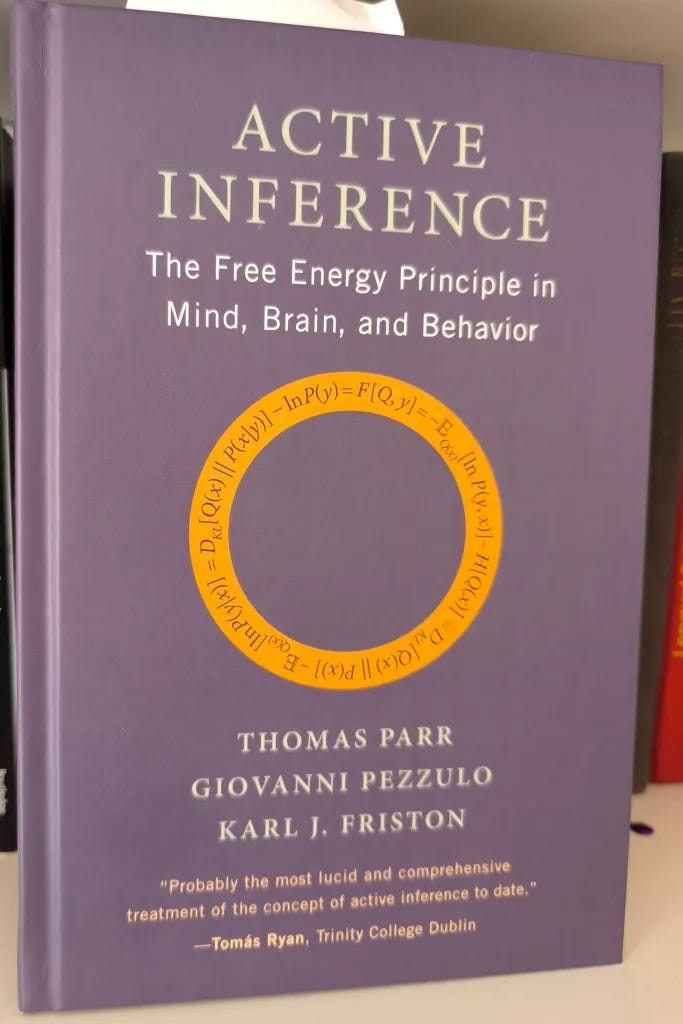
According to this framework, an organism can minimize surprise in two ways:
Perception: Update its internal model to match the outside world.
Active Inference: Act on the outside world to make it match its internal predictions.
If your internal model predicts you are a well-fed organism, but your stomach is empty, you experience a massive prediction error. You don’t just sit there and update your model to “I guess I’m starving.” You perform active inference—you walk to the kitchen and make a sandwich, forcing the world to match your prediction.
This brings us back to Yann LeCun and the bleeding edge of AI.
LeCun argues that standard generative AI (like LLMs or video generators) is fundamentally flawed because trying to predict every single pixel or every single word is computationally wasteful. It doesn’t capture the underlying physics of reality.
Instead, LeCun’s architecture (JEPA) maps the world into an abstract, compressed “latent space.” It ignores the irrelevant background noise—like the exact rustling of leaves in a video—and focuses entirely on predicting the next structural state of the environment.
This is the exact engineering equivalent of Predictive Coding. Just as the human visual cortex doesn’t pass raw retinal data all the way up the chain, JEPA only focuses on what is structurally relevant. It builds a “World Model.”
Once the AI has this model, how does it accomplish a goal? It uses the model to plan. The system hallucinates a sequence of actions, predicts which sequence gets it closest to its objective, and executes the best path. In AI, this is called Model-Predictive Control. In cognitive science, this is Active Inference.
While the philosophical overlap between these disciplines is staggering, it is vital to point out where they diverge: the math.
Friston’s Active Inference is deeply rooted in Bayesian probability and variational inference. It explains how nature evolved an incredibly elegant, energy-efficient solution to probabilistic programming.
LeCun’s World Models do not use Bayesian updates. They are built on deep neural networks, utilizing gradient descent, backpropagation, and contrastive loss functions. AI engineers are essentially brute-forcing a similar predictive architecture using matrix multiplication on massive clusters of GPUs.
We are witnessing a fascinating moment in the history of science.
On one side, cognitive scientists and neurobiologists have worked top-down, reverse-engineering the wetware of the human brain to discover that it is a predictive experience machine. On the other side, computer scientists have worked bottom-up, trying to build autonomous AI agents that can reason about the physical world without hallucinating nonsense.
Two distinct scientific disciplines have arrived at the exact same architectural conclusion. If you want to understand what comes after the LLM hype cycle, look to predictive coding. The engineers are finally building it.
No posts
Comments
Nothing yet. Say the first thing.
Sign in to join the conversation.