
In 1994, cognitive scientists David Kirsh and Paul Maglio sat down to watch people play Tetris. They expected players to rotate the falling pieces only as much as placing them required. Instead, the good players spun the blocks far more than that, and the extra rotations were doing real work. Turning a piece on screen let a player see what it was and where it would fit, faster and more reliably than picturing the rotation in their head. Part of the thinking had moved out of the skull and onto the screen.
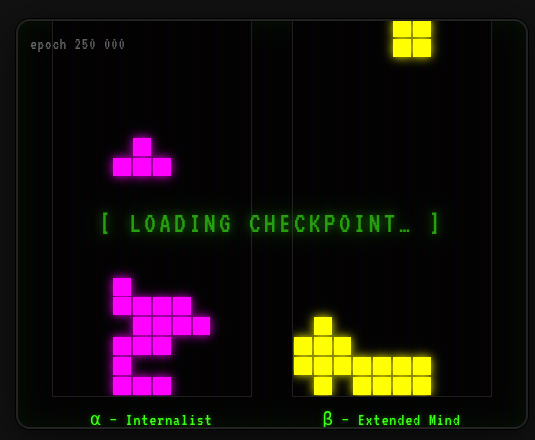
Kirsh and Maglio called this an epistemic action: a physical move made to make the mental work easier, not to advance the game directly. Four years later Andy Clark and David Chalmers built a bigger claim on it. In “The Extended Mind” (1998) they argued that when something outside your head plays the same functional role as a process inside it, there is no principled place to draw a line at the skull. Their case was Otto, a man with memory loss who keeps what he needs in a notebook. If the notebook does for Otto what biological memory does for everyone else, they said, the notebook is part of his mind.
You already live this way. You count on your fingers, work a sum out on paper, keep every phone number you own in a device in your pocket. Now you draft, analyse and think through problems with language models. Clark, in a 2025 paper, reads generative AI as the newest version of a very old habit: a mind reaching outside itself for help.
This matters if you build software. We usually grade an AI system by how the model does on its own. The better question is whether the person plus the system thinks better than the person alone, and the two come apart more often than you would expect. A model that answers everything can still leave its user slower and less certain, because now they are checking work they do not understand. A narrower tool that takes over the mechanical part and hands the judgment back can be the better instrument, even if it loses a benchmark.
So the extended mind gives you a concrete test. Judge the coupled system: does someone working with the software reason better than they would without it? That points you toward tools that show their working, that let people rearrange and poke at what they are looking at, and that take over the costly mechanical steps while leaving the parts a person should own. The Tetris screen worked because the player still ran the game; the screen only made rotation cheap.
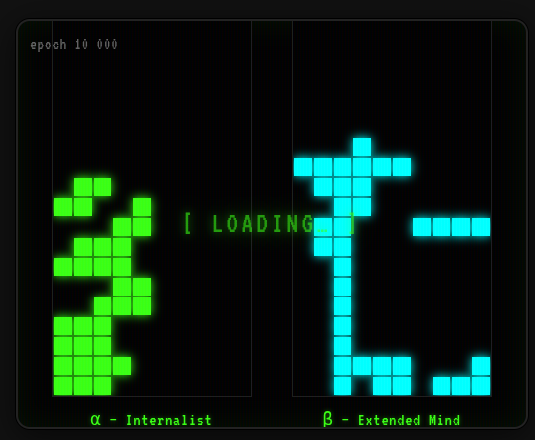
The same idea raises the ethical stakes well above those of an ordinary product. A clumsy tool wastes your time. Something that has become part of how you think can do worse. A system that is confidently wrong corrupts your reasoning, not just your afternoon. Worse, one that steers you without your noticing edges toward tampering with belief. And a tool that makes itself indispensable and then degrades takes a working piece of your mind down with it. Otto’s notebook only helps him because what is in it stays stable, available and trusted. People using our systems are owed the same three things.
None of this asks us to treat AI as a mind or as magic. It asks us to design for the person on the other side, who is doing what people have always done: thinking with whatever is within reach. Our job is to build the thing worth reaching for.
If you want to dig into the extended mind hypothesis, including a version of the Tetris experiment rebuilt inside a pair of reinforcement-learning agents, have a look at our essay “The Epistemic Arcade”: https://crowintelligence.org/aporia/epistemic-arcade/
No posts
Comments
Nothing yet. Say the first thing.
Sign in to join the conversation.