
this post aims to summarize every major supply chain. for instance: where does fertilizer come from? what is required to produce modern electronics? why is produce available year-round? etc.
why think about supply chains? mostly because the world is a wonderful place and i think it’s fun to be aware of all the raw materials and logistics behind the scenes of your day-to-day life! also because understanding supply chains makes it easier to forecast the effects of disruptions. for example: the closure of the Strait of Hormuz will, in the absence of policy intervention, result in food becoming ~20% more expensive in early 2027 and ~10% of restaurants closing, yet somehow nobody is paying attention to this
in the remainder of this post, i will go through four major categories of raw materials (fossil fuels, metals, minerals, agriculture and forestry) and identify where each one comes from as well as what it is used for
ChatGPT Deep Research and Claude Opus helped collect relevant sources for this post. i read all the articles they gathered and cite them wherever appropriate
i. fossil fuels
let’s start with maps of where coal, oil, and gas get extracted:
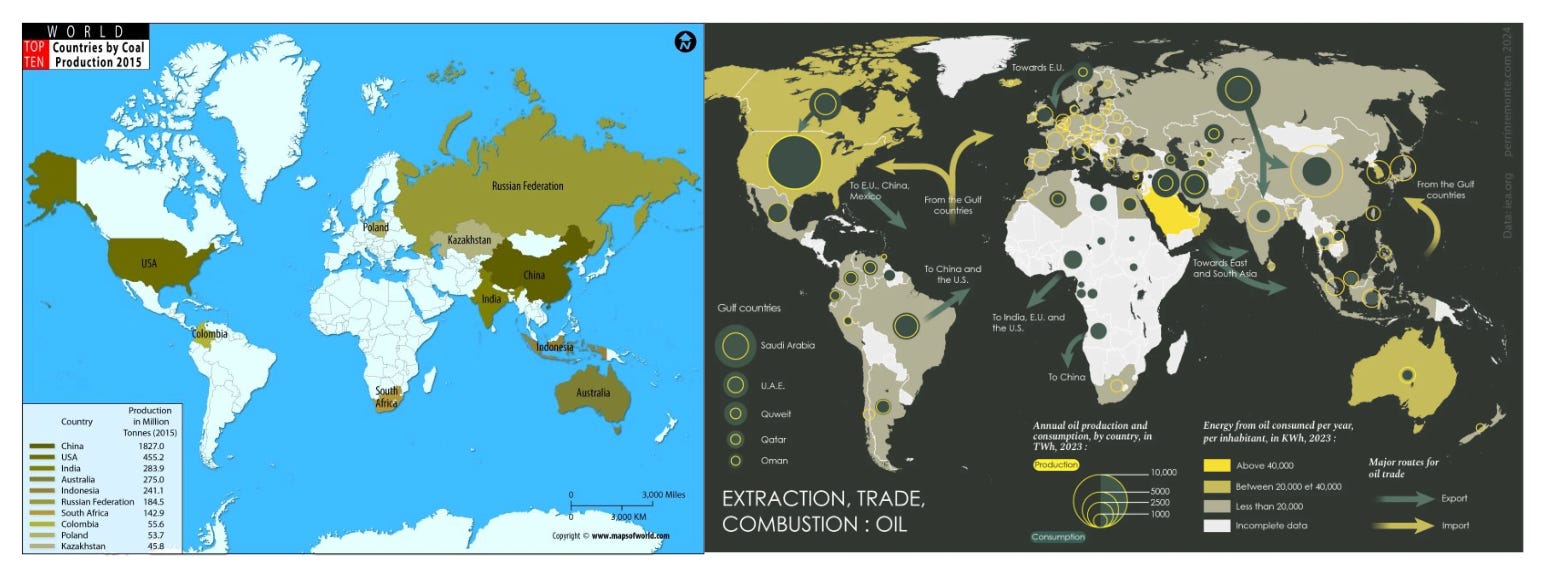
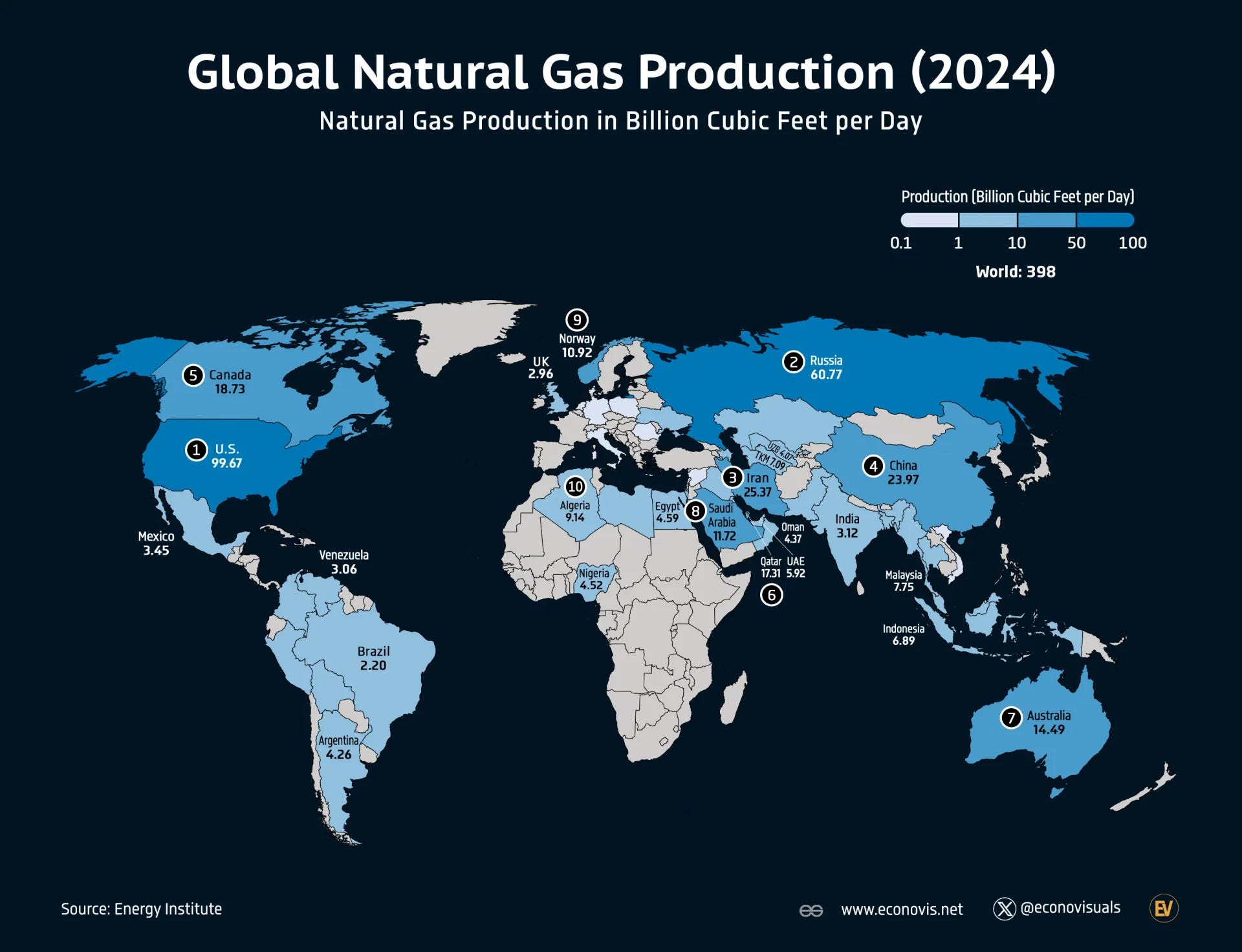
a few quick comments:
the usa is both a top-3 importer and exporter of oil. american refineries were built to process heavy crude (ie. thicker and more viscous oil) because the trend in the 1980s was that the world was running out of light crude, but then more recently they discovered fracking and now have a surplus of light crude. so now they simultaneously export domestic light crude while importing foreign heavy crude. this is why the usa does not have oil independence despite large reserves
while china accounts for half the world’s coal production, it is also the world’s biggest coal importer (the others being india, japan, korea, taiwan). western consumption of coal has dropped off by around 50% in the last 30 years
asia gets most of its gas from the usa, qatar, and australia (china also gets some from russia). the eu used to rely on russian gas but now mostly relies on norway and the us as a result of the ukraine conflict
despite all being categorized as “fossil fuels”, coal, oil, and gas are used for fairly distinct processes, which we’ll describe next
65% of coal is burned in power plants to make steam that spins turbines for power and heating. the rest of the coal is primarily used to make cement and steel. one of the biggest barriers to decarbonization is that, while we can find alternatives for power and heating, coal replacements in the steel-making process are difficult to come by
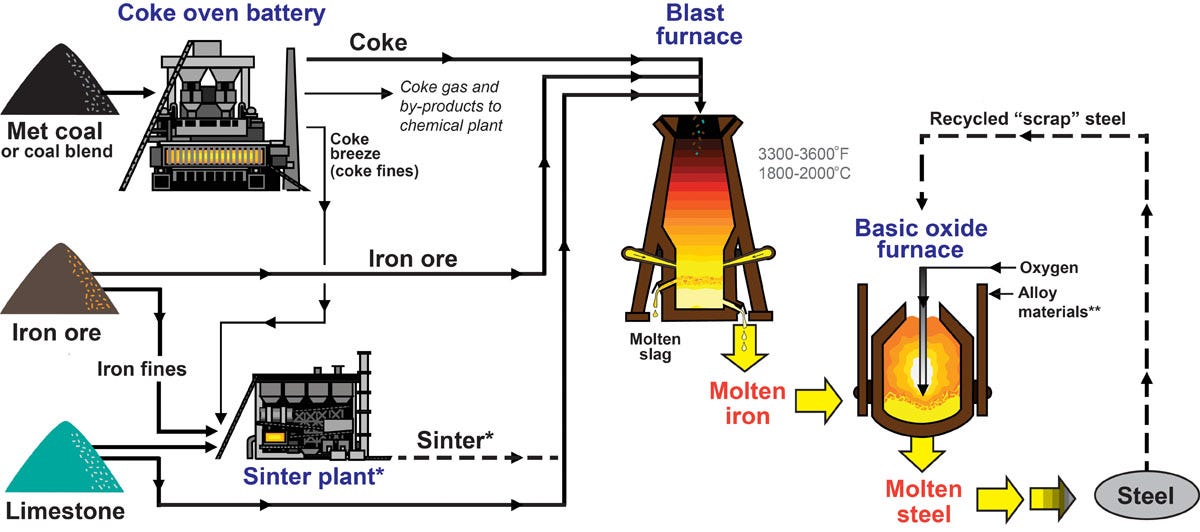
the high-level idea is that, to convert iron into steel, we need to 1) strip away the oxygen that is naturally bound to iron ore 2) melt the reduced iron 3) introduce carbon into the iron to create steel, all without collapsing under thousands of tons of metal. coke (a material produced by baking coal) is one of the few materials we know how to produce at scale which can simultaneously act as a reducer, heat source, carbon source, and structural support
okay let’s move onto oil. oil is more expensive than coal and gas, so we don’t use it for electricity generation whenever possible. instead, oil is mostly used as a transport fuel - for gasoline / diesel / jet fuel / marine bunker fuel - since it is volume-efficient and therefore easy to have onboard vehicles. around 45% of oil is used for gas / diesel and 15% for ships and planes. the rest is mostly used to create plastic. the chemistry is lowkey annoying because there are so many different kinds of plastic so we are skipping it
natural gas is used for electricity (~40%) and heating (~20%). another big use case is fertilizer
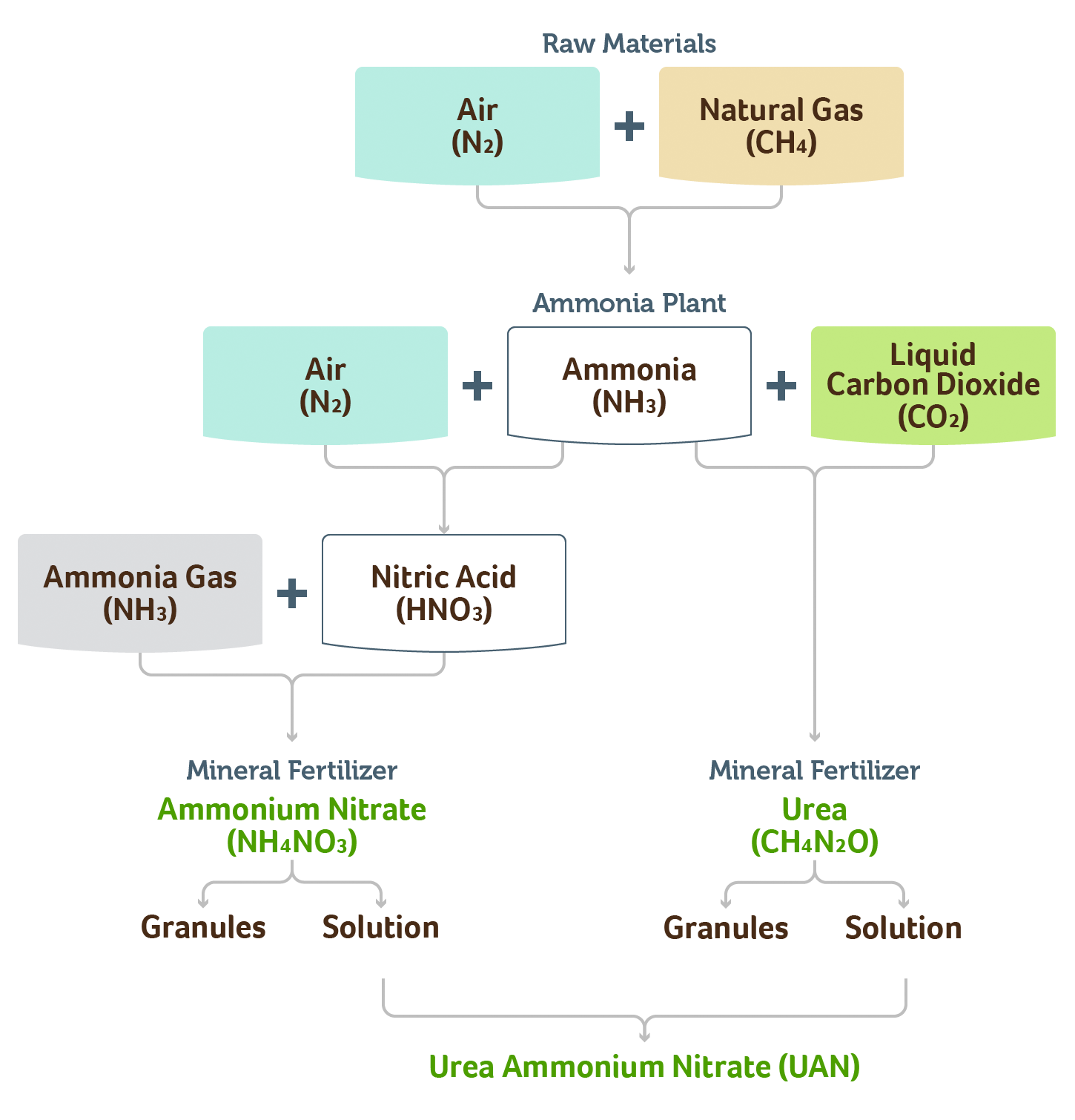
nitrogen is abundant in the atmosphere but is triple-bonded to itself, so it tends to be very stable. to create nitrogen fertilizer we need a gaseous hydrogen supply as well as a heat source which provides the energy required for nitrogen to react with hydrogen. burning natural gas satisfies both constraints, which is why ~80% of nitrogen fertilizer depends on natural gas for production
it’s worth mentioning other raw materials that are extracted alongside fossil fuels. methane is often trapped inside coal deposits, so we extract and burn it for energy (sometimes we don’t harvest the energy and burn methane anyway just to prevent it from leaking into the atmosphere). more interesting is helium, which is created via radioactive decay in the earth’s crust. it tends to get trapped in the same rock formations as natural gas, so we often extract it alongside natural gas

helium is unique because it has low mass and a full electron shell. as a result it experiences very weak intermolecular forces and has the lowest boiling point of any element (around 4 Kelvin), meaning you can use it to make systems very cold via evaporative cooling. this makes helium essential for the superconducting magnets (which only operate at very cold temperatures) used in MRIs and semiconductor fabs. this post contains other uses of helium
okay now let’s talk about supply chains disruptions. the strait of hormuz closing has led to oil and natural gas prices rising by around 30-50%, and this will likely continue because the american military is unable to defeat iran. this means higher energy and gas(oline) costs, but also general inflation due to higher transportation costs in every product’s supply chain. the second-order effects are also concerning: spirit airlines already went bankrupt due to rising jet fuel prices while other low-end airlines will likely go bankrupt later in the year; a third of the world’s fertilizer supply is stranded, which chat estimates will result in ~20% increase in food cost and ~10% of restaurants closing1. for crop cycle reasons the full impact of the fertilizer shortage will not be felt until next year
ii. metals
there are too many metals so we’ll just focus on the most important ones. this map has many of them. one important note is that many metals (eg. copper, lithium, cobalt) are refined in china even though they are mined elsewhere:
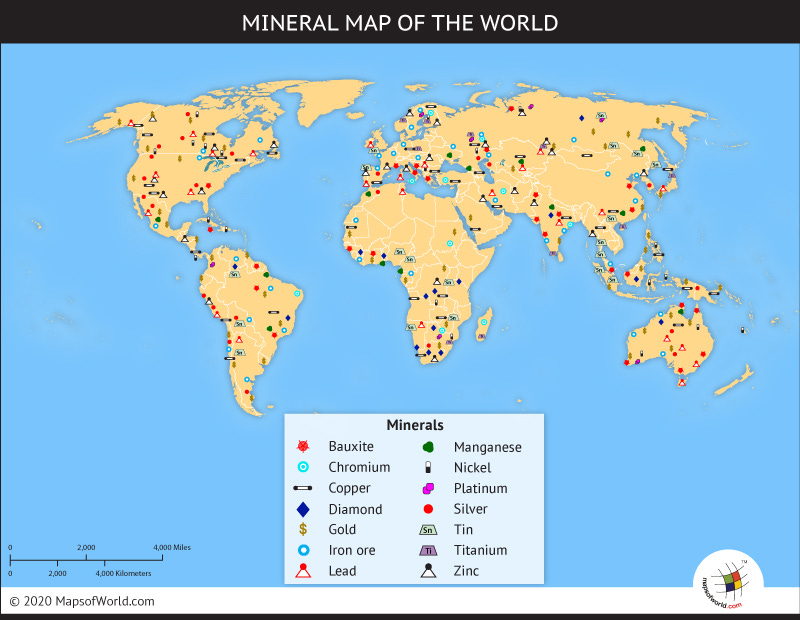
at a high level there are four main reasons to use metals: magnets, structural support, conducting electricity, batteries. each reason corresponds to a different subset of metals, so we’ll cover them separately
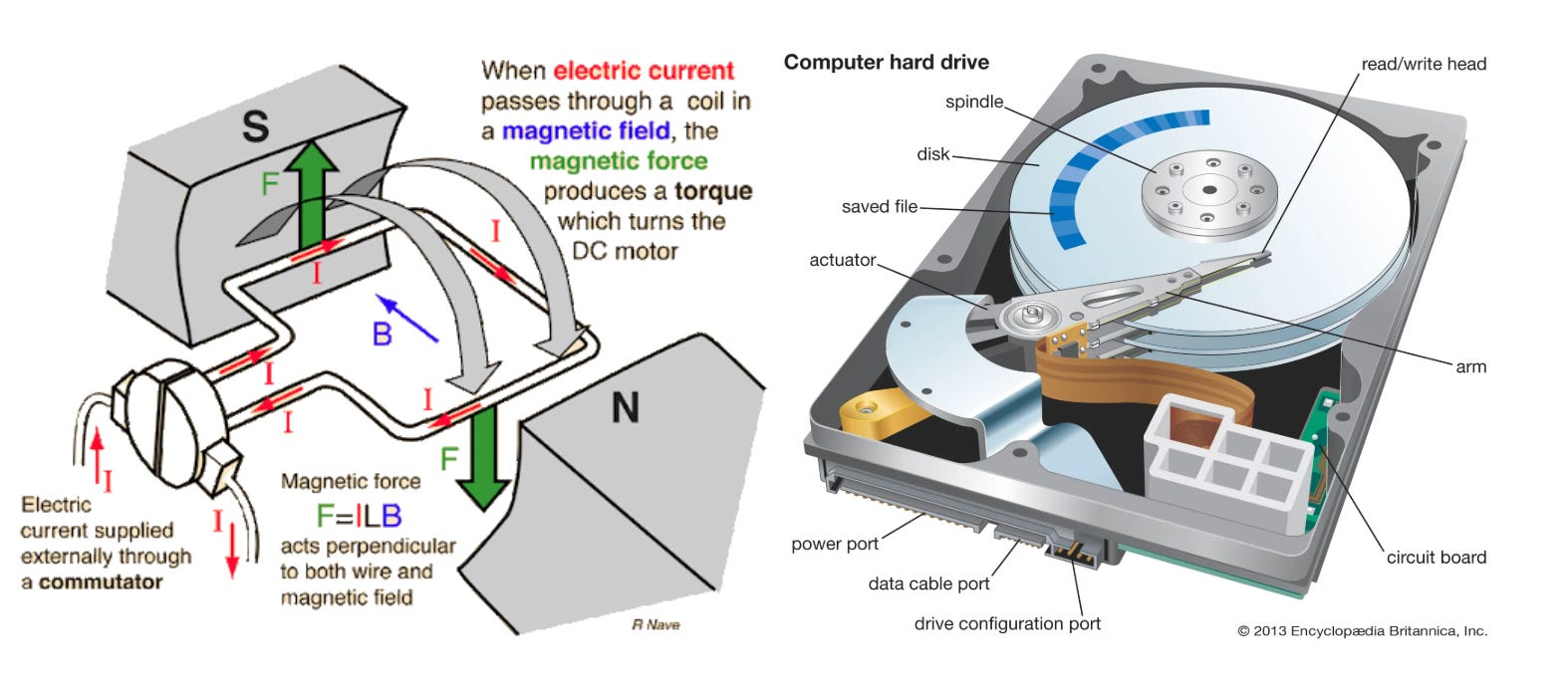
first let’s discuss magnets. permanent magnets enable electric motors because current passing through coil in a magnetic field naturally produces torque. these motors are the most efficient way to convert between electrical signals and physical motion, the obvious applications being robots / sensors / drones / audio systems. another underrated application is hard drives, which store data on a rapidly spinning magnetic disk and contain an actuator which physically moves to memory locations it wants to access. rare-earth magnets are much stronger than traditional iron-based magnets, so they enable smaller and lighter motors. as a result we depend on rare earth metals for most modern electronics and military systems; china dominates the entire chain from mining to refining to producing electronics
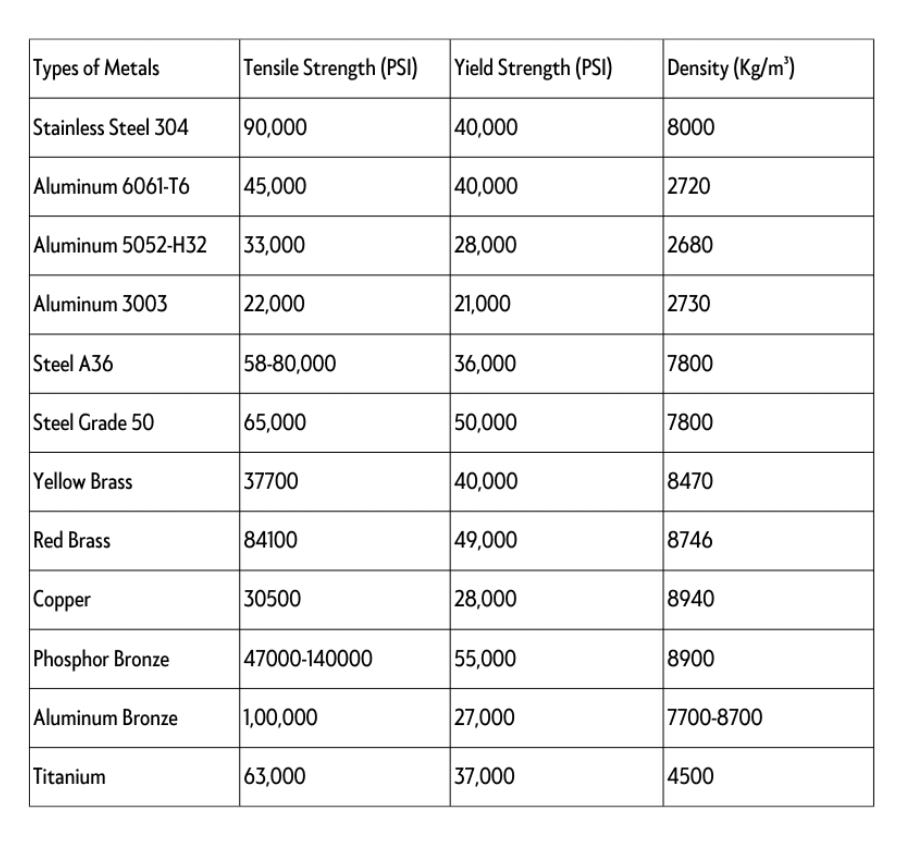
for structural support (eg. construction and infrastructure), it’s good to use abundant metals with high strength. iron (in steel form) is the primary material here2. however, iron and steel variants are quite heavy; for mobility reasons, we primarily use aluminum or titanium in planes and cars because they are strong but much lighter. the other use case for titanium is making very shiny white paint (in fact this is ~90% of total titanium usage)3
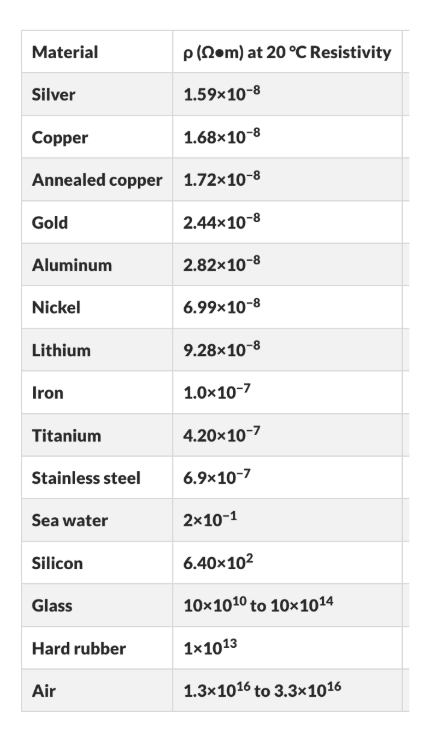
for electrical conductivity it’s good to use metals with very low resistance. this is because power is current2 x resistance, so circuits with higher resistance will waste more energy in the form of heat. the metals with the least resistance are silver, copper, and gold; copper is by far the cheapest of these materials, so most electrical wiring uses copper4. silver is only used for high-performance applications that require maximal conductivity such as satellites; gold is often used for plating and durability because it doesn’t tarnish (the same reason it’s popular in jewelry)
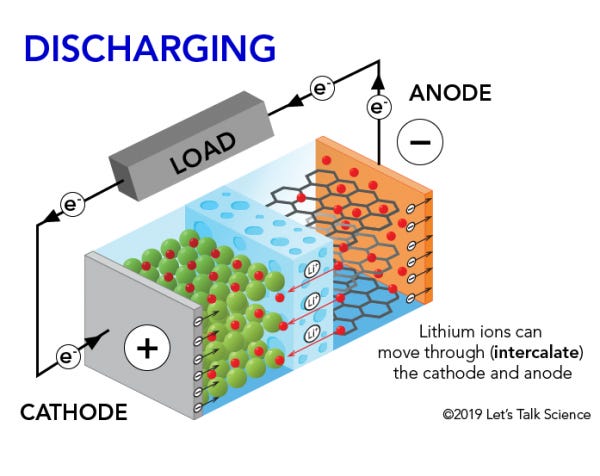
finally we get to batteries. the most important property of modern batteries is that they are rechargeable - metal ions move from the anode to the cathode during discharging and in the opposite direction during charging. the key to rechargeability is to choose ions which can move back and forth many times without degrading the internal structure of the battery. lithium is commonly used because it is a small atom, meaning the battery can remain light and the ions can move around more easily5. the cathode must contain materials that can easily accept lithium ions, so nickel and cobalt are often used6. before we invented lithium batteries we often used lead-acid batteries; because lead is toxic these are now only used in applications that don’t require much human interaction like industrial and car batteries7
iii. minerals
we’ll focus on four main applications of minerals: construction, agriculture, chemical engineering, tech
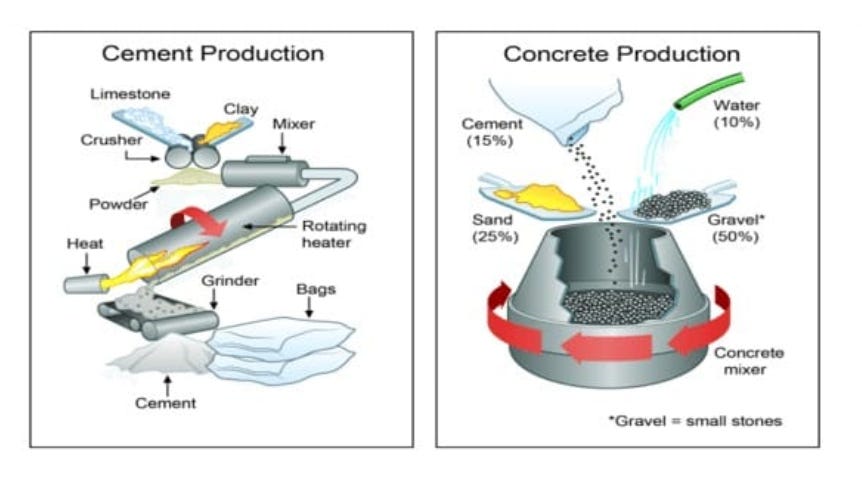
let’s start with construction. you can basically assume every construction material other than wood or metal comes from a combination of limestone, clay, and sand. in some sense this is because all three materials are very stable and interact well when mixed / heated: cement is made by grinding clay + limestone at high temperatures; concrete is made by mixing cement, water, and sand; glass is made by melting sand and limestone; bricks are a baked mix of clay and sand; ceramics are clay; sandstone is sand; etc. clay and limestone are basically everywhere; sand mostly comes from usa / china
(note: industrial sand is almost pure silica, which is different from generic sand on the beach)
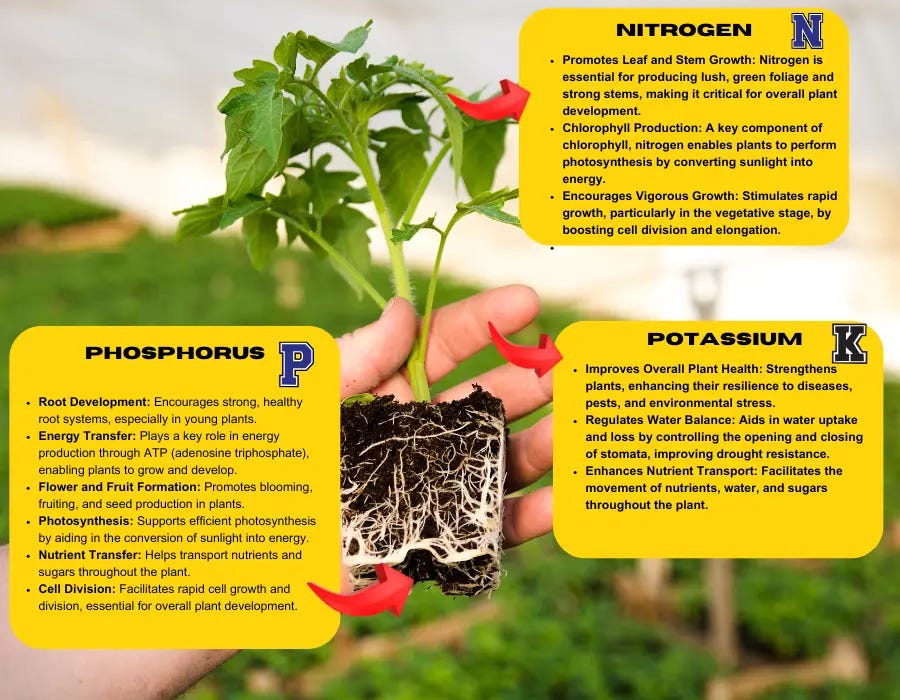
we already discussed nitrogen-based fertilizers earlier. the other two most important nutrients in fertilizer are potassium and phosphorus, which are obtained by mining. around 95% of phosphorus and 85% of potassium is used for fertilizer. potassium mostly comes from canada / russia / china; phosphorus mostly comes from china / morocco
chemical engineering is impossible to cover comprehensively but a simplified model is that you want to use cheap ingredients that are very reactive. the backbones of chemical engineering end up being salt (NaCl) and sulfur (S) because each one is an abundant source of very reactive chemicals
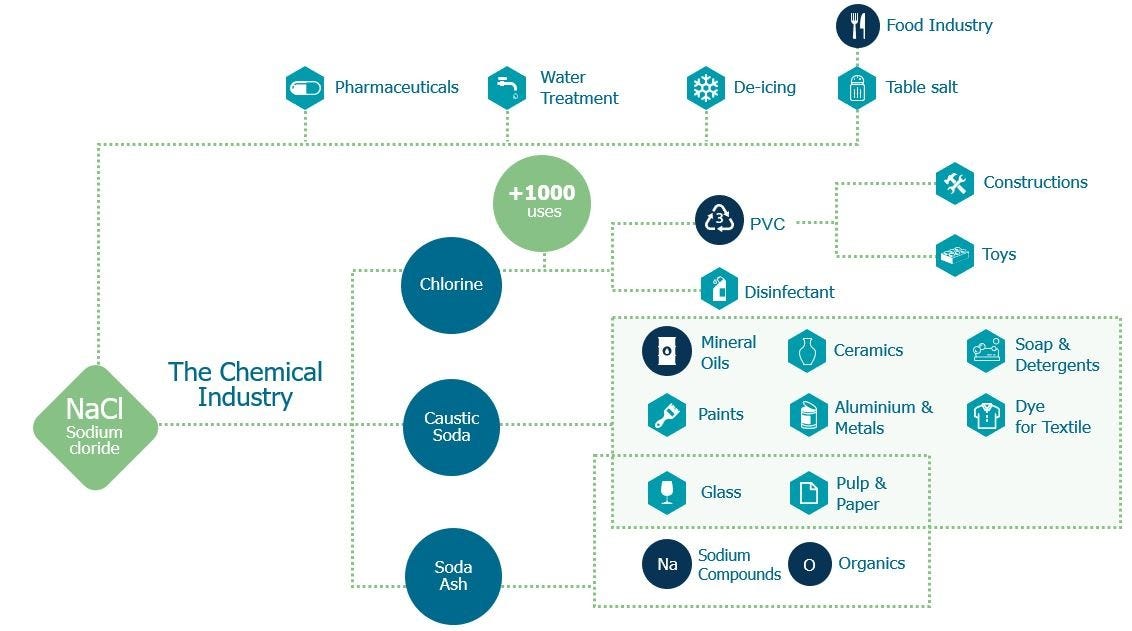
when you run electricity through salt water it splits into chlorine (Cl2) and soda (NaOH). chlorine is very electronegative while soda is a strong base, so both are very useful in downstream processes that produce plastic, glass, paper, etc. these properties also make them very good at breaking down organic matter, which is why they are the main components of bleach / soap / drain wash / other cleaning supplies. salt mostly comes from china / usa / india (obviously we also use salt for food and deicing and whatever)
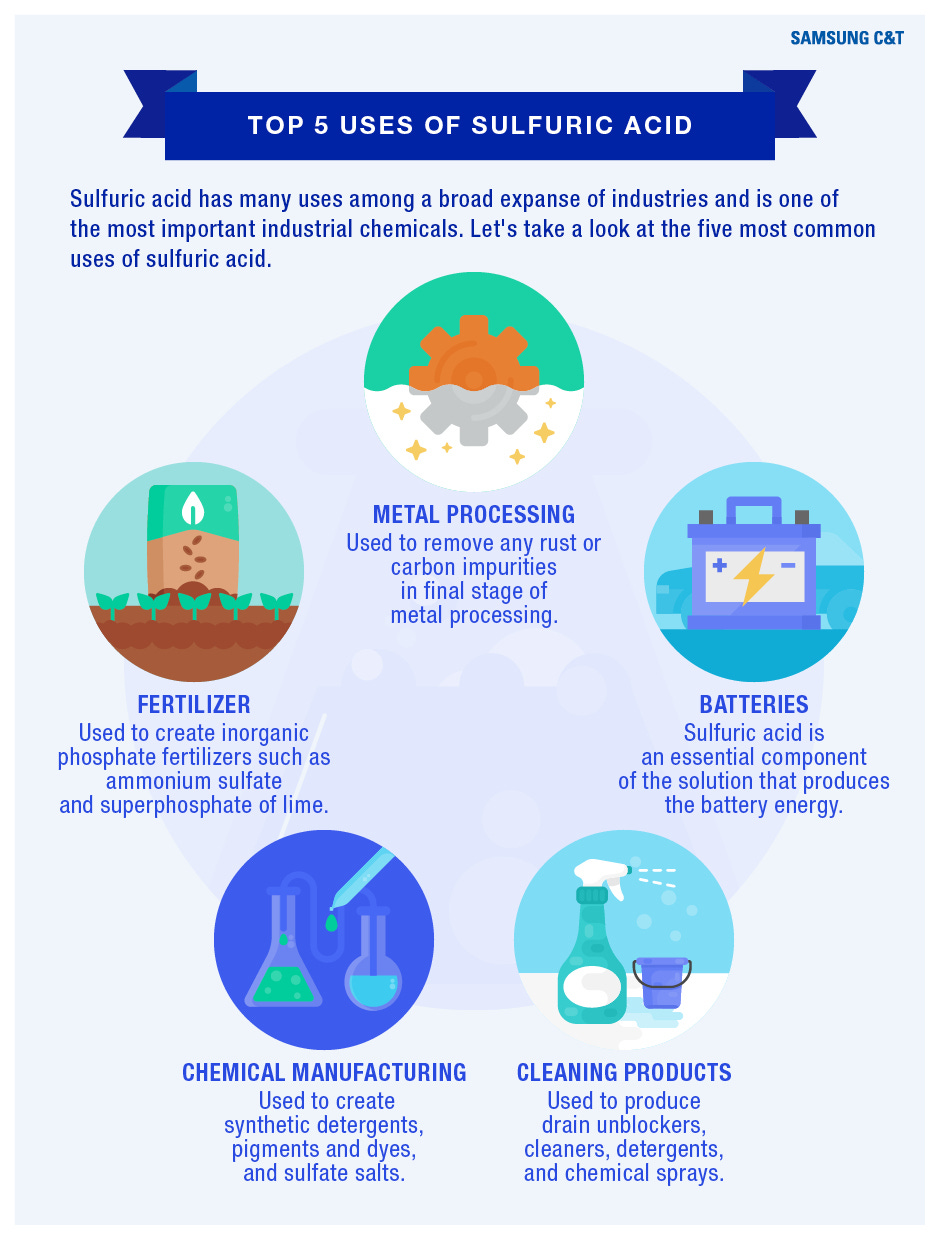
sulfuric acid (H2SO4) is the strongest acid that we can easily produce at scale. as a result almost all (~90%) sulfur is mined for the sole purpose of producing sulfuric acid. it’s used in many reactions where a strong acid is necessary - for example, we previously discussed phosphorus fertilizer, but plants cannot directly absorb phosphorus from phosphate rock, so sulfuric acid is used to dissolve phosphate rock and free the phosphorus (this accounts for half of all sulfur usage). sulfur mostly comes from china / usa / russia
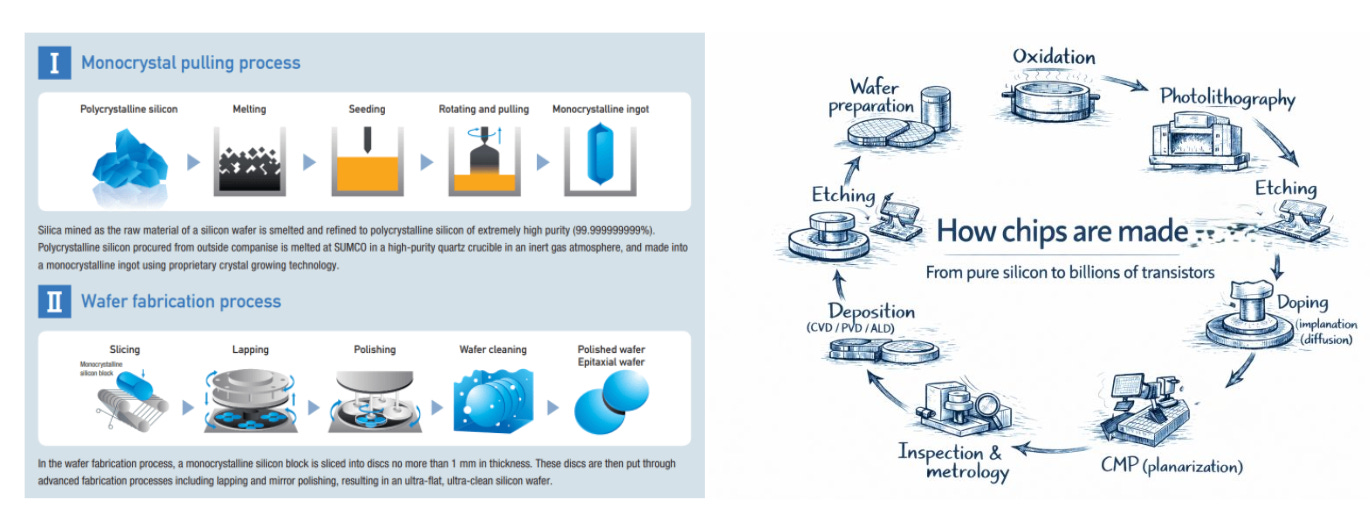
finally we’ll briefly talk about the chip supply chain; i’m not going to do this in detail because semianalysis already exists. okay so we start with silica sand (SiO2) and need some way of removing the oxygen. we do this by heating it in a furnace with carbon - the carbon carries away the oxygen as CO2 so the molten silicon is 98% pure. wafer-grade silicon needs to be 99.9999999% pure so we remove the remaining impurities by repeatedly treating the silicon with acid and boiling away dissolved impurities. then we grow silicon crystals and cut them into thin wafers with diamond saws. afterwards lithography machines etch patterns onto the silicon to produce transistors and circuits
iv. agriculture and forestry
let’s start with an overview of agricultural trade
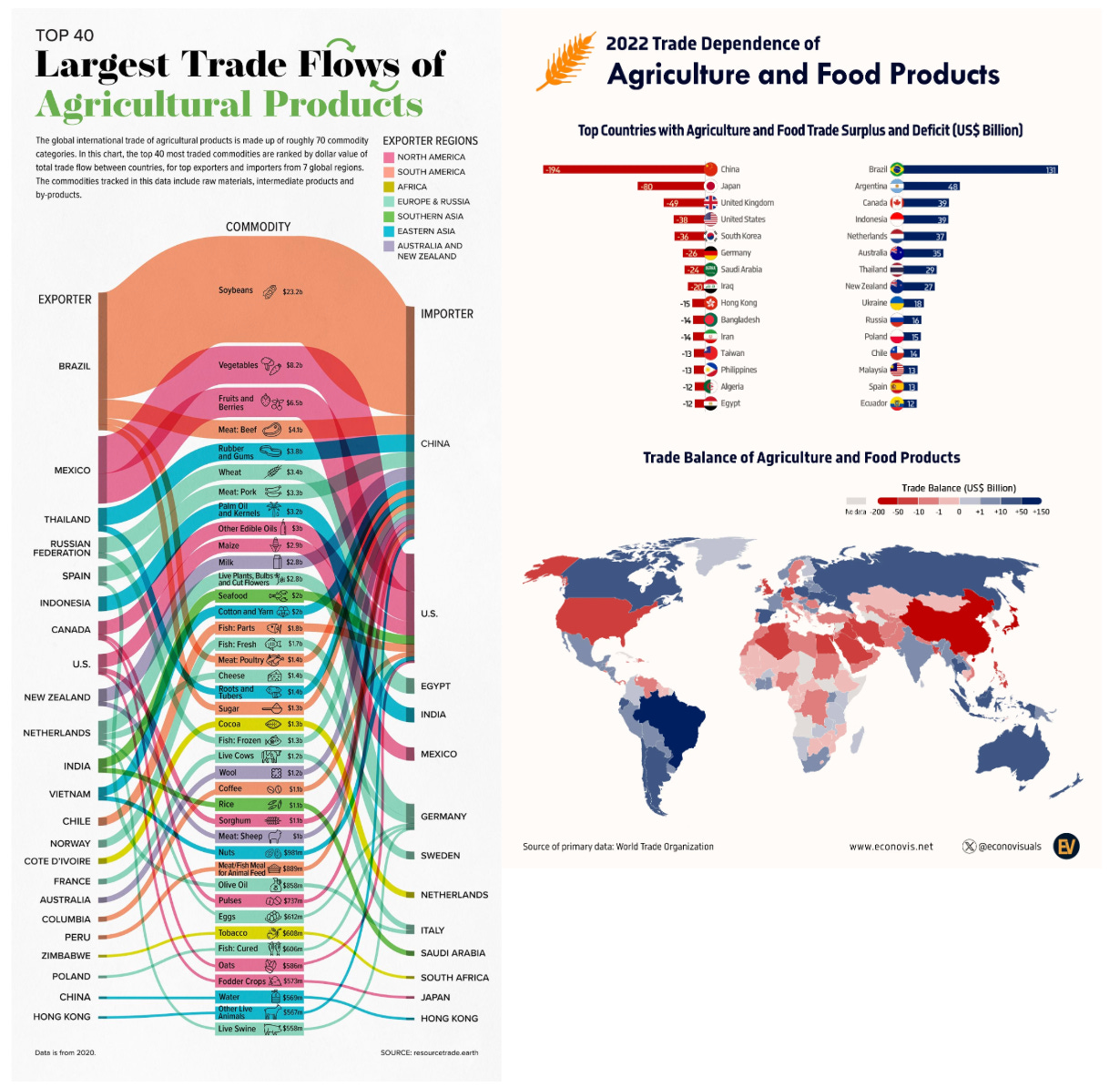
a few high-level observations:
china is extremely dependent on brazil for soybeans and beef, because of massive population and because much of the country (eg. tibet) is not arable. interestingly, india does not have this problem despite a similarly large population because 1) more of the land is arable 2) much of the country is vegetarian. the eu and japan are in a similar situation as china
the middle east is unable to grow things so they import lots of wheat and other foods from russia, ukraine, and india. ukraine and russia account for around a third of all grains, which is why wheat prices rose 50% as a result of the ukraine war
despite having the best farmland in the world (the mississippi river valley), the usa is a net food importer because of a large, wealthy population which insists on year-round availability of diverse crops and can afford to import specialty products like coffee / cocoa / bananas
for non-food agricultural products: 90% of rubber (used for tires, balloons, gloves, etc) comes from southeast asia. the tree we get natural rubber from originated in south america but a blight killed all the rubber trees there and has not spread to southeast asia. cotton is mostly grown in brazil / the usa / india and sent to textile mills in china / bangladesh / vietnam
farmed fish now makes up around half of all seafood
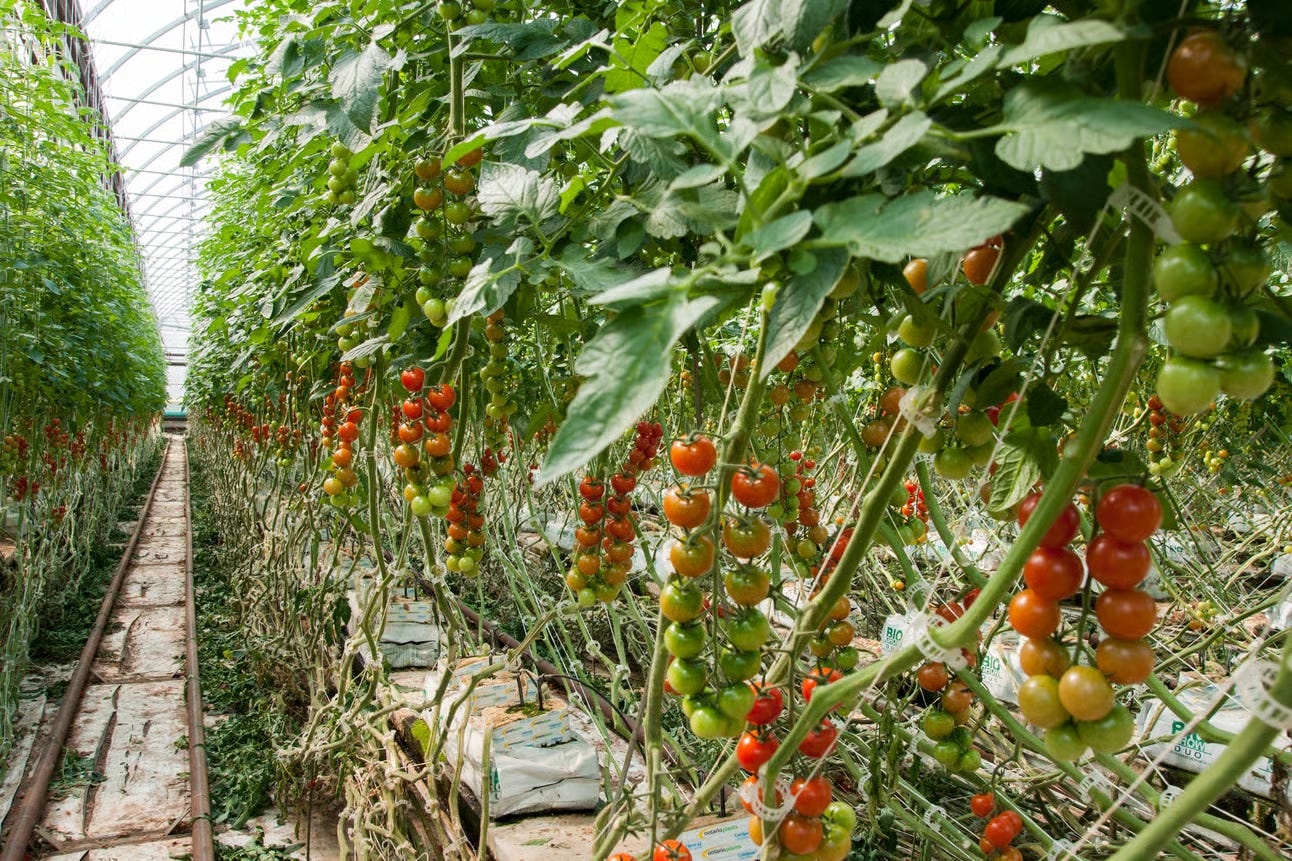
one strange phenomenon is that most produce appears to be available year-round when in theory there should only be two growing seasons (one in the northern hemisphere and one in the south). there are a few factors at play here:
tropical produce (eg. bananas, coffee, avocadoes) is always in season
some produce (eg. citrus, leafy greans) has a long harvest window or grows very quickly, so it is available all the time
some produce (eg. potatoes, onions, carrots, cabbage) can be stored for a long time in cold conditions. apples and grapes are kept at near-freezing temperatures for months with very high humidity to prevent dehydration. the typical apple at a store is up to a year old
other produce (eg. tomatoes, cucumbers, bell peppers) is grown in climate-controlled greenhouses, especially in mexico. greenhouses are expensive to maintain, so this is only worth doing for produce that can grow relatively quickly and on plants that don’t take up much space
finally, many fruits (most berries and melons, cherries, peaches, etc) are simply not available year-round (or at least not with high quality) because they don’t preserve well, have short harvesting windows, and are difficult to grow in greenhouses
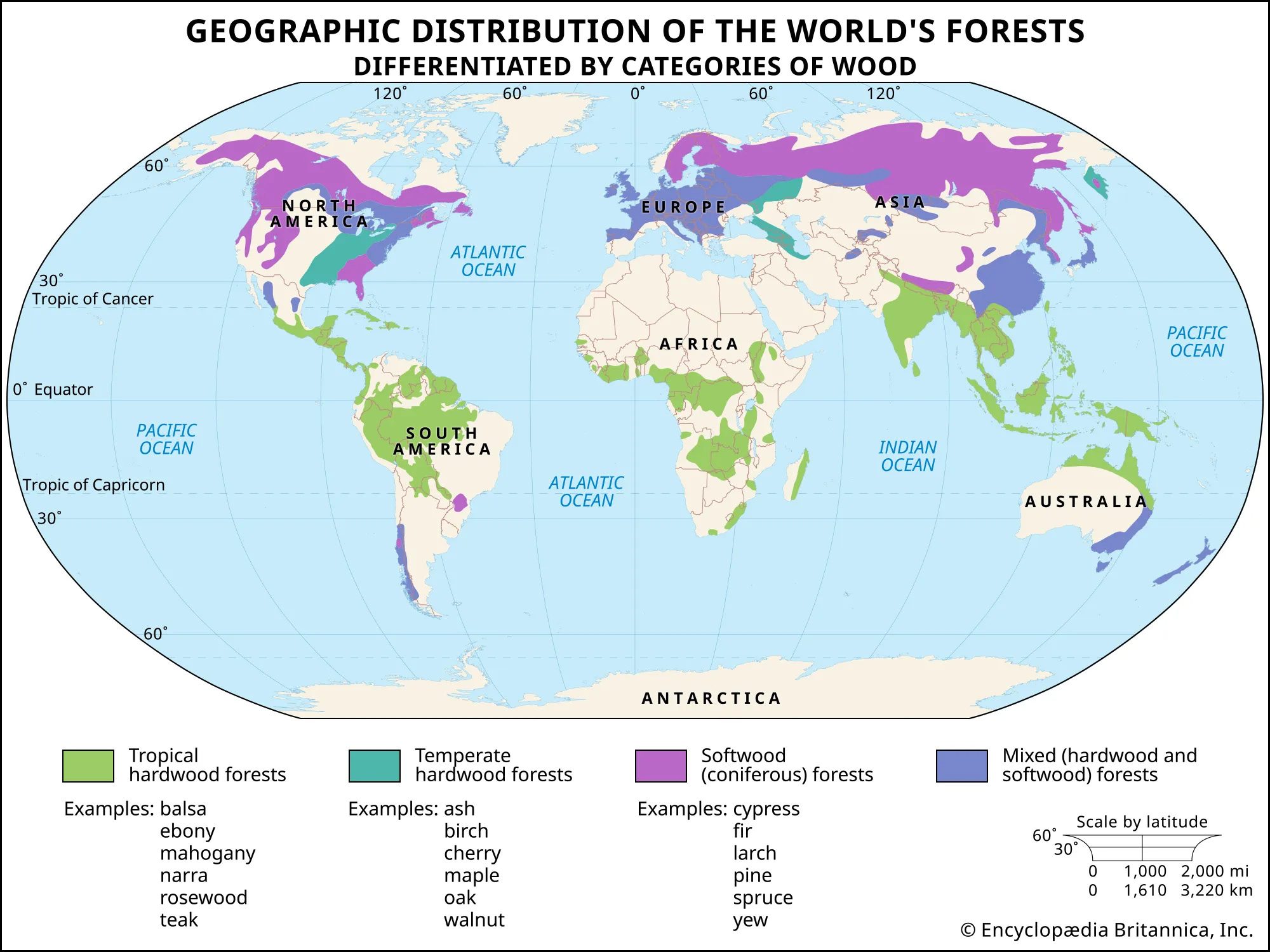
lastly let’s discuss wood, which comes in two main kinds: softwood and hardwood. softwood comes from trees that grow faster, and tends to be cheaper but less dense and durable, so it’s often used as a bulk material in construction, while hardwood is used for flooring / furniture / fine cabinetry. paper is made from a combination of both. north america, europe, and brazil export lots of hardwood, mostly to china and japan. canada, scandinavia, and russia export lots of softwood, mostly to the usa, china, and japan
v. other
i realized after writing the first four sections that there are some important omissions which don’t fit cleanly in the {fossil fuels, metals, minerals, agriculture} breakdown:
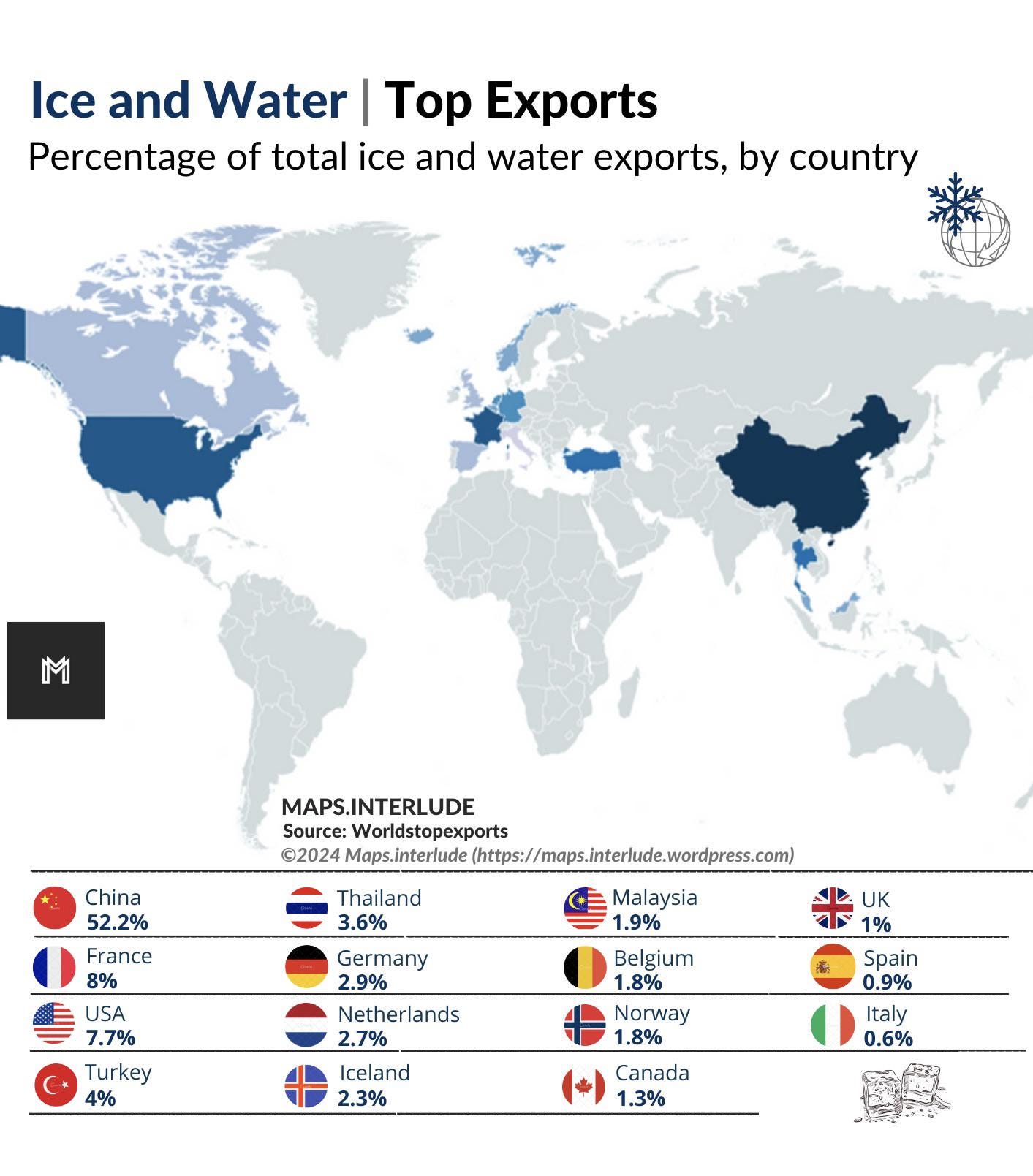
fresh water is an implicit bottleneck in many of the supply chains discussed above. the obvious use case is agriculture but others include fracking and lithium extraction (both of which involve pumping water into the ground), cooling power plants, cleaning semiconductors. the biggest exchanges of water between economies are china → hong kong, usa → mexico, france → netherlands. many middle eastern countries rely on desalination instead of imports
shipping is another implicit bottleneck. most materials described above are transported via ships, but there is an ongoing ship shortage. china / korea / japan make up 95% of all shipbuilding because you need a rare combination of port automation / dry docks / steel mills / skilled labor (and labor costs stopped the usa / europe from competing with asia). ships are also bottlenecked by a small number of passages (eg. panama / suez canals, bosphorus / malacca straits)
other important topics that will have to wait for another day: pharmapheuticals mostly being manufactured in china and india, nuclear fuel and enrichment mostly happening in russia, the west no longer being able to produce artillery and other military equipment, datacenter bottlenecks
okay we’re done! my main takeaways from writing this post:
harvesting enough food to support exponential population growth requires a tremendous amount of work. it is absurd that there is an entire element whose primary use case is to produce the acid to dissolve the rock to create the fertilizer to feed to plants
there are hundreds of materials science companies waiting to be started. so many supply chains are in need of alternate pathways, because of decarbonization or resource scarcity or foreign dependence
chemistry is taught terribly in schools and would be way more interesting if explained in terms of manufacturing processes
deep research is very helpful
i think china will win the ai race despite being behind on model development. more on this in a later post, but tldr ai deployment will be bottlenecked on manufacturing and installing cheap electronics everywhere; smart models deployed in many places are more useful than very smart models deployed in few places
historically (2008, 2022) a 10% grain reduction is enough to cause grain prices to rise 80%. grain is 60% of livestock production cost so meat and dairy also rise ~20-40%. restaurants pass this on as a 10% price hike to consumers
aluminum mostly comes from australia / guinea / china. the usa mostly imports from jamaica. titanium mostly comes from australia / south africa / canada
nickel mostly comes from indonesia and the philippines, while cobalt mostly comes from the congo and is refined in china
lead mostly comes from china and australia
No posts
Comments
Nothing yet. Say the first thing.
Sign in to join the conversation.