
Key Takeaways
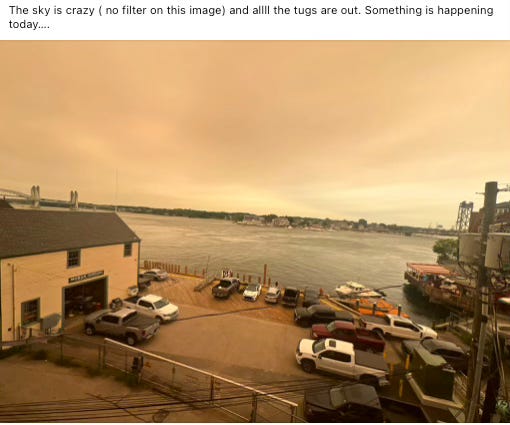
Today in New Hampshire, the sky is a sickly yellow-brown haze from Canadian wildfire smoke, the state’s air quality monitoring page showed “Good” for the Seacoast this morning even as residents watched a smoke plume roll in, not knowing what it was and taking to social media to ask, and across the country a waterborne parasite is sickening people at six times last year’s rate while measles cases approach a 35-year high. None of this is coincidence. The deliberate, accelerating dismantling of our federal public health infrastructure, at the Centers for Disease Control and Prevention (CDC), at the US Environmental Protection Agency (EPA), and across state systems that depend on federal funding and expertise, is leaving us blind, understaffed, and slower to respond at the exact moment we need those systems most. The costs will not be abstract. They are already being paid in hospitalizations, in children sick with preventable diseases, and in communities breathing air no one is adequately tracking.
The CDC has lost more than a quarter of its workforce since January 2025, has no permanent director, and faces a proposed 53 percent budget cut that would eliminate over 60 programs. This is not “efficiency.” It is the strategic destruction of the nation’s early warning system.
The U.S. has now confirmed more than 2,200 measles cases in 2026, already approaching all last year’s record total with months of transmission season remaining, and the country may lose its measles elimination status in November.
A multistate cyclosporiasis outbreak has produced at least 1,645 confirmed domestic cases and potentially more than 5,100 additional cases still under investigation, exceeding the case count at this point last year by more than sixfold, with no source identified. The CDC’s public-facing surveillance page still shows 145 cases, nearly a month out of date, meaning the public is making decisions based on numbers off by more than an order of magnitude from what the agency itself knows.
The EPA was stripped of more than 4,000 positions in 2025, reaching its lowest staffing in over 40 years, while climate-driven wildfire smoke is requiring more complex, real-time air quality forecasting than ever before.
When you hollow out public health infrastructure, you do not get a quieter system. You get a louder crisis with fewer people able to hear it, respond to it, or tell you the truth about what you are breathing.
Step outside in New Hampshire today, and the sky tells you something is wrong before any official alert does. You can smell smoke.
Canadian wildfire smoke from northern Minnesota and Ontario has been drifting across New England since this morning, turning the sky above the seacoast a yellowish, brownish haze. Beachgoers in Rye saw it happen in real time. The National Weather Service in Gray, Maine confirmed the smoke. Photographers documented it. And yet if you pulled up the New Hampshire Department of Environmental Services air quality forecast page this morning, the Seacoast showed up as “Moderate” for ozone, with PM2.5 rated “Good.”
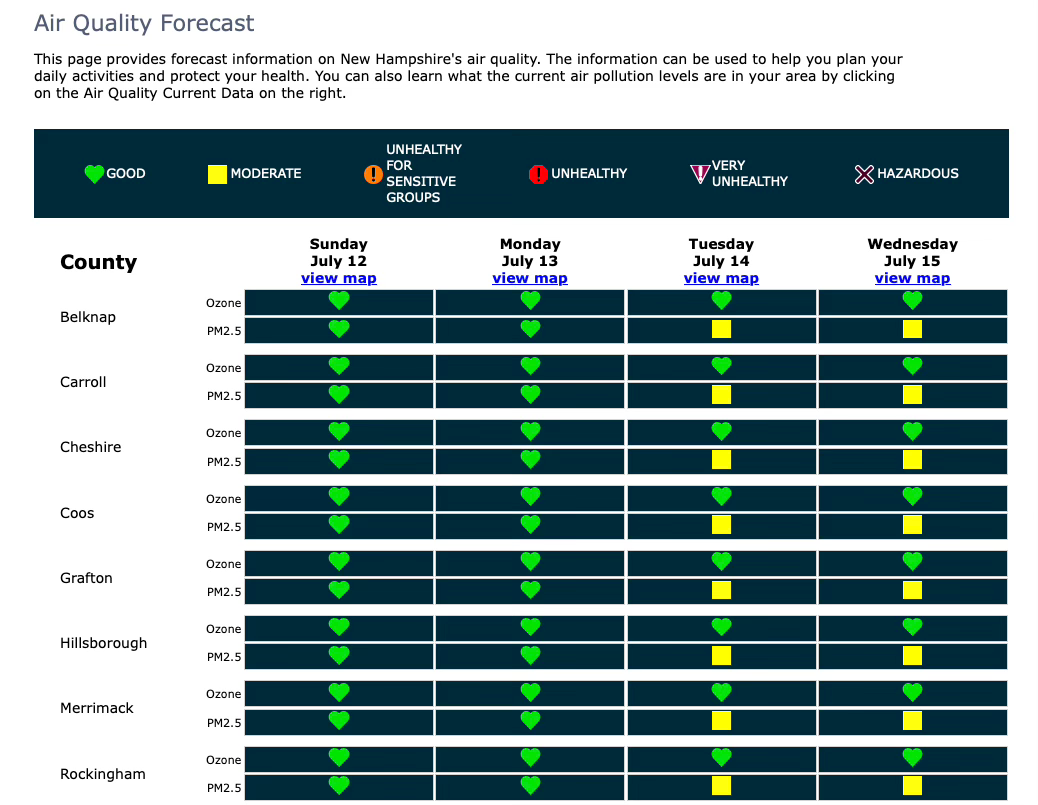
That is not a minor discrepancy. That is the gap between what the monitoring system was built to catch and what is happening to the air people are breathing right now.
I want to be clear that I am not blaming the scientists and forecasters at NHDES, who are doing difficult, technically complex work with limited tools and have been adapting in real time to the new normal of recurring wildfire smoke. NHDES has documented this challenge honestly. But the screenshot I took of that forecast page this morning is a snapshot of something larger: a public health infrastructure stretched far beyond what it was designed to handle, while the federal government is systematically stripping away its capacity.
That is the story of this particular Tuesday in July 2026. And it is also the story of the last 18 months in American public health.
A Parasite No One Can Find
Somewhere in the food supply, there is a contaminated source of Cyclospora cayetanensis, a microscopic waterborne parasite that causes severe gastrointestinal illness, the kind of relentless, explosive diarrhea, cramping, nausea, and fatigue that people sometimes describe as the worst they have ever felt. Since May 1 of this year, the CDC has confirmed at least 1,645 domestic cases across 34 states, with more than 5,100 additional cases still under analysis. Nine percent of confirmed case-patients have been hospitalized. At this same point last year, there were 249 total domestic cases. We are running more than six times the 2025 rate.
No source has been identified.
The CDC, FDA, and state health departments are actively investigating multiple multistate clusters. Past outbreaks have been traced to fresh produce such as basil, cilantro, spinach, and berries, foods consumed at much higher rates during the summer months. Genotyping at the CDC’s specialized laboratory has historically been a critical tool for linking cases to common sources. But that laboratory, like the rest of the agency, is now operating under extraordinary strain.
The CDC has lost more than a quarter of its workforce since January 2025, through mass firings, resignations, retirements, and contract nonrenewal. A survey of 433 current and 191 former CDC employees conducted between February and April 2026 found that only 2 percent of respondents in chronic disease and injury prevention programs reported that their work units remain fully operational and able to meet their missions. Eighty-five percent of current employees reported burnout. And 95% said they believed Americans will die because of the changes to the agency. The CDC has no permanent director, no principal deputy director, no chief of staff, and no chief medical officer. There is no stable leadership structure in place to coordinate a complex multistate outbreak response right now.
HHS has called the cuts the elimination of a “bloated bureaucracy.” Tell that to the 141 people hospitalized so far with a gastrointestinal infection we cannot trace to its source.
The CDC’s public-facing cyclosporiasis surveillance page, the one any concerned parent or clinician would find with a Google search, was last updated June 18 and shows 145 cases across 17 states. The Health Alert Network notice issued to clinicians today, July 14, shows 1,645 confirmed cases across 34 states, with more than 5,100 additional cases still pending analysis. The public page is running nearly a month behind the agency’s own internal alert system.
That gap, between what the public can see and what the system knows, is not a minor administrative lag. It is a window into what happens when you cut the workforce responsible for updating, communicating, and maintaining public health data infrastructure. People making decisions about what to eat, whether to call a doctor, whether to report a sick child, are working from numbers that are off by more than an order of magnitude. That is not transparency. That is the public health information system failing in plain sight.
A Disease We Eliminated. Coming Back.
The United States declared measles eliminated in 2000. That achievement, built on decades of public investment in vaccination programs, surveillance systems, and community immunization infrastructure, saved countless lives and billions of dollars.
We are now on the verge of losing it.
As of this week, the CDC has confirmed more than 2,231 measles cases across 45 jurisdictions in 2026, with 32 outbreaks and 93 percent of cases linked to active transmission chains. The full-year 2025 total was 2,289 cases, itself the highest since 1991. We are already at 97 percent of that total with months of the school year, summer travel season, and fall congregation still ahead. The Pan American Health Organization will convene a review in November 2026 to determine whether the United States retains its measles elimination status.
The primary driver is the erosion of MMR vaccination coverage among children, dropping from 95.2 percent in the 2019-2020 school year to 92.5 percent in 2024-2025, falling below the 95 percent threshold required for community immunity. That translates to roughly 286,000 kindergartners left unprotected last year. When measles is introduced into a community with that level of susceptibility, it spreads.
And the infrastructure we rely on to detect it, contain it, and communicate about it, including CDC epidemiologists, state health department liaison staff, and the public health laboratory scientists who confirm cases and support outbreak response, is being hollowed out in real time.
40 Years of Capacity, Gone
The EPA was stripped of more than 4,000 positions in 2025, bringing the agency to its lowest staffing levels in more than four decades.
That happened in the same years that wildfire smoke from Canadian fires has become a recurring, intensifying force in New England air quality. NHDES documented this shift honestly: before 2021, New Hampshire had not experienced a PM2.5 exceedance since 2013. Since 2021, wildfire smoke has become part of the annual forecasting routine, bringing fine particulate matter into the state that the original monitoring network was not designed to capture. NHDES received IRA funding to install a new monitoring station in Berlin in 2024, working with EPA partners to find the right location. That kind of collaboration between state and federal air quality scientists is exactly what produces better forecasting.
It is also exactly what is being defunded.
EPA grants fund the clean and safe drinking water infrastructure that communities across the country, regardless of political party, depend on. They support the technical expertise that state agencies rely on when their own capacity runs short. They fund the air monitoring networks that tell us what we are breathing. A proposed more than 50 percent cut to EPA funding would not produce a “leaner” regulatory system. It would produce a monitoring gap: more events like today, where the sky is visibly hazardous, and the official forecast says “Good.”
What This Is Actually About
Public health infrastructure is invisible when it works. You do not see the epidemiologist who traced a Cyclospora cluster back to a specific cilantro supplier and prevented a hundred more hospitalizations. You do not see the CDC laboratory scientist who genotyped the samples that made that link possible. You do not see the air monitoring technician who calibrated the PM2.5 sensor that sent you the alert that kept your asthmatic child indoors. You only notice these systems when they fail.
We are being told, repeatedly, that the cuts represent efficiency. That the agencies were bloated. That the money was wasted.
But what we are living through, today, on a July afternoon when the sky is yellow, and a parasite is spreading, and measles has returned to levels not seen since I was a child, is the consequence of those claims. We are watching, in real time, what happens when you remove the people whose job it is to see threats coming, track them, name them, and stop them.
Jennifer Nuzzo of Brown University’s Pandemic Center said it plainly: “Making it real for everyday Americans and what it means for their lives... cutting the federal workforce isn’t just affecting blue states.”
She is right. Wildfire smoke does not stop at state lines. Contaminated produce moves through every supply chain. Measles spreads wherever vaccination rates have been allowed to fall. These are not partisan threats. They are biological facts.
But the decision to defund the systems that protect us from them is a political one. And the people making it need to be held accountable for what that choice looks like on the ground.
What New Hampshire Is Facing
I’ve been fighting for environmental accountability in this state for more than a decade. I helped notify New Hampshire of a pediatric cancer cluster on the seacoast in 2014. I spent years on the Pease Restoration Advisory Board fighting the Air Force to address PFAS contamination at the former base. I served in the legislature and co-founded the NH Safe Water Alliance to push for clean water protections. I know what it looks like when government fails to protect communities from environmental harm, and I know what it costs.
What I am watching right now at the federal level is a faster, more deliberate version of the same pattern. Remove the science. Reduce the monitoring. Eliminate the workforce. Claim it was a waste. Wait for people to get sick.
Today in New Hampshire, the sky is orange-yellow from wildfire smoke that the forecast did not predict. Somewhere in our food supply, a parasite is sickening people, and no one has found the source. Measles is circulating in 45 states. The CDC has no director. The EPA has lost 40 years of workforce capacity.
This is not a coincidence. This is the consequence of a policy decision to treat public health as expendable.
We cannot stay silent.

Mindi F. Messmer, DMSc, MS, is a Senior Research Scientist at a national nonprofit and an Assistant Professor at the Georgetown University School of Medicine. She is a former New Hampshire State Representative, co-founder of the NH Safe Water Alliance and NH Science and Public Health, and a 2026 Keene State College President’s Award recipient for Outstanding Woman of New Hampshire.
No posts
Comments
Nothing yet. Say the first thing.
Sign in to join the conversation.