
On the Fourth of July holiday weekend, tens of thousands of beachgoers across MA, NH, and ME are encountering closed beaches and unsafe water. Not because of some unforeseen act of nature, but because of decades of deferred infrastructure investment and regulatory failure for which both parties share responsibility. A 1970s-era sewer main in Haverhill, MA collapsed under a storm surge on June 27, dumping an estimated 8 million gallons of raw sewage per day into the Merrimack River for at least a week. The warning signs were in plain sight; a 2016 federal consent decree that changed almost nothing.
Meanwhile, MA acted immediately to protect the public while NH spent days assessing whether to increase testing at coastal beaches that had last been sampled before the catastrophe began. NH beaches ultimately cleared, but the structural question remains: a state that monitors 16 coastal beaches up to twice weekly, primarily on federal dollars, is not prepared for the next emergency. Sewage releases do not respect municipal boundaries, and ocean water does not respect state lines. What gets dumped into the Merrimack in MA washes up on beaches in NH. What gets ignored in a consent decree in one state becomes a public health emergency in the next. This is a regional story, and it is an American story, about what happens when environmental infrastructure is treated as a local burden rather than a shared public health obligation.
A federal consent decree signed a full decade ago required Haverhill to fix its combined sewer overflow problem; instead, the city discharged even more sewage than before in 7 of the last 10 years, and the EPA moved the goalposts rather than enforcing the deadline.
An estimated 32 million gallons of untreated wastewater poured into the Merrimack River before a temporary bypass stopped the bleeding, forcing closures of beaches in Ipswich, Essex, Newburyport, and Salisbury just as temperatures climbed toward record triple digits.
MA had closed 41 beaches by Tuesday and acted aggressively, with state-level real-time testing and coordinated closure decisions; NH, by contrast, had last tested its coastal beaches four days before the spill began and spent days “determining” whether additional testing was needed.
The federal government’s combined sewer overflow grant program, meant to help the more than 800 communities nationwide with aging combined sewer systems, currently has $41 million, a sum that wouldn’t cover a single mid-sized city’s infrastructure needs, let alone the regional crisis unfolding along the Merrimack.
This is not a partisan story with clean heroes and villains; it is a bipartisan failure of political will that has played out across administrations, and the people paying the price are the same ones we ask to trust that government works.
It is the July 4th holiday weekend. A heat wave is bearing down on coastal New England, with temperatures forecast to hit triple digits. Families who have planned for weeks to beat the heat at the beach arrive to find signs warning them to stay out of the water. Shellfishing beds are closed. The smell gives it away before the signs do.
Every single part of it was preventable.
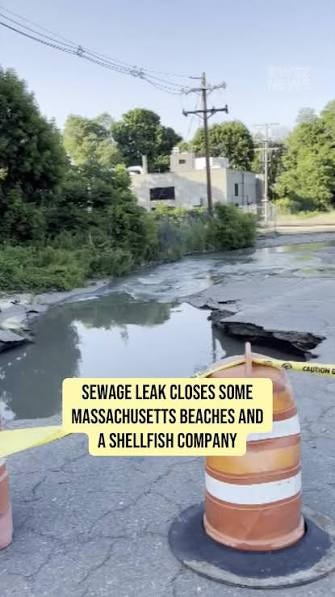
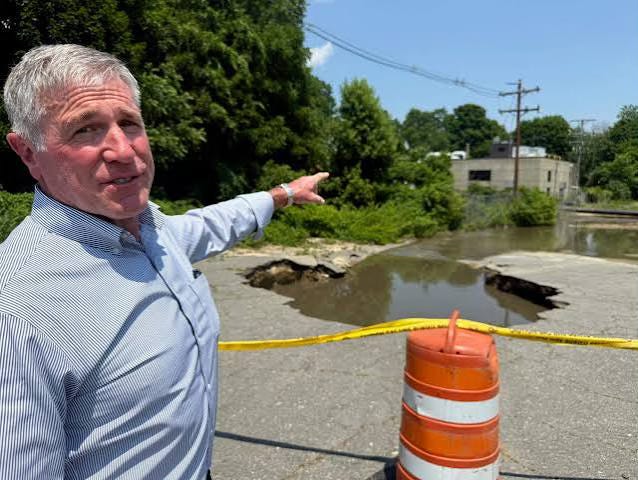
On the evening of June 27, a severe storm overwhelmed Haverhill’s wastewater system. A 42-inch sewer force main near the city’s South Mill Street Pump Station, the main artery carrying the city’s wastewater to its treatment facility, cracked in two places. Since then, roughly 8 million gallons of untreated wastewater have been spilling into the Merrimack River per day.
By Tuesday evening, officials estimated roughly 32 million gallons of untreated wastewater had entered the river. A barrier was installed to hold back solid waste, but contaminated water flowed freely downstream, carrying bacteria counts that at some locations along the river reached up to 40 times the safe level.
Every beach from Essex to the border with NH was closed to swimming. The Ipswich closure included the beloved Crane Beach. Newburyport and Salisbury closed their shores. Shellfishing beds in Gloucester went dark. In addition to the beaches impacted by the sewage leak, another 14 beaches were closed due to high bacteria levels, including two beaches in Salem on Children’s Island, where a YMCA camp was taking place.
The number of MA beaches closed to swimming rose to 41 on Tuesday, with Plum Island, Salisbury Beach, Essex beaches and Crane Beach in Ipswich among those off limits as temperatures were forecast to skyrocket past 100 degrees on Wednesday, Thursday and Friday.
On Wednesday, July 1st, contractors completed the installation of the first temporary 24-inch bypass pipeline and announced that the active discharge had stopped. That is the good news. Here is the bad news: the bypass is a temporary patch while crews excavate the damaged sections of the original 42-inch main and conduct engineering evaluations before permanent repairs can even begin. Officials warned the public to continue avoiding contact with the Merrimack River and downstream waters for at least 48 hours after the discharge stopped, a window that carries directly into the July 4th holiday weekend. As of this writing, multiple beaches remain closed or under advisory. The river is still contaminated. The damage from five days of continuous raw sewage release does not simply wash away the moment the pipe is patched.
All of this happened just before a holiday weekend at the height of summer and during a record heat wave.
The discharge may have stopped. The crisis has not.
A decade before a sewer main broke, city officials signed a consent decree with the US Environmental Protection Agency, agreeing to take critical steps to prevent further pollution of the river.
The year was 2016. The City of Haverhill entered a Consent Decree with federal and state enforcement authorities, agreeing to pay a $125,000 civil penalty and to take critical remedial measures to address pollution the City discharged into the Merrimack and Little Rivers. The complaints alleged that, as early as 2008, Haverhill discharged pollutants from its combined sewer system on 190 occasions, in both dry and wet weather.
Then-Attorney General Maura Healey said at the time the state was “pleased that, through this settlement, steps will be taken to better protect the Merrimack and Little Rivers.”
Except the discharges continued, to the point where in all but three of the last 10 years, Haverhill released an even greater volume of so-called combined sewage overflow than it did in 2016, when the consent decree was signed.
The city pledged to fix the problem. EPA signed off. And then it got worse, not better. For the better part of a decade, the warning lights were flashing, and no one found a way to act with urgency.
“This is a result of not putting the funds in earlier on to fix this,” said Heather Govern, vice president of the Conservation Law Foundation. “It’s an issue that EPA should have dealt with earlier on, with a stricter message that you have to get this done a lot quicker.”
And even more damning: Haverhill’s most recent compliance report, from April, noted that a contractor was working on final designs for discharge pipe replacements at the South Mill Pumping Station, the very site of the recent breaks. The pipe that failed was on the list; it just hadn’t reached the top yet.
“This is what aging infrastructure looks like,” state Representative Andy Vargas wrote in a Facebook post. “The pipe that failed is 1970s-era concrete near the end of its life. This is a problem that runs through many MA communities, not just Haverhill.”
This is a funding crisis masquerading as a management crisis.
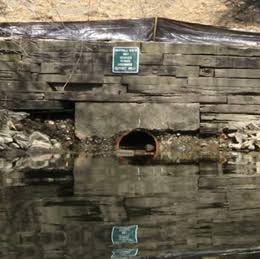
The core infrastructure problem in Haverhill, as in hundreds of American cities, is a combined sewer overflow system: a relic of older urban engineering where stormwater and sewage share the same pipes. When it rains hard enough, the system gets overwhelmed, and sewage exits through overflow valves directly into rivers and waterways. The fix, separating the storm and sewer lines or building holding capacity, is technically straightforward. The cost is not.
In 2017, as part of the consent decree, Haverhill identified 28 deficiencies and a schedule for their completion, estimating that the fixes could cost $56 million. In practice, the costs have grown. Upgrading the wastewater treatment plant carries a price tag of $60 million to $70 million, and separating sewer lines in parts of the city has cost $33 million.
And the federal government, which created this regulatory obligation, has never adequately funded the solution. When Representative Lori Trahan entered Congress in 2019, the federal government had a municipal grant program aimed at this problem, but it was not funded. It now has a grand total of $41 million, for all 800-plus communities across the US with combined sewer systems. “Over the course of history, the feds have kind of walked away from these federal investments,” said Trahan. “That’s hugely problematic because these are super expensive projects and they’re time-consuming. They require a sustained investment.”
Cities “cry poor,” and the EPA offers leniency, moving the goalposts so that what should take 5 years takes 20 or 30. In Haverhill’s case, the leniency outlasted the infrastructure itself.
In the past five years, Haverhill has received $220 million in low-interest loans from the state, including $50 million this year for the wastewater treatment facility and upgrades at the South Mill Street Pump Station. Every dollar borrowed is a dollar that comes back around to ratepayers, disproportionately burdening lower-income communities that can least afford the rate increases.
This is what it looks like when we choose not to invest in public infrastructure as a shared social obligation. We borrow the costs from the future. And eventually, the bill comes due in a catastrophic way, on a holiday weekend, with a heat wave moving in.
I am a public health scientist, and the contrast between how MA and NH handled this emergency tells us something important about preparedness, monitoring infrastructure, and the will to act when public health is at stake.
MA had a crisis on its hands, but it responded with urgency. Governor Healey and the state Department of Public Health maintained a round-the-clock coordinated response. The state’s beach quality dashboard updated hourly. Closures were posted in real time. When the bypass was completed and specific beaches showed clear results, those beaches were reopened within hours, not days. The system, imperfect as it is, was designed to respond.
NH’s situation is more complicated, and the response-time gap is only the surface of it. As of June 29, a NHDES spokesperson said the agency would determine whether the incident required changes to NH’s beach testing schedule. State beaches had last been sampled on June 25, the same day as an earlier accidental sewer discharge in Haverhill, and results showed no contamination.
The major sewer main break happened the night of June 27. NH’s most recent beach samples had been taken on June 25. Two days earlier. The state was “determining” whether it needed to test more. Meanwhile, the Merrimack River was sending up to 10 million gallons of raw sewage into the ocean daily.
But the testing lag is a symptom, not the disease. The deeper problem is that NH has made a sustained political choice to underinvest in environmental protection. The 2026-2027 state budget restructured NHDES programs with the explicit goal of reducing reliance on tax dollars and making programs “self-supporting.” The legislature eliminated mandatory vehicle emissions testing over the objections of NHDES’s own commissioner and despite a direct warning from EPA Region One that doing so would risk federal highway funding sanctions. The state’s beach monitoring program covers just 16 coastal beaches and is conducted up to twice per week, funded primarily by federal Beach Act dollars rather than state investment. ME’s coastal beach program is voluntary, not mandated by state law, leaving monitoring decisions to individual municipalities.
This is the infrastructure of neglect. When a major sewage emergency erupts just across the border, and millions of gallons of contaminated water are flowing toward your coastline, “up to twice per week” and “we are determining next steps” are not adequate public health responses. They are the predictable output of a system that has been deliberately starved. NH did eventually increase testing, and Gov. Kelly Ayotte said the state would continue monitoring through the holiday weekend. The beaches ultimately cleared. But the sequence matters. MA acted. NH assessed, then acted.
That gap is the difference between a public health system designed to prioritize precaution and one designed to minimize cost. I served in the NH House of Representatives. I sat in those budget hearings, and I watched industry lobbyists work the hallways while environmental bills died in committee. I watched colleagues vote down investments in water monitoring, in wastewater infrastructure, in PFAS testing, and then turn around and talk about protecting the Granite State’s natural resources. The fiscal lack of commitment to environmental protection in NH is not a surprise to anyone who has served there. It is a feature, not a bug, and the people paying the price are the ones who just wanted to take their kids to the beach.
The infrastructure failure at the heart of this crisis belongs to both parties, across decades of governance at every level.
The 42-inch pipe that broke in Haverhill was poured in the 1970s. The consent decree intended to fix the problem was signed in 2016 under a Democratic administration in MA. The federal funding that was never adequate has been chronically underfunded through Republican and Democratic Congresses alike. The Trump-era EPA has weakened enforcement posture and walked away from Clean Water Act commitments, yes, and that matters. But the chronic underinvestment in water and sewer infrastructure is a pattern that predates the current administration and reflects a bipartisan political consensus that environmental infrastructure is a budget line to be trimmed rather than a foundational public health investment.
Clean water is not a partisan value. Sewage flowing into rivers that people fish and swim in is not a partisan problem. The people who could not take their children to Crane Beach this Fourth of July were not checking which party is in power. They were checking whether it was safe to go into the water and were told no.
We have had decades of both parties treating water infrastructure as something communities deal with on their own, with a trickle of federal support in the form of loans that must be repaid. The result is sitting in the Merrimack River right now.
The time for waiting on results, waiting for the next storm, and waiting for officials to act is over. So, it’s time to attack those of us who refuse to stay quiet. These are the demands.
First, grant funding for wastewater infrastructure, not just loans. Communities with combined sewer overflow systems that serve working-class and low-income populations cannot finance $200 million in infrastructure upgrades through ratepayer debt. Congress needs to fund the CSO grant program at a level commensurate with the actual national need, which is measured in tens of billions, not $41 million.
Second, enforceable consent decree deadlines with real consequences. EPA has a pattern of extending timelines when municipalities “cry poor” and cry busy. That pattern ends here. If a community has been under a consent decree for a decade and things have gotten worse, something has gone wrong with enforcement, and someone must answer for it.
Third, real-time beach monitoring infrastructure across all three states. MA has built a system that updates hourly during beach season. NH monitors 16 coastal beaches up to twice weekly. ME’s beach program is voluntary, not mandated by state law, and relies on local municipalities. That patchwork is not adequate for a coastline serving millions of visitors during summer heat waves. The federal Beach Act provides funding for exactly this purpose. It needs to be fully deployed.
Fourth, climate-proofing of municipal water systems. Across MA, many cities and towns are grappling with infrastructure that wasn’t designed for their population sizes or the kinds of rain events that are becoming increasingly common as the climate warms, leading to greater atmospheric moisture and larger storms. The storm that broke Haverhill’s pipe was not unusual. It was a preview. If we do not upgrade these systems with climate-resilient design, this will happen again, and again, and again.
I built my career in NH fighting for clean water. I know what it looks like when a community is told to wait, to study, to be patient while the contamination continues. I know what it costs in human health, in economic loss, in the slow erosion of public trust in the institutions meant to protect us.
The people on the beaches this Fourth of July weekend were not asking for much. They were asking to swim safely on a holiday in their own country. Many of them couldn’t.
That is not an acceptable answer. And the officials, at every level, in every party, who signed consent decrees and missed deadlines and underfunded grants and waited for test results that were already days old, owe the public more than a press conference.
They owe us infrastructure that works. Water that is safe. A government that acts before the pipe breaks, not after.
We cannot stay silent. Next, it will be us.

Mindi F. Messmer, DMSc, MS, PG, CG, is a Senior Research Scientist at MedStar Health Research Institute, Assistant Professor at Georgetown University School of Medicine, and co-founder of the NH Safe Water Alliance. She is a former NH State Representative and a nationally recognized environmental health advocate.
No posts
Comments
Nothing yet. Say the first thing.
Sign in to join the conversation.