
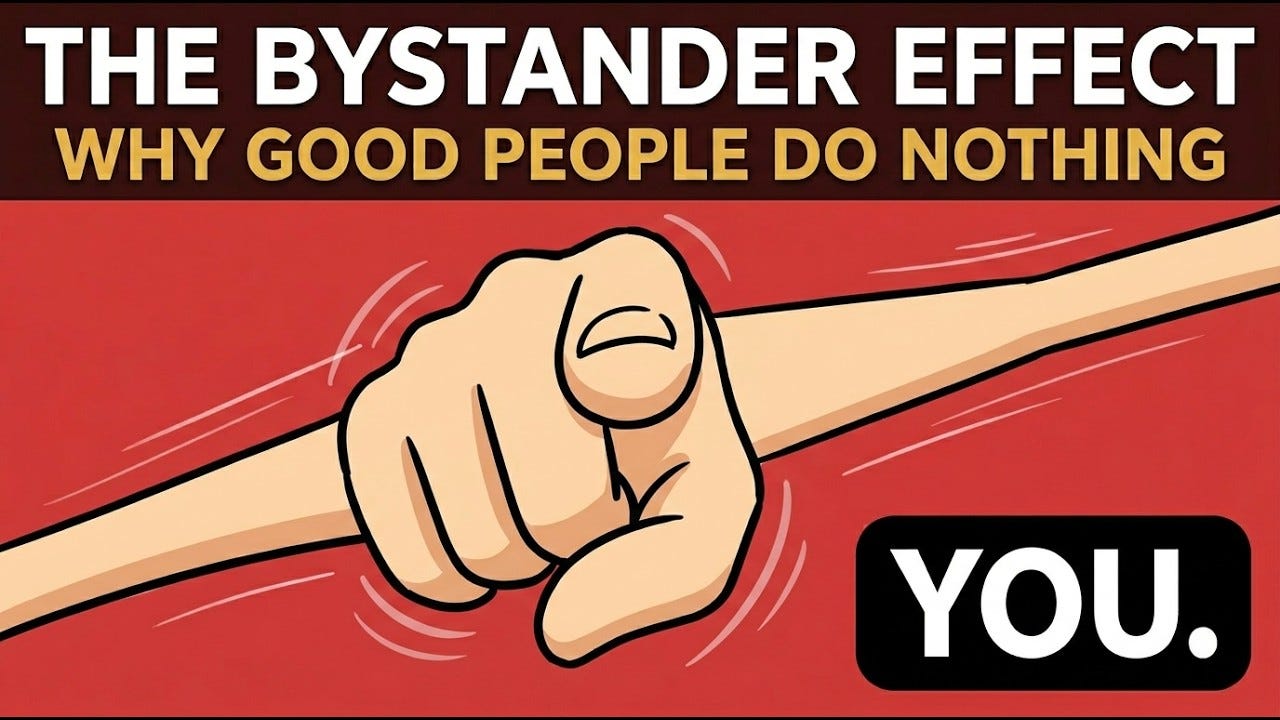
Imagine you’re walking through a crowded street when someone suddenly collapses.
Dozens of people are nearby.
Everyone notices.
Yet for several moments, no one moves.
Most of us like to believe we’d immediately rush to help. But psychology has repeatedly shown that the presence of other people can actually reduce the likelihood that any one individual will act. This phenomenon is known as the bystander effect, and it reveals something surprising about human decision-making.
The bystander effect describes the tendency for individuals to be less likely to offer help during an emergency when other people are present.
Instead of thinking, “Someone needs help, so I’ll step in,” people often assume someone else is better qualified, has already called for assistance, or will act first.
The result is hesitation—and sometimes, no action at all.
Psychologists have identified several reasons.
When many people witness the same event, each person feels less personally responsible.
Responsibility becomes psychologically “shared,” even though the person in need still requires immediate help.
People often judge how serious a situation is by watching everyone else’s reactions.
If everyone appears calm or uncertain, individuals may mistakenly conclude that there is no real emergency.
This creates a feedback loop where everyone waits for someone else to make the first move.
Many people worry about overreacting.
“What if they’re okay?”
“What if I embarrass myself?”
The fear of making a mistake can become stronger than the desire to help.
Public attention to the bystander effect grew after the 1964 murder of Kitty Genovese in New York City. Early reports claimed that dozens of witnesses saw the attack and failed to intervene.
Later investigations showed that those reports were significantly exaggerated. Not everyone witnessed the full event, and several people did attempt to help or contact authorities.
Even so, the case inspired decades of psychological research into why people sometimes fail to act during emergencies.
The lesson remains valuable, even though the original story was more complicated than initially reported.
Laboratory studies have repeatedly demonstrated that people are generally more likely to help when they believe they are the only witness.
As the number of bystanders increases, the probability of immediate action often decreases.
This doesn’t mean people are uncaring.
It means our brains rely on social cues when deciding how to respond under uncertainty.
The good news is that awareness changes behavior.
If you ever witness an emergency:
Assume responsibility instead of waiting.
Call emergency services immediately if appropriate.
Point to a specific person and ask them to help. For example: “You in the blue shirt—please call an ambulance.”
Don’t rely on the crowd to make the first move.
Giving one person a direct task reduces confusion and increases the chance that someone acts quickly.
The bystander effect isn’t limited to emergencies.
It appears in workplaces where everyone assumes someone else will report misconduct.
It appears online when thousands witness harassment but few respond.
It appears in schools, neighborhoods, and communities whenever responsibility becomes “everyone’s job”, and therefore nobody’s.
Understanding this psychological tendency isn’t about judging others.
It’s about recognizing a common human bias so we can make better choices when real moments of responsibility arrive.
No posts
Comments
Nothing yet. Say the first thing.
Sign in to join the conversation.