
Storm Psychology explains psychological ideas for education and reflection. It is not therapy, diagnosis or a substitute for individual professional advice.
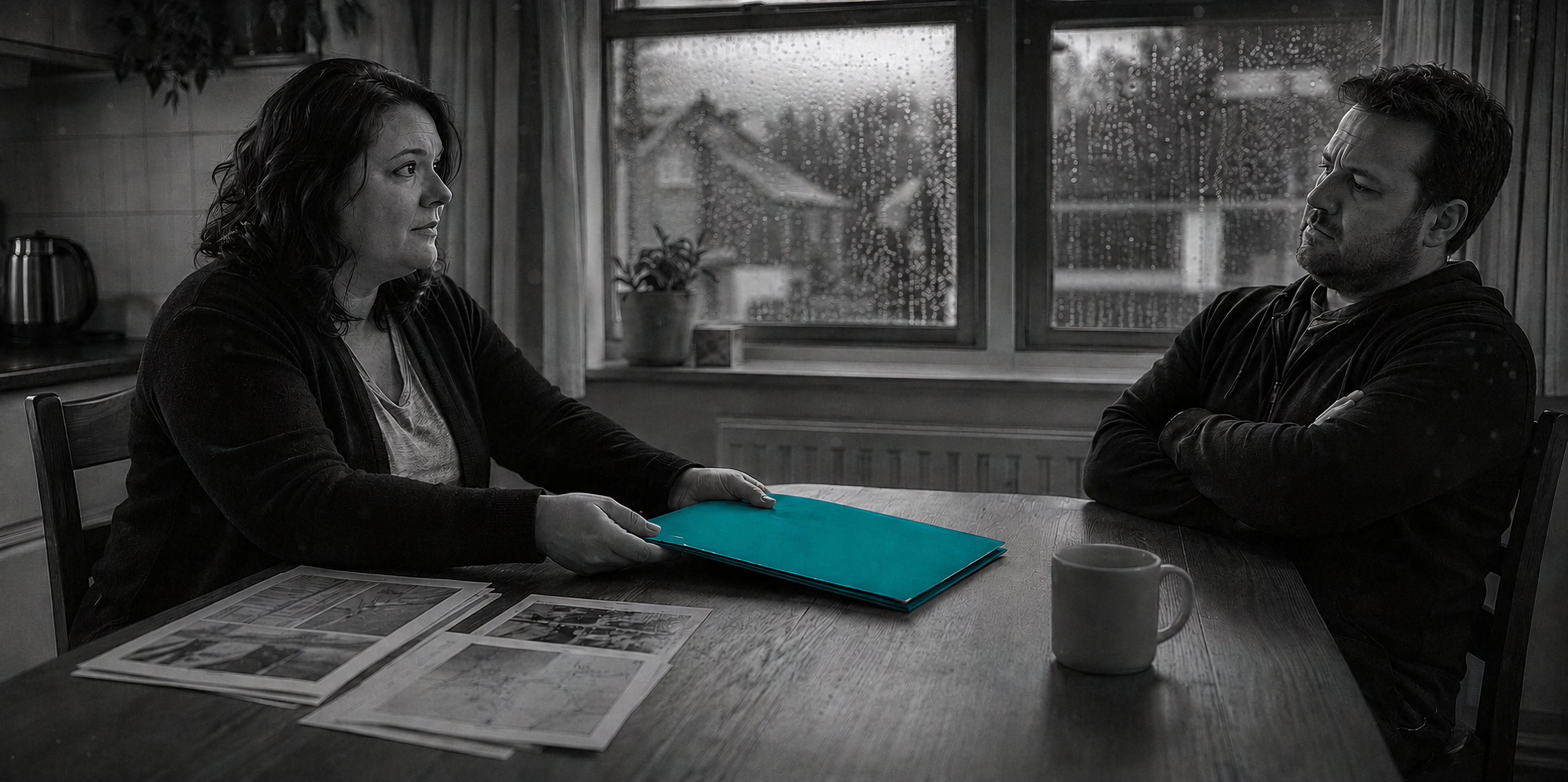
Not a suspicious Facebook graphic made by a man called Gaz. Proper evidence. Reliable sources. Actual research. You arrange it neatly, explain it clearly and place it in front of them like a beautifully prepared factual buffet.
And they look at the whole thing and say, “Well, I still think…”
Suddenly the goalposts have put on trainers and sprinted into another county.
This week’s question came from Sincerely Seb:
“Why can some people not change their opinions despite being shown evidence that those opinions are incorrect? Is there a brain chemistry aspect to it, or is it some old built-in mechanism from an older time?”
Before we get into Seb’s question, the original question box is still open. If there is something about the human brain, emotions or behavior that you have always wondered about, pop your question into the post below. It might become a future Storm Psychology article.
It is a cracking question because the easy answer is usually, “They are stubborn,” followed by a slightly ruder opinion about their intelligence.
But the real answer is more interesting.
There is no single brain chemical that makes people reject facts, and there is no ancient switch in the skull marked IGNORE EVIDENCE. Usually, several very normal bits of human psychology are piling on top of each other.
We hate feeling foolish, we want to belong, and sometimes an opinion becomes so tangled up with who we are that changing it feels like pulling out a load-bearing wall.
Facts do not arrive in an empty brain. They walk into a crowded room full of old beliefs, loyalties, memories, fears and one offended ego asking who invited them.
Some beliefs are easy to change.
If I think Tesco closes at six and you show me it closes at five, I will probably thank you and leave earlier. My identity has not been shattered by the opening hours.
Other beliefs are holding up much more.
They may be tied to someone’s family, politics, religion, job, community or idea of what makes them a good person. They might protect a decision that person made years ago.
Changing the belief may also mean admitting:
I trusted the wrong person.
My group might be wrong.
I defended something harmful.
I said all of this publicly, with confidence, and other humans have receipts.
That is a much bigger psychological bill than simply saying, “Ah, fair enough.”
This is where cognitive dissonance comes in. Big phrase, simple meaning: it is the horrible mental discomfort we feel when two important things do not fit together.
“I am a sensible person” does not sit comfortably beside “I ignored the evidence for three years and called everyone else an idiot.”
Something has to move.
The person could change their belief. Or they could dismiss the source, find one exception, attack the messenger or decide the whole system is corrupt.
The brain does not always choose the truest explanation. Sometimes it chooses the one that hurts the least.
They may genuinely feel reasonable. That is what makes it so maddening.
Confirmation bias means we are more likely to notice, trust and remember information that supports what we already believe.
We may read something we agree with and think, “Exactly!” before checking where it came from. Then we inspect anything that disagrees with us like a furious customs officer looking for undeclared cheese.
The friendly evidence gets asked, “When can you start?” The conflicting evidence must explain a twelve-year gap in its employment history and provide six references.
Then we have motivated reasoning. This is when our thinking quietly changes jobs. Instead of asking, “What is most likely to be true?” it starts asking, “How can I keep believing what I want to believe?”
Our preferences affect which arguments feel convincing and how hard we work to explain awkward evidence away. Being intelligent does not make anyone immune. A clever brain can examine its own beliefs brilliantly, or become a very talented defense lawyer for them.
The hardest beliefs to change are often the ones carrying the most identity.
If an opinion tells someone who their people are or what kind of person they are, evidence can feel personal. Changing their mind might cause conflict, cost them status or mean becoming “one of them.”
None of us checks every medicine, news report or study ourselves. We choose who to trust because one small brain cannot personally verify the entire enormous world.
The problem starts when loyalty becomes the test of truth.
This may be part of the older mechanism Seb wondered about. Belonging and trusted groups have long been useful to humans. There is no ancient “tribe brain” switch, but trust, belonging and self-protection can make beliefs hard to shift.
Then social media comes along and gives those systems an industrial leaf blower.
Not in the neat, one-chemical-causes-one-behavior way.
All thinking involves the brain, but a colorful blob on a scan has not solved the argument. Research suggests the brain may handle “this says something about me and my people” differently from “Tesco closes at five.” Studies in 2016 and 2026 found similar patterns, although the newer one did not repeat every earlier finding.
So be wary of claims that facts simply send the brain into fight-or-flight. Attention, emotion, identity and how we judge new information can all be involved.
Confidence matters too. Research suggests that once we feel very certain, we may give supporting information more weight and let conflicting information have less influence.
Confidence and correctness regularly turn up wearing matching outfits, but they are not the same thing.
It is much easier to spot bias in someone whose opinion annoys us. Their bias is wearing a flashing hat. Ours feels like common sense.
But all of us become more defensive when a belief is protecting something important.
It might be the expensive thing we called a brilliant investment, the person we kept making excuses for, or the belief that we can spot manipulation from three streets away. Even painful beliefs get protected. Someone who feels incapable may dismiss every success as luck.
A belief does not have to make us happy to make us feel safe. Familiar misery can still feel safer than unfamiliar hope.
Nobody escapes the psychological frisking here, including me. Rude, frankly.
You may have heard of the backfire effect, the idea that correcting someone can make them believe the false thing even more strongly.
That can happen, but it is nowhere near as automatic as the internet made it sound.
Across five experiments with more than 10,000 people, corrections generally moved beliefs closer to the facts. But changing one fact does not always change the wider opinion. Someone may accept the number and still distrust the organization.
So yes, keep sharing accurate information. Just do not assume that twelve more links will fix a problem that is not really about missing facts.
When a conversation gets stuck, ask what kind of problem you are actually dealing with.
They are missing information and open to evidence. One clear explanation or reliable source may genuinely help.
The disagreement is about who can be believed. Twelve more links from a source they distrust will do very little.
Accepting the evidence would threaten pride, belonging or their story about who they are. Facts still matter, but humiliation usually makes people defend themselves harder.
You are not pretending that false information is equally valid. You are working out which door is locked before repeatedly kicking the letterbox.
You cannot force another person to change their mind. Sadly, there is no emergency button hidden behind their left ear. But you can make a useful conversation more likely.
Try, “What part of this feels wrong to you?” or “Is there a source we would both trust?”
Their answer tells you whether you are dealing with missing facts, missing trust or something that feels personal. It also saves you from delivering seventeen links to somebody who stopped listening at link two.
If ten claims are tangled together, choose the one that matters most. Give one clear correction, explain why the source is reliable and pause.
A factual avalanche may feel thorough to you. To someone already defensive, it can feel like being buried alive by footnotes.
Mocking someone may win the performance, but it rarely makes reconsidering feel safe. Leave them a dignified way to say, “I hadn’t seen that before,” without demanding a full courtroom confession and a tiny apology hat.
This is not about being endlessly gentle with harmful nonsense. It is about deciding whether you want a satisfying take-down or the best chance of the information getting through. Sometimes you cannot have both.
People often reconsider later, away from the heat of the conversation. Say what you need to say, then leave some space. Silence is not always failure. Sometimes the brain is doing its paperwork in the back office.
Ask:
What evidence would change your mind?
Ask it of yourself too, otherwise it is just a smug little weapon, and we already have enough of those.
If they can describe evidence they would accept, there may still be a useful conversation. If the honest answer is “nothing,” the belief is unfalsifiable. That simply means no possible evidence is allowed to prove it wrong.
At that point, you can stop auditioning new facts for a role that does not exist.
A softer version is: “How certain are you from 0 to 100, and what might move you by ten points?”
Ten points feels less like demanding a full surrender. It gives uncertainty somewhere to sit down, which is often where thinking starts again.
And if it is your belief being challenged, use exactly the same question. Notice the urge to defend yourself, check the source when you are calmer and ask what being wrong would seem to say about you.
Being wrong about something does not make you foolish. Refusing to look because being wrong feels unbearable is where the trouble starts.
Someone refusing to reconsider does not mean your explanation failed. You may be fixing a fact gap while they are defending their family, past choices or sense of being a good person.
That does not make every belief respectable, or mean you must stay in endless conversations with someone committed to misunderstanding you. Sometimes the best thing you can do is share the evidence once, make your boundary clear and step away.
Changing your mind is not proof that you were stupid. It is proof that the new information got through.

The aim is not to have no firm beliefs. It is to hold them firmly enough to act, but loosely enough to revise when reality taps us on the shoulder.
Preferably before reality has to fetch a chair and whack us with it.
Thanks for another brilliant question, Seb. And , if this made your brain pull one guilty little face, mine did too. None of us escaped this one. 😂
If this helped you understand why facts sometimes bounce off the human brain like peas off a toddler, please share it. Someone else might need the reminder that another person refusing to reconsider does not mean they explained it badly.
And if you enjoy Storm Psychology and would like to help me keep making psychology feel a little more human, you can...
I’ll turn it into tea and more mildly unhinged explanations about the human brain. 😂
Before you spend forty-five minutes gathering links for someone whose entire argument appears to be “because I said so,” pause for a moment. 😂
This quick check can help you work out whether the conversation is worth continuing.
This article is written in plain English, but the psychology is grounded in the following research:
Leon Festinger and James M. Carlsmith (1959), “Cognitive Consequences of Forced Compliance.” A classic study that helped establish cognitive dissonance. Read the paper
Lee Ross, Mark R. Lepper and Michael Hubbard (1975), “Perseverance in Self-Perception and Social Perception.” This study showed how impressions can survive even after the evidence behind them has been discredited. PubMed
Charles S. Taber and Milton Lodge (2006), “Motivated Skepticism in the Evaluation of Political Beliefs.” This research found that people can examine opposing arguments more harshly than supportive ones. Journal page
Dan M. Kahan, Ellen Peters, Erica Cantrell Dawson and Paul Slovic (2017), “Motivated Numeracy and Enlightened Self-Government.” Participants interpreted the same numbers differently when the topic became politically charged. Cambridge University Press
Paul Connor, Emily Sullivan, Mark Alfano and Nava Tintarev (2020), “Motivated Numeracy and Active Reasoning in a Western European Sample.” This later study found motivated interpretation but challenged the idea that more numerate people always become more divided. Cambridge University Press
Jonas T. Kaplan, Sarah I. Gimbel and Sam Harris (2016), “Neural Correlates of Maintaining One’s Political Beliefs in the Face of Counterevidence.” A small brain-imaging study of strongly held political and non-political beliefs. Scientific Reports
Małgorzata Kossowska and colleagues (2026), “Neural Correlates of Belief Change in Political and Non-Political Domains.” This larger preregistered study repeated some, but not all, of the earlier brain-imaging findings. Scientific Reports
Max Rollwage and colleagues (2020), “Confidence Drives a Neural Confirmation Bias.” In a controlled task, higher confidence made supporting information more influential than conflicting information. Nature Communications
Thomas Wood and Ethan Porter (2019), “The Elusive Backfire Effect.” Across more than 10,000 people, factual corrections generally improved accuracy rather than making false beliefs stronger. Political Behavior
Comments
Nothing yet. Say the first thing.
Sign in to join the conversation.