
“Given A = B, and B = C, then A = C.” – my 7th grade math textbook
Understanding that employees are engaged when their basic human needs are met, it just makes sense that actions that undermine safety & certainty, contribution & purpose, growth & significance and connection & belonging will damage engagement.

Unfortunately, most companies, while fully cognizant of the value of employee engagement, unwittingly do some or even all of the following:
Erode safety and certainty: with layoffs, layoffs and (did I mention?) layoffs. While you’ve most likely grown up with layoffs as a norm, up until the 1980s, mass reductions were primarily a last resort. They were either a reaction to a reversal in company-specific expectations, such as a competitor launching a market-share taking product, or a reaction to a reversal in the general economic outlook. They were not the blunt-force tool of choice to bolster share price quarter after quarter that they’re today (which is not the same as smoothing earnings or cutting costs).
As a leader, it’s important for you to understand that layoffs have massive engagement-destroying implications. The staff you lay off will move on, but those left behind will never trust you again. No matter the size of your internal communication budget, those remaining team members who witness their coworkers and friends being let go will always remember. They will smirk when you try to motivate them with lines like, “we’re like a family.” And those who can leave will at the very next opportunity.
I understand, “don’t do layoffs” is very easy for me to write, when you may truly need to cut costs. I believe no one takes the decision to execute a layoff lightly. Yet, as layoffs are more common today, I think the consequences are considered less often. I have seen companies rush to calculate the cost savings from a 5% reduction in FTE (Full Time Employees) many times. Not once has one of those financial statements ever included the long-term costs of a disengaged workforce. In addition, if you examine results post-layoffs, you might be startled to know that for most companies, the cost savings from workforce reductions never materialize, while restructuring costs always do, as does the negative impact on engagement.
Another safety destroying practice is forced ranking of employees. If you’re doing this, please stop. In case you don’t know of this anxiety-inducing yet shockingly popular, archaic way of comparatively rating employees, consider yourself lucky. Here’s how it works in a nutshell.
Managers are forced (forced is the key word here) to rank their team members on a scale (1-3 or 1-5) with a fixed percentage in each bucket. For example, let’s say your company has implemented a 1-5 scale (with 1 labeled “poor performance” and 5 labeled “outstanding performance”) and you’re a team head with ten people reporting to you. At the end of the year, you must allocate your ten team members into these 5 ratings, so that for instance 1 person must be rated a 5, 2 are a 4, 3 are a 3, 2 are a 2 and 1 must be a 1.
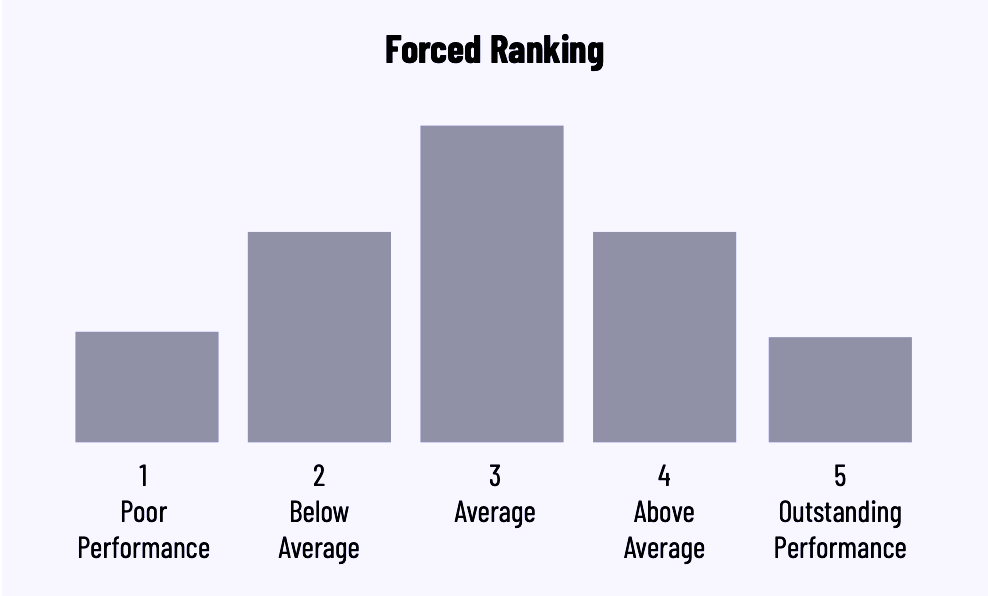
This method has proved to have no redeeming benefits, except for perhaps making the math for allocating bonuses easier. With a deeply negative impact on companies, I have no idea how this ranking method has been sold to so many sober, un-lobotomized organizations. Here are some of the consequences of this practice:
It forces managers to rank productive team members negatively even when they have met expectations. Someone’s got to be at the bottom. Imagine having to fail students who have completely grasped the material.
Managers are left pitting team members against each other. This damages the manager-employee relationship and the individual’s morale, especially since the rating can feel unfair to both manager and employee. Most managers will openly explain that their hands are tied; they must follow the senseless corporate directive. Many go as far as to say that if it were up to them, they would certainly assign a better rating. Managers state outright that if an individual’s performance was truly bottom of the barrel, they would have tried to resolve it during the year or let the person go.
Forced ranking incentivizes managers to keep low-performing team members just so that they don’t have to kick a high performer without cause at the end of the year.
It makes the manager’s job harder. Imagine you as a manager giving an undeservedly poor end-of-year performance rating to some of your team members, after which you need to turn around and motivate the same team members to deliver the next year. How does that feel?
Pitting team members again each other creates a competitive team environment instead of promoting collaboration. Forced ranking invites a mediocre stage 3 culture of “I’m great (and you’re not).” Individuals focus on winning for themselves, hoard knowledge to ensure personal power and operate as lone warriors instead of as part of the team.
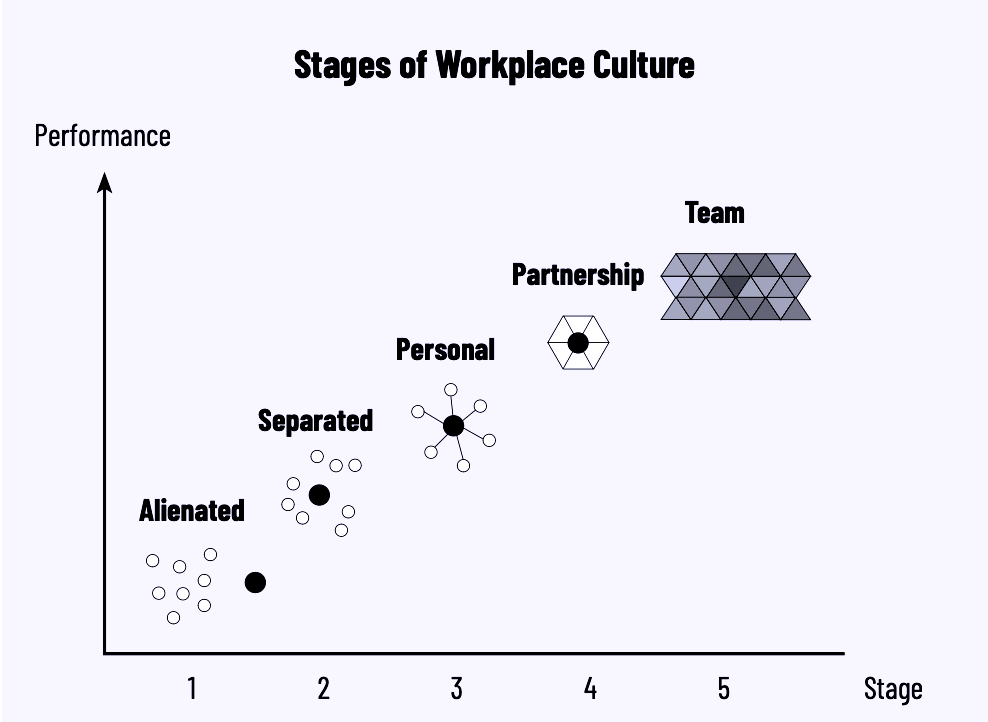
In Tribal Leadership, Dave Logan divides work culture into 5 stages summarized below.
Alienated: the individual feels alone and that “life sucks,”
Separated: the individual doesn’t feel like a part of the team and that “my life sucks,”
Personal: the individual feels personally superior to team members and that “I’m great,” implying the others are not,
Partnership: the individual feels proud to be a part of the team and that “we’re great,” and
Team: the individual feels part of a cause and that “life is great.”
While some argue that this forced rating keeps top performers, survival of the fittest, what it really does is create a highly toxic political environment where employees must constantly jockey for position with the boss. The constant worry about placement is anxiety-inducing and ultimately those who can leave, will do so at the first available opportunity.
Besides layoffs and forced ranking, other things that take a toll on employees’ sense of safety and certainty include restructurings without clear communication, uncertainty around the next round of funding in startup environments, and generally unclear roles and expectations.
Undermine contribution and purpose: by repeatedly not walking the talk, saying one thing and doing another, companies hurt employee engagement. This is characteristic of larger organizations, many of which have indistinguishable, well-polished, consultant-drafted vision and mission statements. Company actions often render the well-intentioned words meaningless, or worse, they work in opposition to these carefully crafted statements. Worse still, and even more sarcasm-inducing, are the barrage of internal communication emails disseminated to spread a rhetoric that is simply not true.
Consider how often in your career you have seen messages claiming we’re “all about quality,” “customer focused,” or “employees are our number 1 asset,” followed by quite the opposite actions. Or how often you have received internal emails that outright insult your intelligence, such as the ones that thank senior leadership for their years of contribution and wish them well as they have decided to resign and go spend more time with their family. Let’s hope someone has warned their family!
If you’re in a leadership position able to decide, ask your internal communication team to take a break and see if anyone misses these messages. You will likely gain time and money to spend on better things.
The point is, trying to portray one set of values, which sound good, while living another, which are genuinely held, is difficult and fosters cynicism. In the long-term, this toxic cynicism makes the work feel worthless and destroys morale. Ultimately, this results in high turnover in an organization.
Crush growth and significance: many companies consistently favor recruiting external candidates before considering promoting from within. This external hero bias weakens engagement. So often, top decision-makers are blinded by shiny-object syndrome: swayed by an impressive former employer’s name or elite school, only to bring on someone who also just puts their pants on one-leg at a time. Or, in the worst case, they bring on a brash, inexperienced outsider who seemed highly charismatic and had that extra dose of leadership mojo during the interview process, but who ultimately causes long-term damage to the organization.
At the core of long-term engagement, which is jargon-intensive, is the simple desire for leaders to have loyalty from their team, right? The thing is that loyalty goes both ways. If an organization is disloyal to its people, it shouldn’t be a surprise when they’re disloyal back.
Miss the boat on connection and belonging: this is the most important and yet the biggest failure of them all that leads to disengagement. As Brené Brown says so beautifully, “We’re hardwired for connection.” Connection is all about the relationship between two people. So, it’s shocking to me that while we’ve come so far in so many areas, manager bashing is still completely acceptable. Just look at your LinkedIn feed and you will notice how much traction posts blaming bad bosses get. Even Gallup has published a book titled It’s the Manager. Of course, they’re spot on regarding the point that the manager has the most impact on an employee’s engagement level. The failure is that it’s NOT the Manager, but the Relationship with the Manager that’s the issue.
To drive home my point, imagine how absurd it would sound if I said that marriages fail because “It’s the Men.” This blame game is not helpful nor accurate. Think about a time when you (or someone you know) were in a relationship that ended, and how you (or they) went on to be in successful relationships with other people, some without changing, much less improving in any way.
The two important points are: 1) it’s all about the manager-employee relationship. And 2) like other relationships, as a leader, your management style resonates with some and not with others. Again, blaming one side, bad manager or bad employee, is not helpful nor accurate.
Now that we’ve talked about what not to do, from layoffs to forced ranking to unnecessary outside hires to blaming the manager, let’s turn to how we set ourselves up for retention in the next post. What are the foundations of our retention strategies? Are we killin’ it?
If you’d like to share your thoughts with me, click below to setup a call.
No posts
Comments
Nothing yet. Say the first thing.
Sign in to join the conversation.