

By now you know the four drivers of engagement: safety & certainty, contribution & purpose, growth & significance and connection & belonging. The good news is that most companies, including yours, already have tools to address three: safety & certainty, contribution & purpose and growth & significance. These tools include your goal setting process, your mission and vision statements, and your annual review process. But the tools are not enough; to implement them effectively we have to understand their value in driving employee engagement.
To improve your team members’ sense of safety & certainty, we have goal-setting processes for tracking milestones and KPIs (Key Performance Indicators) and for creating clear expectations. This sounds so basic, but even very senior people express frustration when what is expected of them is a moving target. When we set clear expectations, not only are we more likely to get what we want, we build credibility on both sides.
Regarding contribution & purpose, while you have a corporate vision & mission statement, as leaders, it’s far more powerful if you can dig deep and uncover the values most important in your area. Perhaps it’s increasing efficiency or building relationships with the best suppliers. Take Philip Morris’s previous values statement, for example, “Defending the right to personal freedom of choice.” Far from glossy words, their stated purpose was authentic to their business ethos.
For growth & significance, there is the annual review process, which is a time to review past performance as well as define a growth path for each person on your team. Of course there is a limit to the growth you can offer, and sometimes, it is hard for managers to see their team members move on. But in the long run, nothing good comes from holding someone back. The need for growth is natural.
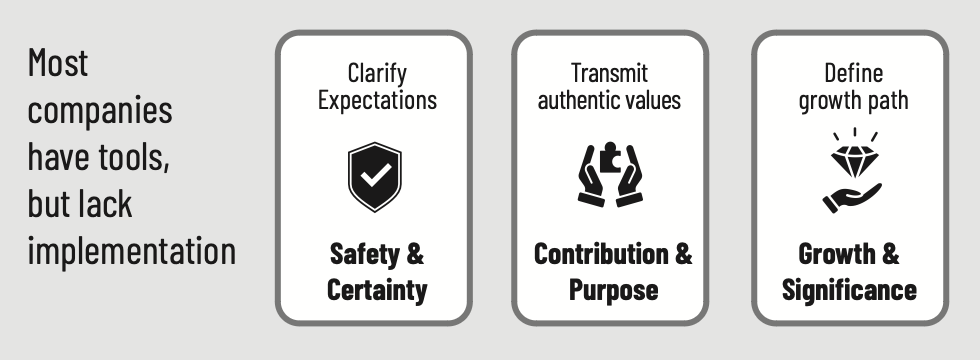
In working with managers, frequently the issue is that there is a gap between having access to well-defined tools and how a team head puts them into practice. Meaning it’s like the differences in fitness results between 1) knowing we should move more, 2) having a gym membership, 3) going regularly, and 4) carrying out a workout routine tailored to our goals. My aim is to show you where the gaps are between knowing what you should do and getting it done and to give you concrete steps to close the gap doing the right things regularly to achieve your goals.
Now, I want to underscore that my aim is not to add hours of things for you to do to engage your team. I hate when I go to an expert such as a fitness coach, just to be overwhelmed by their recommendations. I’m willing to do a lot, but working out (and counting my macros) is not the focus of my life; I can’t (and don’t want to) prioritize fitness at the level my coach does. In that vein, all recommendations here are geared towards delivering managers easily implementable results and prioritizing strategies that are low-hanging fruit. Well, not just any low-hanging fruit, the optimum low-hanging fruit.
You might be familiar with Samin Nosrat’s Salt, Fat, Acid, Heat as the four basic factors that determine how good your food will taste. Yet we know that most people don’t say “I enjoy salt,” “I love fat,” or “I want more acid.” They say things like “I have a sweet tooth,” “I love pastries,” or “I add hot sauce to everything.” Similarly, employees don’t say they prioritize safety, contribution, growth, connection and so on. Most people don’t even know which of the four core values they prioritize. What they’re more likely to say and focus on is how it shows up in the workplace. Meaning, they are likely to voice that they want reasonable job security, a meaningful job, advancement opportunities and a good relationship with their boss.
The table below illustrates the four core needs and some examples of how they show up in the workplace.
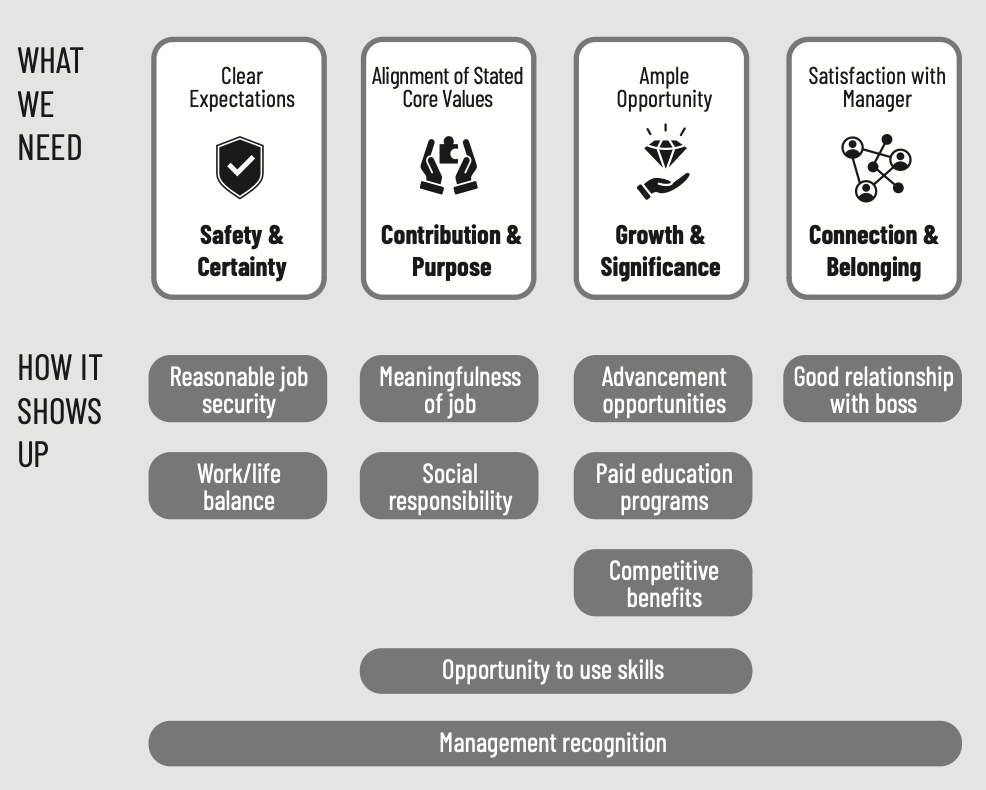
Not only do individuals prioritize these needs differently, but they also vary in cost and ease of delivery for a manager. See the table below which illustrates this for a large corporation.
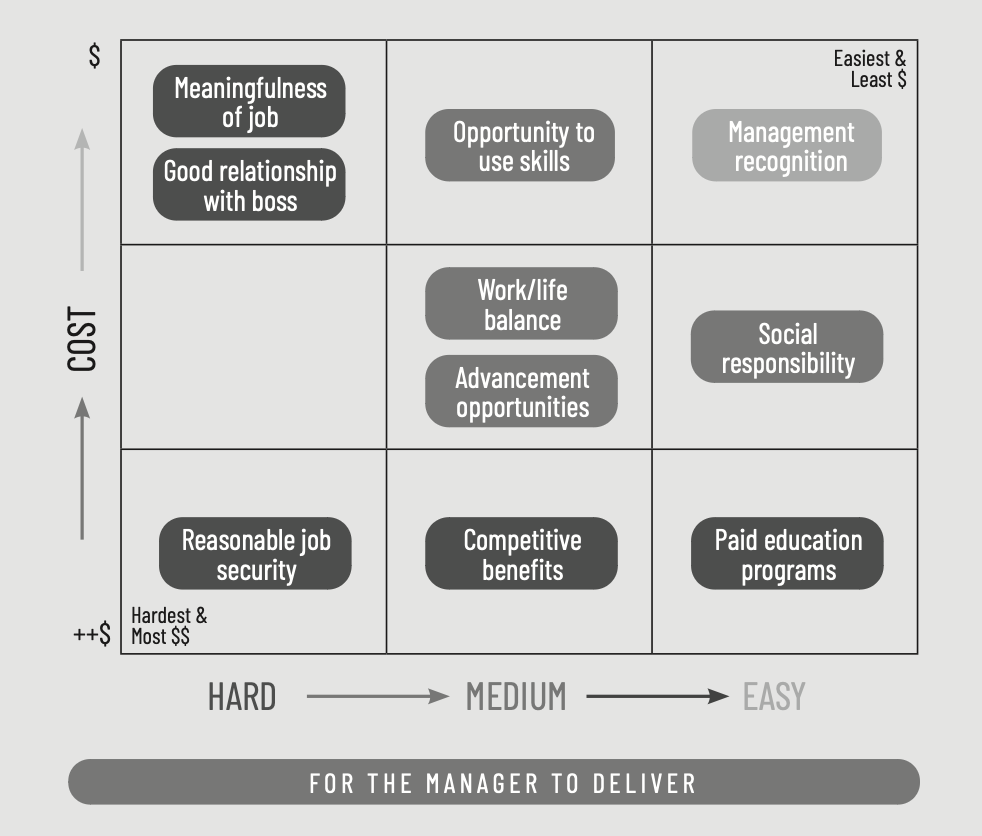
Note the following:
Reasonable job security can be very hard and expensive, frequently not in a manager’s control. Consider for example, when there is uncertainty and cost pressure on an organization from the macro-economic environment.
Delivering meaning is almost impossible. Even though it’s not costly, if employees feel that what they do is meaningless there is almost nothing a manager can do to change this feeling and install a new one.
For a manager, at any level in an organization, delivering management recognition is the easiest and least costly. It requires no additional budget or approval in any organization.
The best thing you can do is actually know what your specific team members value, which we will discuss further in the next chapters. However, understanding this matrix of easy to do and least costly, here are two painless yet powerful recommendations to increase employee engagement. The basis for these best practice recommendations is the vast client data from my company OpenElevator.
Implementing these two recommendations, you can positively impact each person’s sense of safety & certainty, contribution & purpose, growth & significance and connection & belonging. They’re simple; you may find them even too simple. Yet, how often are the simplest solutions the best solutions? The power is in the doing.
Recommendation 1: One-To-One Meetings
When & Who: Schedule recurring meetings with each team member. My team and I like every 6 weeks; 4 weeks can be overwhelming depending on your team size and workload, and 8 weeks might let too much time pass between check-ins to have an impact. Consistency is key.
Why: These meetings increase safety and certainty by giving you an opportunity to proactively address issues before they escalate and manage your and your team member’s expectations. They also reinforce contribution, purpose & significance by creating a space where you can recognize individual performance. And they impact growth by allowing you to uncover and define mid-to-long-term plans and recalibrate for any changes. And these one-to-one meetings help you simply connect.
What: We recommend a three-part agenda for these meetings as detailed below. Certainly, there is nothing magical about a specific question, the point is to help guide a productive conversation and deliver results for you and your team members.
Three-part Meeting Agenda Framework:
Reflect on the recent past since last meeting
How have things gone since our last conversation?
What are the highlights of your month so far?
What could have gone or been better in the last weeks?
Give feedback on where things could have gone or been better.
Acknowledge things that the team member got done and/ or handled particularly well.
Plan for the next weeks
What will make the next month successful for you?
What kind of support do you need?
What would you like to do differently?
Announcements: this can include milestones, anniversaries, job openings, training opportunities & resources, such as local internal workshops, and recommendations for books, podcasts, or even apps you think would be helpful for them to know for their job.
Understand long term alignment (on a biannual basis)
How would you like your position to evolve in the next few years?
What can you do to make that happen?
How do your goals align with department or company goals?
Communicate your vision for your team, where you see alignment, and how you can support their goals, for growth, increased work/life balance, etc.
Recommendation 2: “Connect” Emails
When & Who: Send a regularly recurring “connect” email to your team, cc’ing your direct boss and other key stakeholders for greater impact. We recommend aiming to send about every 6 weeks, as with one-to-one meetings, every 4 weeks can be overwhelming, and every 8 weeks can be too infrequent to have an impact. Our clients find it helpful to use the last message sent as a template in their draft mailbox and update it with highlights more or less weekly. The key again is consistency.
Why: These emails let you share management insights on how your business is evolving, increasing safety. They can be a platform to tie individual members’ work to the big picture, at team-level and/or department-level, and publicly recognize your team members with a broader audience. They can be a great tool to reinforce contribution, purpose & significance. And these emails can help position your team members for future opportunities with key stakeholders, tangibly and positively affecting growth.
What: We recommend a three-part connect email as detailed below. Clearly you might not always have content for a particular section; the outline is only meant to make this easy for you to carry out and benefit from.
Three-part Connect Email Framework:
Employee focused content
Recent wins: acknowledge team members for things they’ve done well recently. For example, a last-minute request someone handled particularly well.
Announcements: this can include milestones (completed or coming up), anniversaries, job openings, training opportunities and resources (such as local internal workshops).
Client focused content
Scope update: give status of existing deliverables, divided by the business area or client you serve, including any product- or process-related changes. Share information on any additions to your scope of responsibilities.
Here you can also recognize team members instrumental in handling stakeholders’ and/or clients’ new topics or changes.
Client perspective: share your experience with or feedback from stakeholders, including internal and/or external clients. This is so meaningful for team members.
Company focused content
Company news: share organizational and operational updates, relevant industry or economic news (for example, an anticipated regulatory change), and upcoming events. Be sure to acknowledge the person on your team responsible for ensuring your offering reflects the newest updates.
Policy or corporate changes: share any changes relevant for your team as long as they don’t cause personal stress. For example, leadership changes, milestones achieved or a new holiday schedule. Things that might cause stress should be communicated in person, such as organizational restructuring that directly impacts team members. Announcing something like this via email is simply bad form.
My first clients were entrepreneurs at startups, open to my equally new and innovative data driven approach. As you can imagine, entrepreneurs, hustling like crazy to build their businesses, have few processes in place. So they were very grateful to have practical tools to engage their teams. What surprised me, and still surprises me at times, is getting that same grateful reaction from clients working in large multinational organizations with thousands of employees. We take for granted that big established organizations have superior processes. But this is simply not the case. Consider the companies you’ve worked for and how different, how well put together, they seemed before you started working there.
Our three-part meeting framework is designed to help clients gain clarity on where individual team members stand, address issues before they spiral, connect with coworkers on a human level, even via video calls. I never get tired of clients consistently and proudly reporting back how sending out the connect emails raised their leadership gravitas in their organization. And this positive impact is felt on both fronts, by their team members and by their senior leaders. Team members appreciate and respect the manager for delivering insights. And they beam with gratitude, yes, beam with gratitude, whenever they’re acknowledged in these emails.
Senior leaders on these emails also praise managers for their leadership, impressed by the message bridging team tasks and projects to the bigger picture. Over time, my clients are promoted and given greater responsibilities.
Managers don’t go to manager school; you learn on the job. Instead of forcing you to figure everything out by trial and error, simple practical tools can really make the difference - whatever your organization’s size. I’ve seen this with clients over and over. It just makes sense that if you implement the two practices above, regularly communicate through one-to-one meetings and the connect emails, you will already be far ahead of most managers. After all, isn’t communication one of the hallmarks of any relationship, be it marriage, friendship, or work?
Want a bigger edge? Read the next post.
If you’d like to discuss how you can easily implement best practice to improve your team engagement and retention, click the button below to setup a call.
No posts
Comments
Nothing yet. Say the first thing.
Sign in to join the conversation.