
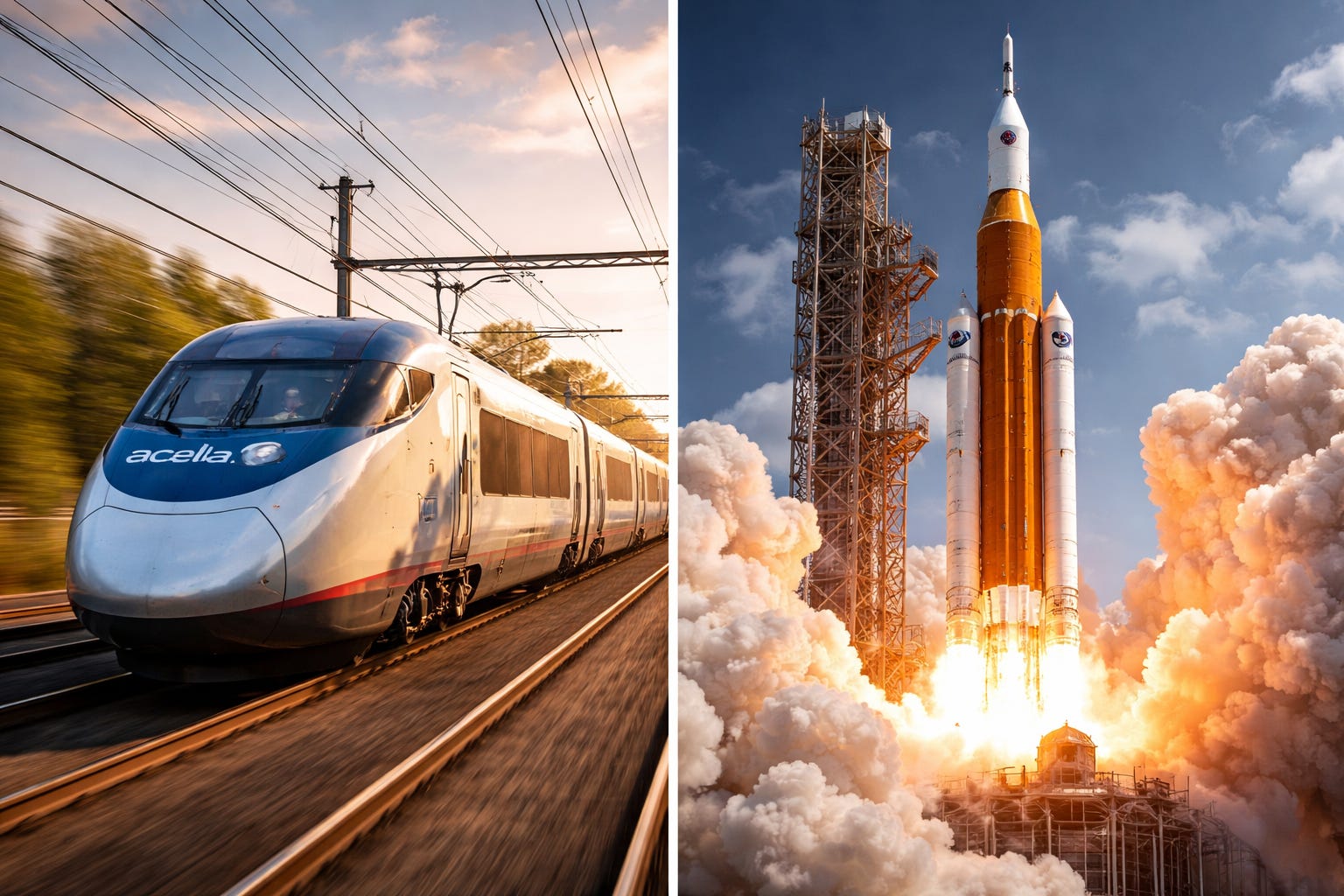
Worried about gusty winds and no-show TSA agents, I took the Acela from Providence to Washington this past week. America’s fastest train. Also—let’s be honest—arguably the world’s slowest fast train.
At moments it moves at a pretty sporty clip. You feel it lean into a curve, stretch its legs, flirt with the idea of Shinkansen velocity, and then it settles back into something more familiar. A drink-spilling crawl down an uneven railbed. It’s reminder that ambition and execution are not the same thing. The latter requires real money, which is in perpetual short supply at Amtrak.
Not to jump too far off the rails, but I see some parallels in NASA’s Artemis program. It’s a powerful idea with a bold name and a promise of speed, progress, and a return to greatness. And yet—if you’ve been watching closely—it feels a lot like the Acela. Big ambition without a realistic, properly funded plan for execution.
I was in Washington to appear on PBS News’ Horizons with William Brangham. Casey Dreier of the Planetary Society and my old friend, former astronaut, Leroy Chiao joined me on the panel. We were there to talk about Artemis II—the mission that is supposed to finally, send humans back to the moon since Apollo 17 in 1972.
Just spend a moment to consider how sad it is that humans have not ventured farther than low earth orbit for nearly 54 years. What a waste of time.
On the program, I found myself saying what I’ve been thinking for a while now: NASA has had “a rough and long road to this moment.” That’s the polite version.
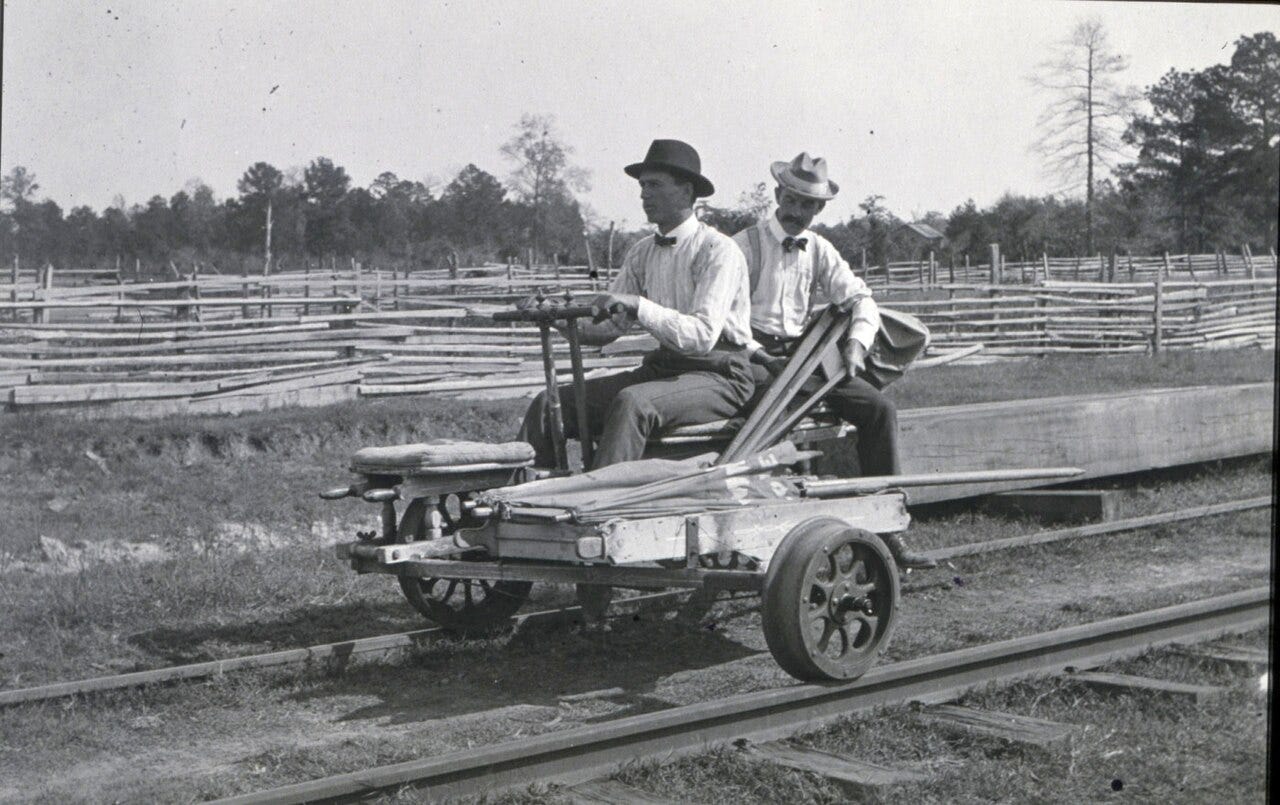
The less polite version is this: we’ve been idling on the platform for decades, announcing departures, changing destinations, swapping locomotives, and occasionally asking passengers to disembark and try the handcar on for size.
To be clear, Artemis II matters. Leroy explained it well: this is a systems check. Life support, communications, navigation—and critically, the Orion heat shield, which didn’t behave as expected last time.
In other words, before we sprint—we need to make sure the train stays on the tracks.
Casey made the broader argument: this is what governments are for. Big, risky, long-term investments that the private sector won’t—or can’t—do alone.
I agree with that. But here’s where the Acela metaphor starts to bite. Because Artemis isn’t just about going fast—it’s about feeling like we’re going fast. The branding, the rhetoric, the urgency—it all suggests momentum. Yet under the hood, the reality is more complicated.
The Space Launch System—the rocket at the heart of Artemis—is immensely powerful. It’s also immensely expensive, designed largely by politicians, and increasingly outpaced by commercial alternatives that iterate faster and cheaper.
It’s a bit like the Acela lumbering through Elizabeth, New Jersey — knowing that somewhere else in the world, there are trains moving twice as fast on tracks built this century.
And then there’s the deeper issue—the one that really keeps this train from ever reaching top speed. Politics. The passenger train lobby cannot match the gusher of campaign funding that the fossil fuel industry pours into Washington ($3-5 million a year versus about $435 million). As a result, good ideas to improve the rail infrastructure in this country are often stillborn.
Money is also time. And as I said on Horizons, space exploration - and infrastructure investmnent - doesn’t fit into two- or four-year election cycles. It requires decades of commitment.
And in space, we keep changing the destination. Moon. Mars. Back to the moon. Maybe Mars again. And for now, it’s to the Moon (Alice)! New administration, new priorities, new plan, new delays.
“If you keep moving the goalposts… you’re going to go nowhere,” said I.
That’s not a technology problem. That’s a governance problem.
Even now, there are warning signs. The Trumpistes unleashed their DOGE-saw on NASA - prompting north of four thousand experienced civil servants to pull the ejection handle—a devastating brain drain that matters enormously in a field where experience is everything.
Congress did something unusual in the case of NASA: it showed up for work and exercised its constitutional authority to dispose what the White House has proposed. The devastating cuts to the science programs at NASA proposed by the Trump White House were reversed. Artemis actually got $10 billion in additional funding
Our political leaders may not understand rocket science, but they do see the geopolitical value in reaching the Moon. They want to beat China, but I don't understand that argument. We won that race in 1969.
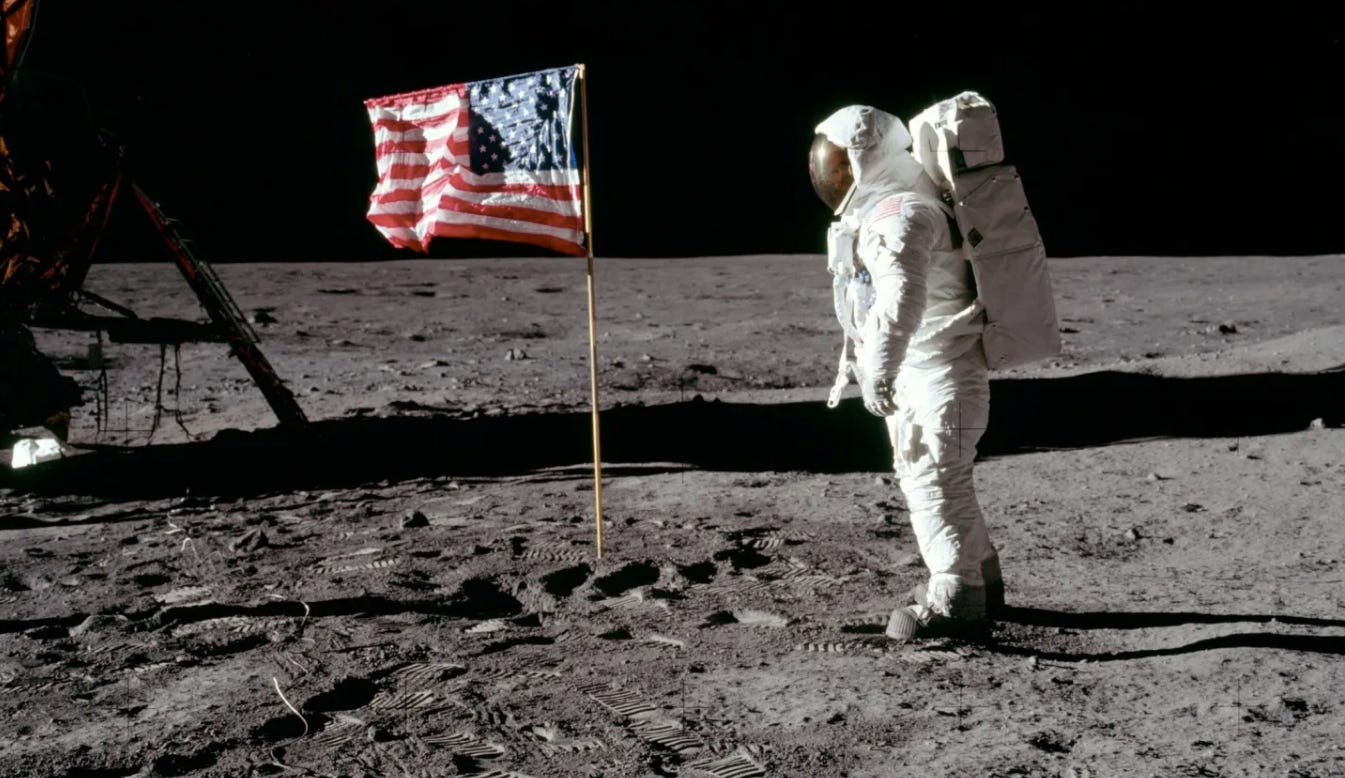
This is why Casey called for urgency—but also restraint. Don’t rush just to land. It's important this time not to simply leave flags and footprints, but rather to stay; to set up camp and see what it's like to live and work on another celestial body.
And that's what brings us to the uncomfortable question: Is Artemis truly a transportation system that is part of an infrastructure of a sustained presence in space? Or is an an gold-plated stunt to give the Trump administration some other kind of distraction from the Epstein files?
The Acela eventually got me to Washington. It (almost) always does - eventually.
But it never quite delivers on the promise embedded in its name.
That’s where NASA finds itself. The vision is still extraordinary. The why still resonates. As I said on the program, exploration inspires, it drives innovation, it reminds us what kind of nation we are.
But inspiration isn’t propulsion.
If Artemis is going to succeed, it has to become more than a series of well-intentioned departures. It has to become a system that endures—across administrations, across technologies, across decades.
Can NASA stay on the right track? If it cannot, we risk repeating something we did nearly sixty years ago. A burst of speed. A sense of arrival. Flags, footprints, and then, a long, slow slide into the annals of space history and nostalgia.
No posts
Comments
Nothing yet. Say the first thing.
Sign in to join the conversation.