

Pennsylvania Gov. Josh Shapiro stood in Harrisburg on Tuesday and told data center developers they would not be allowed to bully their way into Pennsylvania communities. He signed an executive order requiring them to pay for their own power, submit to local approval before the state will even look at their paperwork, and drop the nondisclosure agreements some have used to keep neighbors in the dark. He called the worst of them “predatory” and said Pennsylvania now has the strictest data center rules in the country.
He’s not entirely right about that. Texas Gov. Greg Abbott, a Republican, got there first and arguably went further.
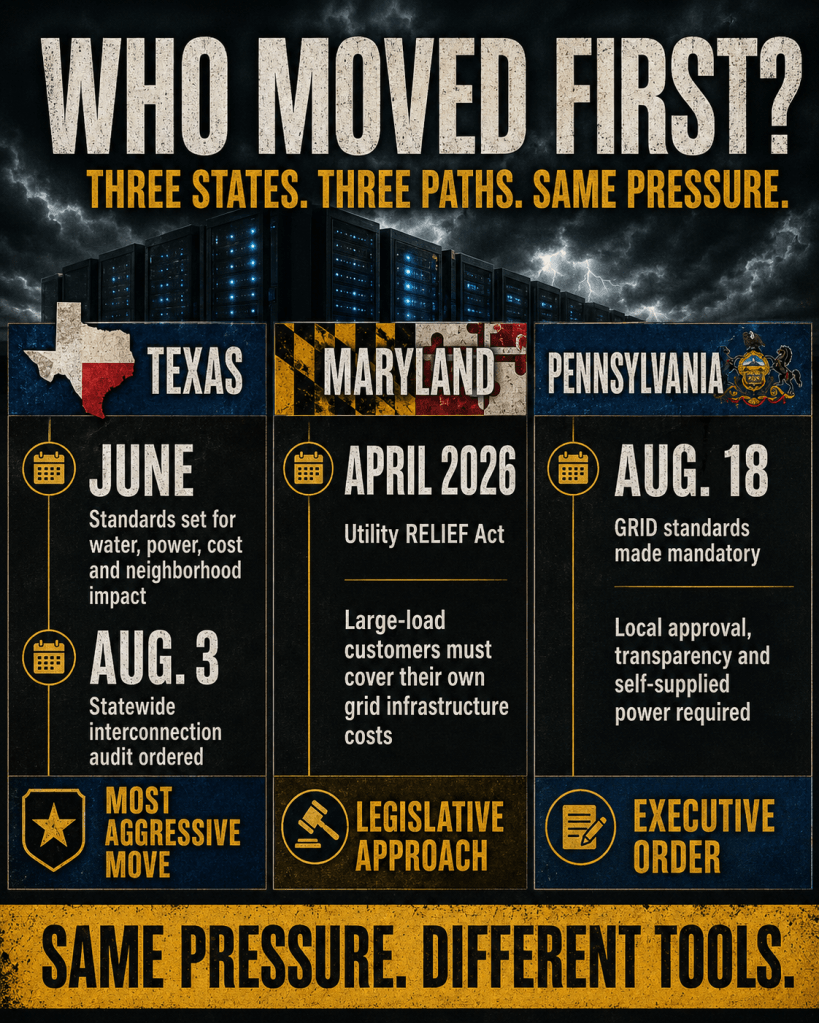
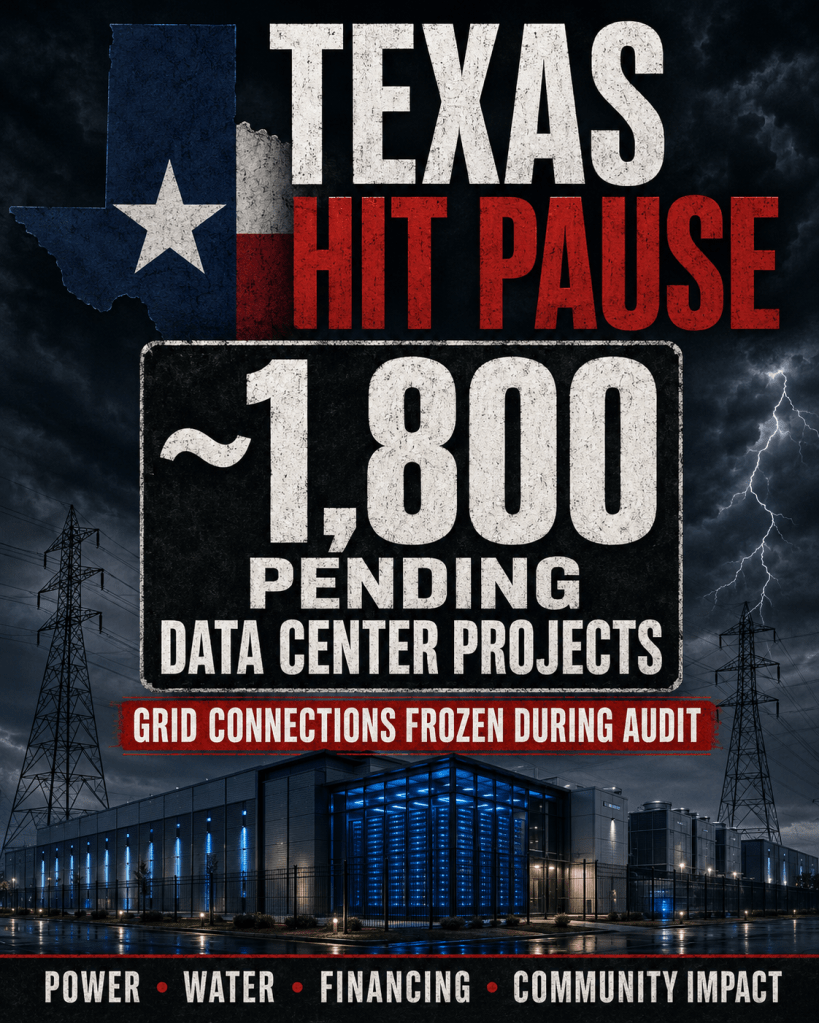
On Aug. 3, Abbott directed Texas regulators to freeze new grid connections for data centers until an audit is complete, building on guardrails he’d already established in June requiring developers to prove they aren’t straining local water supplies, taking power the grid needs elsewhere, raising electricity costs or disrupting neighborhoods. The Electric Reliability Council of Texas told reporters the directive “effectively pauses” roughly 1,800 pending data center projects statewide, more than any single action either Democratic governor has taken.
Three governors, three states, three different party labels, and within the span of about six weeks, all of them arrived at nearly the same conclusion: developers don’t get to write their own rules anymore. That convergence is worth sitting with, because it undercuts the easy version of this story where data center pushback is just another front in a partisan fight. It isn’t. It’s a bipartisan reaction to the same set of problems, arriving in different states on different timelines, and Maryland’s version of it has moved noticeably slower than the other two.
“Three governors, three states, three different party labels, and within the span of about six weeks, all of them arrived at nearly the same conclusion: developers don’t get to write their own rules anymore.”
Texas: Abbott’s June directive set four standards data centers must meet: they cannot take water or power that local communities and the grid need, they must help lower electricity costs rather than raise them, and they cannot disrupt neighborhoods. His Aug. 3 follow-up turned that into an enforcement mechanism, ordering the Public Utility Commission of Texas and ERCOT to audit every project in the interconnection queue, covering financing, water and power sourcing, and community impact, before any of them can move forward. ERCOT immediately postponed its Batch Zero transmission study to comply. Several major developers, including Core Scientific, Vantage Data Centers and QTS, have since announced they’ll comply with the standards.
Pennsylvania: Shapiro’s Aug. 18 executive order made his previously voluntary GRID standards legally binding, requiring developers to bring their own power, secure local approval first, submit to strict transparency rules and give up fast-track permitting eligibility. He acted unilaterally after, in his telling, Senate Republicans refused to bring his standards up for a vote. Shapiro said more than 100 data center proposals are under discussion in Pennsylvania, though only five projects statewide currently hold the permits needed to begin operating.
Maryland: Gov. Wes Moore has landed on a similar message: that developers should pay their own way and stop dictating terms, but through a slower legislative path. He initially vetoed a 2025 bill that would have funded a state study of data centers’ grid, water, and economic impact, and the General Assembly had to override that veto before the study moved forward. By April 2026, Moore was fully behind the Utility RELIEF Act, which requires large-load customers like data centers to cover their own grid infrastructure costs. But unlike Abbott or Shapiro, Moore has not used his own executive authority to impose anything close to a statewide pause or audit.
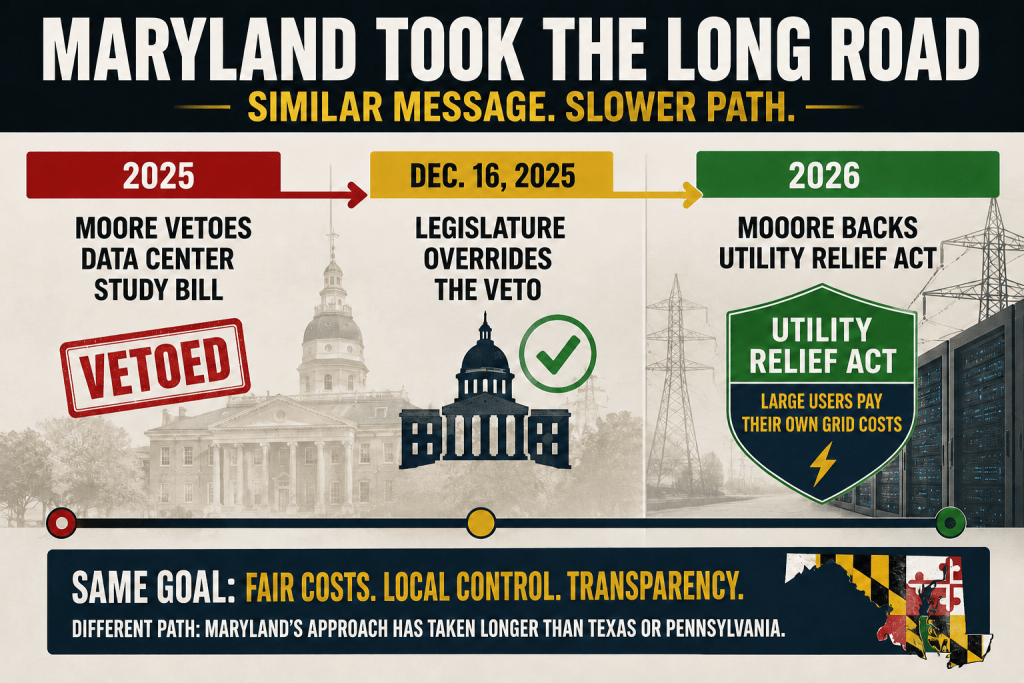
“Unlike Abbott or Shapiro, Moore has not used his own executive authority to impose anything close to a statewide pause or audit.”
None of this is happening in a vacuum. Abbott is running for reelection this fall against Democratic state Rep. Gina Hinojosa, and a University of Texas/Texas Politics Project poll from June found 56% of Texas voters oppose data center construction in their own communities. Shapiro is up for reelection too, and is frequently mentioned as a potential 2028 presidential contender facing a Republican challenger who has called for an outright pause. Moore is seeking a second term this November in a state where county-level revolts against data centers have already toppled multiple sitting officials.
“The politicians responding to those concerns are doing so with one eye on the calendar.”
Whatever the substance of these policies, the timing lines up with the same electoral pressure in three different states. That doesn’t make the concerns residents have raised, about water usage, grid strain and diesel generators, any less real. It just means the politicians responding to those concerns are doing so with one eye on the calendar.
It’s worth being precise about what these announcements are not. None of the three governors has imposed an outright ban on data center construction. Abbott’s audit is a pause on new grid connections, not existing projects, and Texas officials have not said how long it will last. Shapiro’s order explicitly stops short of a moratorium. Maryland’s Utility RELIEF Act is a cost-allocation and transparency law, not a construction freeze.
“None of the three governors has imposed an outright ban on data center construction.”
The actual moratoriums, the closest thing to real construction bans, have come from local governments, not governors. Calvert County’s commissioners passed a six-month freeze on new applications the same day Shapiro signed his order. Frederick County Executive Jessica Fitzwater signed her own pause on new data center permitting through the end of the year, effective July 1. Worcester County has had a 12-month moratorium in place since late July. Maryland Matters reported this month that 13 of Maryland’s counties have now enacted some form of data center moratorium, and Harford County has gone further, banning the facilities outright. None of it was ordered from Annapolis.
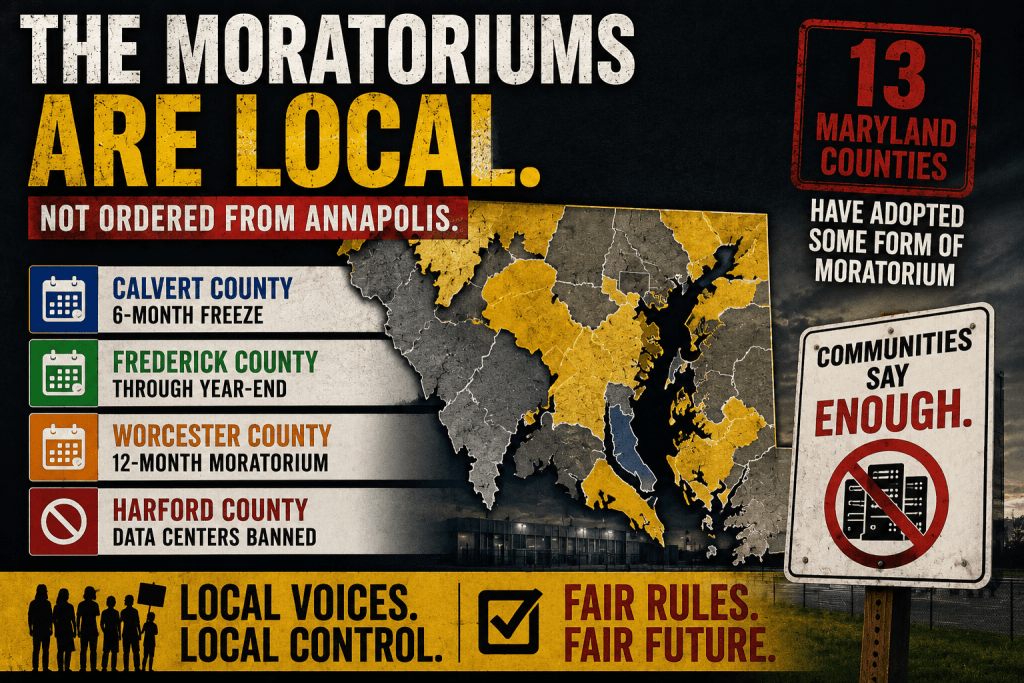
“The actual moratoriums, the closest thing to real construction bans, have come from local governments, not governors.”
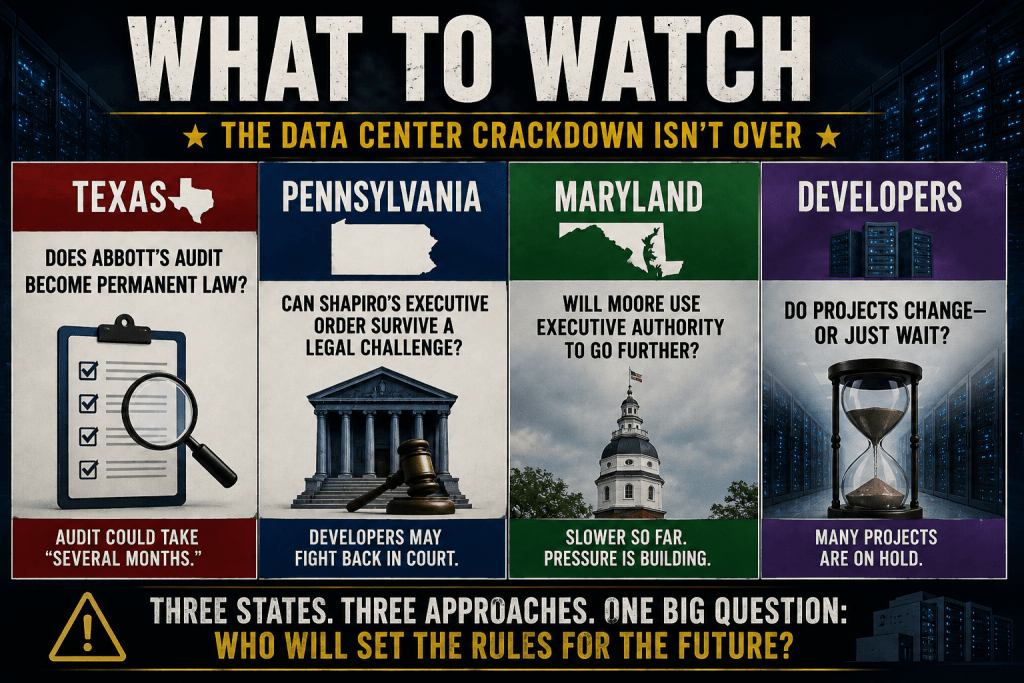
Whether Abbott’s audit, which Texas officials say could take “several months,” produces real standards or just delays projects until after his November reelection.
Whether energy consultant Beth Garza, a former independent watchdog for Texas grid operators who has questioned the legal enforceability of Abbott’s directive since Texas has no statute backing it, turns out to be right, and whether Abbott ends up calling a special legislative session to codify it.
Whether Shapiro’s order survives a legal challenge from developers who argue GRID standards were never passed into law.
Whether Moore, facing his own reelection this year, follows Abbott and Shapiro toward unilateral executive action rather than continuing to rely on the General Assembly.
Sources: Governor Greg Abbott’s June 10 and Aug. 3, 2026, directives and public statements, Office of the Texas Governor; Texas Tribune, Houston Public Media, Utility Dive and E&E News/POLITICO reporting on the Texas data center audit, Aug. 3-14, 2026; NPR reporting on the political context of Abbott’s directive, Aug. 10, 2026; University of Texas/Texas Politics Project poll, June 2026, as cited by Reason; Governor Josh Shapiro’s remarks at the Aug. 18, 2026, executive order signing ceremony and Executive Order 2026-05, Commonwealth of Pennsylvania; NBC10 Philadelphia and WHYY reporting on the Pennsylvania order, Aug. 18-19, 2026; Governor Wes Moore’s remarks on the Utility RELIEF Act, as reported by Capital News Service and Maryland Matters, April 2026; Maryland General Assembly override of HB 270 veto, reported by The BayNet and Technical.ly, Dec. 16, 2025; Calvert County Government press release and Fox 5 DC, Aug. 18, 2026; Maryland Matters’ Aug. 10, 2026, county-by-county roundup of data center moratoriums; WGMD and 47ABC/WMDT reporting on Worcester County’s Resolution No. 26-18, July 21, 2026.
Comments
Nothing yet. Say the first thing.
Sign in to join the conversation.