
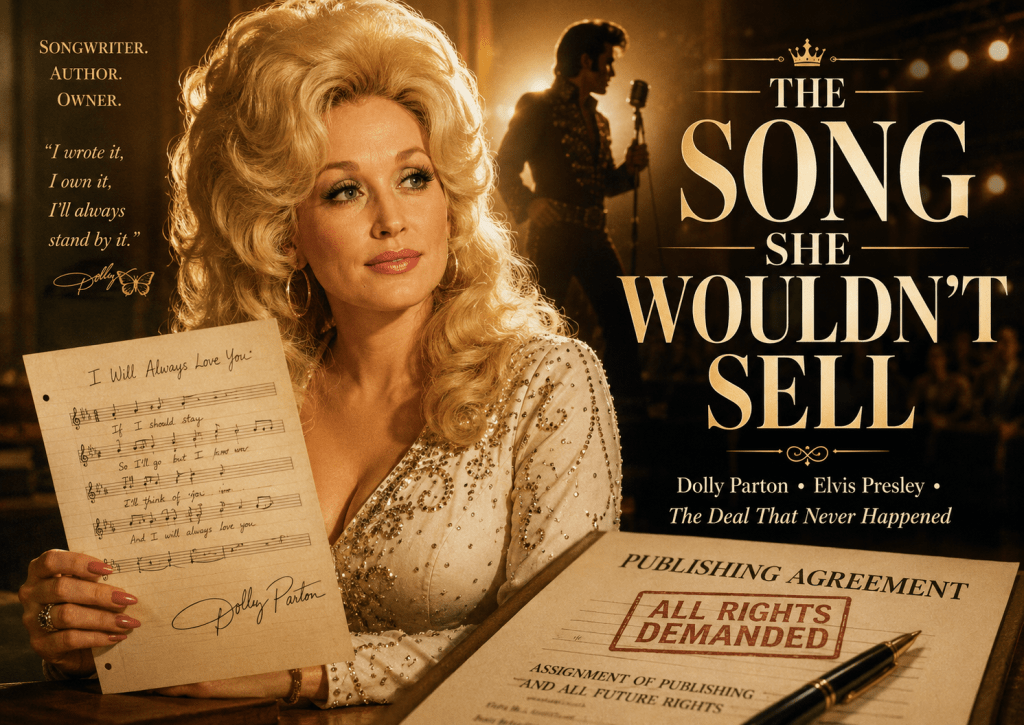
Dolly Parton died today at 80. Most of what’s being written right now is about her music, her warmth, her decades as one of the few universally liked figures in American public life. Fair enough. But there’s a story in her catalog that belongs here more than in a tribute piece, because it’s actually about leverage, and about a young woman refusing to hand it over to a much more powerful man.
In 1973, Parton wrote “I Will Always Love You” and had it out as a number one country single by 1974. Elvis Presley heard it and wanted to record his own version. This was Elvis at the height of his cultural weight, and Parton has said she was thrilled at the idea, excited enough that a session was arranged and she planned to be there for it.
The night before the recording, Presley’s longtime manager, Colonel Tom Parker, called her. Parker told her that Elvis didn’t record material unless his side owned at least half the publishing rights. It wasn’t a negotiation. It was presented as the rule, the cost of doing business with the King.
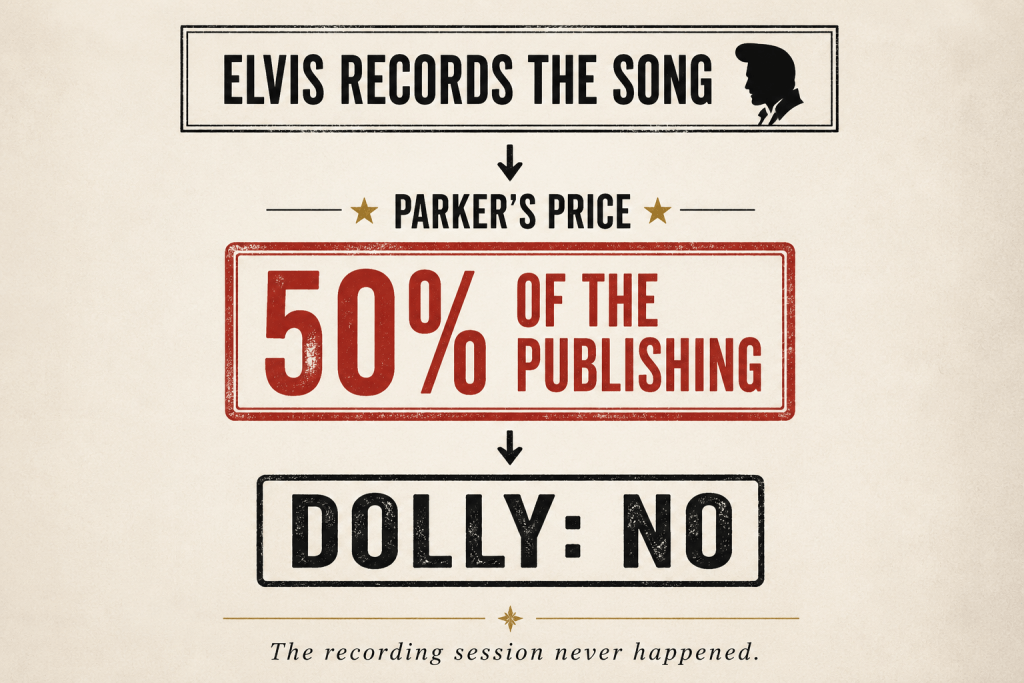
Parton said no.
Her stated reasoning was direct: she’d already had a number one hit with the song under her own publishing, and she wasn’t giving up half of something that valuable, even for Elvis Presley. Parker’s response was that Elvis wouldn’t record it without the deal, so the session never happened. Parton has said she cried that night. She’s talked about it in multiple interviews over the years, including to BBC Radio and to CMT, and the account has stayed consistent: she wanted Elvis to sing it, she said no anyway, and it cost her something in the moment to do it.
What’s worth sitting with here isn’t the sentimentality of missing out on an Elvis cover. It’s the position she was in. She was a rising country artist. He was arguably the biggest recording star in the world, represented by a manager known for extracting exactly this kind of deal from artists who wanted access to Presley’s audience. The easy move, the move most people in her position would have made, was to take the exposure and give up the percentage. She didn’t.
“The easy move was to take the exposure and give up the percentage. She didn’t.”
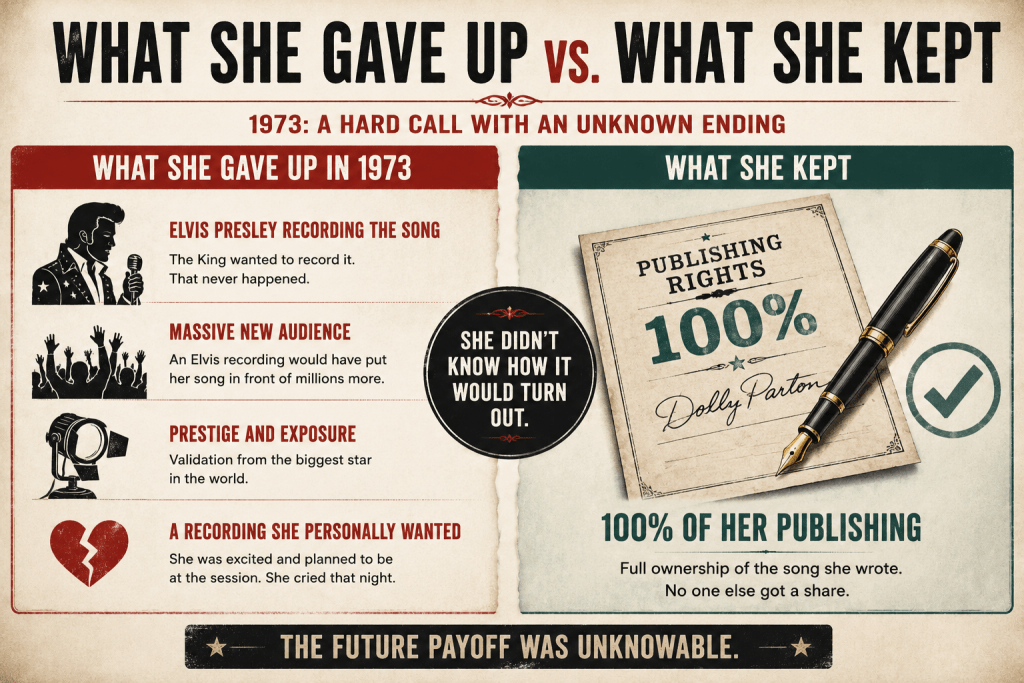
“Parton owned all of the publishing.”
Nineteen years later, in 1992, Whitney Houston recorded “I Will Always Love You” for The Bodyguard. It became one of the best-selling singles in recorded music history. Parton owned all of the publishing. None of it had to be split with a manager who’d tried to take half of it off a phone call the night before a session that never happened.
“She wasn’t betting on a future payout. She was making a call about what she thought the song was worth right then.”
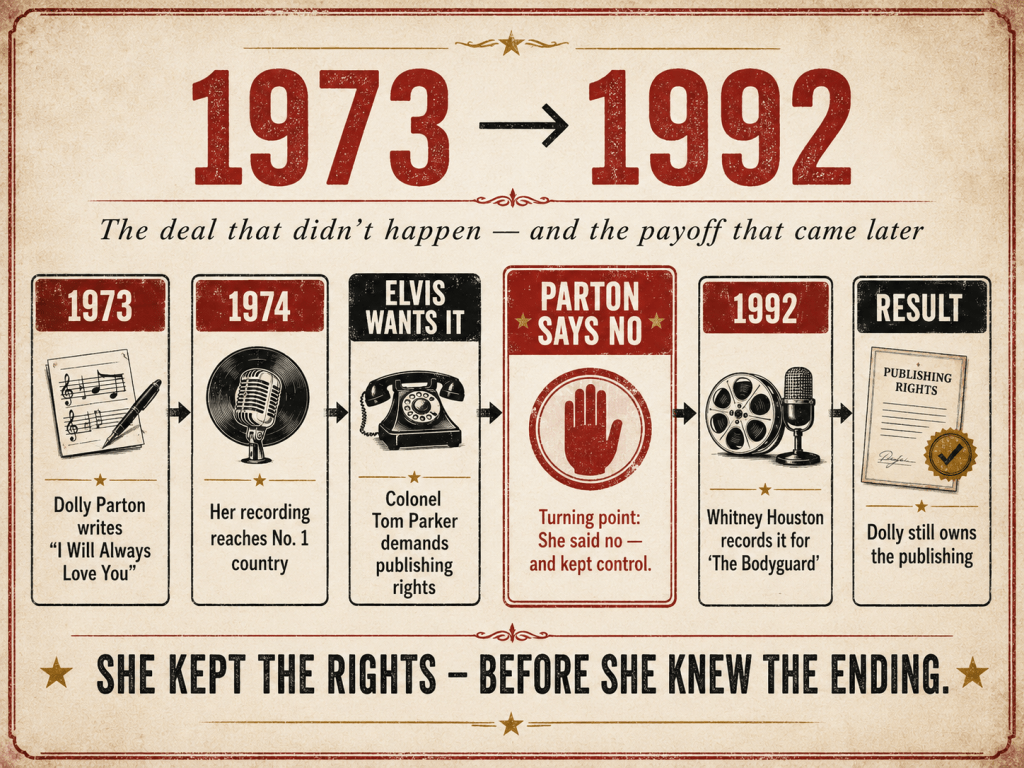
That outcome gets told as a nice irony, a “guess it worked out” anecdote. It’s worth being less cute about it than that. Parton had no way of knowing in 1973 that Whitney Houston would exist as a commercial force two decades later, or that a Kevin Costner movie would turn her song into a cultural fixture. She wasn’t betting on a future payout. She was making a call about what she thought the song was worth right then, against pressure from someone with vastly more leverage than she had, and she held the line without knowing whether it would ever pay off at all.
“Most people who refuse a bad deal from someone more powerful than them don’t get a Whitney Houston movie moment nineteen years later to justify it.”
That’s a story about what it costs to say no to power when you can’t see the ending yet, and about how rarely that instinct gets rewarded on any visible timeline. Most people who refuse a bad deal from someone more powerful than them don’t get a Whitney Houston movie moment nineteen years later to justify it. They just have to live with having said no.
Sourcing note: details on Parton’s death come from reporting by TODAY, ABC News and Variety, published August 25, 2026. The account of the Elvis Presley recording session and Colonel Tom Parker’s publishing demand is drawn from Parton’s own retellings over the years, including interviews with BBC Radio, CMT and a 2020 cover story in W magazine, in which the details of the phone call and her reasoning stayed consistent. The commercial performance of Whitney Houston’s 1992 cover for The Bodyguard is well documented and not in dispute.
Comments
Nothing yet. Say the first thing.
Sign in to join the conversation.