

For years, Americans were told to worry about Wall Street, Big Oil, and pharmaceutical companies buying influence in Washington.
In 2026, there is a new group writing very large checks.
Crypto companies, artificial-intelligence interests and online betting firms are pouring hundreds of millions of dollars into congressional races, rapidly becoming some of the most powerful players in American politics.
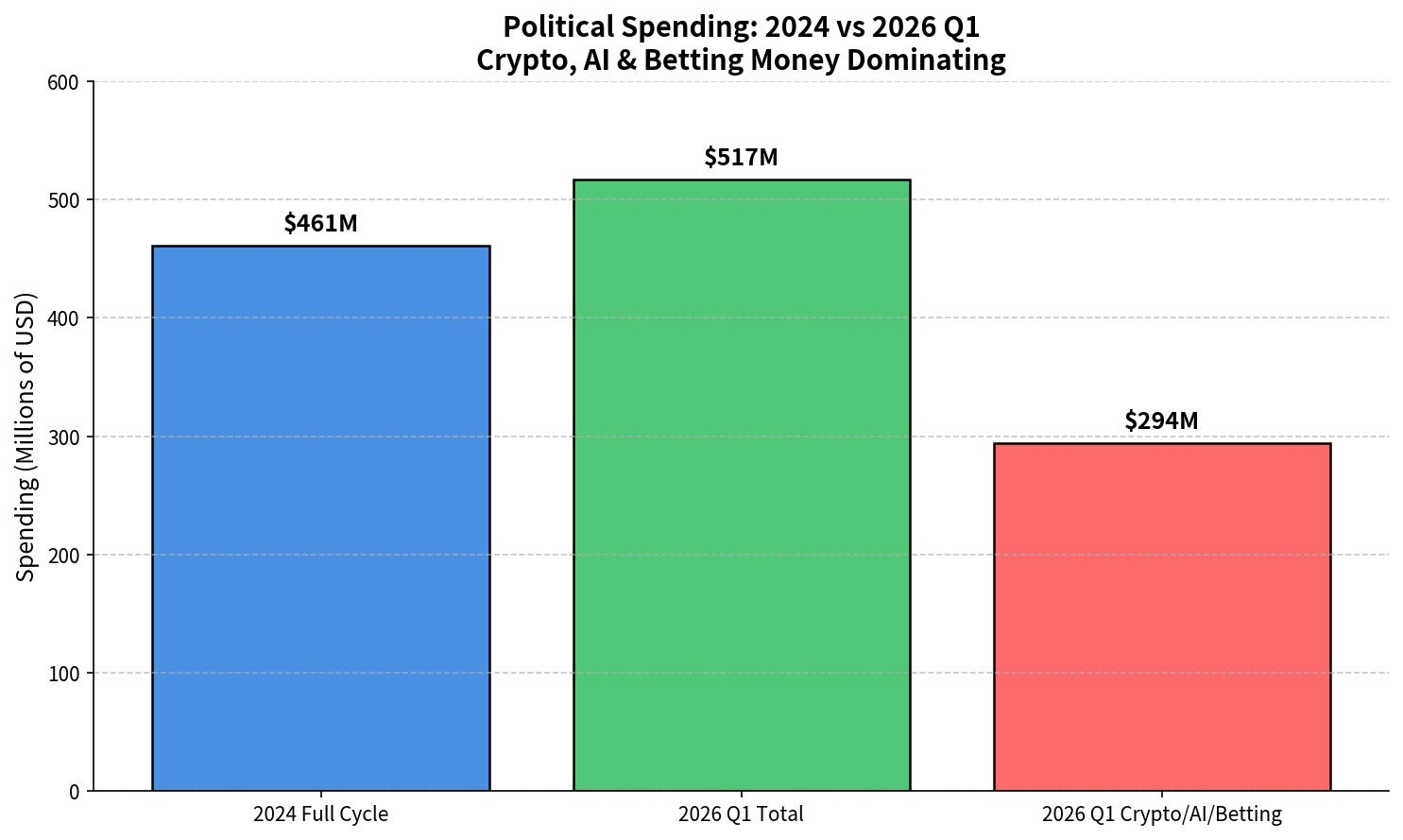
According to Public Citizen figures cited by Reuters, U.S. companies had already spent about $517 million on House and Senate races through the first quarter of 2026, surpassing the roughly $461 million spent during the entire 2024 election cycle.
Crypto, AI and online gaming interests reportedly accounted for at least $294 million of that spending.
That should get everyone’s attention.
The rise of these political war chests shouldn’t be surprising.
When Washington gains enormous power to decide which technologies can operate, how businesses can compete, and which industries will survive regulation, companies have an enormous incentive to influence the people writing those rules.
Crypto has learned that lesson particularly well.
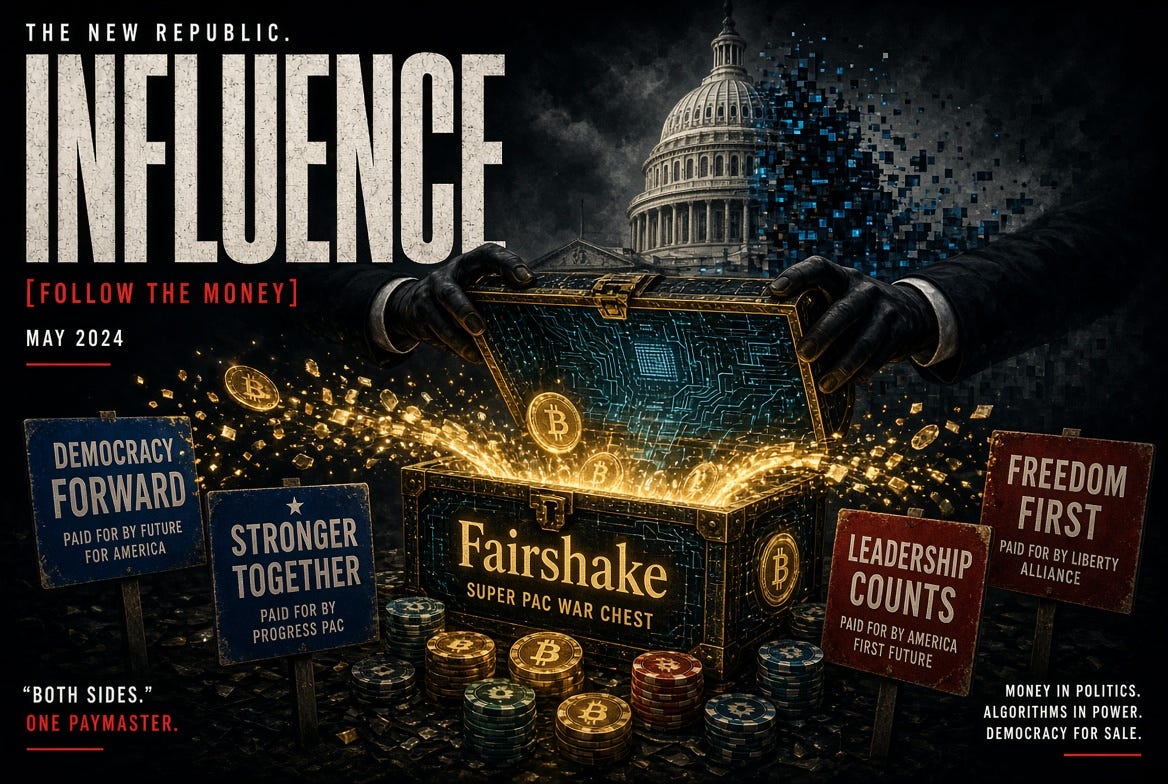
The industry-backed super PAC Fairshake, supported by companies including Coinbase, Ripple and Andreessen Horowitz, entered the cycle with a massive war chest and has demonstrated that it is willing to support friendly candidates — and spend against politicians viewed as hostile to the industry.
Artificial intelligence companies are following the same path as Washington debates how aggressively AI should be regulated.
Online gambling interests are doing it too.
This isn’t simply a story about billionaires suddenly becoming interested in civic participation.
It is a story about industries realizing that political power can determine their future.
Republicans shouldn’t assume this money automatically belongs to the Right.
Much of it doesn’t.
These groups are increasingly willing to support candidates from either party depending on who agrees with their regulatory priorities.
That means the real dividing line may increasingly be less Republican versus Democrat and more regulator versus industry.
Candidates who promise favorable rules can suddenly find themselves backed by enormous outside spending operations.
Candidates who threaten those industries may discover millions of dollars arriving on the other side.
That is a remarkable amount of political leverage.

There is an important conservative argument here that goes beyond campaign-finance outrage.
The bigger government becomes, the more valuable political influence becomes.
If Washington can decide whether an emerging industry thrives or dies, companies will naturally spend fortunes trying to control Washington.
The answer isn’t simply demanding that the “wrong” billionaires stop spending while applauding the billionaires on your side.
It is reducing the government’s ability to pick winners and losers in the first place.
Americans should know who is financing the campaigns competing for their votes.
Because in 2026, some of the biggest political kingmakers may not be the industries we’ve spent decades watching.
They may be the industries building the future — and spending heavily to make sure Washington builds it their way.
Reporting and figures in this article are drawn primarily from Reuters’ Aug. 20, 2026 report, “The new kingmakers: Crypto, AI and betting firms fuel record spending on the 2026 midterms,” which examined the growing influence of technology, cryptocurrency and online-betting interests in federal elections. The underlying corporate-spending totals come from a June 2026 Public Citizen analysis of Federal Election Commission and OpenSecrets data, which found that corporations had contributed $517 million to influence the 2026 midterms, including $294 million from cryptocurrency, AI/Big Tech and online-betting companies, already surpassing the previous $461 million record set during the entire 2024 cycle. Public Citizen reported that crypto companies alone accounted for about $189 million, while AI/Big Tech companies contributed roughly $60 million and online-betting companies about $45.6 million.
Comments
Nothing yet. Say the first thing.
Sign in to join the conversation.