Michael Phillips · Michael Phillips | Riptide / MDBayNews
The Maryland Racing Commission held its monthly meeting on Wednesday, August 12. It was the first official gathering of Maryland’s racing regulatory body since the CDI/NYRA championship series excluded the Preakness, and Governor Moore held his press conference announcing the new Sunday date and NBC deal.
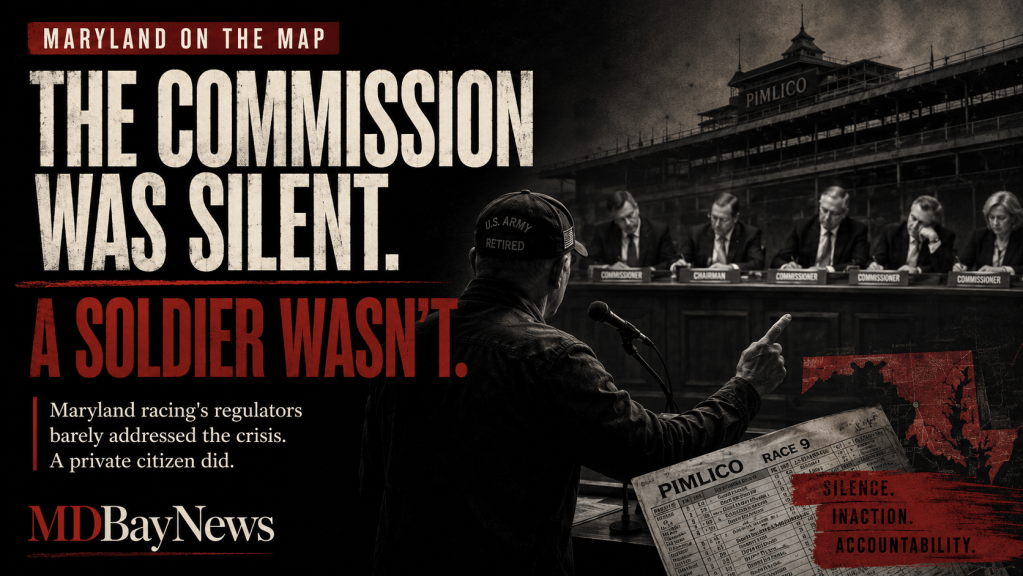
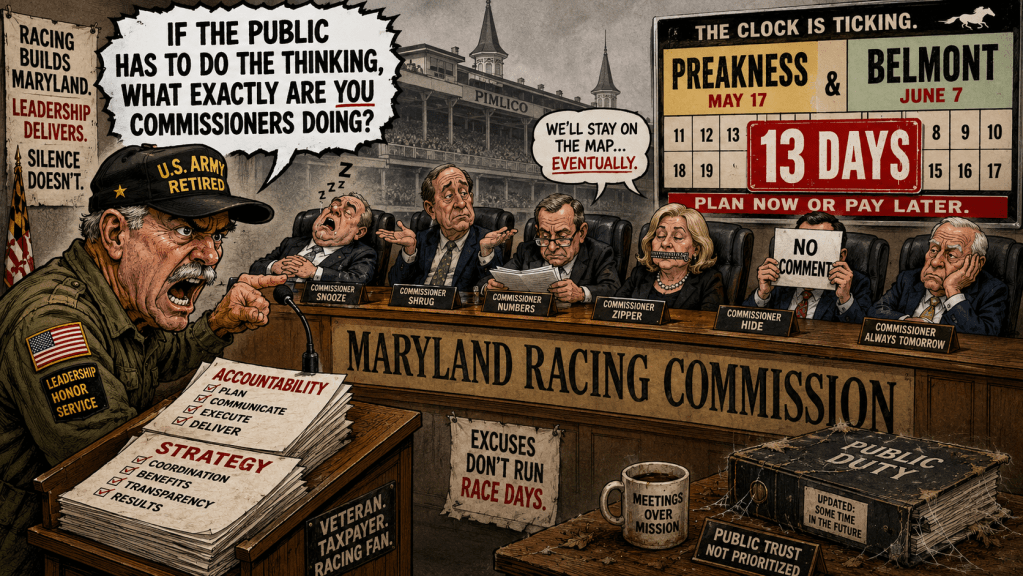
The commission largely said nothing.
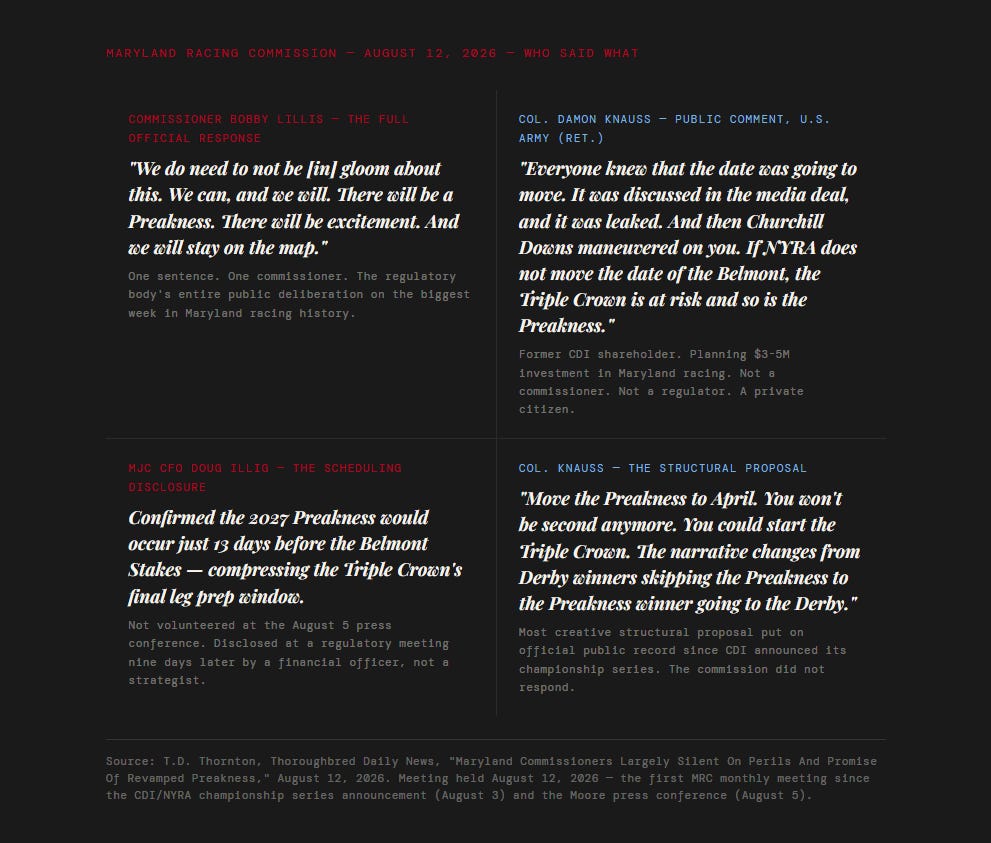
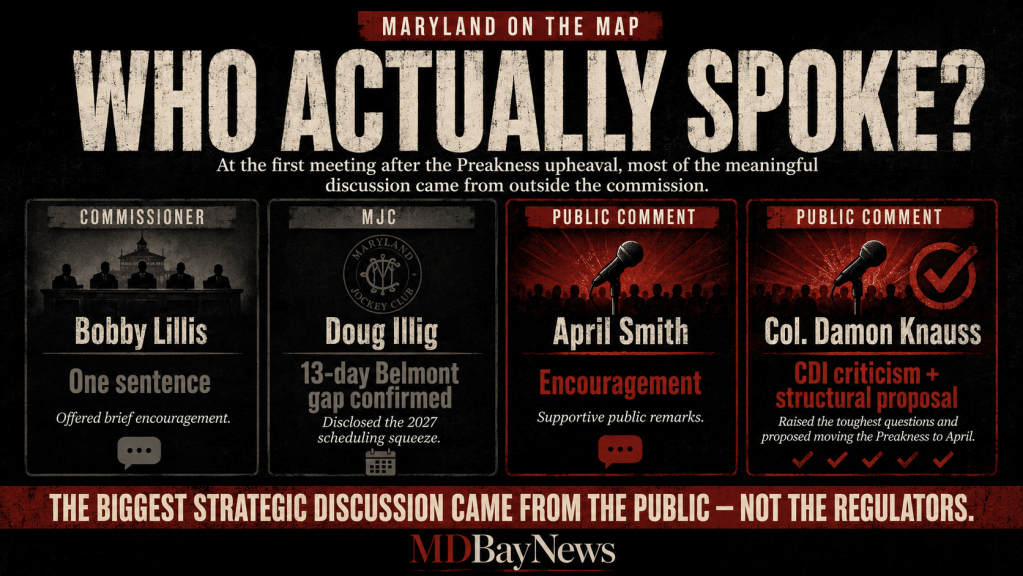
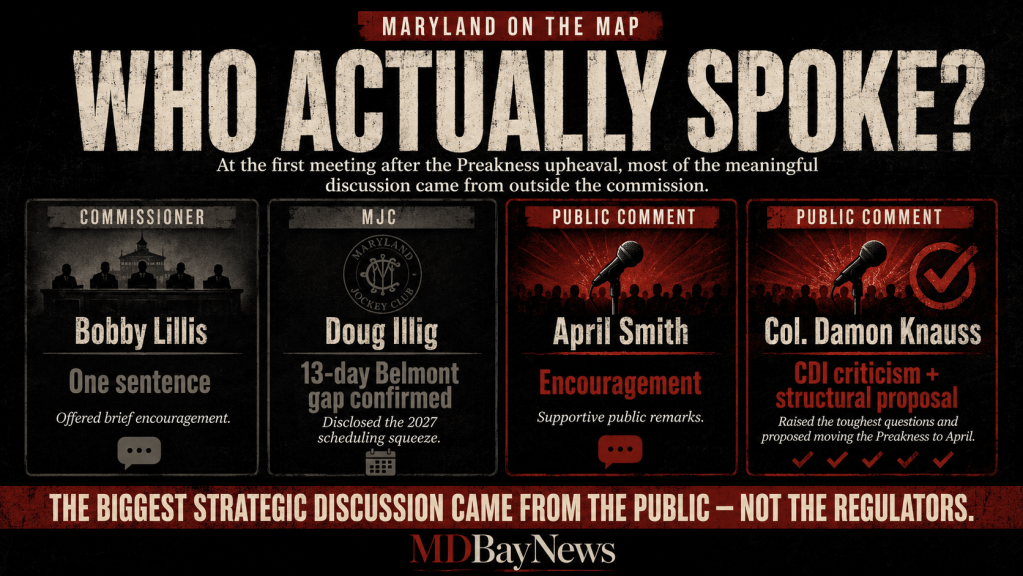
Aside from a summary of recent Preakness transactions during the Maryland Jockey Club’s report, one commissioner offered one sentence. “We do need to not be [in] gloom about this,” said Commissioner Bobby Lillis. “We can, and we will. There will be a Preakness. There will be excitement. And we will stay on the map.”
That was it. No deliberation on the Sunday betting handle problem. No discussion of the 13-day Belmont prep window. No strategic response to CDI’s championship series. No accountability questions from the board. The regulatory body responsible for overseeing Maryland horse racing spent its August meeting on other business.
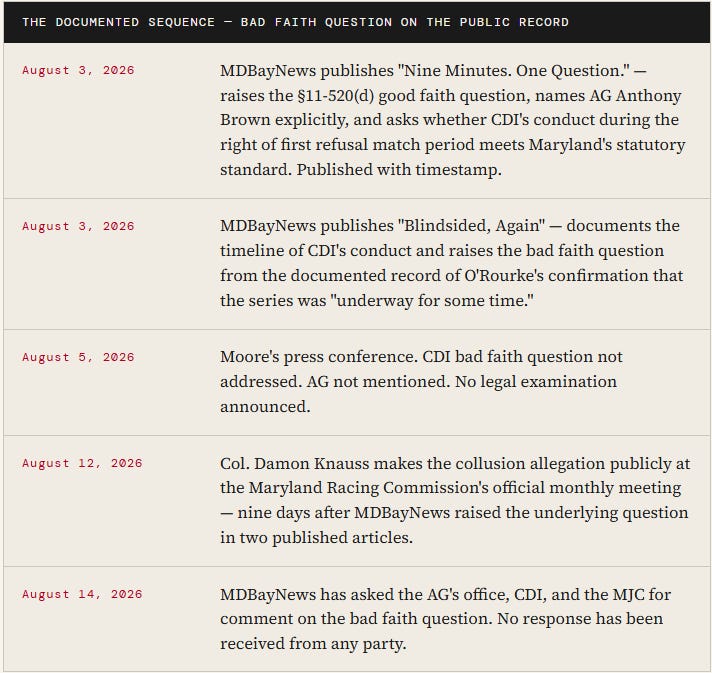
The silence mirrors and validates everything this series has documented since August 3. Maryland’s institutional response to a strategic crisis has been, at every level, to manage announcements and leave the hard questions to others.
Maryland’s institutional response to a strategic crisis has been, at every level, to manage announcements and leave the hard questions to others.”
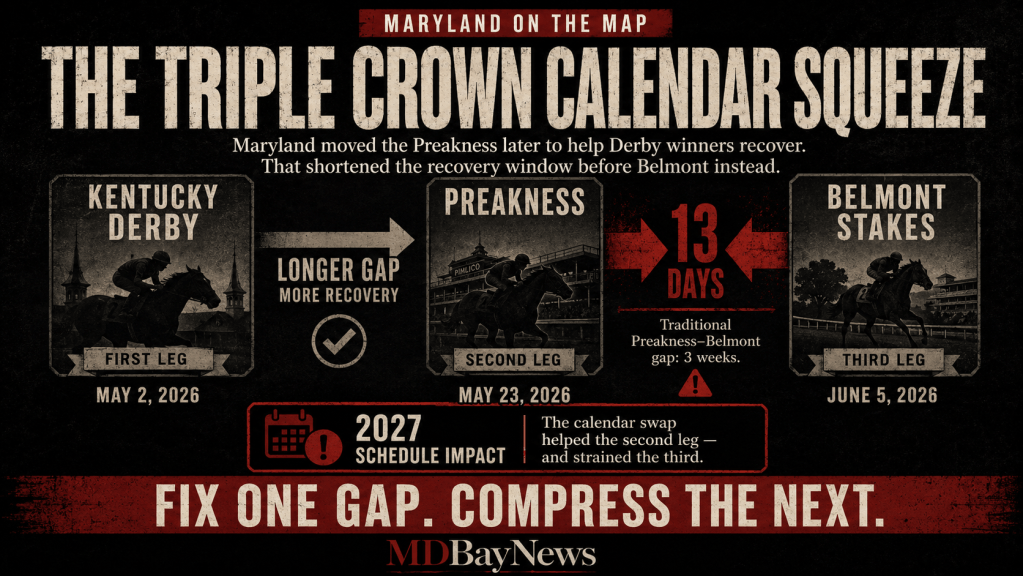
The one substantive scheduling detail that emerged at the meeting came not from a commissioner but from the MJC’s own chief financial officer. Doug Illig confirmed that the NBC deal puts the Preakness on Memorial Day Sunday in every year from 2028 to 2031 — and that the 2027 edition would occur just 13 days before the Belmont Stakes.
Thirteen days. The traditional gap between Preakness and Belmont was three weeks. Maryland moved the Preakness back one week to give Derby winners more recovery time before the second leg. In doing so, it compressed the recovery time before the third leg instead. The calendar swap that was supposed to help the Triple Crown may be straining it at a different seam.
This was not addressed at the August 5 press conference. It was confirmed, matter-of-factly, by the MJC’s own CFO at a regulatory meeting nine days later. This publication documented the calendar swap problem in the “What Maryland Didn’t Consider” piece on August 9. The MJC’s CFO confirmed it on August 12.
Two members of the public offered comments at the meeting. The first, April Smith of Friends of Pimlico, offered encouragement. The second was more pointed.
Colonel Damon Knauss identified himself as a 47-year-old retired Army officer and professor of military science who recently relocated to Maryland from Kentucky. He told the commission he had been a large owner of Churchill Downs stock.
Col. Damon Knauss — public comment, Maryland Racing Commission, August 12, 2026“Not anymore, after the antics that happened last week. My wife and I are going to make a significant investment in breeding and racing in Maryland as I retire from service and go into my second career.” U.S. Army Colonel (ret.) · Professor of Military Science · Former large CDI shareholder · Planning $3-5M Maryland racing investment
He told the commission he believes the under-construction Pimlico has the potential to be “the best track in the country” and applauds state officials for securing the Preakness IP. Then he said what the commission itself would not.
“Everyone knew that the date was going to move. It was discussed in the media deal, and it was leaked. And then Churchill Downs maneuvered on you.”
“Everyone knew that the date was going to move. It was discussed in the media deal, and it was leaked. And then Churchill Downs maneuvered on you.”
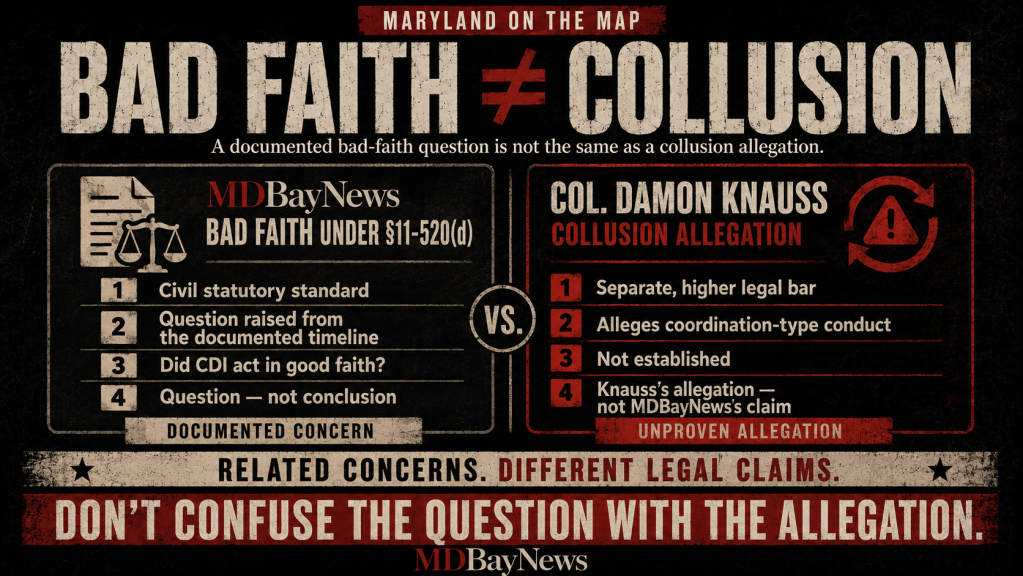
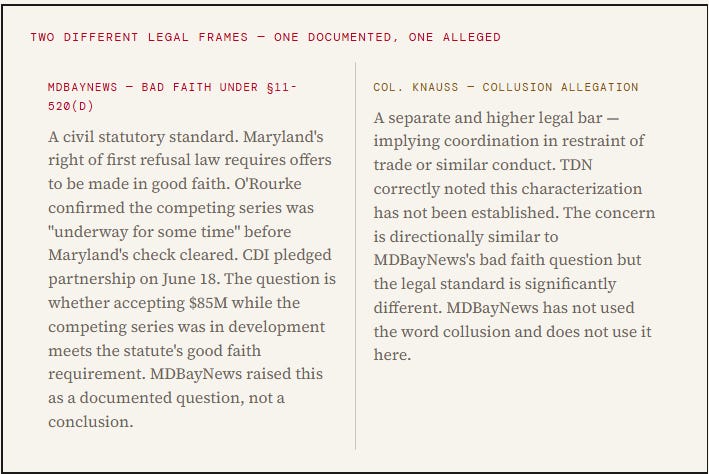
He alleged that CDI and NYRA’s conduct amounted to collusion. TDN correctly noted in its coverage that this characterization has not been established. But the underlying concern is one MDBayNews raised on August 3 — eleven days before Knauss stood at a microphone in an official regulatory proceeding and said it publicly.
The distinction between what MDBayNews raised and what Knauss alleged matters and should be stated plainly.
Knauss’s $3-5 million investment comment drew no follow-up at the meeting. It deserves one.
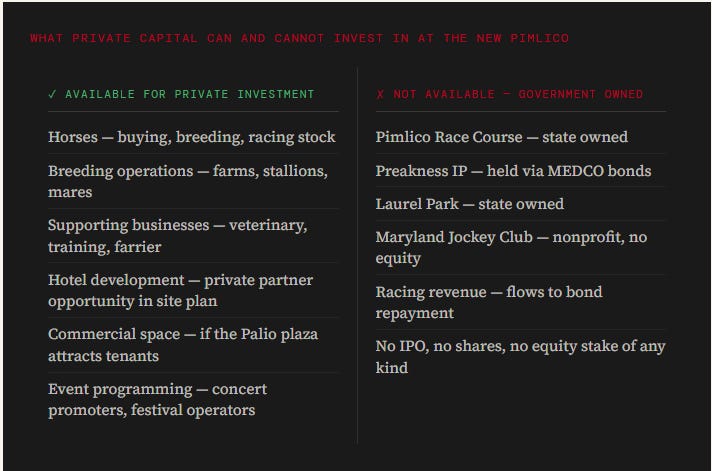
Pimlico is state-owned. The Preakness IP is held via MEDCO bonds. The Maryland Jockey Club is a nonprofit operator. There is no equity stake available in any of these entities. You cannot buy shares in a government-owned racetrack.
What Knauss can invest in is the industry around the facility — horses, breeding stock, racing partnerships, the supporting businesses that a thriving racing calendar generates. That is precisely how public infrastructure investment is supposed to work: state capital builds the platform, private capital follows with activity.
“Private capital follows programming.”
Private capital follows programming. A $3-5 million investment in Maryland breeding and racing makes financial sense if Maryland is running 100-plus racing days at a world-class facility, hosting an international invitational, anchoring a domestic coalition, and staging a Maryland Day Stakes every March. It makes considerably less sense if Maryland is running one race on one Sunday in May and leaving the Palio plaza empty for the other 364 days.
Knauss is offering exactly the kind of private follow-on investment that justifies public infrastructure spending. His $3-5 million becomes rational only if Maryland builds the programming that makes it rational. That programming has not been announced.
“You won’t be second anymore. You could start the Triple Crown.”
Knauss put on the official public record the most structurally creative proposal anyone has offered since CDI announced its championship series. Move the Preakness to April — before the Kentucky Derby.
The proposal inverts the entire competitive dynamic. Right now, the Preakness is the race Derby winners skip. In an April-first model, the Preakness is the race every serious Triple Crown contender must run — because it comes first. The horse that wins the Preakness goes to the Derby with momentum. The horse that skips the Preakness skips the first leg of the Triple Crown, not the second.
Knauss acknowledged complications: Easter timing in April creates scheduling conflicts in some years, Derby prep races would need restructuring, and Maryland’s own steeplechase season occupies spring dates. These are real. They are not necessarily fatal.
“You won’t be second anymore. You could start the Triple Crown.” — Col. Knauss, MRC public comment, August 12
The deeper question is whether the Triple Crown’s 151-year sequence — Derby, Preakness, Belmont — is a feature or a constraint. For most of that history, it was a feature. CDI’s championship series is now treating it as a constraint Maryland cannot escape. Moving the Preakness to April would be the most aggressive possible response — not adapting to CDI’s structure, but dismantling the assumption that makes CDI’s structure work.
This publication is not endorsing the proposal. We are noting that it was made publicly, at an official regulatory proceeding, by a credentialed military officer who just sold his CDI stock and is putting private capital into Maryland racing. The Maryland Racing Commission did not respond to it. The MJC did not respond to it. The Governor’s office has not responded to it.
The Maryland Racing Commission exists to oversee, protect, and develop Maryland horse racing. Its August 12 meeting was the first opportunity for the regulatory body to deliberate publicly on the most consequential week in Maryland racing in decades.
One commissioner offered one sentence of encouragement. The MJC’s CFO disclosed one scheduling detail that should have been addressed at the press conference nine days earlier. Two private citizens — not commissioners, not regulators, not industry officials — provided the meeting’s most substantive content.
The pattern this series has documented since August 3 is not limited to press conferences and no-comments. It extends to the regulatory body itself. Maryland’s institutional response to a strategic crisis has been, at every level, to wait, manage announcements, and leave the hard questions to private citizens at public comment periods.
“He walked into a regulatory meeting and said what no commissioner would say.”
Colonel Knauss sold his CDI stock. He’s investing in Maryland. He walked into a regulatory meeting and said what no commissioner would say.
Maryland needs more of that energy from the people who are actually paid to provide it.



Comments
Nothing yet. Say the first thing.
Sign in to join the conversation.