
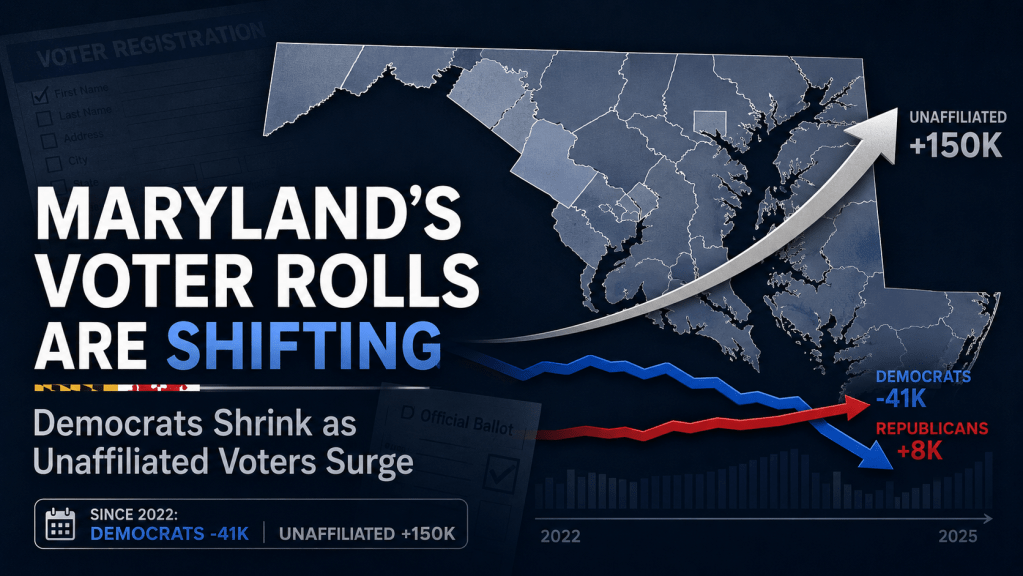
ANNAPOLIS, Md. — Maryland remains a heavily Democratic state, but the makeup of its electorate is quietly changing.
The latest voter-registration figures from the Maryland State Board of Elections show that active Democratic registration has declined since both the 2022 and 2024 elections, Republicans have given back some of their gains since the last presidential election, and unaffiliated voters have grown dramatically.
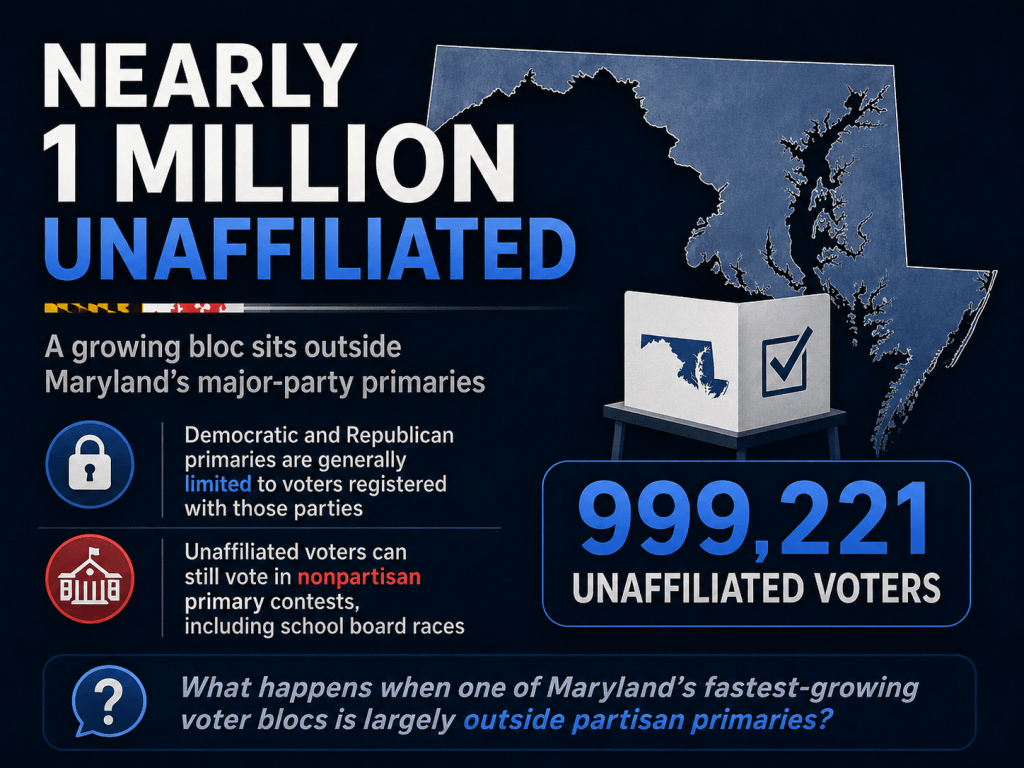
The July 2026 report lists 2,221,550 active Democrats, 1,016,008 Republicans and 999,221 unaffiliated voters statewide. Maryland had 4,317,543 active registered voters overall.
That puts unaffiliated voters just 16,787 registrations behind Republicans — a striking change in a state whose politics have long been dominated by the two major parties.
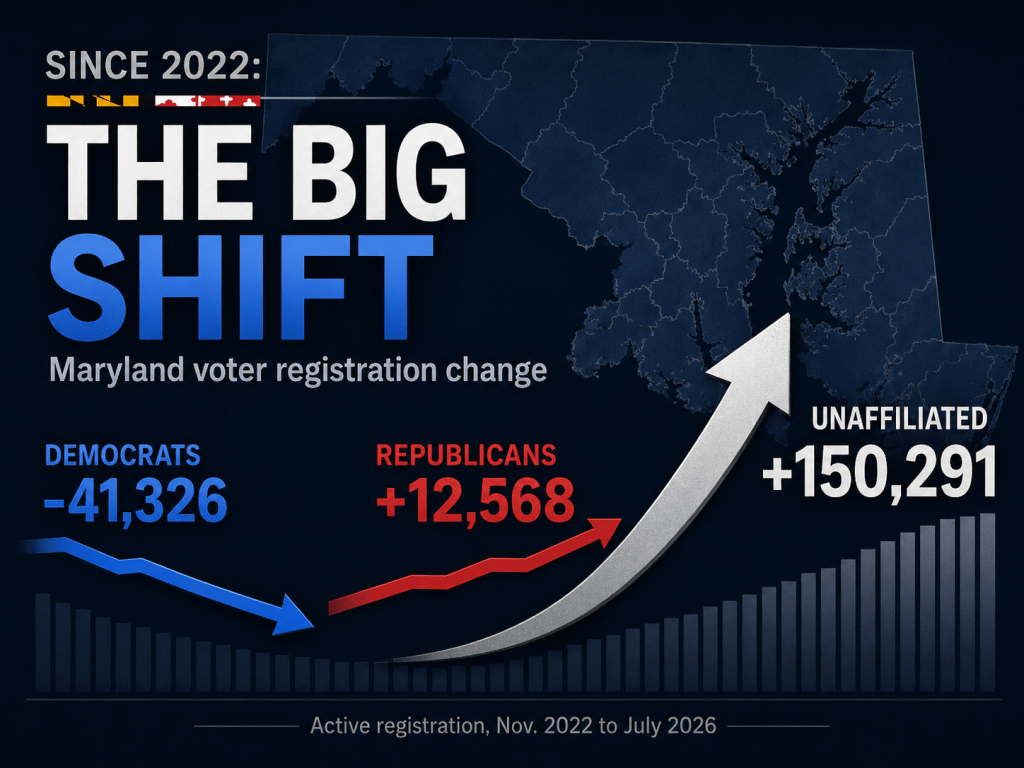
In November 2022, Maryland reported 2,262,876 Democrats, 1,003,440 Republicans and 848,930 unaffiliated voters, with 4,185,827 active voters overall.
Compared with July 2026, Democrats are down 41,326, Republicans are up 12,568, and unaffiliated voters are up 150,291.
That represents roughly a 1.8% decline in Democratic registration, a 1.3% increase in Republican registration, and a 17.7% surge among unaffiliated voters.
The Democratic registration advantage over Republicans has also narrowed. Democrats outnumbered Republicans by 1,259,436 in November 2022. By July 2026, that margin had fallen to 1,205,542 — a reduction of 53,894 voters.
That does not make Maryland a Republican state. It does show that the Democratic registration advantage is smaller than it was four years ago.
The more recent comparison tells a different story.
In November 2024, Maryland reported 2,256,889 Democrats, 1,032,440 Republicans and 943,624 unaffiliated voters, with 4,313,835 active voters overall.
Since then, Democrats have lost 35,339 active registrations, Republicans have lost 16,432, and unaffiliated registration has increased by 55,597.
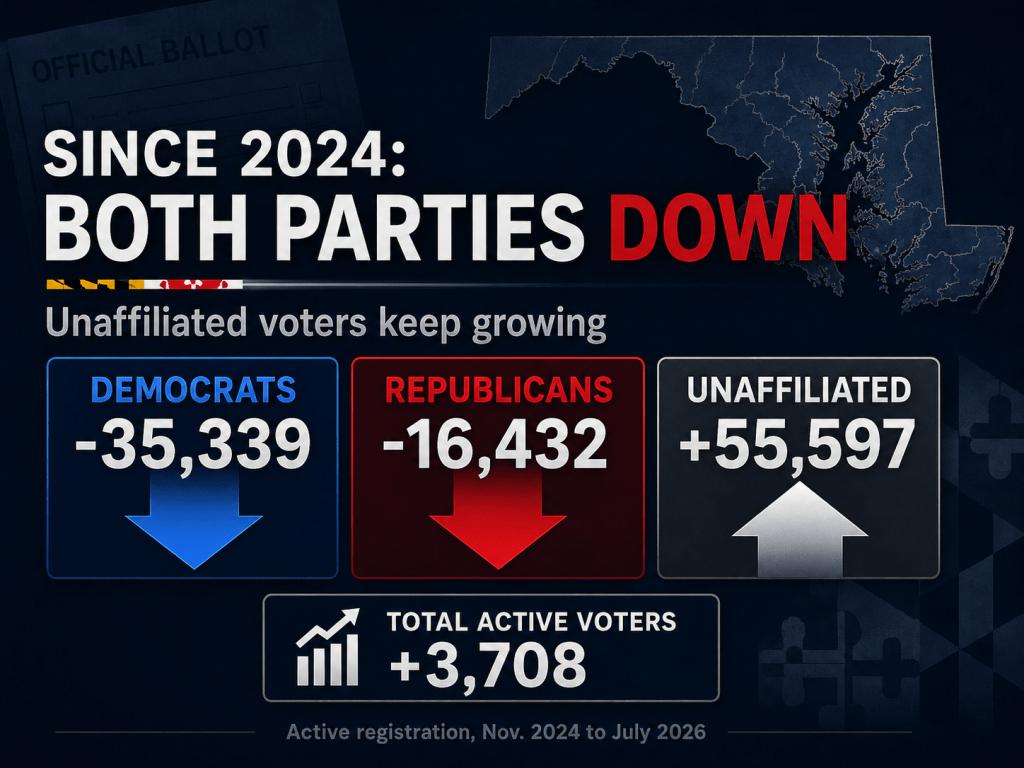
Total active registration, meanwhile, has grown by only 3,708 voters.
That is one of the most important numbers in the data. Maryland’s overall active voter pool is nearly unchanged from November 2024, while the unaffiliated category has added more than 55,000 voters.
The composition of the electorate is changing even though the total size of the active voter roll has barely moved.
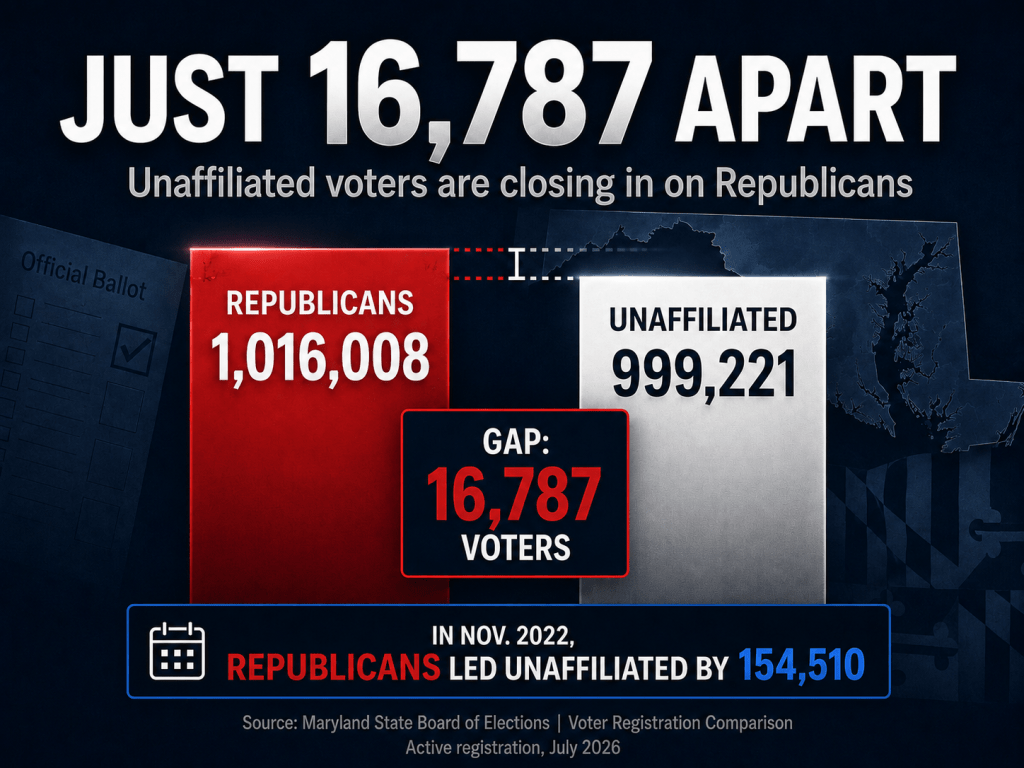
Perhaps the most striking figure in the July report is 999,221.
That is Maryland’s active unaffiliated registration.
Republicans stand at 1,016,008.
The gap is now just 16,787 voters.
In November 2022, Republicans outnumbered unaffiliated voters by more than 154,000.
If the trend continues, unaffiliated voters could eventually become Maryland’s second-largest registration group.
That could have broader implications in a state where Democratic and Republican primaries are generally limited to voters registered with those parties. Maryland law permits a party to open its primary to voters outside the party, but the State Board says unaffiliated voters generally cannot participate in partisan Democratic or Republican primary contests. They may still vote in nonpartisan primary races, including school board contests.
As the unaffiliated population grows, so does the share of Maryland voters outside the two party organizations that nominate most candidates for partisan office.
There is an important limit to what these numbers show.
Registration is not the same thing as voting behavior.
Maryland Democrats still hold an enormous statewide numerical advantage, with more than 1.2 million additional active registrations compared with Republicans.
They also retain overwhelming registration margins in several of Maryland’s largest jurisdictions.
In July, Montgomery County reported 403,861 active Democrats and 98,205 Republicans. Prince George’s County had 457,896 Democrats and 41,581 Republicans. Baltimore City had 298,445 Democrats and 29,388 Republicans.
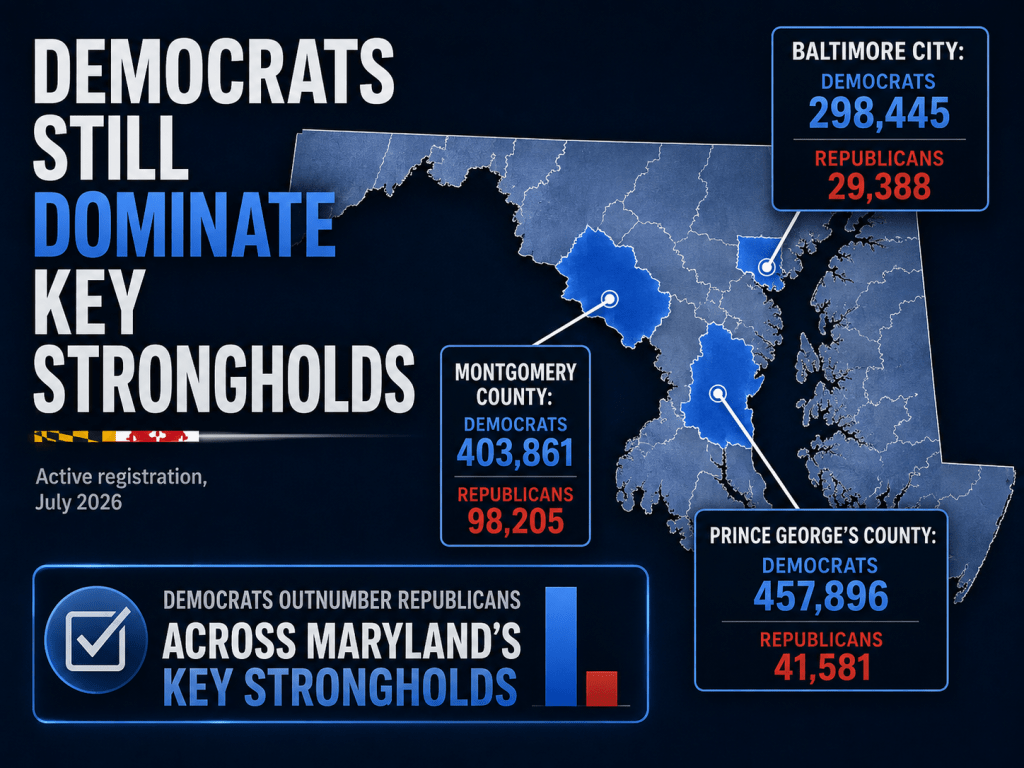
Those margins are not erased by a statewide decline of roughly 41,000 Democratic registrations since 2022.
But a party can maintain a commanding structural advantage while still seeing its registration base shrink.
The data are not an uncomplicated victory for Maryland Republicans either.
Republican registration grew from 1,003,440 in November 2022 to 1,032,440 in November 2024. But by July 2026, it had fallen back to 1,016,008.
Republicans therefore remain above their 2022 level, but they have lost more than 16,000 active registrations since the last presidential election.
For a state party trying to expand beyond its traditional strongholds, that is a meaningful warning sign.
The broader registration story is not simply Republican growth. It is the rapid rise of voters registered outside both major parties.
Maryland’s July activity report recorded 19,826 new registrations.
Of those, 8,673 were Democratic, 3,673 Republican and 7,008 unaffiliated.
The state also recorded 28,427 removals from active registration, including 13,385 Democrats, 7,003 Republicans and 7,396 unaffiliated voters.
Those monthly figures should be interpreted cautiously. Voter-roll changes can reflect new registrations, address changes, party switches, deaths, moves, list maintenance and other administrative activity.
But the longer-term totals are clear: unaffiliated registration has grown rapidly while both major parties are below their November 2024 levels.
Registration figures do not predict who will win Maryland’s 2026 general election.
They do show that the structure of Maryland’s electorate is changing.
Since the 2022 election, Maryland’s active voter population has grown by about 132,000 voters.
Unaffiliated registration alone has grown by more than 150,000.
For Democrats, the warning sign is that a historically overwhelming registration advantage has continued to narrow.
For Republicans, the warning sign is that the party has failed to hold all of the registration gains it accumulated by 2024.
And for Maryland’s nearly one million unaffiliated voters, the trend raises a larger question:
What happens when one of the fastest-growing blocs in Maryland politics remains largely outside the partisan primaries that can effectively decide races in heavily Democratic or heavily Republican jurisdictions?
As of Aug. 25, July remains the latest monthly voter-registration report posted by the Maryland State Board of Elections. The agency says its latest figures can take approximately three weeks to publish.
Sources: Maryland State Board of Elections, Monthly Statistical Report — November 2022; Maryland State Board of Elections, Monthly Statistical Report — November 2024; Maryland State Board of Elections, Monthly Statistical Report — July 2026; Maryland State Board of Elections, Voter Registration Statistics; and Maryland State Board of Elections guidance on participation in primary elections. Registration totals and changes cited in this article were calculated from the state’s published active-voter figures for those reporting periods.
Comments
Nothing yet. Say the first thing.
Sign in to join the conversation.