
“And so with the sunshine and the great bursts of leaves growing on the trees… I had that familiar conviction that life was beginning over again with the summer.”
From writer - F. Scott Fitzgerald
At the risk of sounding like my late father, ‘Where the bloody hell have the first four months of this year gone?’
It seems like only yesterday I was giddy with the excitement of snowdrops pushing through frozen soil, yet today, I pulled the lacklustre, yellow remnants of their foliage from my borders, the contents of their fat, green seed pods already received by the fecund cradle of the soil. The once-vibrant, yellow trumpets of daffodils hang now from pale stems like deflated party balloons, while the sparse remains of tiny blue forget-me-nots sit atop empty spikes, riddled with mildew; I also hauled their ghostly remains from the emergent growth of boisterous perennials. And, adding insult to injury, the last of my triumphant tulips were also discharged from their pots this week, their once, richly-hued tepals blown forlornly across the patio now - the faded and forgotten headlines of spring.
Despite the straggly mess that spring foliage leaves in its wake, it's important not to prune faded foliage before it turns the colour of custard, which can take up to six weeks. Premature pruning, or pulling, deprives bulbs of the nutrients generated through photosynthesis that seep slowly back into the bulbs, power-charging them to battle the long wait before they clock on again for next year’s spring pageant.
The somewhat fleeting appearance and subsequent passing of spring could have us all pulling on mantles of melancholy - but we’re better than that! For me, the pea-green translucence of fresh foliage pricking the stems of the old sweet chestnut tree that hangs over my garden fence, brings with it a deep-seated joy. The same joy from the warm, caramel-leaved flush of Cercis ‘Eternal Flame’ has me reaching for my mobile, posting a volley of paparazzi-style images on socials, each tagged with the clichéd #springhassprung.

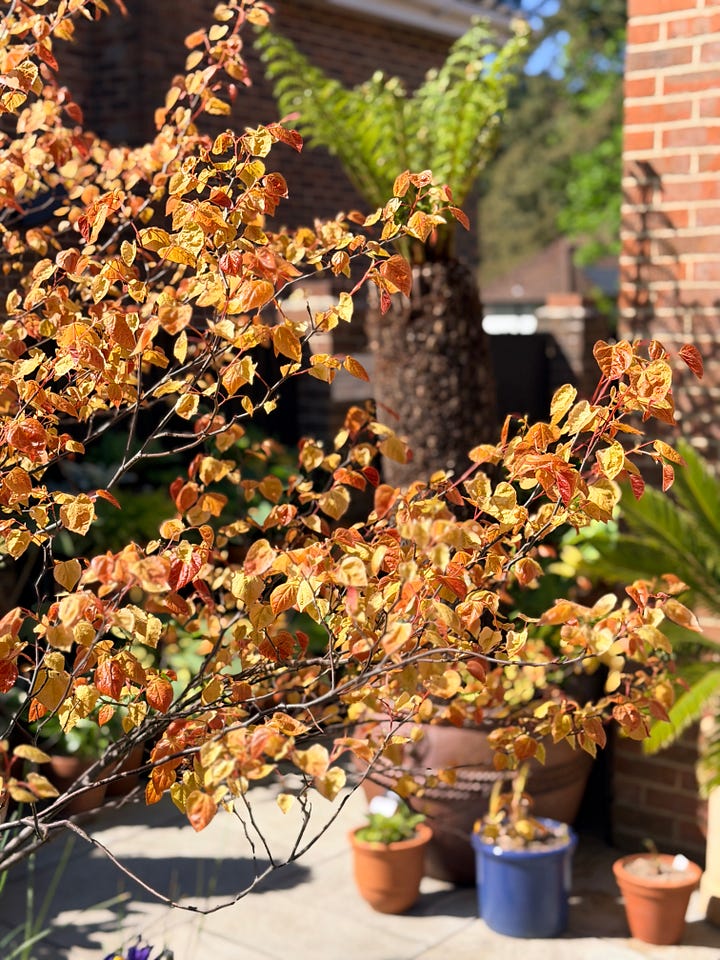
The emergence of leaves on deciduous trees is prompted by growing degree days (GDD), which, technicalities aside, is essentially a cumulative measure of warmth over a period of time. Once the tree has satisfied its internal winter dormancy requirements (chilling hours), it begins to respond to sustained spring warming.
I find the emergence of foliage on deciduous trees to be a fairly reliable indicator that a number of gardening jobs can now be undertaken:
Hardening off seedlings *
Moving tender plants outdoors during the day *
Direct sowing of half-hardy annuals *
Starting more active feeding regimes for borders and containers *
Final pruning of late flowering shrubs (if not already completed) *
* Fearful of recriminations from frostbitten gardeners, please treat the emergence of tree foliage as a guide, rather than a guarantee, and always keep a watchful eye on your local weather forecast before undertaking the aforementioned tasks.
~
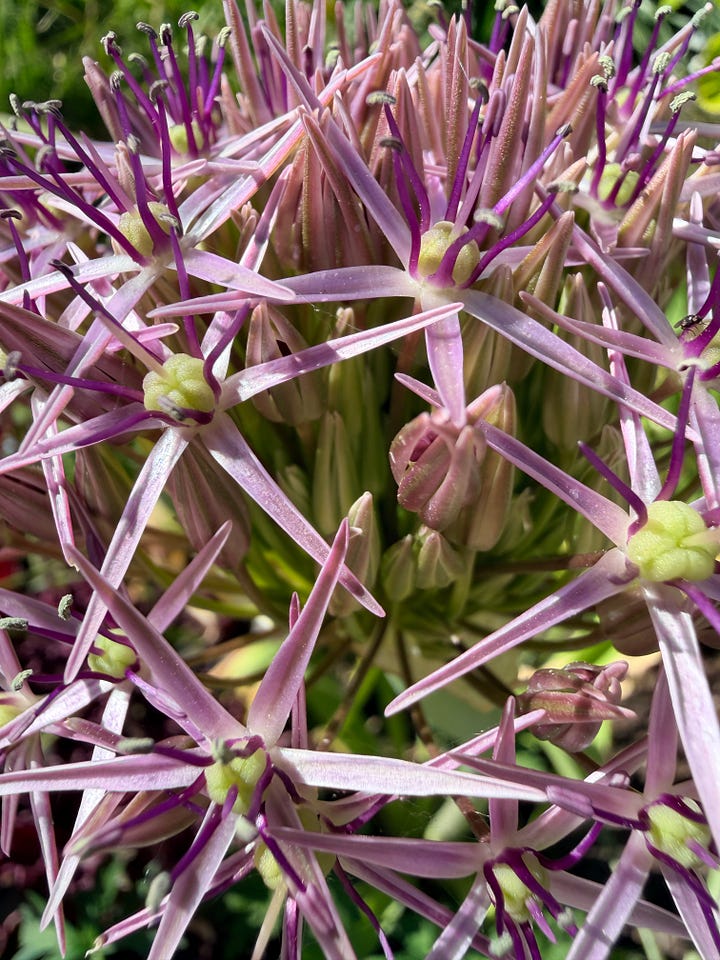
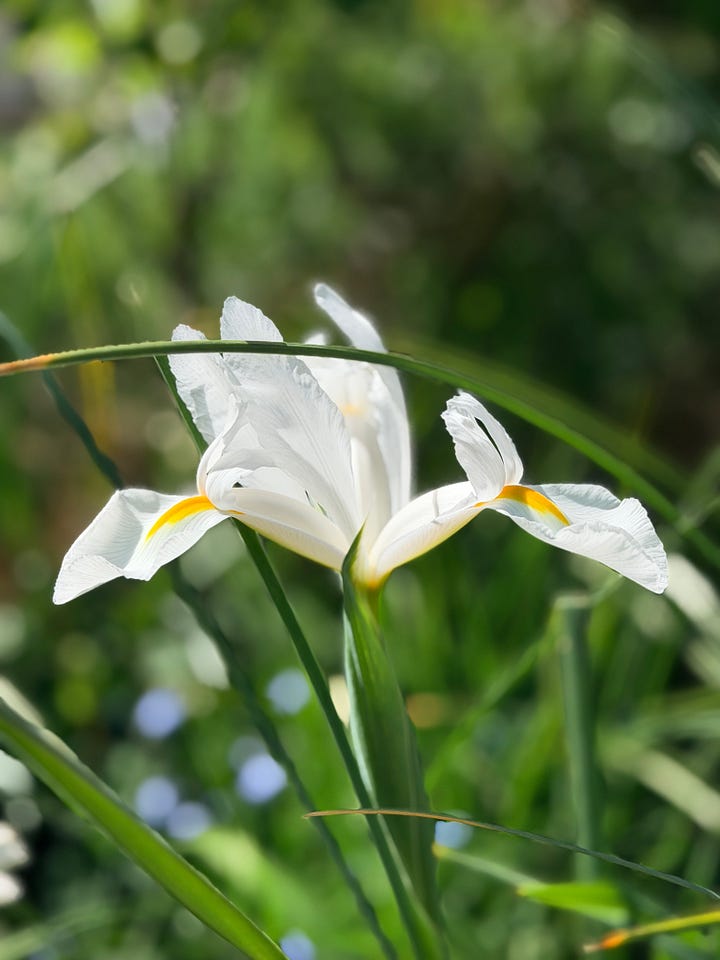
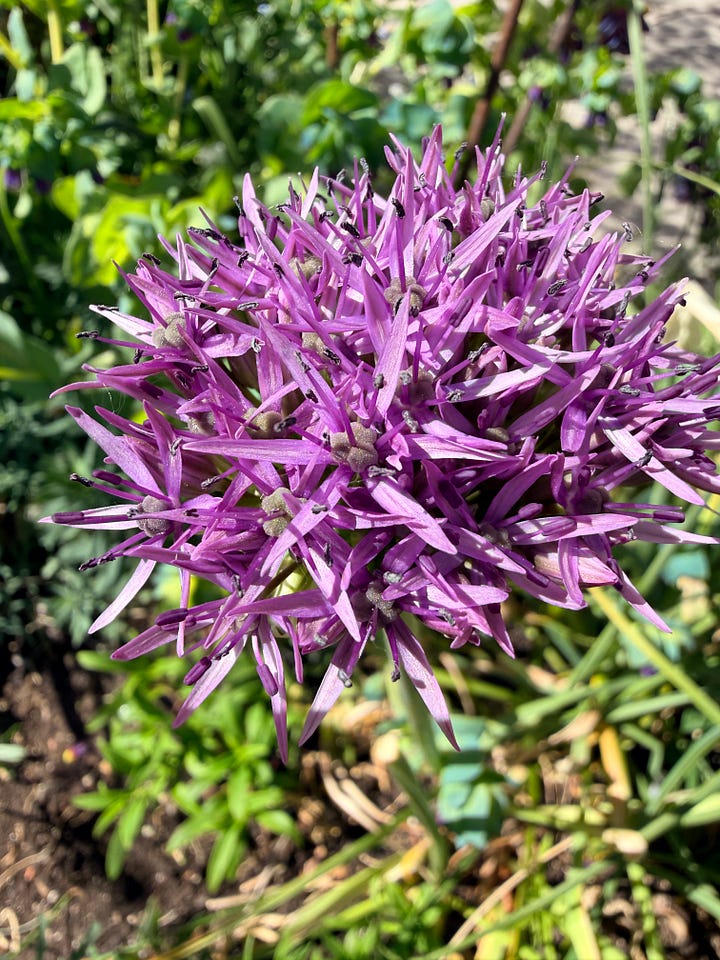
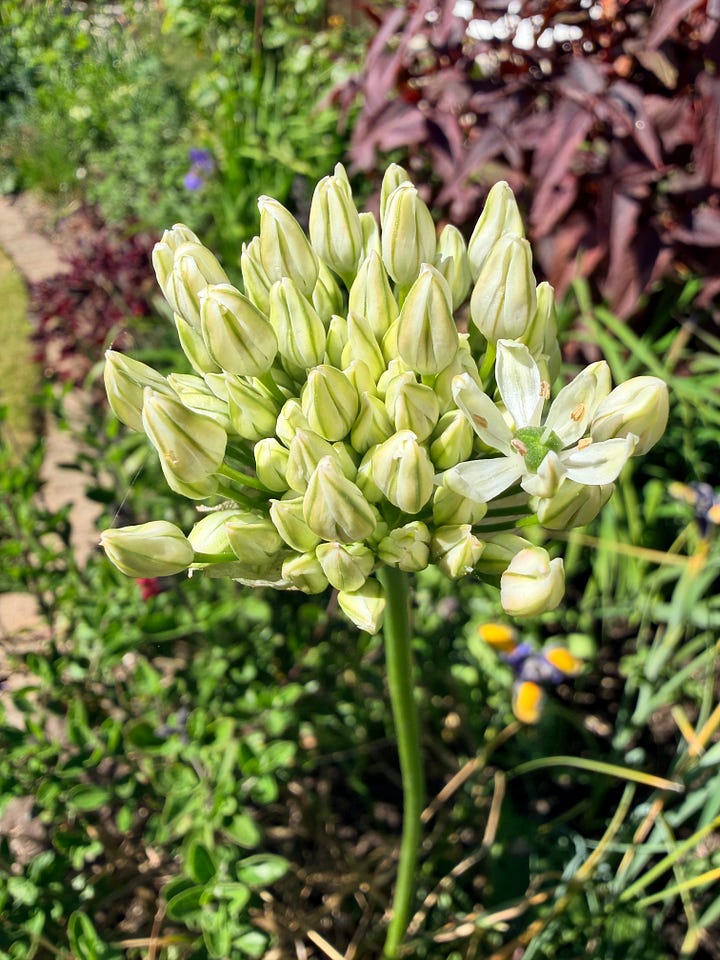
In my southerly-appointed borders (a mile from Bournemouth beach), alliums, Dutch iris and lilies are getting into their stride; rose buds are swelling, pregnant with the promise of early summer. The curly-edged, glaucous foliage of Opium poppies glint seductively at me during my morning inspections. The garden is alive, breathing into its lungs the warm excitement that heralds the cusp of early summer.
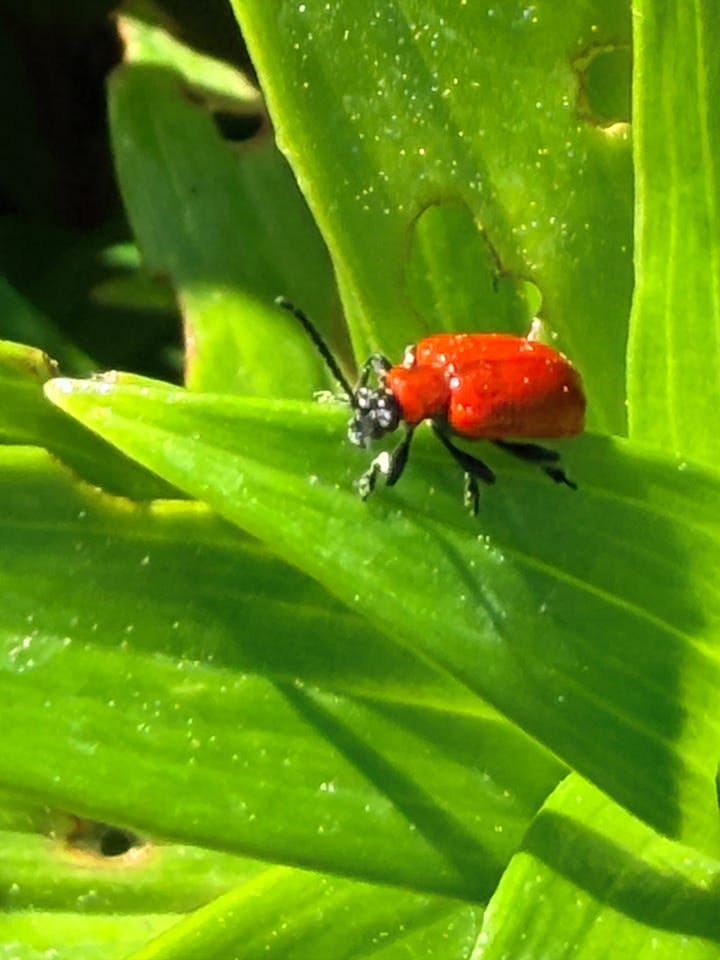
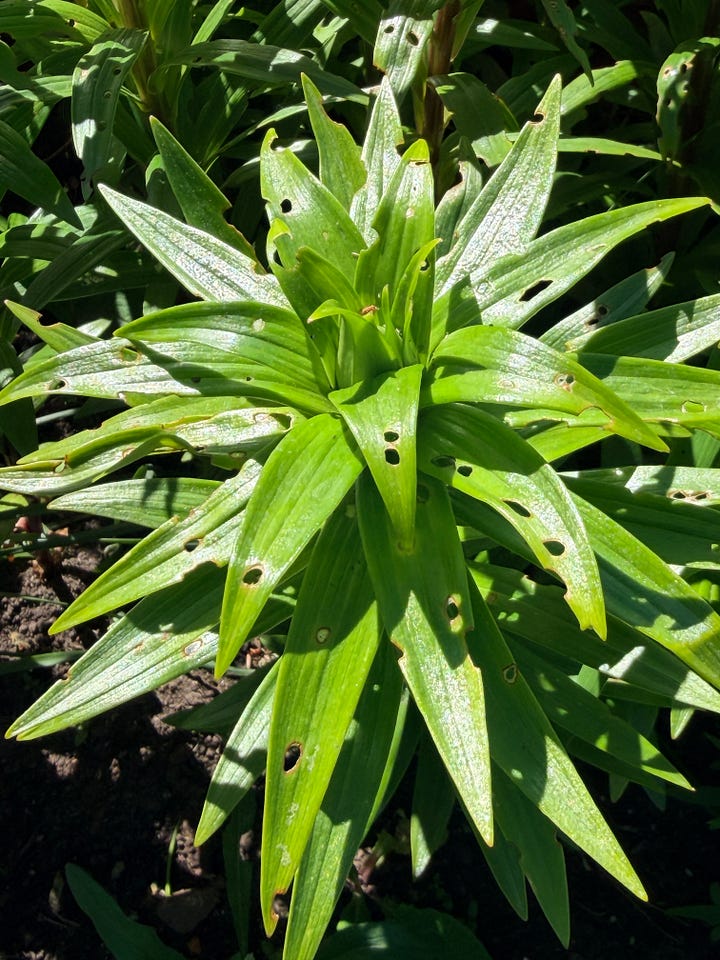
The building excitement is not solely the preserve of gardeners. Oh, no! An army of chlorophyll-addicted predators have surreptitiously entered stage right and are already gorging upon the lush, juicy foliage that has dared to peak its nose above ground level. An army of shiny red lily beetles can be seen cavorting, two, even three at a time - they have no shame, on members of the Liliaceae family including lilies and fritillaries, before indulging in the post-coital munching of the foliage that served as their cradle of lush devotion. Mating completed (heaven only knows how they work out who the fathers are), the female lily beetle lays hers eggs within a few days, cleverly camouflaging her clutch with her own faecal matter. The larvae hatch within a week, and set about feeding on the foliage, causing significant damage in just a few days, meaning the timing of preventative measures is key. I wipe off the faecal residue with larvae, with, yes, a sheet of Andrex(!) to keep the crimson population manageable.
Elsewhere, returning the Andrex (other brands are available) to the smallest room of the house, colonies of sap-sucking aphids are easily displaced from lush, new growth (roses are an aphid delicacy) with a jet of water from a well-aimed hose.
~
The much-yearned for longer days allow us to skip lithely around our green spaces, fighting errant weeds, smothering tender seedlings with (far) too much love, slopping water from heavy watering cans across patios and pathways, before decanting their precious cargo upon already parched, immature dahlias. But here’s the rub: that relentless, biting wind, pegging temperatures back, and seeing me reach for my quilted doublet, corduroy knickerbockers and Tam o’ Shanter.
I remember the springs of my childhood when swathes of golden daffodils stood proud and erect beneath cirrus-studded blue skies, untroubled and unscathed by mischievous winds. In recent weeks, a wave of sparkling, Cadbury-blue Camassia leichtlinii were assaulted and recklessly flattened by strong winds, and the fragile new growth of burgundy Acer palmatum was torn mercilessly from its lodgings and spat to the ground quicker than a mouthful of cold porridge. Whilst there is little we can do to protect unfurling foliage from high winds, the early staking of perennials (sadly too late for my Camassia leichtlinii), does help to minimise the damage caused by the destructive forces of wayward winds. I much prefer natural plant-stakes, like pea-sticks or a matrix of bamboo canes (complete with rubber cane-toppers) with a web of garden-twine spun between them. It’s a little unsightly initially, but the support system will soon be hidden from view as plants grow away, and will hold vulnerable plants as securely as the corset that secured Ms Winslet in Titanic.
~
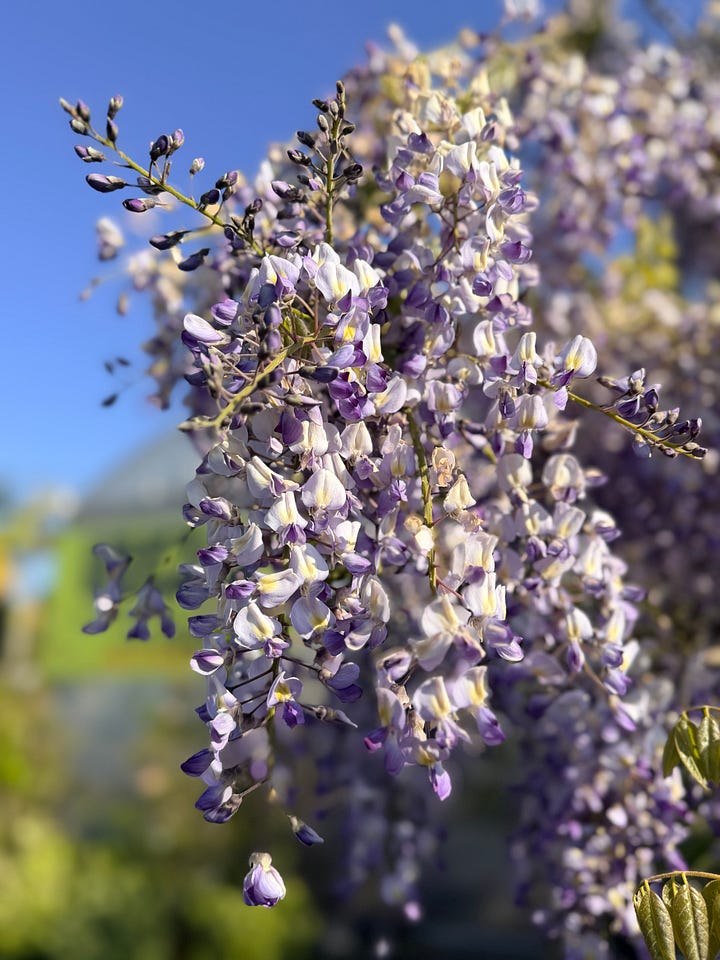
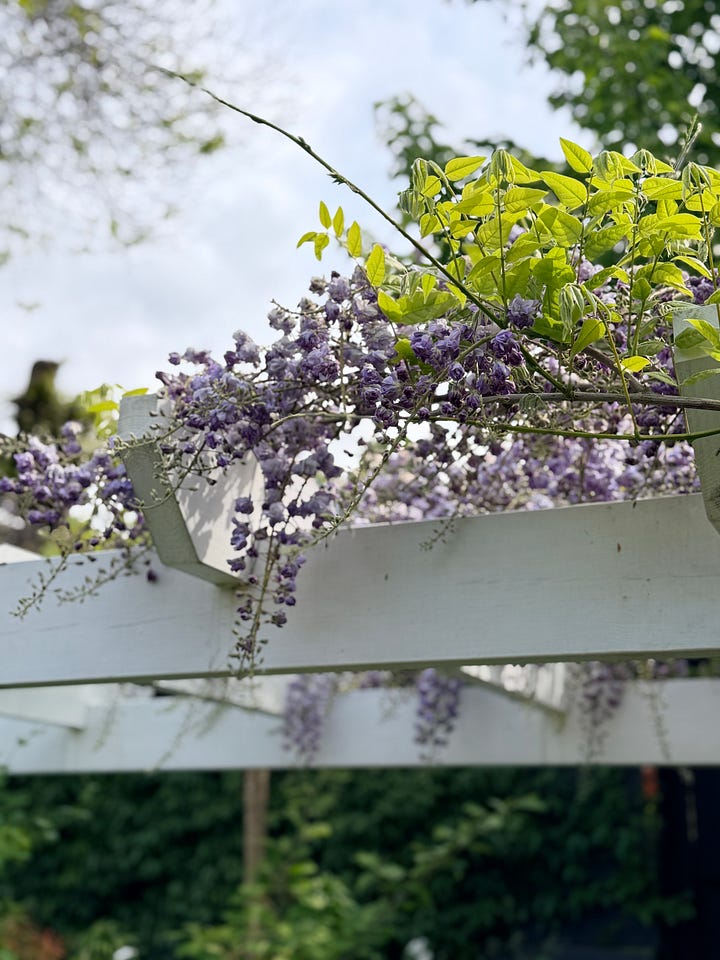
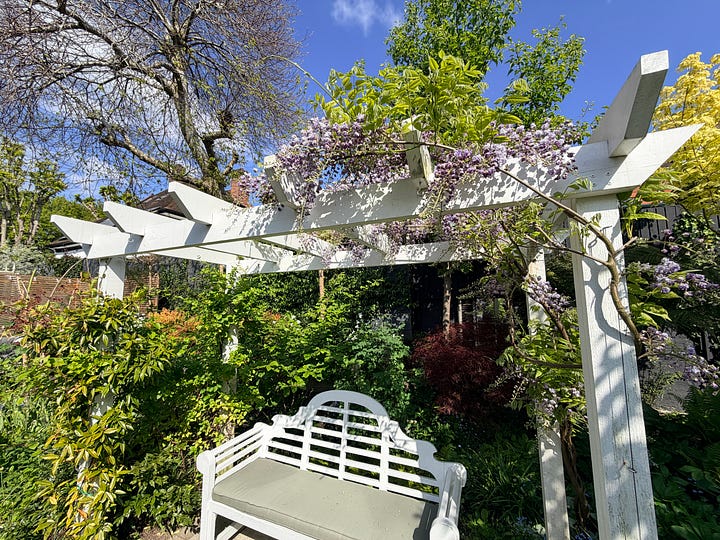
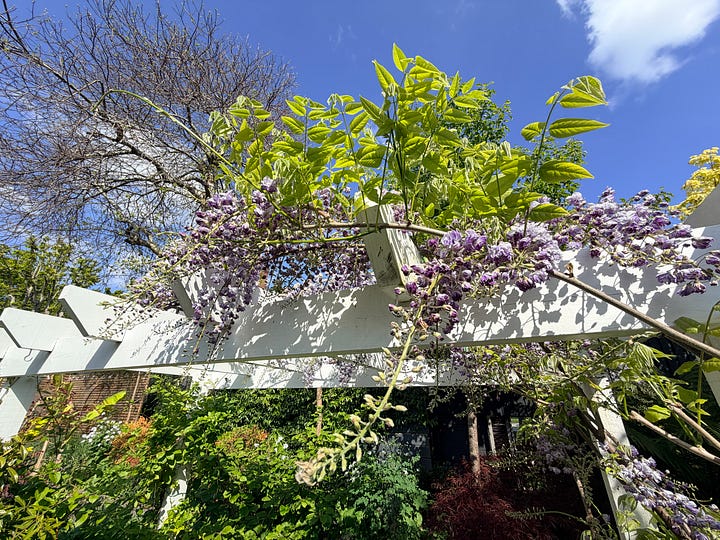
Who doesn't love wisteria? Their pendant, and often heavily scented racemes of white, pink and purple dazzle beneath cerulean skies. Prolific flowering is subject to perfect pruning, which, despite popular belief, is very straightforward, and is performed in two separate sessions.
Flowering completed, wisteria bounds away with ‘miles’ of long, whippy growth. Come, July, growth spurt over, select some of the long, whippy growth to tie in to its support, (a pergola or south facing wall), if its reach needs to be extended, especially on newly established wisterias, with all of the remaining whips growth being cut back to approximately 30cm from a main stem.
In February, the barebones of deciduous wisteria revealed, the previously pruned long whippy growth taken to 30cm can be shortened again to approximately three buds. The resultant prunings can be chopped up and composted.
Following these simple guidelines will have your wisteria flower its proverbial socks off, however, said the garden writer, a word of caution; immature wisterias can take up to 7-10 years to flower, so always buy a wisteria in flower to ensure blooming in subsequent years - you’re welcome.
Thanks for reading, as always, and if you've enjoyed this piece, please hit the heart below to show your appreciation, and perhaps share with another gardening friend.

Comments
Nothing yet. Say the first thing.
Sign in to join the conversation.