
Not long ago, I thought I was on track to be a sports writer. I have a complicated relationship with sports. I was never a gifted athlete; I never played organized sports beyond a few seasons of Little League. I loved pickup basketball and could hold my own. Despite being a Canadian, I can’t really skate, but I spent endless hours playing street hockey. My family has no affection for sport, or at least didn’t when I was growing up. My lifelong friends are not steeped in fandom, though I found some myself. I was an Ottawa Senators, Montreal Expos and Canadiens, and Toronto Blue Jays fan at some point in youth through adulthood, finding those teams through avenues I don’t quite recall. In the early 2010s, on the far side of a flailing literary career, I found myself involved in sports writing and broadcasting. I was a co-founder of the late, almost great The Barnstormer pop culture and sports website. I co-wrote the expository experimental novel, The Diary of a Locked-Out Hockey Player. I wrote the occasional sports column for Indiewire, The National Post, Maisonneuve, The Smoking Jacket, and the Toronto Star. I co-hosted the Kaufman and Spry podcast before podcasts existed. Through Bell Media, I appeared as an occasional panelist on TSN radio in Toronto and Montreal, as well as the short-lived MTV Canada series, Play with AJ, and I was an early contributor to the then-fledgling BarDown, a TSN offshoot.
But whether haunted by cynicism or corrupted by an anti-establishment bent, I viewed sports singularly through a cultural and socioeconomic lens. I saw sport not as an opportunity to drink pitchers and scream at bar TVs, though I certainly spent my time in those arenas, nor as an opportunity to indulge in analytics. Instead, I wrote about misogyny, prejudice, corruption, and violence. I called for the dismissal of Hockey Night in Canada icon Don Cherry, and received the first—but not last—hatemail of my writing life. But some people agreed with me, and I disguised dissent in humor, which likely extended most gigs beyond their natural shelf life.
This, in retrospect, unsurprisingly, led to the end of my sports writing career. At BarDown, I was continually admonished for pitching columns about hockey’s toxicity to the point where the higher-ups demanded I stop. Eventually, after publishing a piece (vetted by my editor) in which I awarded Ottawa Senators owner Eugene Melnyk the “Harold Ballard Award” for hockey’s worst owner, predicting that he had a Ponzi scheme in his future that would make Bernie Madoff look like a humanitarian, my relationship with TSN ended rather abruptly, and my relationship with sports at large followed rather quickly. I stopped watching hockey, a sin of sorts for a proud Canadian. The Expos were gone, and the Jays sucked, so baseball was easy to give up. The rest of sports just kind of followed, though I still read about all leagues and items of interest daily.
My greatest sports memories are not set in grand stadia or lush, manicured fields. They do not involve wagering, replica jerseys, or face painting. There’s no soundtrack of team fight songs, culturally appropriate war cries, or halftime entertainment. As a kid, my most cherished memories of sports are back home in Ottawa, playing street hockey on Cole Avenue, pickup basketball at McKellar and Tillbury parks, and early spring baseball tryouts at Frank Ryan Field. In adulthood, moments that I return to include the 2002 Men’s Olympic Hockey final, the Habs 2010 playoff run, and last year’s Blue Jays World Series nailbiter.
We are currently in the high season of professional sports. The Super Bowl just drew 120 million viewers, some for the Patriots, some for the Seahawks, most for the spectacle. Just a few days before, the Winter Olympics kicked off in Italy. As I write this, pitchers and catchers are reporting to spring training in Florida and Arizona. The NHL and the NBA are about to enter their stretch runs to the playoffs, and the NCAA March Madness beckons just beyond February. The Jays’ season, Canadian Olympic pride at a time of pan-American conflict, this high season, reminds me of another life I almost had, and I have found myself questioning what it was about sports I was drawn to in the first place.
And I couldn’t remember.
And then I watched Eephus.
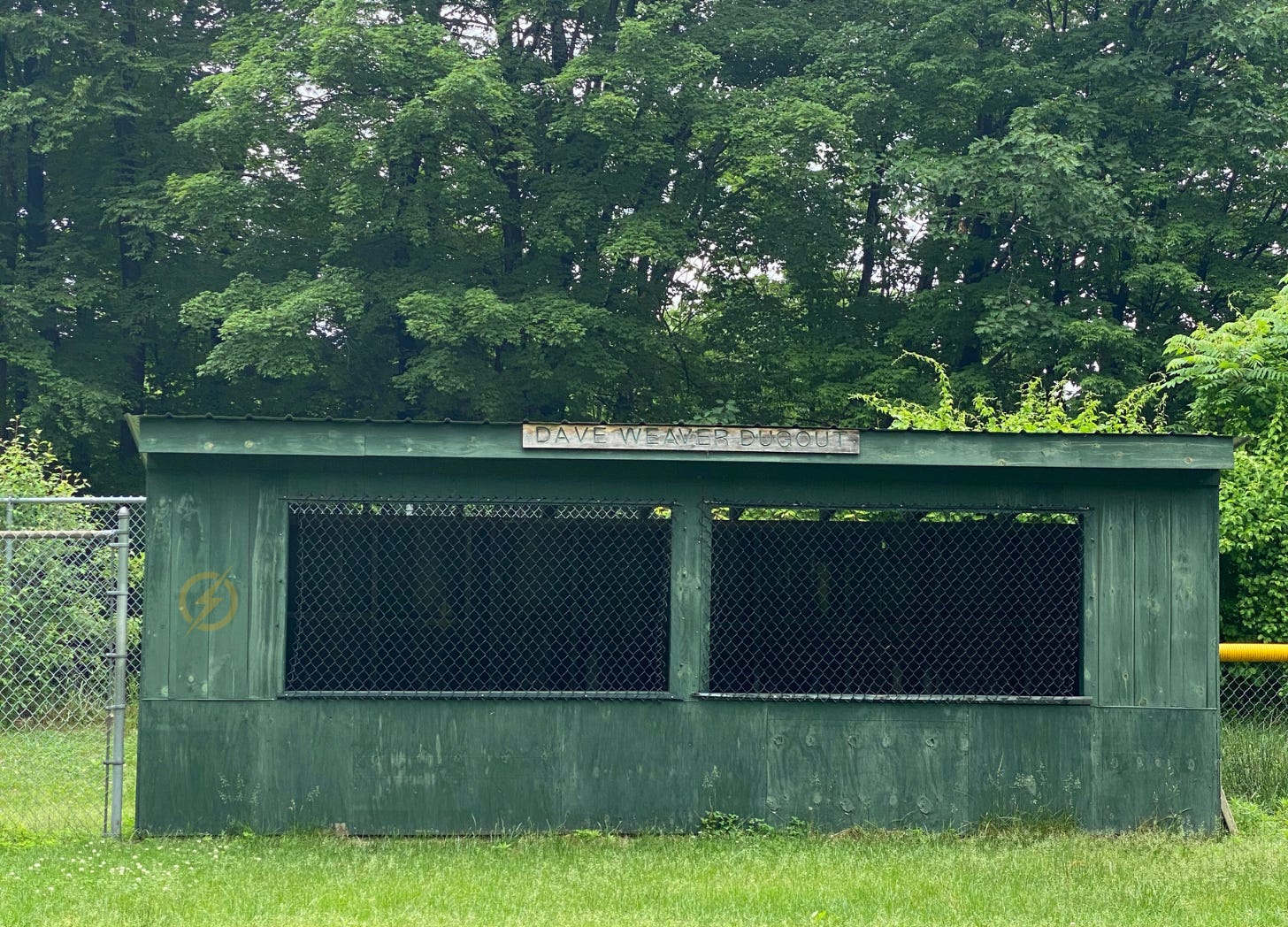
Eephus is a small-budget baseball film, directed by Carson Lund, set in small town Massachusetts in the 1990s, where Adlers Paint meets the Riverdogs in one last beer league game before their ballfield is demolished to make room for a new school, and it reminded me of what I fell in love with about sports in the first place, something that I got a hint of in the Jays’ run, and was consummate in this indie masterpiece. Eephus sees sport not as a cultural commodity, but a community engagement, and the simplicity of its framing—narratively and functionally—finds the beauty in the relationship baseball has not just to its participants and onlookers, but the landscape of the country. The film takes place over a day and evening, as their last game and relationships descend into absence. It is beautifully shot, concerned with the game’s community rather than the machine that extends beyond it. There are no wide-angle shots or replays, no drones for context for the upcoming pitch. There are just too few balls, too many beers, and a love for a sport that serves the community, rather than relying on or exploiting it. I was taken back to when bases were marked by our shoes scuffing gravel, when the most common exclamation wasn’t “goal!” but “car!”, when yard markers were our strides, and, as David Berman wrote, “the only play was go out long.” I was transported back to the late afternoons and evenings of my childhood, when road hockey games were lit by streetlights and ballfields became apparitions of the once-sun-rich day. I have no idea what the score was at the end of Eephus, and it doesn’t matter.
Eephus doesn’t bother with what angers me about sport: egos, avarice, and Dave Portnoy. Rather, the film remembers what sports no longer can afford to: Baseball as ritual, not spectacle, a game that matters only to those present, and a community that exists because the game is ending. The film doesn’t include a storyline of the players fighting to save the field, but rather allows us to mourn with them as they say goodbye. And the guy building the school? He’s out there playing, too. He’s no villain. No one’s egging his truck in the parking lot. The demolition gets mentioned, sure—it hangs in the air like the cool of an October night that encroaches upon the game—but he’s still there, still part of it. There’s something beautifully honest about that. The field is going, and it matters. But so does a new school. The movie doesn’t pretend otherwise. It understands that loss and progress can occupy the same dugout.
There’s a striking moment in the film, perhaps its thesis, where two children of one of the players are watching from an aged press box, itself a relic of a time long past, and one says to the other: “Why do they care so much? Don’t they have more important things going on?” But they don’t. And we don’t. Eephus is the underclass, those whose victories don’t come in bank accounts or grand stages, but rather in the humble confines of games that end, of seasons that are finite, and common. And yet, the pitch itself is singular, a unicorn the film tells us. “You get bored watching it, and the hitter does to; he tries to swing at it like normal. But it’s already past him, or it waits till he’s done swinging. The eephus makes him lose track of time; it’s pretty mean that way.” The pitch is a long arc without logic, which seems almost paranormal, and yet when reduced to its essence, it is a lovely, simple endurance that doesn’t need explanation.
My frustration with sports culture remains. I rarely watch anymore because the culture has been robbed of what Eephus so beautifully celebrates: that sport belongs to the beer leagues and hacks, not the select few who dominate its narrative. I couldn’t watch the Super Bowl with the hate that accompanies its halftime show. It’s difficult to watch the Olympics without thinking of Canada versus the US, as oligarchs conspire to destroy my homeland, to burn bridges, literal and metaphorical. Sports are supposed to bring us together, like the disparate collection of players in the community of Eephus. I can’t help but watch the spectacle and think about where we’ve gone wrong. I can’t help but see how the institutions that stage these games mirror the power structures they never question.
I have found it hard to write lately. I don’t like the world we’re currently surviving. It is a spectacle that never ends. I have enough energy to get to work and home, and that’s about it. Sports and film were once escapes, but they have—to an extent—appropriated the culture of excess. The ethos of Eephus, the idea that community is stronger and more important than spectacle, is something I need to keep reminding myself of: The game ends, and we all get to go home. Tomorrow is tomorrow.
Thanks for reading Narrative Electric Co.! This post is public, so feel free to share it.
Comments
Nothing yet. Say the first thing.
Sign in to join the conversation.