
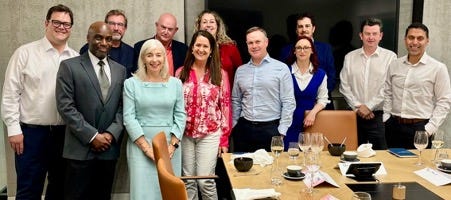
l-r: Anthony Waller (CMS Law), Ronnie Ajoku (London Business Journal), Rupert Lee-Browne (Caxton) Monique Drummond (Relish) Graham Davies (The Presentation Coach), Mindy Gibbins-Klein (Thought Leadership), Olivia James (The Harley Street Coach), Dan Hall (Rathbones), Jessica Da Rui Labrecciosa (Cubitts), Matthew Fisher (Scamp Speakers) Professor Andy Pardoe (Top 100 in AI), Altaf Jasnaik (Managemend.AI)
We have all been to dinner parties where the conversation was sparkling, and everyone left with a spring in their step. We have also attended dinners which, despite the best intentions of the host, were ruined by a bore looking to monopolise the conversation or offering offensive opinions, especially after a few drinks.
There is a rigorous methodology to the preparation and execution of high-level business-related dinner events. This is notan informal networking event where people promote their products and services. The objective here is to connect people who have something interesting to say and who are happy to share their experience and expertise.
The business dinner process starts with someone who has a significant personal network built up over many years. You should look out for individuals in your organisation who seem to know everybody in your industry, particularly your customers, even if they are not their specific account manager. They can talk business with anyone and also interact engagingly on non-business topics.
Then, you need to find the right host. For my last dinner, it was Dan Hall, a Senior Director from the wealth management company Rathbones, who helps successful people to structure and manage their assets. We have known each other for nearly 20 years and have run many highly successful business dinners together. He provides an impressive building with a private dining facility, and we always discuss the invitation list in advance.
Then my really hard work starts. Wrangling people’s diaries is an intense process and, for first invitees you need to explain exactly why they should take out an evening of their valuable time to meet people they don’t know.
A key part of this process is eliciting biographies and, if necessary, tweaking them into a compelling Elevator Pitch. You provide this biography to all attendees in advance, always including contact details and a link to their LinkedIn profile.
You also need to double-check their dietary requirements. Vegans, vegetarians, pescatarians, plus those suffering from allergies and with religious dietary requirements, such as Kosher or Halal should be clearly identified and accommodated. You should also be prepared for any last-minute cancellations and accept these with good grace.
I always make sure that I am in the Ground Floor Reception, monitoring their exact arrival time on WhatsApp and greeting them personally as they arrive. The dinner should start precisely on time, even if there are late comers.
Everyone is briefed in advance to prepare a short personal introduction of no more than 30 seconds, explaining who they are and the main problems they solve. Once people realise that they are in a structured, moderated event where I ensure that everyone has a voice and nobody is allowed to dominate the conversation, then the mood always lightens, and any pre-event nerves disappear.
After the food was cleared, we enjoyed a fifteen-minute after-dinner presentation by Graham Davies, who is profiled elsewhere in this magazine. He is a frequent commentator on the television performances of leading politicians of every hue, who are nowadays looking to come across as ‘Presidential’. Graham’s presentation was very timely, with what turned out to be an iconoclastic election just round the corner.
Then, there was the round-table conversation. We were operating under ‘Chatham House Rules’. Attendees could mention what was discussed outside the room, but not attribute any specific comments to a particular individual.
We had wide-ranging discussions on both Artificial Intelligence and the nature of work post-COVID, specifically hybrid working. We also covered the needs of people coming into the workplace for the first time. It is clear that ‘youngsters’ now approach work with radically different perspectives to us ‘old-timers’.
I ensured that we finished right on time, and I could already sense the formation of sub-groups of new friends. Some carried on the conversations in local hostelries while others arranged to meet up to discuss matters of mutual interest, whether business or social.
I consider that everyone with a positive attitude, good self-awareness, and expert skills, whether an owner-manager or working in a corporate environment, is an Entrepreneur.
I very much enjoy bringing them together in the right social environment. Once your personal network starts to talk to each other, then real business magic can happen, so that profit and pleasure may be the result.
No posts
Comments
Nothing yet. Say the first thing.
Sign in to join the conversation.