
I’ve been thinking about miracles, and I’ve worked out a taxonomy. It is not complete, but it is instructive. There are two kinds of miracles, and the division holds whether we’re talking about the miracles of the Bible or the events we casually grant the label today. There are restorative miracles and additive miracles.
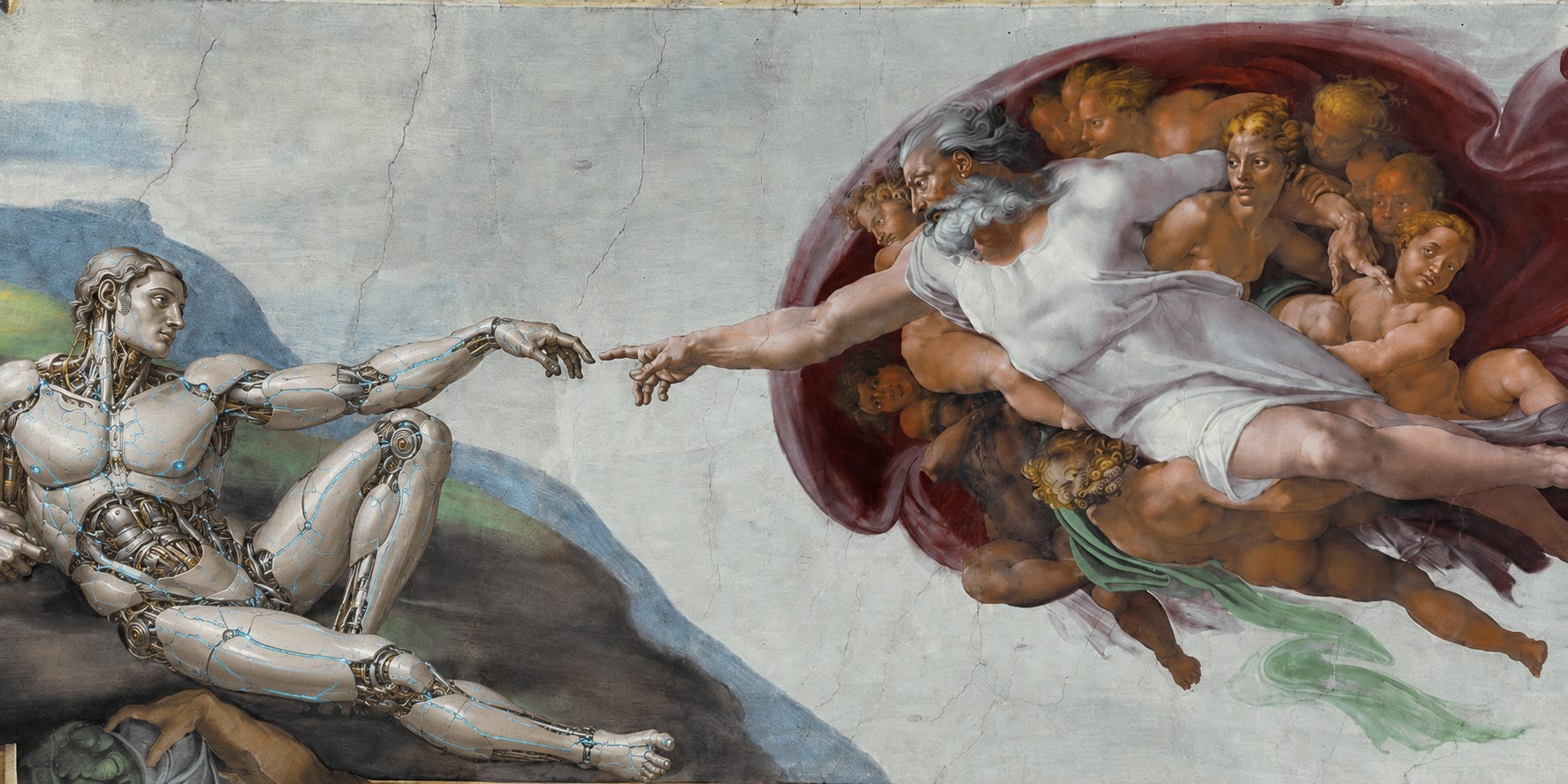
The restorative miracle returns a thing to its original healthy state. Jesus raising Lazarus is the scriptural example; the miraculous rescue from the collapsed mine or the rebirth of a hollowed-out downtown is the modern one. The additive miracle creates something the world has never seen. Not the revival of inner-city Providence, but the conjuring of Dubai from sand. Not the cure, but the invention.
Why should this distinction give us any insight? Because the two kinds of miracles provoke opposite reactions. Restorative miracles are welcomed, and they are not scary. A return to the status quo comforts us. It represents stasis. When the miracle worker comes through town and puts things back the way they were or the way they were supposed to be, we give him credit, and then we stop thinking about it. Nobody lies awake wondering about the implications of the way things have always been. The consequence of the way things have always been is, well, everything that has happened ever thus.
Additive miracles are different. They bring questions. They bring dislocation. Imagine standing in the crowd in Galilee watching a man, or what you took to be a man, take a few loaves and fish and transform them into enough for thousands. Your eyes might drop out of your head. You might refuse to credit what you had just seen. In fact, as you read that last sentence, some part of you objected that you wouldn’t have seen it at all, because it couldn’t have happened. That is precisely the point. The additive miracle is so hard to get your mind around that the rational observer concludes it never occurred.
Which brings me to artificial intelligence. AI, like the printing press, the steam engine, antibiotics, and the internet, is an additive miracle. It creates something that has never existed before. But AI comes with a feature its predecessors lacked, which I think of as the double black box. The layman doesn’t understand how it works, which is nothing new. The layman didn’t understand the telegraph. But Gutenberg, had he been so inclined, could have walked you through the movable type. The novelty here is that the experts don’t fully understand it either. The people who build these systems cannot tell you, with completeness, why the machine said what it said. They find it pretty cool that it works at all, especially the ones holding shares in the company.
So a certain wariness about AI is not ill-founded. But I have noticed a social phenomenon that goes well beyond wariness. This spring, when commencement speakers mentioned AI and its clearly transforming nature, they were booed. Booed! And when I heard those boos, I did not think, here are undergraduates wise beyond their years, or here are job seekers rationally anxious about their prospects. I thought, “They are booing the technology without which a healthy percentage of them would not have made it to graduation.”
This is the strange etiquette of the additive miracle. Unless you are on CNBC or actively salivating over OpenAI's IPO, the only publicly acceptable register for discussing AI is the grouse, the worry, the dark joke. There may be much to worry about. I don’t dismiss the worriers. But I notice that an enormous amount of social approval flows to whoever phrases the worry best, whoever casts it in the most frightening form. The fear has become a performance with its own applause lines.
And here is where I’ll abandon the miracle frame, because privately, AI doesn’t strike people as a miracle at all. It strikes them a little bit like pornography. There is one acceptable way to react to it among other people, when you believe you are being watched and noted. And there is another way to react to it on our screens, when our names and reputations are not on the line. This isn’t a divide among tech investors or the class of people who venerate the wizards of Silicon Valley. It’s a divide among regular people who want to be seen as sophisticated, for whom it has become de rigueur to accompany any mention of AI with a laugh and an “if it doesn’t destroy us first.”
The laugh is the interesting part. Global warming, the other supposed existential threat of our era, never got this treatment. Nobody ends a discussion of sea level rise with a chuckle and a “but who knows, maybe we’ll all drown.” Yet AI gets the boo, the eye roll, the how-dare-you-credit-the-thing-that-wrote-half-your-term-papers treatment in public, while in private the conversation runs more like: oh my God, have you seen how much faster Fable is than Opus? People trade tips and tricks. They compare models the way they once compared fantasy football sleepers. The dominant private emotions are admiration and curiosity, and I say this as someone who belongs not to any elite tech class but to the worried-in-public media class, where the grousing is practically a union requirement.
Maybe the guy eating miracle fish said to his neighbor, “Are you eating one of the original fish or the new Jesus Fish?” And his neighbor said, “I got an original one. I’m not sure I trust the sourcing on the Jesus Fish.” “I know,” joked the first guy. “These Jesus Fish just might kill us!” Chomp chomp.
It may all come true, the warnings. AI may come for our jobs, our livelihoods, even, I can’t totally discount it, our nuclear codes. The future assessment of this era will read either as a great triumphant work or as a tale ultimately built on falsehoods. Fittingly, Anthropic has already named its new and old models for both outcomes: an opus or a fable. Privately, most of us are betting on the opus. Publicly, we’ll keep booing.
Comments
Nothing yet. Say the first thing.
Sign in to join the conversation.